
The Myth That Preliminary Residents Are ‘Less Qualified’: What Data Shows
The belief that “prelim residents are the ones who couldn’t match categorical” is lazy, wrong, and not supported by the data we actually have.
You hear it all the time on wards: “Oh, they’re just a prelim,” said with that slight downward tone. Attendings who should know better. Seniors who forgot how the Match actually works. Med students parroting Reddit threads that are 60% anxiety, 30% rumor, 10% reality.
Let’s kill this myth properly.
Preliminary residents are not a homogeneous group of “weaker” applicants who failed the Match. They’re a mixed population with very different goals, constraints, and strategies. Some are absolutely stellar candidates with higher Step scores and stronger research than the average categorical resident in the same program. Some are average. Some are struggling. Exactly like categorical.
The difference is structure and intent of the position. Not inherent quality.
What a Preliminary Year Actually Is (And Isn’t)
A preliminary (prelim) year is a 1-year, non-advanced PGY-1 position, usually in internal medicine or general surgery, sometimes in transitional year (TY). You complete one year of ACGME-accredited training, get credit for PGY-1, then either:
- Move into an advanced specialty you matched into (e.g., radiology, anesthesia, derm, rad onc, ophtho, PM&R, neuro)
- Re-apply for a categorical spot (same specialty or different)
- Rarely, continue in the same institution if they have open positions
The key point: prelim ≠ “failed” categorical. There are three big buckets of prelims:
- People who matched into an advanced specialty that requires a separate PGY-1 (e.g., many anesthesia, radiology, derm, ophtho matches)
- People intentionally doing a preliminary year as a bridge to re-apply more competitively (often to more competitive specialties)
- People who SOAPed or didn’t match and took a prelim spot as a foothold in the system
Those three buckets have completely different competitiveness profiles.

What the Match Data Actually Shows
If prelims were uniformly “less qualified,” you’d expect a few things:
- Lower board scores on average
- Easier match metrics across the board
- Less competitive applicant pools
That is not what the NRMP and specialty data show.
For US MD seniors, here’s the reality from recent NRMP Charting Outcomes and Program Director Survey data:
Many advanced specialties with mandatory prelim years are intensely competitive.
Think dermatology, radiology, radiation oncology, ophthalmology, anesthesiology at top programs. Their matched applicants usually have higher Step 2 CK scores, more AOA, and far more research than the median categorical internal medicine or general surgery match.Their PGY-1s are prelims or TYs by design.
That derm resident with a 255+ Step 2, 15+ pubs, and a PhD? They’re in a prelim medicine year somewhere. On paper, they’re “just a prelim.”Transitional year and strong prelim spots are themselves selective.
The cushy TY or surgical prelim at a big academic place is not an “easy” backup. Programs openly say they’re flooded with advanced-matched applicants and re-applicants with very strong applications.
Here’s a simplified picture using representative NRMP trends (these are ballpark, but directionally accurate):
| Track / Role | Typical Applicant Profile |
|---|---|
| Categorical IM (mid-tier) | Step 2 ~240, moderate research |
| Prelim IM for Derm/Rads/Anes | Step 2 often 245–255+, heavy research |
| TY at desirable location | Step 2 ~245+, strong CV |
| Categorical Surgery (community) | Step 2 ~240s |
| Surgery Prelim at big academic | Often similar or HIGHER than categorical |
So when someone glibly says, “prelims are weaker,” ask them: weaker than whom, exactly? The average FM categorical? The Hopkins derm prelim who already matched derm? The SOAP prelim who scrambled in overnight? They’re lumping wildly different groups into one stereotype.
Why People End Up in Prelim Spots (And What That Means)
Let’s walk through the major paths into a prelim year and what they imply about “qualification.”
1. The Advanced-Match Candidate
This is the most overlooked group in this entire debate.
- Matched derm at a university program
- Matched radiology, anesthesiology, ophtho, rad onc, PM&R at strong institutions
- Their PGY-2+ is locked. The prelim year is a required stepping stone.
These people used their prelim/TY lists strategically:
- Many rank prelim programs in the same city or system as their advanced program
- They target prelim programs known for decent hours or flexible curriculum
- They often have better metrics than the categorical residents they’re standing next to on rounds
I’ve watched a prelim medicine intern present a flawless cardiac workup, then go to their derm clinic in year two and never see the wards again. Calling that person “less qualified” than the average categorical IM resident is nonsense. They just have a different endgame.
2. The Strategic Re-Applicant
Then there’s the group doing a prelim year explicitly to re-apply:
- Gunning for neurosurgery, ortho, ENT, plastics, derm, or another hyper-competitive field
- Or pivoting from one specialty to another after a late change of heart
These folks often:
- Have decent-to-strong scores (sometimes excellent)
- Were in a specialty where even a 250+ does not guarantee a spot
- Are using the prelim year to collect stronger letters, show they can function as a resident, and plug holes (research, signals, late decision, poor advising, etc.)
They are not “less qualified.” They’re playing on hard mode.
3. The SOAP / Didn’t-Match Candidate
Yes, there is a third set: people who did not match their primary specialty and took prelim positions through SOAP or because it was the best remaining option.
They’re the ones most people are actually thinking about when they say “prelim = weak.”
Even there, the story is more complicated than the caricature:
- Some didn’t match because they applied way too top-heavy or to too few programs, not because they were fundamentally unqualified
- Some are excellent but couples-matched badly or were geographically constrained
- Some really do have red flags or weaker stats
This is the only group where “on average slightly weaker” might be partly true. But even then, they’re already above the baseline of thousands of unmatched applicants and IMGs who never got any PGY-1.
Calling them “less qualified” across the board ignores the obvious: a prelim PGY-1 who survived the same intern year workload as categorical peers is, by definition, functioning at a resident level.
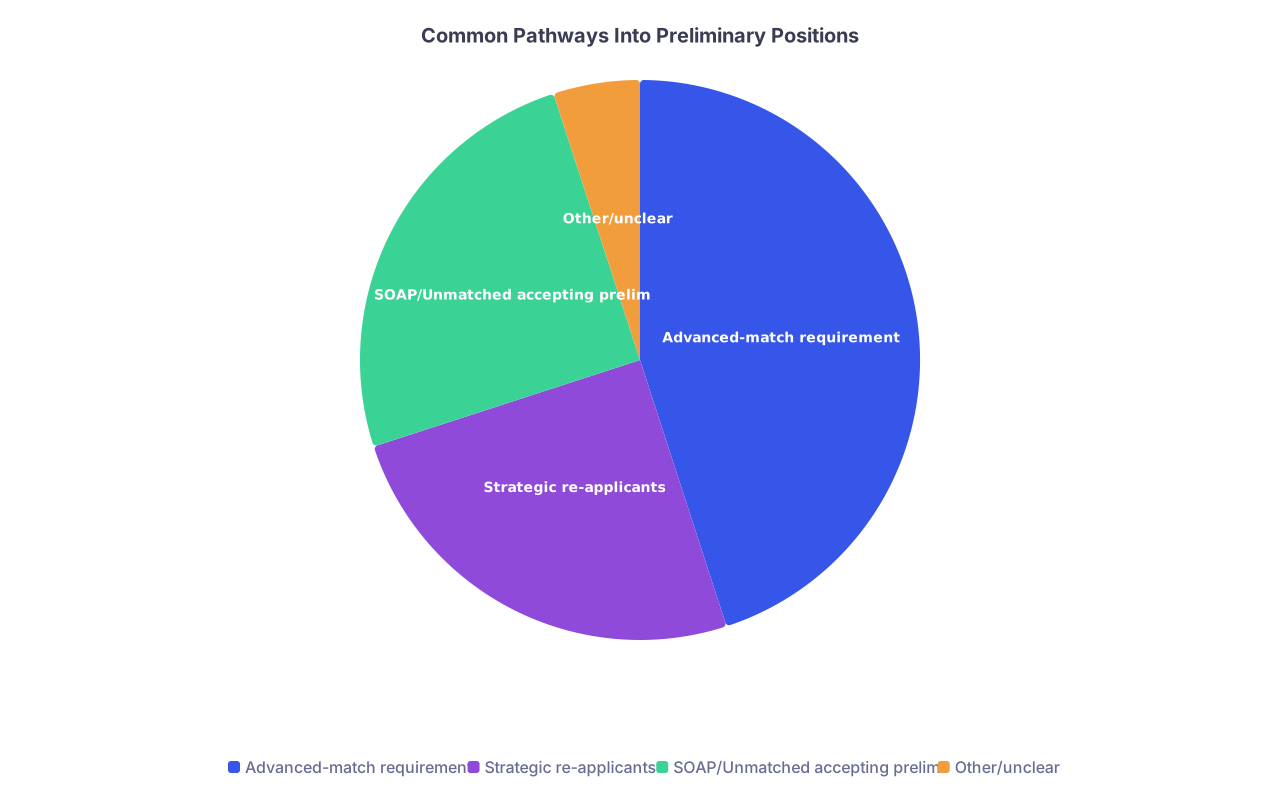
| Category | Value |
|---|---|
| Advanced-match requirement | 45 |
| Strategic re-applicants | 25 |
| SOAP/Unmatched accepting prelim | 25 |
| Other/unclear | 5 |
Program Behavior: Who Actually Gets These Spots?
- Prelim spots, especially at academic programs, often get more applicants per seat than categorical positions
- They prioritize:
- Proven test-taking ability (Step 2 CK, sometimes Step 1 if still numeric)
- Letters showing reliability and work ethic
- For surgical prelims: technical interest and stamina; for medicine prelims: ability not to implode on q4 call
- For advanced-matched applicants, some prelim programs view them as ideal because:
- They’re “self-cleaning” (leaving after 1 year, predictable turnover)
- They’re often high-performing and motivated
- They bring research/grant prestige if they’re already affiliated with an academic department
So while some low-demand prelim spots fill late in SOAP with whoever is left, the higher-quality programs are absolutely not lowering standards across the board. In certain institutions, the “best” CV on the team belongs to a prelim.

The Hidden Bias: Why the Myth Persists
If the data and logic undercut the myth, why does “prelim = less qualified” still float around?
Because of status signaling on the wards.
Here’s the social reality:
- Categorical = “I belong here long term”
- Prelim = “I may or may not be here next year”
Humans (including doctors) are bad at separating permanence from competence. A PGY-1 who won’t be in the program in year two feels “less central,” so people subconsciously mark them as “less.” Even when that same intern is going to a hyper-competitive specialty.
Senior residents will say things like:
- “Don’t worry about involving the prelim, they’re gone next year anyway.”
- “He’s just a prelim, give that clinic opportunity to the categoricals.”
- “She’s a derm prelim, she doesn’t care about medicine.”
That’s not commentary on quality. It’s commentary on how much the system is willing to invest in someone who isn’t long-term property.
It becomes circular: the prelim gets fewer local opportunities, less mentorship, sometimes worse schedules, and then appears less integrated or less polished. People misread that as lower baseline ability rather than lower institutional investment.
The myth also persists because of the worst-case stories:
- The prelim who clearly doesn’t want to be there and checks out
- The SOAP prelim who is truly struggling, unsafe on nights, and everyone knows it
People latch onto those anecdotes and generalize. They conveniently ignore the derm prelim who is absolutely crushing on the cards service and quietly disappears to fellowship-level competitiveness.
Reality Check: Performance vs. Label
On any given team, this is what you actually see if you pay attention instead of reading the name tag:
- Some prelims outperform categoricals on knowledge, presentation, and efficiency
- Some categoricals outperform prelims
- Some of both are barely hanging on
The label tells you almost nothing about how that person will function at 2 a.m. on cross-cover.
And over the long term, what matters for career trajectory is:
- How they perform during that year
- The letters they earn
- The relationships they build
- Their ability to advocate for themselves while swimming in work
A strong prelim year can absolutely rehabilitate a borderline application. Program directors will often say, “If they can handle this intern year well, I do not care as much about that B in second-year path.”
Practical Implications If You’re Considering a Prelim Year
You might be reading this as a med student trying to decide whether to rank prelims or SOAP into one. You should see the reality clearly, not the myth.
A prelim year is:
- Not automatically a mark of failure on your record
- Not a downgrade compared to a “weaker” categorical in a specialty you do not want
- Often a pragmatic way to:
- Bridge into a more competitive field
- Strengthen your application with real, recent clinical performance
- Stay inside the GME system rather than outside looking in
But it’s also:
- Hard. Sometimes harsher scheduling than categoricals because you’re the “extra body”
- Politically tricky; you have to hustle more for opportunities because you’re not long-term
- Dependent on you doing real work to secure the next position early in the year
The key move is simple: stop internalizing the “less qualified” nonsense. It will only make you smaller. You need to walk in like a full resident—because you are one—and collect the evals, letters, and skills that prove it.

| Step | Description |
|---|---|
| Step 1 | Start Prelim Year |
| Step 2 | Proceed to PGY2 in advanced specialty |
| Step 3 | Decide to reapply |
| Step 4 | Apply broadly with stronger letters |
| Step 5 | Pivot to new specialty |
| Step 6 | Match categorical or advanced |
| Step 7 | Continue training |
| Step 8 | Advanced spot already matched |
| Step 9 | Reapply same specialty |