

The biggest myth about away rotations is that you’re only being judged on your clinical performance. You’re not. Your research reputation is getting passed around too—quietly, informally, and in ways you will never see on paper.
Let me tell you how it really works behind the scenes.
The Hidden Currency: Your “Research Reputation”
Every specialty with even a whiff of academic prestige has a second eval system you never see: the informal research report.
No forms. No grades. No checkbox. Just emails, side conversations, and Slack DMs between faculty across institutions:
- “Is this student actually involved in that trial or are they just a data mule?”
- “They say they’ve published three papers—are those legit or fluff?”
- “Good in the OR, but their ‘research’ is… generously described.”
Faculty are not only judging whether you did a good job on the rotation. They’re judging whether what you wrote on ERAS about research feels real, overstated, or fabricated. And once they decide, that judgment travels.
On away rotations, three versions of you show up:
- The person on the wards
- The person in your ERAS application
- The person in your whispered research reputation
If those three don’t match, programs flag you. Hard.
How Faculty Actually Learn About Your Research
Almost no one will tell you this directly. But I’ve watched it happen in real time on away-heavy services like ortho, derm, ENT, rad onc, neurosurgery, and competitive IM subspecialties.
It usually starts casually.
1. The “So, tell me about your research” Trap
An attending on your away rotation will ask this in the middle of a case, in clinic, or walking between patients. It sounds friendly. It isn’t just small talk.
They’re doing three things at once:
- Checking if you actually understand the projects you list
- Testing whether your role matches what you claimed
- Seeing how you think about science, not just memorize buzzwords
If your ERAS says “first author retrospective outcomes study,” and you can’t explain:
- the primary outcome
- how you handled missing data
- the basic stats used
they clock that. They may not call you out to your face. But they absolutely talk later.
I’ve heard verbatim in a workroom:
“She says she’s on three projects but couldn’t explain a single method. Someone wrote her name on stuff and she ran with it.”
That doesn’t just die in that room.
2. The Quiet Backchannel to Your Home Institution
Here’s the part students consistently underestimate: academic medicine is a tiny village.
If you rotate at a mid- or high-tier academic program, faculty can usually reach someone at your home:
- “Hey, you know this student from [Your Med School]—are they actually strong in research?”
- “They say they’re working with Dr. X on a multi-center trial. Is that real?”
- “They list a paper with your department—did that come out yet?”
It happens by:
- A two-line email
- A hallway chat at a conference
- A text between former co-fellows who now sit on different faculties
And once that question is asked, the answer is blunt. Faculty don’t feel compelled to protect you if they suspect you’ve inflated your involvement.
I’ve watched an away student’s rank list position drop because a quick email came back:
“Nice kid, but research involvement is overstated. Did not drive any projects.”
That single line matters more than anything you submitted in ERAS.
3. The Internal “Research Credibility” Tag
Programs keep informal notes. Some literally on spreadsheets, others just in shared conversations after interview season.
It’s not, “Did this student do research?”
It’s, “Does this student have real research chops or just padded CV noise?”
There are basically four categories:
| Category | How Faculty Describe You |
|---|---|
| Genuine Researcher | "Real deal, understands the work" |
| Solid but Limited | "Some experience, honest about role" |
| CV Padding | "List is long, substance is thin" |
| Red Flag / Exaggerated | "Inconsistent, likely overstated" |
You want to be in the first two. Third is survivable in some specialties. Fourth is fatal in competitive ones.
The Moments You Don’t Realize You’re Being Evaluated
You think you’re being judged on presentations, notes, and how you get along with residents. Those matter. But your research reputation is being formed at a different set of pressure points.
Case 1: Clipboard Researcher vs. Thinker
You’re scrubbed in on a case. Attending sees on your CV that you have multiple “retrospective cohort studies.”
They say casually:
“Ah, I see you’ve done some outcomes research. What’s the main limitation everyone forgets in retrospective surgical studies?”
If you stare blankly, or mumble something like “small sample size,” you’re cooked.
They don’t need you to recite a biostats textbook. They just want to see that you’ve actually thought about what you worked on. That you’re not just the person who clicked boxes in RedCap.
I’ve seen someone recover from this beautifully:
“Honestly, for the one I worked on, selection bias was the big one. Only certain patients got the surgery we studied, and that already made them different from the general population.”
The attending later in sign-out:
“She actually thinks like a researcher. Put her near the top.”
Case 2: The “Talk Me Through Your Paper” Test
Some attendings will open PubMed while you’re off seeing a patient. They’ll search your name. They’ll scan your actual paper.
Then they’ll ask:
“Tell me how you got from hypothesis to conclusion in that J Surg Res paper. Walk me through it.”
If your answer sounds like you’ve never seen the methods section, they assume:
- You were minimally involved
- Someone else did the heavy lifting
- You slapped your name on it and now you’re owning it as “your” paper
That’s when they start sending emails.
Case 3: When You Overplay a Weak Project
A common mistake: you center your application on a fluffy, low-impact project and sell it like it changed the field.
Faculty can smell that a mile away. Posters at weak conferences, case reports with no depth, “quality improvement” that’s just a compliance form—none of this is bad by itself. But if you wrap it in hero language, they’ll think you lack perspective.
A better move is to be accurate and low-drama:
- “This project was small, but it taught me X, Y, Z.”
- “I joined this late, so my role was mainly data abstraction and helping with revisions, but it got me into thinking about [topic].”
That kind of honesty actually builds trust. And people do talk about that.
How Attendings Quietly Report You
Let me pull back the curtain on how this actually gets communicated.
1. The Off-the-Record Email
This is the most common:
“Hey [PD],
Had [Your Name] on our service for 4 weeks. Clinically solid, good team member. Research section of their CV is probably a bit padded—didn’t seem to have deep understanding of most listed projects.
Would rank, but I’d temper expectations about academic productivity.
– [Faculty]”
That email never hits your ERAS file. You’ll never see it. But the PD reads it, nods, and updates their mental model.
2. The Rank Meeting Comments
In the closed-door rank list meeting, every program has “whisper” categories.
Someone will say:
- “Good research. Real output, knows the material.”
- “Thin research. List looks heavy, substance not so much.”
- “Research feels exaggerated. I’d be cautious.”
And you shift up or down the list accordingly. Often by a lot.
3. The Conference Network
If you rotated at a big-name place, there’s a high chance at least one faculty or fellow there knows someone from your home program or another place you rotated. I’ve seen these exchanges happen between sessions at national meetings:
“You had [Student] on your away, right? Any concerns?”
“Nice enough. But their ERAS made them sound like a junior PI. Not accurate.”
One sentence. That’s all it takes to soften your whole academic story.
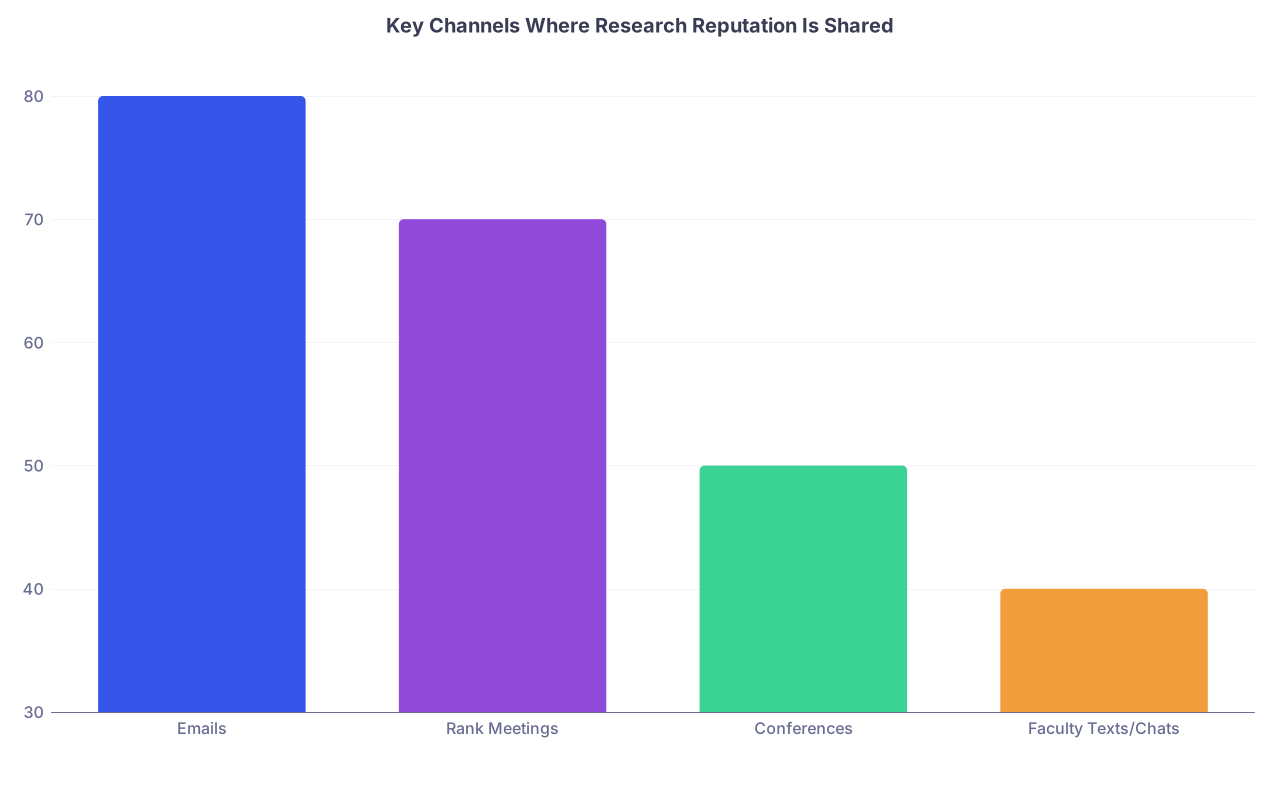
| Category | Value |
|---|---|
| Emails | 80 |
| Rank Meetings | 70 |
| Conferences | 50 |
| Faculty Texts/Chats | 40 |
Those numbers aren’t from a published paper. They’re from watching how often I saw each channel actually used over years.
The Red Flags Faculty Look For in Your Research Story
Faculty are not stupid. They’ve seen hundreds of ERAS applications and thousands of student CVs. They instantly pick up on patterns that scream “inconsistent” or “inflated.”
1. Too Many Projects, Too Little Coherence
You list:
- 6 projects in totally unrelated areas
- All “in progress”
- No clear theme, no depth, no paper actually finished
They assume:
- You bounce around for lines on a CV
- You don’t take anything to completion
- Your mentors probably did most of the intellectual work
They might still rank you. But not as their “future academic star.”
2. No Understanding of Methods
If you can’t explain:
- What a confidence interval is
- What regression basically does
- Why you chose a chi-square vs t-test (or at least what each one is used for)
they mentally downgrade you from “researcher” to “participant.”
You don’t need to be a statistician. But you must understand your own paper at a conceptual level.
3. Inflated Titles and Roles
Calling yourself “lead author” on something clearly driven by a big-name attending is dangerous. Same with:
- “Co-PI” as a medical student on a large trial
- “Directed” or “designed” a multi-site study when you were one of several helpers
Faculty can tell when your title is disproportionate to your training level.
How to Protect And Strengthen Your Research Reputation on Away Rotations
This doesn’t require genius. It requires honesty, preparation, and precision.
Know Your Own Work Cold
You should be able to, without notes:
- Describe the question your project asked
- Explain the basic study design
- Summarize the key result in one or two clear sentences
- Acknowledge limitations without collapsing into self-criticism
If one of your projects is weak, don’t panic. Just be transparent:
- “That one was pretty small and mainly descriptive, but it opened the door to working with Dr. X, and that led to [better project].”
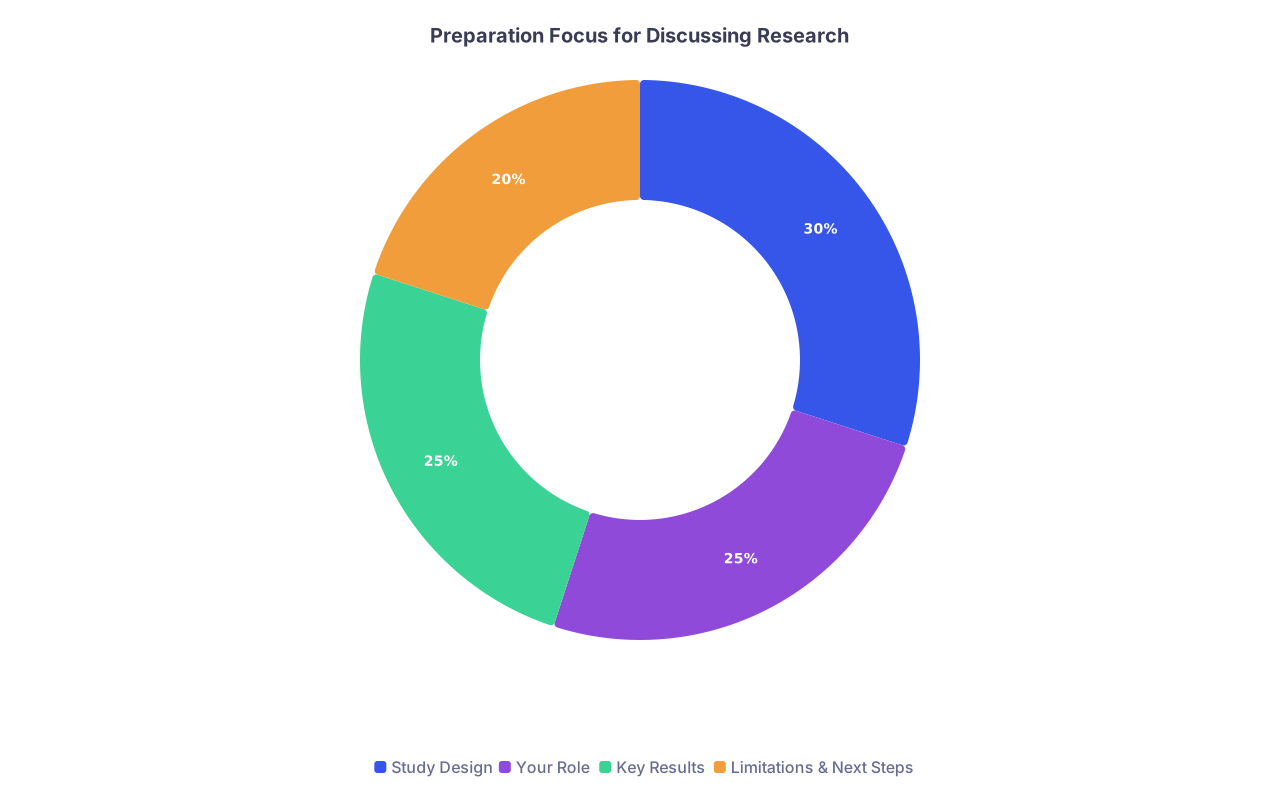
| Category | Value |
|---|---|
| Study Design | 30 |
| Your Role | 25 |
| Key Results | 25 |
| Limitations & Next Steps | 20 |
That’s how most experienced faculty mentally divide “Do they get it?”
Stop Selling, Start Describing
On away rotations, overselling is poison. The moment you sound like you’re pitching instead of describing, suspicion goes up.
Good:
“I helped with data collection and contributed to the discussion section. My mentor really drove the design, but I learned a lot about [X].”
Bad:
“I led a groundbreaking QI project that transformed outcomes in our unit.”
If it was actually you cleaning up a handoff form, they will see the mismatch.
Align Your Story Across Rotations
Here’s something few students realize: when you rotate at two places in the same specialty, faculty may compare notes.
If at Program A you say:
“I’m still pretty early in research, mostly helping with data abstraction right now.”
And at Program B you say, two months later:
“I’ve been leading multiple clinical trials and I’m basically running the project logistics.”
Someone will pick up the contradiction if they ever talk. And they do.
So your story has to be consistent. Growth is fine. Reinvention is not.
Let Residents Help You
Residents are your early warning system. They hear how attendings talk. They know who cares about research and who does not.
Ask a trusted senior resident:
- “Dr. X saw my ERAS – anything I should be ready to talk about?”
- “How deep do people here usually go on research questions with students?”
They’ll tell you who grills on methods vs who just wants to hear that you’ve tried something scholarly. Use that intel.

| Step | Description |
|---|---|
| Step 1 | Your ERAS Research |
| Step 2 | Faculty Conversation With You |
| Step 3 | Faculty Impression of Credibility |
| Step 4 | Emails/Text to Colleagues |
| Step 5 | Rank Meeting Comments |
| Step 6 | Final Perception of You as Researcher |
That’s the real pipeline. Not the one in the handbook.
The Specialty Factor: Who Cares Most
Let me be blunt. Not every specialty weighs research reputation the same way.
| Specialty Type | Interest Level | Insider Comment |
|---|---|---|
| Rad Onc, Neurosurg, Derm | Very High | Research is near-mandatory |
| Ortho, ENT, Plastics | High | Big differentiator among strong apps |
| IM (academic tracks) | High | Especially for fellowship potential |
| EM, Community IM, FM | Moderate | Helps, but not make-or-break |
| Purely community programs | Low–Moderate | CV padding matters less |
If you’re applying in a research-heavy field and you rotate at a major center, assume your research reputation is being explicitly discussed. Not just incidentally. Explicitly.
The One Thing That Always Helps: Being Believably Curious
Programs do not expect you to be a mini-faculty member. What they want to know is:
- Are you teachable?
- Do you understand what you did well enough to build on it?
- Are you honest about your role and limits?
A student who says:
“I realized during this project that I really do not understand regression as well as I should. I’m trying to learn more about it now so I can design something better next time.”
is going to get a kinder informal research report than:
“I’ve basically run multiple projects, handled all the stats, and designed the study.”
when clearly you did not.
Faculty are far more forgiving of inexperience than of performance.
Years from now, you will not remember exactly who asked you about that obscure methods detail in the OR. You will remember whether your story about your own work was something you had to defend—or something you could stand on without flinching.
Build a research reputation you’d be comfortable having whispered about in rooms you’ll never enter. Because those conversations are happening, whether you’re ready for them or not.


