
The second look visit is massively overrated in your head and mildly overrated in real life.
You’re probably replaying every weird silence, every half-smile, every joke that didn’t land, convinced the entire program walked you out to your car and said, “Well, not that one.” I know exactly the soundtrack running in your brain: “I just tanked my chances at my top program over one awkward afternoon.”
You almost certainly didn’t.
Let’s pull this apart before you spiral yourself into re-writing your whole rank list at 2 a.m.
What Second Looks Actually Are (And What They’re Not)
Second looks feel high stakes because they happen late in the game, when you’ve finally attached real emotions to specific programs. By the time you’re doing them, you’re thinking, “This could literally be where I spend the next 3–7 years of my life.” So your brain decides every small moment is life-or-death.
Programs don’t see it that way.
Second looks are mostly for you, not them. They’re a chance to:
- See the day-to-day vibe when it isn’t a polished interview day
- Check call rooms, clinic flow, resident dynamics, neighborhood, etc.
- Ask real questions you didn’t want to ask on interview day (“No, but really, what time do you actually go home?”)
Here’s the part nobody says out loud: by the time you come back for a second look, a lot of programs already have a pretty stable sense of where you roughly sit on their rank list. They’re tweaking at the margins, sure, but they’re not building a whole new opinion from scratch because you seemed a little quiet during lunch.
Second looks are usually optional signals, not decisive auditions.
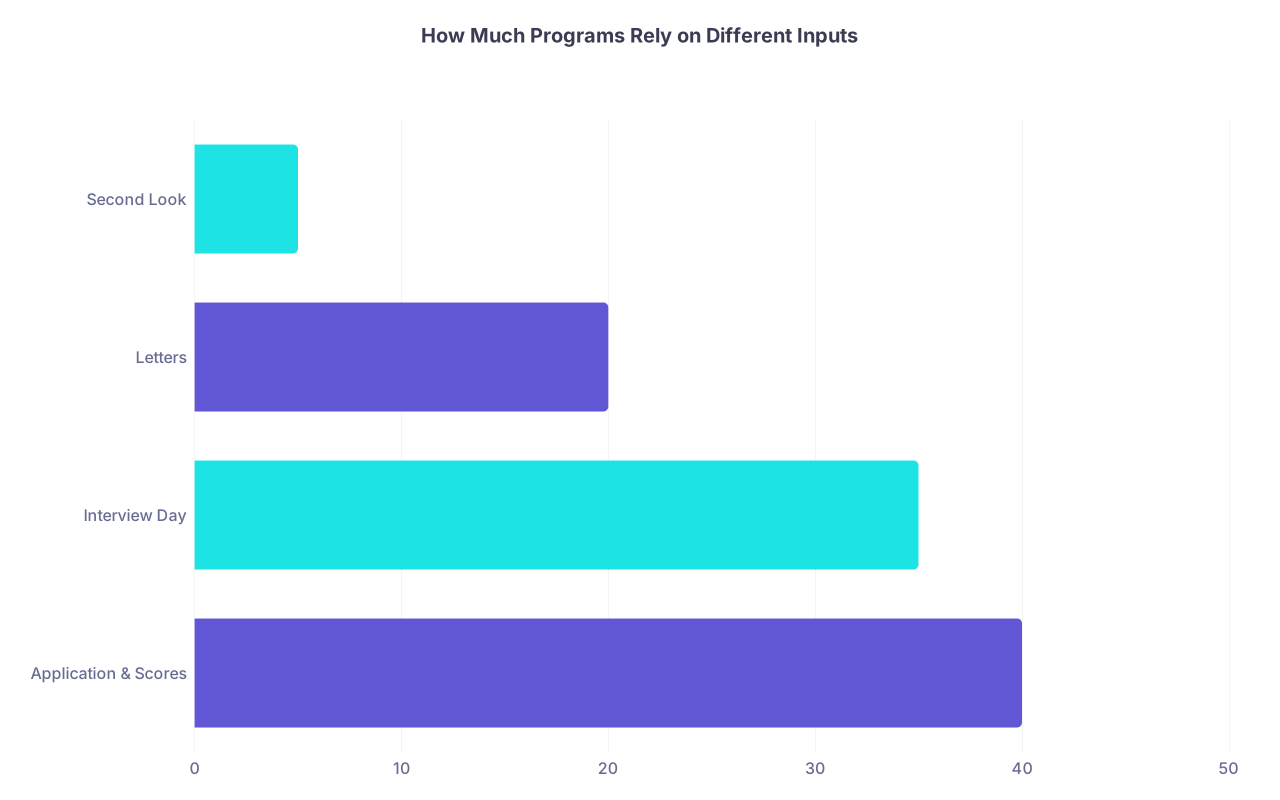
| Category | Value |
|---|---|
| Application & Scores | 40 |
| Interview Day | 35 |
| Letters | 20 |
| Second Look | 5 |
Is this exact data from NRMP? No. But it’s honestly close to the reality I’ve seen: second looks are a tiny slice of the pie.
What “Awkward” Usually Looks Like (And How Programs Interpret It)
When you say, “My second look was awkward,” you probably mean something like this:
- You got stuck in a small group where the residents all knew each other and you felt like a fifth wheel.
- There were long silences during downtime, and you panicked about not asking enough questions.
- You said one thing you keep obsessing over: a clumsy joke, a too-honest comment about being tired, a weird answer to “So why this city?”
- You felt “off” that day—tired, anxious, socially rusty—and now you’re convinced everyone noticed.
Let me translate how this usually looks from the program side:
- “They seemed a little quiet/tired, but they were fine.”
- “Nice applicant, kind of shy. Totally normal.”
- “I honestly don’t remember much—they blended in like most people do.”
The gap between how intensely you experienced the awkward and how much they remember it is massive.
There are 3 basic scenarios where a second look actually hurts you:
- You were rude to staff or residents.
- You said something blatantly unprofessional (bigotry, trashing other programs, wildly inappropriate jokes).
- You created extra work or drama—showed up late without explanation, argued with people, refused to follow instructions.
If your “awkward” was: “I sat at lunch and didn’t say much and then stumbled on one answer about why I like the program,” that’s not on this list.
Half the residents you met barely remember individual second-look visitors by February.
The Myth of “I Have to Impress Them Again”
A lot of us treat second looks like Round 2 of the interview:
If I don’t outperform my interview persona, I’ll slide down their list.
No. That’s not how this works.
Here’s how most programs use second looks—especially these days, with virtual interviews becoming more common and second looks mostly in-person, casual visits.

| Step | Description |
|---|---|
| Step 1 | Applicant Interviews |
| Step 2 | Program Makes Initial List |
| Step 3 | Applicant Returns for Second Look |
| Step 4 | List Mostly Unchanged |
| Step 5 | Move Down or Off List |
| Step 6 | Huge Red Flag? |
They’re not waiting for you to “win the room.” They’re checking:
- Are you basically the same person you were on interview day?
- Are you reasonable? Not wildly difficult, not obviously unbearable to work with?
- Do you seem like someone the residents wouldn’t mind at 2 a.m. on a call shift?
You don’t have to dazzle. You just have to not set off alarm bells.
An awkward lunch does not qualify as an alarm bell.
But What If I Really Did Say Something Dumb?
Okay, let’s play into the anxiety for a second. Worst-case thinking.
You’re replaying something like:
- You admitted another program is higher on your list.
- You said, “I’m not really sure about this city,” and now you think they’ve branded you as not committed.
- You tried to be funny and it came out kind of snarky.
- You overshared about burn out, imposter syndrome, or hating a certain rotation.
Can this hurt you? Possibly, yes. Can it “ruin” your chances? That’s a much higher bar.
For it to ruin your chances, a few things have to line up:
- Multiple people there have to notice and agree it was bad enough to bring up.
- Someone has to care enough to document it or bring it up in ranking meetings.
- It has to stand out among a sea of other applicants, many of whom will also have awkward moments.
Most of the time, it’s like this:
Resident on rank list night: “Oh, yeah, they were a little awkward during second look. I don’t think it was that serious though.”
Other resident: “Yeah, whatever, they seemed nice.”
PD: “Okay. Next candidate.”
Not exactly career-ending.
If you legitimately made a really negative impression—like you argued with someone, dismissed a nurse, or ranted about another program—that’s the zone where serious damage is done. But you wouldn’t be here carefully dissecting the silence at lunch if that’s who you were.
Your anxiety about it is almost proof you didn’t cross that line.
Does a Bad Second Look Mean I Should Rank Them Lower?
Here’s the important flip nobody talks about: second looks are more dangerous to your ranking of them than theirs of you.
You’re looking for that “click.” That feeling of, “Yes, I can survive here.” But sometimes what you get is: “Huh. That was… kind of weird.” Then comes the mental ping-pong:
- Was it me?
- Was it them?
- Am I overreacting?
- Am I about to sabotage my future over one off day?
So first, separate two questions:
- Did I ruin my chances there?
- Did what I saw change how I actually feel about training there?
Those are not the same.
You should absolutely consider:
- How residents treated each other when they thought no one was paying attention.
- Whether they seemed burned out, bitter, or exhausted more than you’d expect.
- How faculty talked about residents (respectfully or like they’re disposable).
- Whether you felt safe, welcome, and like you could be yourself at least a little.
You should not over-weight:
- One socially awkward resident who didn’t ask you many questions.
- A quiet morning where you felt like a ghost trailing around.
- Your own internal nervousness and overanalysis of every moment.
If the “awkwardness” was mostly inside your own head, don’t punish the program for that. If the awkwardness was clearly about their culture—fractured, cold, dismissive—that’s a reason to move them down, regardless of how much you “liked them on paper.”
How Much Do Second Looks Really Matter Compared to Everything Else?
You’re probably afraid second looks are this hidden secret factor that silently crushes or saves your chances.
They’re not. They’re one more tiny input on top of months’ worth of data.
| Factor | Relative Impact on Rank |
|---|---|
| Interview Day | Very High |
| Overall Application | High |
| Letters of Recommendation | High |
| Second Look Visit | Low |
That “Very High / High / Low” is my honest sense from talking to residents and faculty across multiple programs. Especially post-virtual era.
If programs really wanted second looks to matter, they’d be:
- Required
- Structured, with formal scoring
- Documented in detail
Most are none of those things. They’re informal, they’re variable, and half the time they’re organized by residents who are just trying to cram them into an already packed call schedule.
Second looks are rarely the tie-breaker. When they are, it’s usually because someone truly shined there or truly imploded there. You don’t end up in either extreme category by feeling weirdly quiet for an afternoon.
What You Should Do Now (Instead of Obsessively Replaying It)
So you had a second look that didn’t feel great. What now?
First: don’t email them a long explanation.
Do not write: “I’m so sorry I was quiet at lunch; I was just tired and anxious and I really do love your program and I hope I didn’t come across wrong.” That does nothing but spotlight something they might not have even noticed.
Only reach out if you have:
- A concise thank-you to someone who genuinely helped you.
- A real question you didn’t get answered.
- A sincere, brief statement of interest: “After visiting again, I remain very interested in your program because of X/Y.”
No confessions. No apologies. No over-explaining.
Second: sit with how you felt there.
Under all the anxiety about what they thought, there’s probably a quieter voice saying something like:
- “I actually felt pretty comfortable there despite being awkward.”
- “I left wondering if they really care about wellness.”
- “I liked the residents, even if I didn’t say much.”
- “I felt invisible, and I hated that.”
Listen to that voice more than the shame replay of some tiny social misstep. That voice is the one that has to live there for years.
Third: rank based on where you’d be willing to wake up on a random Thursday in February, not on which place made you feel the least awkward on one weird day.
The Bottom Line: Did You Ruin Your Chances?
Let me be as blunt as possible:
If your “awkward” second look consisted of being:
- Quiet
- A bit off your game socially
- Unsure what to ask
- Mildly self-conscious
…you did not ruin your chances.
Programs deal with humans. Humans are awkward. Residents are awkward. Attendings are awkward. A second look is not a Broadway audition.
You ruin your chances by being cruel, unprofessional, arrogant, or blatantly disrespectful. Not by being a tired, overthinking, fourth-year med student who’s spent the last year micromanaging their every word.
You’re allowed one weird afternoon. Or three. They’re not going to base your entire future on it.