

You just finished another 12‑hour “day off” where you somehow did 600 Anki cards, watched 3 lectures on 1.75x, and skimmed First Aid. Your brain feels like oatmeal. Your phone lights up: “Can we talk? I miss you. I feel like we barely exist in your life anymore.”
You stare at it. Because you also miss them. A lot. But you also know that if you FaceTime for 90 minutes right now, tomorrow’s small group and quiz are going to hurt. And this is not a one‑time thing. This is the new reality: you’re M1, they’re in another city or state, and both of you are trying to pretend this long‑distance relationship will magically “work itself out.”
It will not “work itself out.” You have to build it. Very deliberately. With boundaries and routines that treat your relationship like something you’re actively maintaining, not passively hoping survives.
Let’s walk through what to actually do.
Step 1: Get Honest About the Math of M1
Before you talk about boundaries, you need to understand what you’re working with. Emotionally and time‑wise.
Most M1s wildly misjudge their actual disposable time. They remember undergrad. They think, “Yeah it’s harder, but I can squeeze in more calls.” Then block exams hit and everything explodes.
Here’s roughly what your week looks like once things get real:
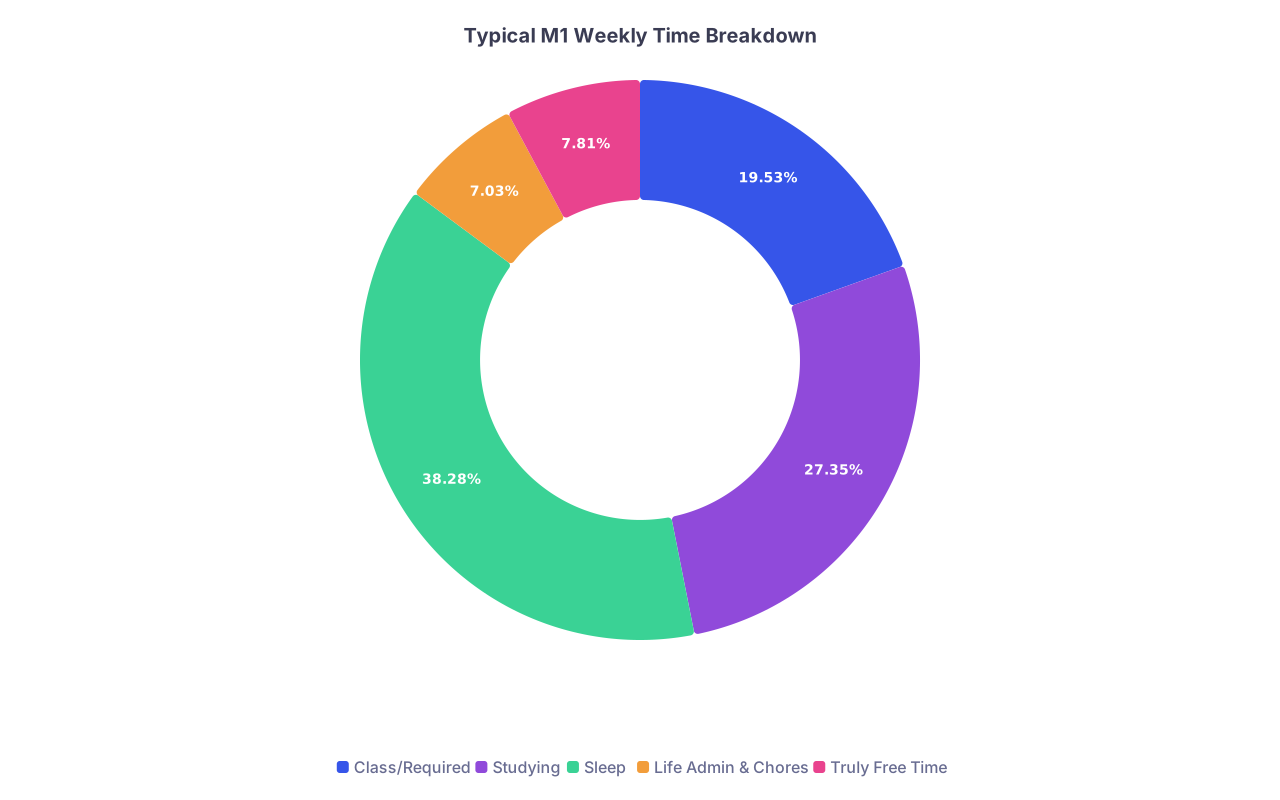
| Category | Value |
|---|---|
| Class/Required | 25 |
| Studying | 35 |
| Sleep | 49 |
| Life Admin & Chores | 9 |
| Truly Free Time | 10 |
That “Truly Free Time” slice? That 8–10 hours per week is where:
- Exercise
- Errands
- Groceries
- Social life
- Partner time
- “Stare at wall because I’m cooked”
all have to live.
So first, sit with this:
You cannot be “on call” for your partner 24/7 and still be a functioning M1. If you try to be a full‑time med student and a full‑time partner in a long‑distance relationship, you’ll fail at both.
The fix is not to be more heroic. It’s to be more structured and much more honest.
Step 2: Have the Hard Conversation Early (Not After the First Fight)
You need one serious, explicit conversation about what this long‑distance year is actually going to look like. Not vague “we’ll make time” nonsense. Concrete.
Do it when:
- You’re not pre‑exam panicked
- They’re not in the middle of a crisis
- You have at least 45–60 minutes
And you say something like:
“M1 is already much heavier than undergrad. I love you, and I want us to be intentional about this. I can’t do constant texting and random long calls every night. But I can commit to specific times that are protected. Can we figure out a routine that works for both of us?”
Here’s what you need to cover explicitly:
Frequency of Calls
- Daily brief check‑ins + a couple longer calls
- Or fewer, longer calls (e.g., 3–4 evenings per week)
- What’s realistic for you, not what sounds romantic
Preferred Times
- You: “I’m a zombie after 10 pm.”
Them: “I’m free after 9 pm.” - You might land on:
- Short call 9:00–9:20 pm most weekdays
- Long call Saturday afternoon
- You: “I’m a zombie after 10 pm.”
Texting Norms
- Are you expected to reply during class? During study blocks?
- What does “I’m not ignoring you, I’m in the middle of a block” look like in practice?
Expectations Around Exams
- You: “The 3 days before an exam, I’m gone. But I will still send you a good‑morning and good‑night text.”
- Them: “Okay, I’ll text you memes but not expect a long reply.”
Conflict Rules
- No starting big relationship arguments at midnight before your anatomy practical
- If something big comes up on an exam week, you say, “This matters. Can we schedule time right after my exam so I can give it my full attention?”
If having this conversation makes them defensive—“Why are you treating our relationship like a meeting?”—you reframe:
“I’m doing this because I care. If we don’t make a plan, we’re going to keep hurting each other’s feelings and resenting med school. I’d rather build something that actually works.”
If they refuse to even engage in planning, that’s data. Not about you. About the relationship’s readiness for long distance in med school.
Step 3: Design Routines That Actually Survive Exam Weeks
Let’s make this practical. You need two separate systems:
- Your relationship baseline routine
- Your exam‑mode routine
If your “normal” is unsustainable, you’ll crash and burn every block. So build something exam‑tolerant from the start.
Baseline Weekly Structure
Use this as a template; tweak to fit your schedule.
| Day | Study Focus | Partner Time |
|---|---|---|
| Mon | Heavy content, Anki | 15-min check-in before bed |
| Tue | Lectures + review | 30-min call early evening |
| Wed | Small group / labs | Text, no call if exhausted |
| Thu | Review / Qbank | 20–30 min call after dinner |
| Fri | Lighter study, social | 45–60 min date-night call |
| Sat | Long study day | 60–90 min afternoon/evening |
| Sun | Review + planning | 30–45 min evening call |
Baseline rules that help:
- “No call” nights are deliberate, not a failure. They’re there to protect your brain.
- Keep weekday calls short by default. Set a timer. Yes, literally.
- Have one “anchor” longer call (Friday or Saturday) where you treat it as a real date:
- You both order food and eat “together”
- Watch a show together
- Play an online game
- Do something that feels like an activity, not just venting
Exam‑Mode Adjustment
Inform them of your exam calendar upfront. Then define what “exam mode” means.
For example:
- Exam week =
- Daily: good morning + a quick check‑in text at lunch + good night
- Calls: short 10‑minute calls only, maybe every other day
- Long call only after the exam
Tell them something like:
“When I say ‘I’m in exam mode,’ please know that I’m not pulling away from you emotionally. I’m closing some loops so I can stay afloat. I’ll still send you quick texts and I want you in my life—just not hour‑long calls these few days.”
And then actually follow through on the scaled‑back, not dropped‑off‑the-face‑of‑the-earth mode. Silence is what hurts partners. Not shorter contact.
Step 4: Build Boundaries Around Study Time (So You Don’t Resent Them)
If you’re trying to flip between Boards & Beyond and a deep conversation about their bad day, you’re going to do both poorly and feel guilty on both sides.
Set study blocks that are non‑negotiable. For example:
- Weeknights: 6:30–9:00 pm = Deep work
- Phone on Do Not Disturb
- They know this block exists
- After 9:00 pm = Relationship / chill / shutdown
Tell them clearly:
“From 6:30 to 9 most nights, I’m in full study mode. If you text, I’ll see it later. It’s not that I don’t care—it’s that this is how I survive here.”
Then, important part:
- At 9:00 pm, you actually put the books away.
- You don’t “just do another hour” and then call them at 11:45 half‑asleep. That’s how you train them to feel unimportant.
Your boundaries only work if you honor both sides: protecting study time and honoring the promised partner time.
Step 5: Fix the Texting Problem Before It Blows Up
Texting is where most long‑distance M1 fights start.
Common patterns I’ve seen:
- Partner: texts all day, expects near‑immediate replies
- You: answer between lectures…Then ghost for 4 hours in lab
- Partner: “You clearly have time for Instagram but not for me”
- You: “I’m literally dissecting a cadaver, what do you want me to do?”
You need explicit texting norms. For example:
You will:
- Send a “Good morning, here’s my day” text
- Reply between classes or at lunch, not during deep study
- Send a short “hey, crazy day, will reply late” when things are nuts
You won’t:
- Reply mid‑lecture or mid‑block
- Have multi‑hour real‑time text debates while trying to watch Pathoma
And they agree to:
- Not assume silence = anger
- Not blow up your phone during exams
- Flag true emergencies clearly (“Need you if possible. Serious family thing.”)
If they get upset that you sometimes open a meme but don’t answer their “how’s your day” immediately, say this once, clearly:
“My brain space is limited. If I have 10 seconds, sometimes I’ll look at something dumb to reset. That doesn’t mean I care more about that than you. It means I’m trying to survive the grind so I can be more present with you when I actually have time.”
If they still weaponize your every delay in replying, that’s not a texting issue. That’s insecurity and control. You cannot fix that with more responsiveness; you fix it with boundaries and sometimes with distance.
Step 6: Protect Both of You from “Med School Dumping”
Long‑distance quickly turns into one of two bad things:
- Your emotional dumpster
- A performance review of your relationship every call
You come home, you’re wrecked, and the first 30 minutes of every call is just:
- “This attending was awful”
- “I’m so behind”
- “Everyone is smarter than me”
Your partner gets it, initially. They’re supportive. Over time they feel like they’re dating your stress, not you.
So, structure calls:
- First 10 minutes: Their day. Ask. Actually listen.
- Next 10–15: Your day. Hit highlights and lowlights.
- Then: Move to something else (show, game, future planning, shared book, etc.)
If you need a true vent session, label it:
“I had a terrible day. Can I vent for 10 minutes and then we talk about you? I don’t want this to become every call.”
That one sentence reduces so much resentment. It shows you’re self‑aware and that you know med school can suck the oxygen out of the room.
Also, you’re allowed to say “I cannot do heavy emotional processing tonight”:
“I want to talk about this, but my brain is mush and I’m not going to be fair or thoughtful right now. Can we schedule a real conversation tomorrow when I’m not an empty shell?”
That’s maturity, not avoidance.
Step 7: Plan Real Visits Like They’re Exams
Random, last‑minute visits every time either of you miss each other will wreck your studying and your wallet.
Think of visits like mini‑rotations: they require planning, and they have tradeoffs.
Use a simple framework:

| Step | Description |
|---|---|
| Step 1 | Check Academic Calendar |
| Step 2 | Do Not Plan Visit |
| Step 3 | Identify Light Week/3-day weekend |
| Step 4 | Discuss Dates with Partner |
| Step 5 | Set Boundaries: Study vs Date Time |
| Step 6 | Book Travel & Block Schedule |
| Step 7 | Exam Soon? |
When planning a visit:
Avoid:
- The week before block exams
- Anatomy practical weeks
- New unit first‑week chaos
Better times:
- Weekend after an exam
- Long weekends (if workload is lighter)
- “Integrated week” / wellness days some schools offer
And then be brutally clear what the visit will look like:
“You’re here Friday to Monday. Friday night and all day Saturday, I’m yours. Sunday I need 6–7 hours to study, but we can do brunch and hang at night.”
If you oversell—“We’ll spend all weekend together!”—and then study 10 hours every day while they sit alone on your couch, of course they’ll feel lied to and unimportant.
You integrate them into your real life, not a fantasy life where med school vanishes.
Step 8: Handle Jealousy and “You Have Time for Them but Not Me”
This one’s ugly, but common.
Scenarios I’ve seen:
- You grab a quick beer with classmates after exam → Instagram story → partner: “So you’re too busy to text me back but not busy enough to go out?”
- You mention a “lab partner” or “group” a few times → partner fixates on someone as a threat
You can’t avoid all of this, but you can blunt the worst of it.
Concrete moves:
Proactive transparency
- “Going out with 3 classmates after the exam. I’ll text you when I’m home.”
- Mention people by name early, casually, and neutrally. Unknown = scarier.
Boundary against interrogation
- You do not need to provide a full report of who was there, who sat where, who laughed at whose joke.
- If they want every detail because “I’m just anxious,” you can be empathetic and firm:
“I get that this is hard, but me answering a hundred questions after every interaction isn’t going to fix that anxiety. I’m committed to you. We need to build trust, not surveillance.”
No apologizing for a basic social life
- You’re allowed to have friends. Study groups. Post‑exam drinks.
- You can say: “I function better when I act like a human occasionally. That includes seeing friends. It does not mean you’re less important.”
If they constantly weaponize your normal social life, that’s not a med school problem. That’s a relationship problem that just happens to show up here.
Step 9: Watch for Red Flags That This Is Not Sustainable
Some relationships bend and adapt to M1 long‑distance. Some snap. You need to know what to watch for so you don’t torch your mental health trying to hold together something that’s already over.
Big red flags:
They regularly:
- Call during your known study block “just to see if you’ll pick up”
- Start serious fights the night before exams
- Accuse you of not loving them if you do not reply in under 10 minutes
You:
- Feel dread when you see their name pop up
- Constantly choose them over sleep and studying, then panic and crash
- Are slipping academically and they respond with guilt or blame, not support
If more than one of these is familiar, you need a very direct conversation:
“This current pattern is not working. I’m burning out. I need us to find a way to support each other that doesn’t wreck my training or our mental health.”
Sometimes, after that talk, things improve. Often they do not.
Then you’re in decision territory:
- Do you stay knowing this is likely how the next 3+ years will feel?
- Or do you acknowledge that the relationship you had pre‑M1 does not fit your life anymore?
I’ve watched people cling hard, sacrifice sleep, skip studying to keep a failing relationship alive, only to break up mid‑M2 with worse grades and worse mental health than if they’d had the hard conversation earlier.
You cannot fix a fundamentally incompatible relationship with more FaceTime.
Step 10: Protect Yourself Too, Not Just the Relationship
Easy trap: you bend everything to protect your partner’s feelings and the relationship structure, and you forget there’s a third thing that needs guarding—you.
So:
Non‑negotiables for you:
- Minimum sleep hours you won’t compromise for calls
- Maximum weekly call time you can realistically sustain
- One night a week that’s just yours (no studying, no partner, just you decompressing or seeing local friends)
Check in with yourself monthly:
- “Do I feel supported or drained after most of our interactions?”
- “Have my boundaries slowly eroded since we set them?”
- “Am I starting to resent them for needs I agreed to meet?”
If you’re constantly exhausted, behind, anxious, and the relationship conversations are mostly demands and guilt, something’s off.
You’re training for a job that will always ask a lot of you. You need relationships that leave you more alive, not less.
Key Takeaways
- Treat your long‑distance relationship like a shared project: set explicit routines for calls, texting, and visits that both of you actually agree on and can sustain during M1.
- Protect real study blocks and real partner time with equal seriousness; if you blur both, you’ll end up resenting med school and the relationship.
- Watch for patterns—constant guilt, boundary‑pushing, pre‑exam fights—that show the setup is not sustainable. Adjust early, or be honest that M1 + long distance may not be compatible with this particular relationship.


