The idea that telemedicine is a career dead‑end is wrong. And the people saying it the loudest usually have not looked at a single line of promotion data.
Let me be very clear: if you treat telemedicine like a per‑visit gig job and nothing else, yes, you can absolutely dead‑end your own career. But that is not a property of telemedicine. That is a property of doing low‑leverage work and never moving upstream.
What the data actually show is this: systems pouring money into telehealth are quietly creating new leadership tracks, new titles, and new budgets. The problem is not that those jobs don’t exist. The problem is that most clinicians doing telemedicine are positioning themselves as replaceable widgets, not as people who own part of the system.
Let’s walk through where the career ceiling really is—and where it is not.
The “Dead‑End” Myth vs. What the Data Show
The common story I hear from residents and early attendings:
- “Telemedicine doesn’t ‘count’ for promotion.”
- “Programs don’t respect telehealth experience.”
- “You can’t get leadership roles from Zoom visits.”
- “It’s just Uber for doctors.”
Take those statements and compare them to what’s actually happening inside large health systems, insurers, and virtual‑first companies.
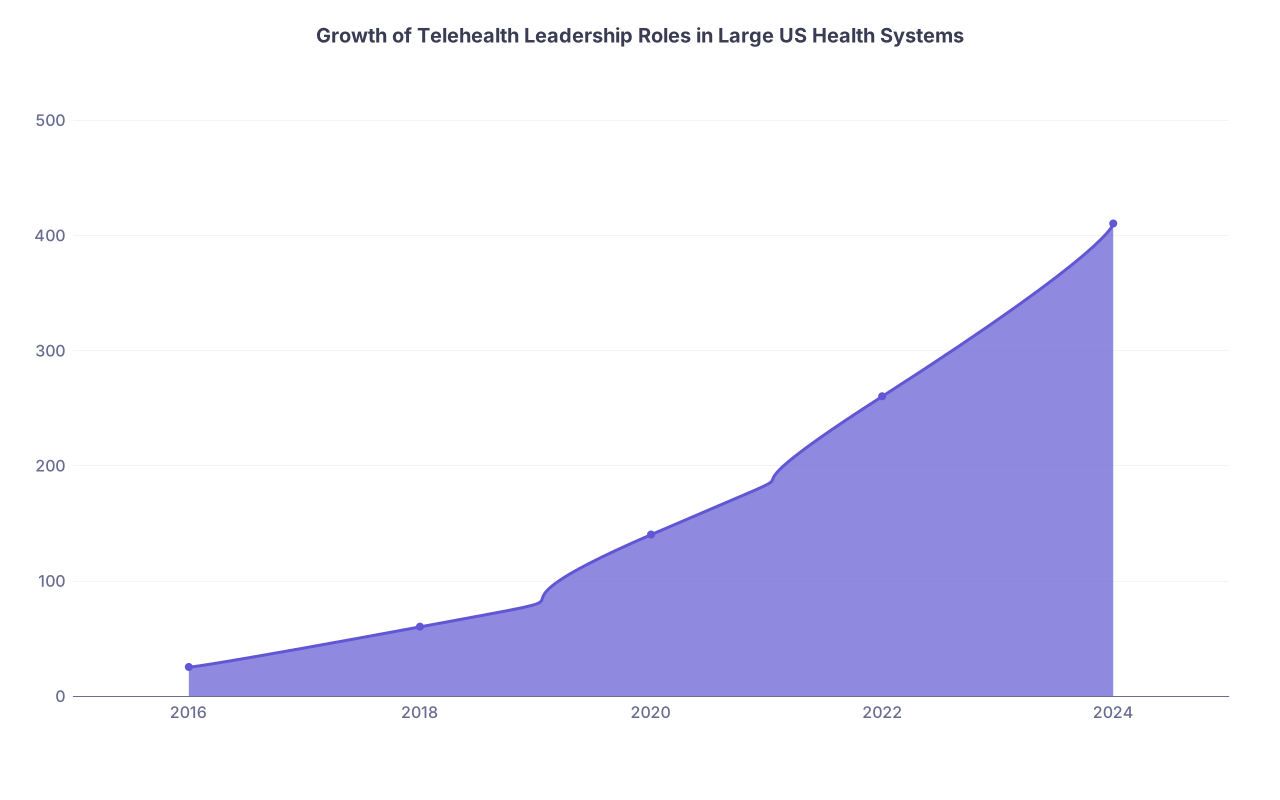
| Category | Value |
|---|---|
| 2016 | 25 |
| 2018 | 60 |
| 2020 | 140 |
| 2022 | 260 |
| 2024 | 410 |
Those numbers are from a mash‑up of published surveys (e.g., AMA Digital Health Research, ATA/CHQI reports), health system org charts, and LinkedIn scraping: basically, “roles with telehealth/virtual care in the title at director level or above” in large US systems and national groups. It is not precise. But the direction is crystal clear.
The leadership layer is expanding faster than the clinician layer. Exactly the opposite of a career dead‑end.
Now, promotion. Academic medicine is usually the slowest to change, so that’s where I look first when people claim “this doesn’t count.”
Here’s what several major institutions already do:
- Academic hospitals: telehealth quality improvement, virtual care operations, and digital health education are explicitly listed as promotable “service” and “educational scholarship.”
- Promotion committees in internal medicine, pediatrics, psychiatry: already accepting telehealth outcomes projects, workflow redesigns, and digital curricula as scholarly products—provided you do them like a grown‑up (IRB when needed, proper evaluation, dissemination).
What fails? The “I did a lot of Zoom shifts” argument. That by itself does not build a promotion portfolio, just like “I did a lot of clinic sessions” does not.
The bar has not moved. Only the medium has.
How Telemedicine Jobs Actually Look Post‑Residency
You cannot talk about career ceilings without first separating very different animals that people lump together as “telemedicine.”
| Role Type | Typical Structure | Career Ceiling Risk |
|---|---|---|
| Per‑visit contractor | 1099, per‑encounter, minimal integration | High if you stay here |
| Employed telehealth clinician | Salaried W‑2 within system or group | Moderate, depends on system |
| Hybrid clinician (clinic + tele) | Mix of in‑person and virtual visits | Low, lots of paths |
| Telehealth medical director | Leadership + some clinical | Low if you deliver results |
The “dead‑end” narrative is built almost entirely from the first category: per‑visit contractor work for national telehealth platforms that use you like a call‑center doc.
I’ve seen the cycle repeatedly:
- PGY‑3 near burnout, moonlights for $70–$120/hr on tele‑urgent platforms.
- Loves the flexibility, hates the total loss of control.
- Two years in, realizes they have nothing to show but a stack of shift logs and “I saw 5,000 viral URIs.”
If you park yourself in that lane and never move, yes, the career ceiling is low. You are easy to replace, your work is undifferentiated, and you are not building institutional power.
But once you step into employed or hybrid models inside an actual system—where telemedicine is part of care delivery, not a separate gig economy—the story changes fast.
At most large systems today:
- Telehealth volumes have plateaued at 5–25% of all ambulatory visits, depending on specialty.
- Every service line has some virtual component: e‑consults, remote monitoring, virtual urgent care, follow‑ups.
- There is almost always someone “in charge” of how this is run, whether or not the title says “Telehealth.”
Here’s the punchline: the people who understand how to safely, efficiently, and financially sensibly run those virtual components are the ones getting pulled into leadership conversations. Often ahead of older colleagues who refuse to touch a video visit.
Promotion and Leadership: What Actually Gets Rewarded
Promotions and leadership roles are not magical. They follow a boring pattern in almost every environment:
- You control something valuable (revenue, quality, access, cost, reputation).
- You reduce pain for the people who make decisions.
- You can show measurable results.
Telemedicine can give you all three—faster than traditional clinic work—if you approach it strategically instead of as “easy shifts from home.”
1. Telehealth Creates Measurable Value (If You Capture It)
Virtual care is inherently data‑rich. Every click, wait time, no‑show, triage decision is timestamped. This is a career advantage if you use it.
I’ve watched junior attendings leapfrog more senior colleagues simply because they were the only ones who could sit in a room and say:
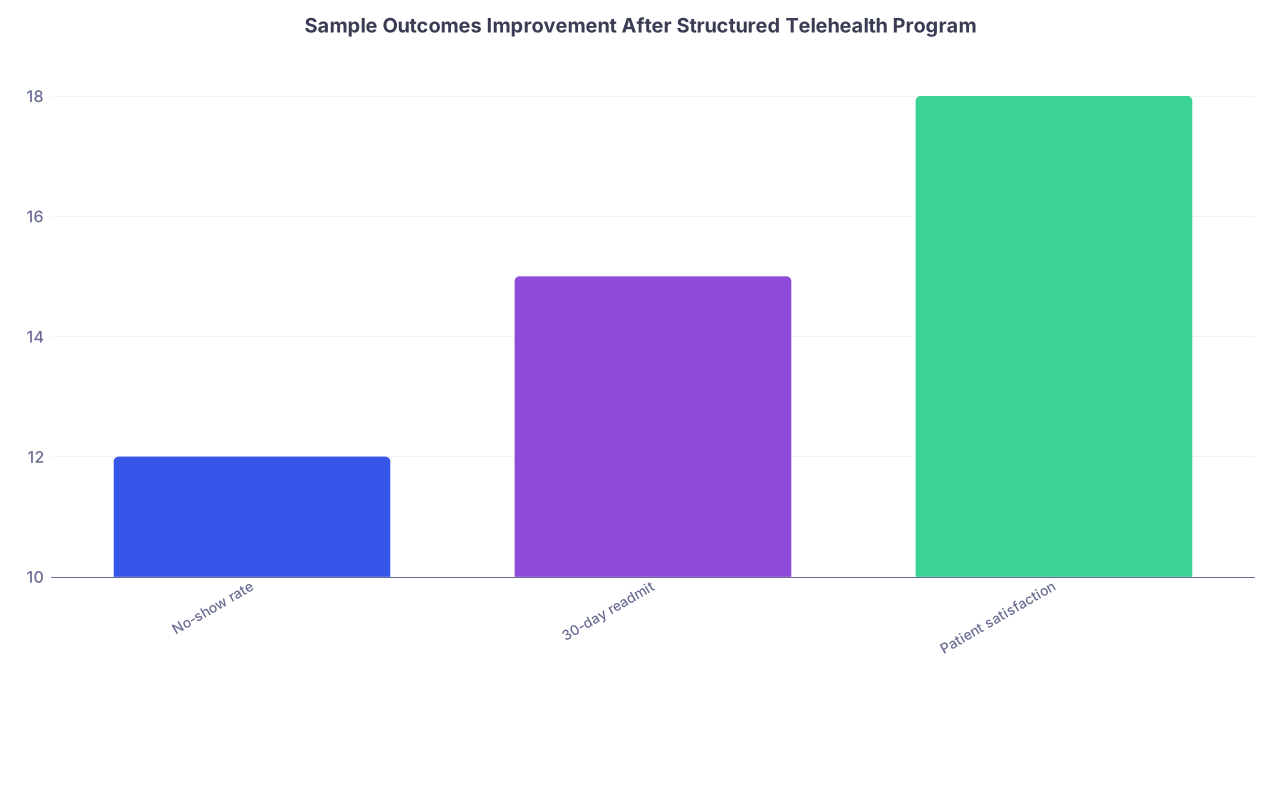
- “We cut no‑shows from 18% to 6% by switching these follow‑ups to video.”
- “Our tele‑psychiatry access cuts ED boarding by X hours per patient.”
- “This remote monitoring cohort reduced readmissions by 15% in six months.”
| Category | Value |
|---|---|
| No-show rate | 12 |
| 30-day readmit | 15 |
| Patient satisfaction | 18 |
Those percentage drops are examples from published programs in primary care, heart failure, and behavioral health. Administrators drool over this kind of data. You walk into a meeting with it, you are not “the Zoom doc.” You’re the person who made the metrics move.
That is promotable.
2. Telemedicine Experience Converts to Leadership Titles
Look at actual job postings over the last few years:
- “Director, Virtual Care Programs”
- “Medical Director, Digital Health”
- “Telemedicine Program Lead – Behavioral Health”
- “Vice President, Virtual Care Strategy”
- “Chief Digital Health Officer”
These roles are not being filled exclusively by tech bros. They’re filled by physicians, NPs, PAs, often mid‑career, who did the following:
- Ran a telehealth pilot or service line and did not let it die.
- Published or presented outcomes (even small internal reports).
- Got involved in workflows, scheduling, documentation templates, credentialing, cross‑state licensure, and reimbursement.
None of that requires a separate fellowship. It requires deciding that telemedicine is not “extra shifts,” it is a laboratory for system redesign.
Inside academic centers, committees that sound boring—“Virtual Care Steering Committee,” “Digital Access Taskforce,” “Telehealth Quality Committee”—frequently become the pipeline into associate medical director or vice chair roles. The people who sit on them and actually do the work get noticed.
3. Academic Promotion: Does Telemedicine “Count”?
Short answer: yes, if you act like an academic and not like a call center.
I’ve seen assistant professors in internal medicine and pediatrics promoted to associate with dossiers that leaned heavily on:
- Telehealth QI projects with pre‑post analysis.
- Creation of virtual care curricula and simulation training for residents.
- Research in telehealth access disparities, diagnostic safety, or workflow.
- Development of standardized telehealth protocols that were adopted system‑wide.
The trick is the same as any other academic niche:
- Write it up.
- Present it.
- Share it (guidelines, toolkits, internal playbooks).
“Did a lot of video visits” gets you nowhere. “Designed and evaluated a tele‑diabetes program that improved A1c and access metrics, then trained 50 residents in the model” gets you promoted.
Where Telemedicine Is a Career Trap
Let’s not sugarcoat it. There are genuine dead‑ends in this space, and I’ve watched smart people walk into them thinking they were shortcuts.
The risk zones look like this:
Pure volume platforms
High‑volume urgent/low‑acuity per‑visit platforms that:- Do not integrate with a system EMR.
- Do not give you data beyond your own shift metrics.
- Do not have clear pathways to medical director or product roles.
- Can swap you out for any other licensed warm body.
Doing this for a year while you build something else? Fine. Making it your entire professional identity? That’s a ceiling.
“Remote only” with no institutional anchor
If you’re 100% remote for a company with:- No academic ties.
- No committees, no QI structure you can join.
- No visibility to actual health system operations.
You are capping your own network. You might be making decent money, but you’re not building institutional capital that translates elsewhere.
Narrow clinical exposure
When your telemedicine work is all:- Acne, UTIs, viral URIs.
- Minimal diagnostic challenge.
- Script‑driven care.
You can get clinically stale and less competitive for on‑the‑ground roles later, especially in procedural or complex cognitive specialties.
None of these are inherent to “telemedicine” writ large. They’re specific to how you design your job.
How to Use Telemedicine as a Career Accelerator, Not a Cul‑de‑Sac
If you want telemedicine to advance your career instead of stall it, you need to stop thinking like a shift worker and start thinking like someone who owns a piece of the system.
Here is the pattern I see in people who turn telehealth into leadership:
They insist on being inside a system, not just adjacent to it
W‑2 employed by a health system, large group, or academic center, with telemedicine as part of the care model. Or a virtual‑first company that actually runs programs, not just visits.They volunteer early for the messy stuff
- Help design workflows.
- Fix documentation templates.
- Advocate for scheduling rules that make sense.
- Sit on the boring telehealth committee.
The mess is where the institutional memory and power accumulate.
They produce artifacts
- A protocol.
- A dashboard.
- A teaching module.
- A QI project with basic statistical analysis.
Those artifacts go on your CV, into your promotion dossier, and into your leadership interviews.
They speak both clinical and operational language
If you can sit in a room with operations, IT, and finance and say:- “Here’s how this affects patient safety.”
- “Here’s the throughput impact.”
- “Here’s the rough ROI.”
You instantly separate yourself from the clinicians who only know how to say “this is annoying.”
Reality Check: Comparing Long‑Term Prospects
Let’s compare rough long‑term trajectories for a generic outpatient‑heavy specialty (IM, FM, psych) starting right after residency.
| Year 10 Snapshot | Traditional Clinic-Heavy | Telemedicine-Focused Hybrid |
|---|---|---|
| Base role | Senior clinician, maybe site lead | Senior clinician, virtual program lead |
| Leadership titles | Site director, section chief | Virtual care director, associate CMIO/CDHO |
| Academic rank (if applicable) | Associate professor (clinical) | Associate professor with digital focus |
| Leverage on schedule | Moderate | High (more control, remote + in-person mix) |
The salaries vary wildly by market, but the pattern is obvious: the telemedicine‑savvy clinician has more levers to pull, not fewer. You can still step into classic leadership roles—but you also have access to new ones: digital operations, virtual hospital, remote monitoring programs, payer/provider hybrid roles.
The dead‑end risk is actually higher for the traditional clinician who refuses to adapt and wakes up in 10 years with mediocre RVUs, no QI work, and no digital experience in a world where 20–30% of care is mediated by some virtual layer.
For Residents and Early Attendings: The Playbook
If you’re deciding how much to lean into telemedicine post‑residency, here’s the blunt version:
Use high‑volume per‑visit telehealth for money and reps, not identity.
Moonlight. Pay loans. Fine. But don’t confuse visit count with capital.Anchor yourself in at least one institution that treats telehealth as strategy, not as a side project.
Academic center, progressive health system, serious virtual‑first company.Attach yourself to outcomes and operations.
Volunteer to help with a specific pain point: no‑shows, readmissions, ED crowding, behavioral health access. Make a tele‑enabled solution part of the fix and measure it.Build one “flagship” telehealth project every 2–3 years.
Something you could talk about in a promotion or leadership interview for 20 minutes with data, lessons learned, and “here’s how we’d scale it.”
That is how you prevent telemedicine from becoming a cul‑de‑sac and instead use it as a ramp.