

The belief that “Step 2 is easier once you have passed Step 1” is how strong applicants quietly sabotage themselves.
You passed Step 1. Good. Now stop assuming that buys you any safety for Step 2 CK.
The Core Myth: “I Did Fine on Step 1, So Step 2 Will Be Fine Too”
This is the most dangerous assumption I hear from third-years:
“I got a 240+ on Step 1, I’ll just do UWorld during rotations and I’ll be fine.”
No. That lazy logic is how people with strong Step 1 scores end up with Step 2s that are mediocre, disappointing, or flat-out program-limiting.
Here is what you are up against:
- Step 1 going pass/fail changes how programs weigh Step 2.
- Step 2 CK is not a simple “clinical Step 1.” The style, stakes, and expectations are different.
- Your clinical year schedule fights your study time every single day.
The mistake is not underestimating the content. The mistake is underestimating the context.
You assume continuity: “Good MCQ test-taker on Step 1 = good MCQ test-taker on Step 2.”
But Step 2 is written for someone tired, interrupted, and clinically distracted. That might be you.
Let us walk through the specific assumptions that will burn you if you are not careful.
Assumption #1: “Step 2 Is Easier Because Step 1 Was Pass/Fail”
This one is new but already everywhere.
The thought process goes like this:
“I survived preclinical. I passed Step 1. The worst is behind me. Step 2 is just one more test.”
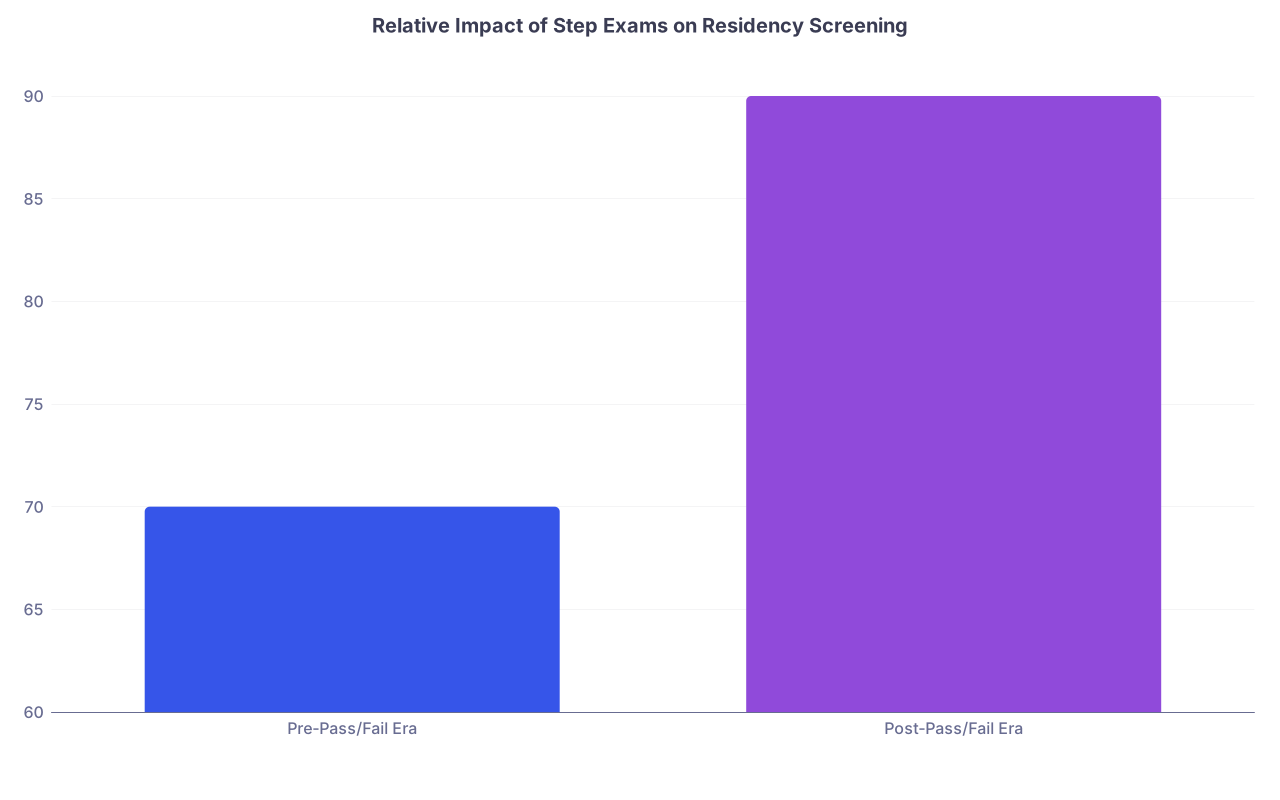
Wrong order. With Step 1 pass/fail, Step 2 quietly became the high-stakes exam.
| Category | Value |
|---|---|
| Pre-Pass/Fail Era | 70 |
| Post-Pass/Fail Era | 90 |
What changed:
- Before: Programs filtered heavily on Step 1 score, then used Step 2 as secondary data.
- Now: Step 2 is often the first and sometimes only hard number they trust.
- Step 2 scores are used to separate “strong” from “average” applicants in a way Step 1 no longer can.
The mistake: treating Step 2 like the second MCAT.
The reality: for many of you, Step 2 is now your primary numerical impression.
I have watched students relax after a Step 1 pass, then wake up halfway through M3 realizing that their Step 2 CK is the only thing standing between them and “Sorry, we did not invite you to interview.”
Do not assume:
- That program directors will “understand” your clinical schedule.
- That away rotations or a “great fit” will compensate for a mediocre Step 2.
- That being at a big-name medical school automatically softens a low Step 2.
Residency selection is brutal math. Filters and cutoffs before anyone reads your personal statement. Step 2 is now integrated into that machinery, not floating off to the side.
Assumption #2: “I Already Know the Basics from Step 1”
Another quiet trap: thinking Step 2 is just Step 1 plus some management.
You hear:
“Same subjects, just more clinical. I already saw this in UWorld Step 1.”
So you relax. You skim. You “recognize” questions instead of truly working them.
Here is the problem: recognizing words is not the same as understanding decisions.
Step 1 trained you to:
- Identify mechanisms
- Link symptoms to pathophysiology
- Choose diagnoses
Step 2 expects you to:
- Prioritize next steps
- Distinguish reasonable vs best management
- Balance diagnostics, treatment, and patient safety
Those are not the same skills.
I see students fall into these specific traps all the time:
- They treat every question like a diagnosis question, even when the answer is actually “start empiric treatment now” or “observe and follow up.”
- They cling to Step 1-style memorization (e.g., lists of bugs or drugs) instead of learning actual algorithms.
- They misinterpret normal variation as pathology because that is how Step 1 trained them.
On Step 1, you needed to know “what is this?”
On Step 2, you need to know “what do I do right now?”
If you keep thinking like a Step 1 test-taker, you will miss the Step 2 logic and lose points you should not lose.
Assumption #3: “My Clinical Rotations Will Prepare Me Automatically”
This one sounds reasonable. It is still false.
“Third year is all clinical. Step 2 is a clinical exam. I am literally preparing every day.”
I have heard that exact sentence. From people who then scored 20–30 points below their Step 1 level.
Clinical work and exam work overlap, but not enough. The gaps are predictable:
- Clinical life: fragmented, patient-specific, driven by what walks in the door.
- Step 2 CK: pattern-based, guideline-driven, requires coverage of topics you will never see on your rotations.
You will not see everything, but Step 2 will test as if you did.
Here is how students get burned:
- They let attending preferences override guidelines (“my attending always orders CT first”). The exam does not care what your attending does.
- They never solidify “standard of care” across rotations. So their mental model becomes a patchwork of idiosyncrasies, half-remembered orders, and Epic presets.
- They assume being “good on the wards” equals “good at standardized exams.” Two different games.
You need to translate clinical experiences into exam-based reasoning. That means:
- After each interesting case, explicitly ask yourself: “What would they ask about this on Step 2?” Differential, next step, best initial test, red flag to admit, etc.
- Checking what UpToDate or guideline summaries say, not just what your senior likes.
- Relating what happens in the hospital back to your question bank learning, not hoping that repetition on rounds equals mastery.
Clinical exposure is raw material. Step 2 requires processed, organized, exam-structured knowledge. Do not confuse the two.
Assumption #4: “If I Did Well on UWorld for Step 1, I Know How to Study”
You probably used some combination of:
- UWorld Step 1
- First Aid / Boards & Beyond / Sketchy / Pathoma
- Anki
You survived. So you assume you already have “your system.”
Then the third-year reality hits: 5 a.m. pre-rounding, notes, floor work, signout, a random pimp session on ARDS, and you stumble home at 7 p.m. and try to do 40–80 UWorld questions while half-conscious.
Your old system collapses. And instead of redesigning it, you pretend it still works.

The big mistake is assuming past success equals current compatibility.
Step 2 studying needs to account for:
- Cognitive fatigue after 8–12 hours on the wards.
- Non-negotiable clinical responsibilities.
- Rotations that may not align with your testing schedule at all.
You cannot just “do UWorld after work” for every rotation without adjustments in:
- Question volume
- Review depth
- Rest and sleep
The pattern I see:
- Students overshoot daily question goals early in a rotation to feel “on track.”
- They burn out halfway through, fall behind on their question bank, and start doing questions without reviewing them properly.
- By the time their dedicated period starts, they are rushed, guilty, and already mentally fried.
You do not need a beautiful, color-coded master plan. You do need a realistic one.
If your plan requires you to be a machine, it is a bad plan. Machines do not fall asleep on the bus after night float. You might.
Assumption #5: “Dedicated Study Time Will Fix Everything”
The fantasy:
“I will make up for a chaotic third year with a strong dedicated block. I always clutch in the end.”
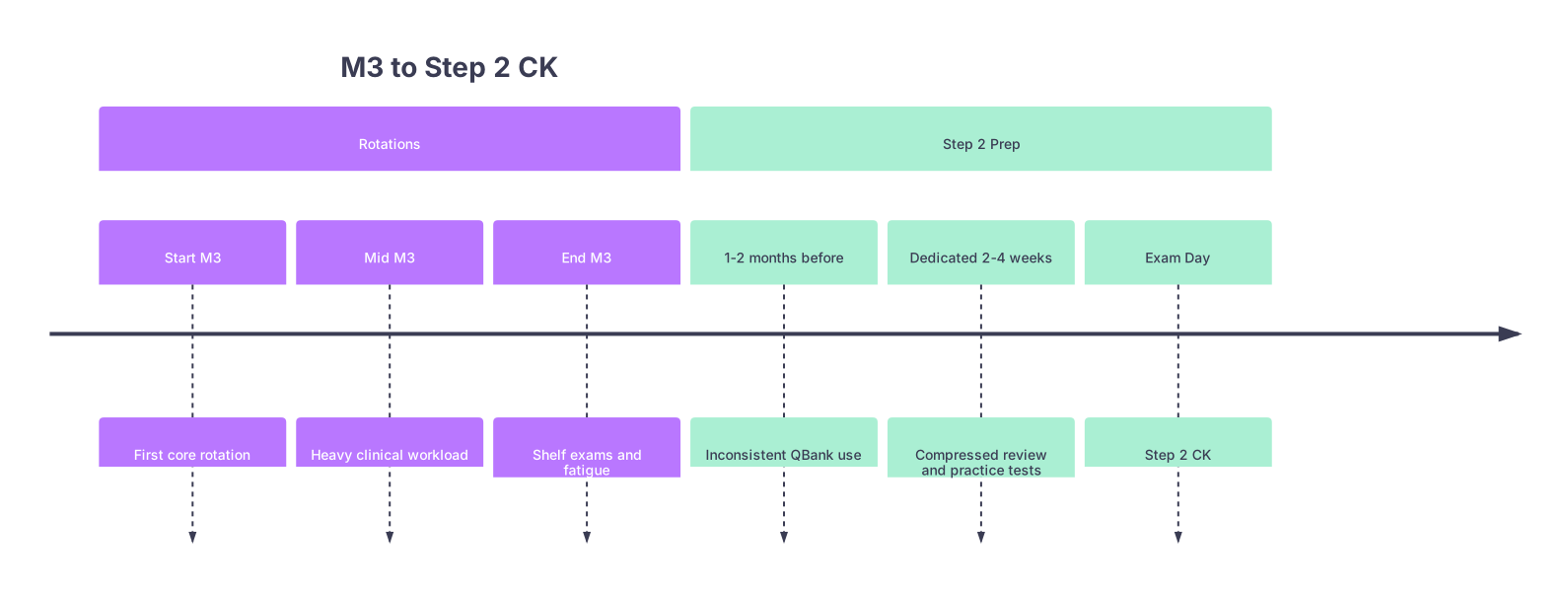
The reality: a lot of schools are shrinking Step 2 dedicated time. Two to four weeks. Some less. And that time is often packed with:
- Required checkouts
- OSCEs
- Moving, travel, or life logistics
- Fatigue you have accumulated for a year
| Period | Event |
|---|---|
| Rotations - Start M3 | First core rotation |
| Rotations - Mid M3 | Heavy clinical workload |
| Rotations - End M3 | Shelf exams and fatigue |
| Step 2 Prep - 1-2 months before | Inconsistent QBank use |
| Step 2 Prep - Dedicated 2-4 weeks | Compressed review and practice tests |
| Step 2 Prep - Exam Day | Step 2 CK |
If your entire Step 2 plan is basically: “Do whatever during the year, crush it during dedicated,” you are setting yourself up for:
- Panic when you realize your QBank completion is at 40–60%.
- Superficial cramming of weak areas you should have addressed over months.
- A false sense of security from short-term score bumps on NBMEs that do not reflect true retention.
Dedicated should refine and sharpen, not reconstruct from rubble.
I have seen students spend 10 months drifting, then pretend 3 weeks of heroics can magically fix that. Sometimes they get lucky. Often they do not.
Do not outsource your future specialty to a Hail Mary “dedicated” phase.
Assumption #6: “A Lower Step 2 Than Step 1 Is Fine If I Passed Both”
This is where people get blindsided.
They think: “As long as I do not bomb Step 2, it will be okay.”
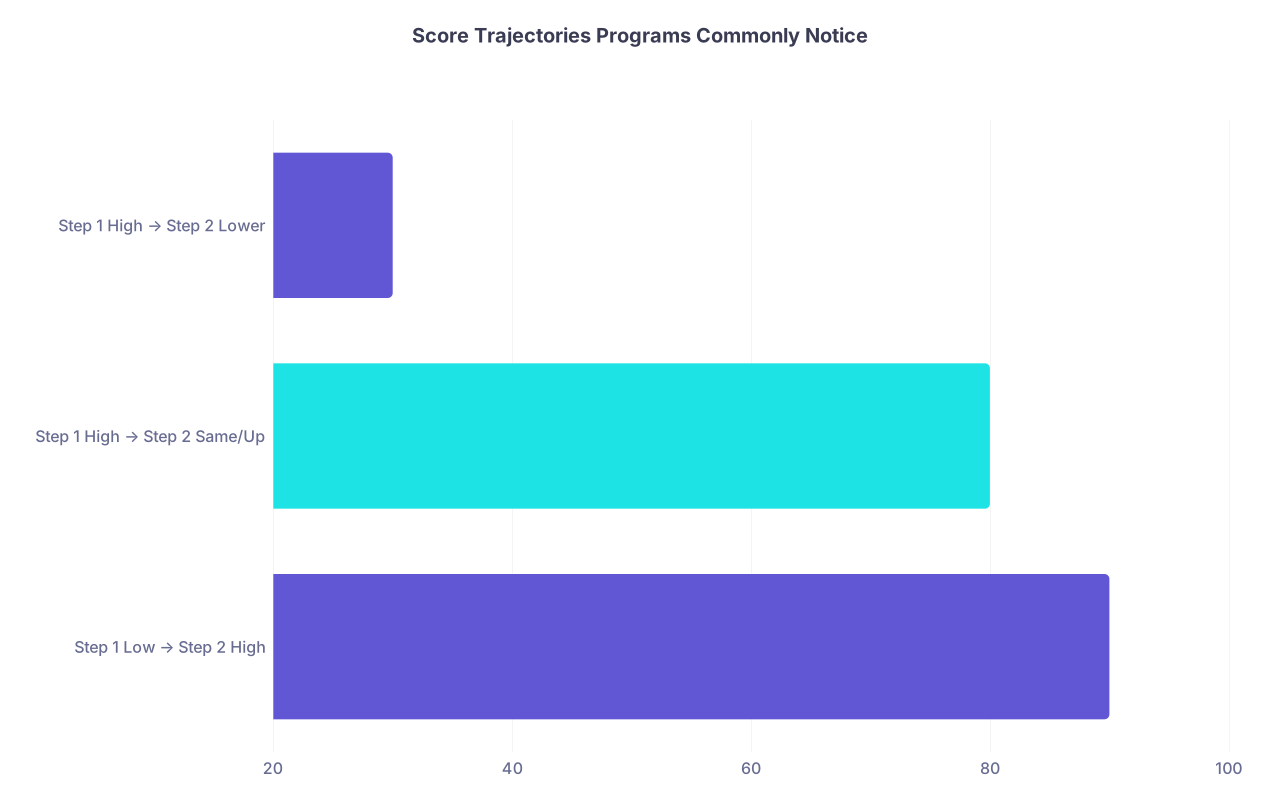
They ignore that programs still compare Step 1 and Step 2 trajectories.
| Category | Value |
|---|---|
| Step 1 Low → Step 2 High | 90 |
| Step 1 High → Step 2 Same/Up | 80 |
| Step 1 High → Step 2 Lower | 30 |
Patterns program directors like:
- Modest Step 1 → strong Step 2: “This student is improving.”
- Strong Step 1 → equal or stronger Step 2: “Consistent high performer.”
Pattern that raises eyebrows:
- Strong Step 1 → significantly weaker Step 2: “Was there an issue? Burnout? Ceiling? Motivation?”
No, one small dip will not kill your career. But pretending it never matters is naive.
Ask people in competitive specialties (derm, ortho, plastics, ENT, ophtho, rad onc). Many will tell you bluntly:
“A Step 2 weaker than Step 1 does not help you. At all.”
Your goal is not perfection. Your goal is to not create a narrative you then have to explain away in every interview. A large Step 2 drop after a strong Step 1 forces that conversation.
Assumption #7: “I Will ‘Figure Out’ Test-Taking Strategy Later”
This is the quiet killer for good-but-not-great test-takers.
They believe:
- Their content gaps are the main problem.
- Strategy is optional seasoning, not a core ingredient.
- They can iron out timing and stamina “later.”
So they:
- Do full blocks without simulating real test conditions.
- Review content but ignore why they fall for distractors.
- Never track patterns of error (premature closure, misreading, overthinking rare diagnoses, etc.).
By the time dedicated hits, bad habits are cemented.

I have looked at review notes from dozens of students. The pattern is consistent:
- Pages of fact regurgitation from explanations.
- Almost nothing documenting cognitive errors.
- Zero structure around changing behavior.
You are not just studying medicine. You are studying how you think under pressure.
Ignore that, and you become the student who “knows everything” but cannot get past 230. And then blames the exam for being “tricky.”
It is not tricky. It just punishes unexamined habits.
Assumption #8: “One Resource Will Be Enough”
Another comforting but dangerous idea:
“I will just do UWorld and I am done. Everyone says it is all you need.”
UWorld is excellent. It is also not magic.
I have seen students do UWorld twice and still miss core concepts because:
- They memorized answers instead of learning thinking patterns.
- They never supplemented with structure (e.g., a concise review resource).
- They could not recall information outside the specific wording of UWorld stems.
You do not need ten resources. But you probably need more than one.
For most students, a minimal but sane structure looks like:
| Component | Resource Example |
|---|---|
| Primary QBank | UWorld (full pass) |
| Secondary QBank | Amboss / OnlineMedEd Qs |
| Content Review | OnlineMedEd / BTK / Anki |
| Assessment | NBME forms + UWSA |
The mistake is not “using too few” or “too many” resources in some abstract sense.
The mistake is using your primary QBank in isolation, without any structured review to tie everything together.
If you finish UWorld and still cannot explain heart failure management stepwise, something is wrong with how you are studying, not with UWorld.
Assumption #9: “Everyone Struggles in Third Year; I’m Still On Track”
Yes, third year is hard. Yes, everyone is tired. But “everyone is struggling” becomes a shield people hide behind to excuse falling standards in their own preparation.
You hear classmates say:
- “I am behind on UWorld too.”
- “No one is really studying seriously right now.”
- “We will grind during dedicated.”
You use that to justify your own drift.
But you have no idea what they are doing when they get home. Or on weekends. Or during lighter rotations. The most disciplined students are often quiet about it.
I have watched this happen:
- One student says, “I have barely done any questions.”
- Another chimes in, “Same.”
- One of them quietly goes home and does 40 every night. The other believes the group narrative and does 0–10.
Guess which one breaks 250.
Peer normalization of being “behind” is socially comforting. And academically dangerous.
Treat other people’s “I’m not studying” comments as unverified data. Not as a safety net.
Assumption #10: “As Long As I Pass, I Can Fix Things With Research or Aways”
This is the last refuge: believing that a mediocre Step 2 can always be patched with CV fluff or personality.
Reality check:
- For many programs, Step 2 is a hard filter. You do not get to the part where your research matters if your score is below a certain line.
- Aways can absolutely help, but they rarely override a glaring test performance drop, especially in highly competitive specialties.
You also underestimate how programs interpret your priorities.
If you somehow had time for substantial research but “not enough time” to study properly for Step 2, the message is not great.
You are not applying to a PhD. You are applying to treat patients safely. Step 2 is designed to measure that.
Use research and aways to enhance a solid foundation. Not to patch avoidable cracks.
What To Do Instead: A Saner, Less Delusional Approach
You do not need to become a Step 2 monk. You just need to stop lying to yourself with these comforting assumptions.
Here is a more honest framework:
- Accept that Step 2 is now the central standardized metric. Treat it accordingly.
- Use rotations as context, not as your only “studying.” Turn cases into exam questions in your mind.
- Build a realistic QBank plan that matches your rotation intensity. Adjust volume, not standards.
- During every question review, ask: “What was my thinking error?” Not just “What fact did I miss?”
- Protect a few non-negotiable habits: timed blocks, full-length practice tests, and at least one comprehensive content resource.
You can still have days where you do almost nothing. That is normal. The danger is confusing “I am tired” with “I cannot afford to take Step 2 seriously.”
Final Takeaways
Three things I want you to remember:
- Passing Step 1 does not mean Step 2 will “take care of itself.” Different exam, higher stakes, worse schedule.
- Clinical rotations do not automatically prepare you. You must actively convert experiences into exam-ready knowledge and algorithms.
- “I will fix it in dedicated” is the lie that ruins strong applicants. Build steadily now so dedicated is sharpening, not emergency reconstruction.
Do not let a comfortable story about Step 2 difficulty cost you options you have not even seen yet.


