
The way most people try to prep for Step 3 while switching programs is completely wrong—and that’s why they burn out or barely pass.
You’re not just “taking another test.” You’re juggling new EMR, new attendings, new expectations, maybe a whole new city… and somewhere in there you’re supposed to care about CCS cases and ambulatory management algorithms. If you treat Step 3 like some side project you’ll “fit in when things calm down,” you’re going to get crushed. Things do not calm down.
Here is how to handle Step 3 prep specifically when you’re transitioning programs—changing specialties, starting residency, transferring, or doing a prelim-to-categorical jump.
1. Get Honest About Your Exact Transition Situation
You can’t copy someone else’s study plan. Your transition details define what’s realistic.
Let me break down the common scenarios I see:
| Scenario | Step 3 Risk Level |
|---|---|
| Prelim → Categorical switch | High |
| Switching specialties (e.g., Surgery → FM) | High |
| IMG starting first U.S. residency | High |
| Categorical PGY-1 staying same program | Moderate |
| In-between programs with a gap month | Lower |
If you’re in a high-risk category, you do not have the luxury of “winging it.” Programs sometimes watch Step 3 more closely for:
- IMGs (they want proof you can clear all exams)
- People transferring or switching specialties
- Residents who scraped by on Step 1/2 or barely passed COMLEX levels
You need to answer three questions for yourself in writing today:
What is my hard deadline?
Not “sometime intern year.” I mean the actual date before which your new program wants Step 3 done (or when you need it for licensing/visas). Email GME if you are not sure.What is my realistic weekly availability in the first 2–3 months of the new program?
Not fantasy hours. Real ones. On ICU months you may be able to do 20 questions a day, max. On elective, you might hit 60–80 plus some CCS.What’s my baseline risk?
- Step 1/Level 1: barely passed, average, or strong?
- Step 2/Level 2: improved, same, or worse?
- Time away from exams: more than 18–24 months since last major board?
If your answers look rough (low scores, long gap, high-risk program), you plan defensively: more lead time, firmer schedule, less procrastination.
2. Use the Short “In-Between” Window Better Than Everyone Else
The real leverage point isn’t during 80-hour weeks. It’s before you fully hit that schedule.
You probably have one of these:
- 2–4 weeks after graduation before residency starts
- A gap between prelim and categorical
- A lighter orientation month with more classroom than call
This period is gold. Most people waste it sleeping, traveling, and “settling in,” then regret it badly in September.
Here’s what you should actually do with that time.
A. Front-load your Step 3 foundation
Your goal in this period is not to memorize minutiae. Your goal is to:
- Select and set up one main Qbank
- Start and mostly finish CCS practice setup
- Refresh core medicine and ambulatory management
If you’ve got 3–4 weeks fairly open, a solid structure is:
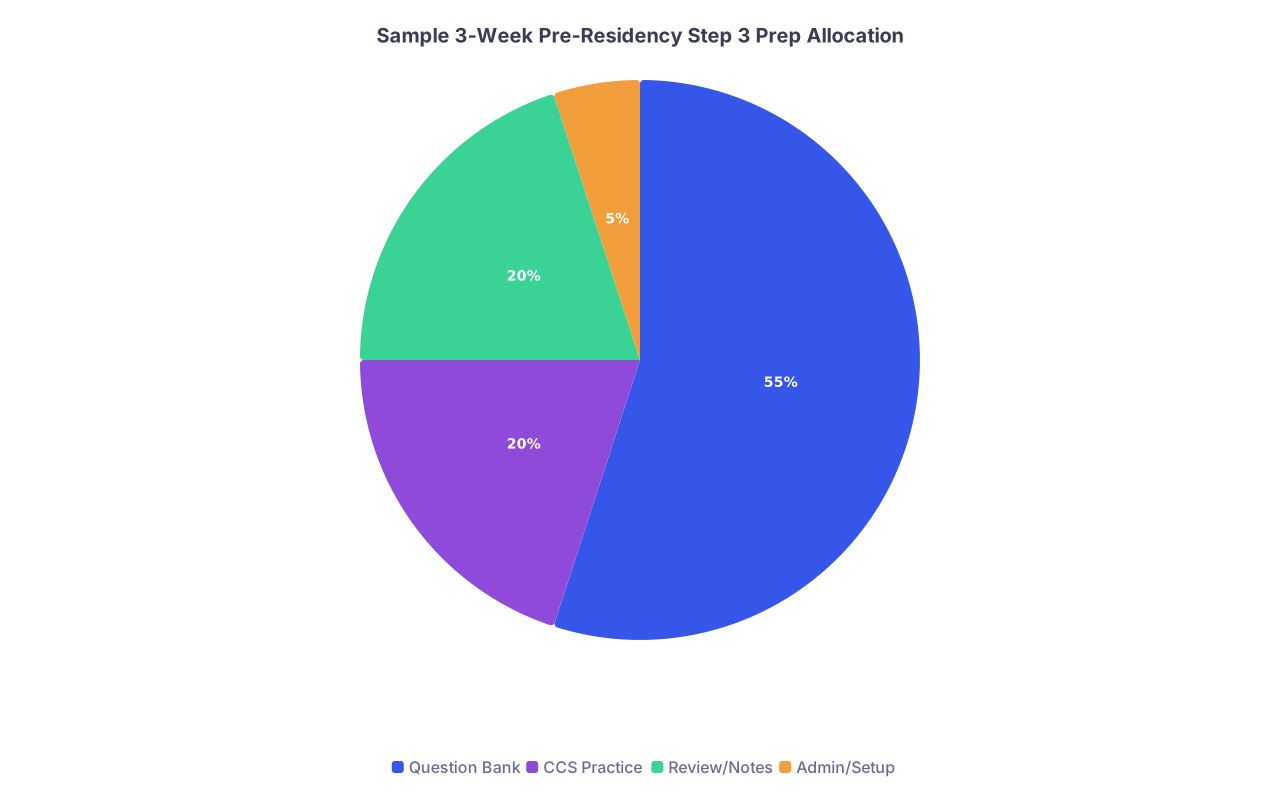
| Category | Value |
|---|---|
| Question Bank | 55 |
| CCS Practice | 20 |
| Review/Notes | 20 |
| Admin/Setup | 5 |
Translation into actual work:
- 40–60 mixed Qs/day (timed, random)
- 1–2 CCS cases/day (even if you feel clueless at first)
- Brief review of wrongs (not 45 min per question—stop doing that)
You’re not aiming for mastery. You’re aiming to remove the “I have no idea what Step 3 looks like” fog before life gets chaotic.
B. Fix the logistics early
If you wait to schedule your test until residency starts, you’ll compete with everyone else and end up with awful dates. During this pre-transition window:
- Register for Step 3
- Block off a 2-day exam window that:
- Does not land in your ICU month
- Does not land in your first month at a new program
- Ideally falls during or right after an elective block
If you’re switching programs (prelim → categorical), coordinate with both programs about any time-off constraints. Get it in writing if they promise you “study days” or “no call before Step 3.”
3. Design a Plan That Survives Real Intern/Transition Life
Most Step 3 plans fail because they’re built for an imaginary person who lives in UpToDate and sleeps 8 hours every night.
You are going to be:
- Getting paged about nonsense at 2 am
- Learning new workflows and EMR paths
- Struggling to figure out which attending expects what
- Possibly dealing with move logistics, visas, or credentialing issues
Your study plan must be modular and resilient, not “perfect.”
A. Think in “floors” and “ceilings”
You need two numbers:
- Floor = minimum number of questions you’ll do on a bad day
- Ceiling = max you’ll push to on a good/easier day
For many interns:
- Floor: 10–15 questions/day
- Ceiling: 40–60 questions/day
If you promise yourself “I’ll do 60 Qs every day,” you’ll quit by week 2. Instead, commit to:
- Non-negotiable: floor every day (even post-call, even tired, even pissed off)
- Stretch: hit ceiling 3–4 days a week on lighter days
This is how actual residents pass Step 3 while surviving call.
B. Build around rotations, not weeks
Look at your first 4–6 months schedule:
- ICU / Night Float / ED: treat as maintenance periods
- Wards: moderate productivity
- Elective / Clinic: heavy push
Create something like this:
| Rotation Type | Questions/Day Target | CCS Focus |
|---|---|---|
| ICU/Nights | 10–20 | 0–1 case/week |
| Busy Wards | 20–30 | 1 case/week |
| ED | 20–30 | 1–2 cases/week |
| Elective/Clinic | 40–60 | 3–4 cases/week |
Tape this to your wall, or better, put it in your phone calendar as recurring reminders.
C. Pick the right time slots
You have three realistic windows:
- Before work (early morning) – best for people who crash hard after sign-out
- After work but before dinner – best if your commute is short
- Mid-day downtime – happens on some electives/clinic days, almost never on ICU
I’ve watched this play out for years: the residents who reliably get through a Qbank are those who pick one primary study window and protect it like an OR case. If you’re “fitting it in whenever,” you’ll slip.
Choose:
- “20 questions with coffee before leaving for work”
or - “Block 45 minutes right after I get home before touching my phone/TV”
Stick with it for 3–4 weeks, then adjust.
4. CCS: Do Not Ignore It Just Because It’s Annoying
Everyone hates CCS at first. The interface looks like it was coded in 2003 (because it was). But in a transition year, CCS can actually work in your favor.
Why? Because you’re already in “systems learning” mode—figuring out consults, orders, workflows. CCS is just a simulated version of that.
A. Minimum CCS plan that actually works
You do not need to do 100+ CCS cases. You do need to:
- Learn the interface cold (time management, ordering, advancing time)
- See enough core scenarios that you’re not guessing: chest pain, SOB, abdominal pain, prenatal care, pediatric fever, DKA, sepsis, well visits, etc.
Realistic target:
- 25–40 total CCS cases
- Spread over 4–8 weeks
- Clustered when you’re on electives, not ICU
During a heavy month:
- 1 CCS case on your golden weekend = enough
During a lighter month:
- 3 cases spread over the week
B. Leverage your rotations
On wards, when your attending asks, “What’s the next step in management?” that is literally a CCS moment.
Start mentally translating daily cases into CCS flow:
- Admit → stabilize → initial orders → monitoring → consults → discharge planning
You’ll internalize patterns. That matters more than some 8-page CCS writeup.
5. If You’re Changing Specialties or Programs Midstream
This is a special kind of chaos.
Typical scenario:
You did a prelim surgical year, realized you hate the OR, and are starting a PGY-1 in medicine or FM. Or you’re transferring from one IM program to another because of geography or fit.
In these cases, Step 3 can feel like either:
- A chance to “prove yourself,” or
- One more thing weighing you down when you’re already stressed about being the new person again
Here’s how to handle it sanely.
A. Decide: prove-yourself strategy vs. survival strategy
If your prior exams or evals look shaky and your new program took you as a bit of a risk, Step 3 matters more. A strong score won’t erase everything, but a pass with cushion helps reassure them.
Survival strategy:
- Goal: solid pass, not a hero score
- Emphasis: one Qbank + enough CCS to be comfortable
- Timeline: schedule the test within first 6–9 months, aiming away from hardest rotations
Prove-yourself strategy:
- Goal: score well above passing (e.g., 220–230+ range if U.S. MD/DO)
- Emphasis: complete Qbank, targeted review of weak areas, a few NBMEs or practice exams if available
- Timeline: still early, but allow 2–3 months of consistent prep (does not mean “no life,” it means less Netflix)
If you’re exhausted and burned out, do not chase a vanity score. Survive and pass. Burnout plus test failure is far worse than “average but done.”
B. Use your prior year smartly
If your prelim year gave you strong inpatient exposure but weak outpatient, your Step 3 focus must compensate:
- Double down on ambulatory: HTN, DM, lipids, contraception, cancer screening, depression, chronic pain
- Pediatric and OB outpatient tend to be weak spots for surgically-focused prelims
Flip side: if you did a transitional year heavy on clinic and EM, you probably need to tighten inpatient algorithms: sepsis, acute coronary syndrome, stroke, GI bleed, COPD/asthma exacerbations, DKA/HHS.
You should literally sit down and write:
- “Comfortable with: X”
- “Shaky on: Y”
Then build your Qbank filters and extra review around Y, not the stuff that makes you feel good.
6. Manage Energy, Not Just Time
The part no one talks about: you’ll be more tired and emotionally drained during a transition than you expect. New systems, new social dynamics, imposter syndrome—all of it steals energy.
If you try to study like a full-time student again, you will fail.
A. Create a “low-brain” study mode
On days when you’re toast, do not open dense videos or 50-case CCS blocks. Have a backup plan:
- 10–15 “untimed, tutor mode” questions with fast review
- Re-doing only prior incorrects
- Light reading of brief Step 3-specific notes or summaries
- CCS interface practice with no pressure on content
This way, you preserve the habit of “I touch Step 3 every day” without requiring peak performance.
B. Protect sleep the week before your test
The week before Step 3 is not the time to suddenly become a study machine. The worst combo I see: new program, call-heavy month, and then someone decides to cram for Step 3 on 4 hours of sleep.
If your schedule is brutal before your test dates, do this:
- Two weeks before: finish heavy new learning
- One week before: shift to review and light Qs, not 100-question marathons
- Last 3–4 days: focus on sleep, familiar routines, maybe cut Q count in half
If you can swap calls or rearrange shifts, do it early. Program coordinators are much more flexible one month ahead than they are three days before.
7. What to Do If You’re Behind or Failing Qbank Blocks
You will probably hit a wall at some point. New job, life chaos, and then you realize: “I’m halfway to my exam date and only 30% through the Qbank, scores mediocre.” That’s common. Not fatal.
Here’s your triage plan.

| Step | Description |
|---|---|
| Step 1 | Realize behind or low scores |
| Step 2 | Adjust schedule, increase daily Qs |
| Step 3 | Focus on weak areas + CCS |
| Step 4 | Strongly consider postponing |
| Step 5 | Email GME/program about new date |
| Step 6 | Exam > 6 weeks away? |
| Step 7 | Completed at least 50% Qbank? |
If exam is >6 weeks away and you’re behind:
- Increase daily floor by 10–15 questions
- Use commute or lunch for 5–10 Qs
- Stop perfectionism with review—2–3 minutes max per question
If exam is <6 weeks away and:
- Qbank <50% complete
- And scores are barely above passing or worse
Be adult enough to consider rescheduling. Step 3 failure during a program transition is a real problem: it stresses your program, triggers extra oversight, and kills your own confidence.
Rescheduling once to avoid a failure is not weakness. It’s good strategy. Just do not keep punting it forever.
8. Tools and Tactics That Actually Help (and Which to Skip)
People transitioning between programs love to hoard resources. It feels safer. It is not.
Pick:
- 1 main Qbank
- 1 CCS resource (if not already built into Qbank)
- Optional: 1 set of concise Step 3 notes or short review text
That’s it.
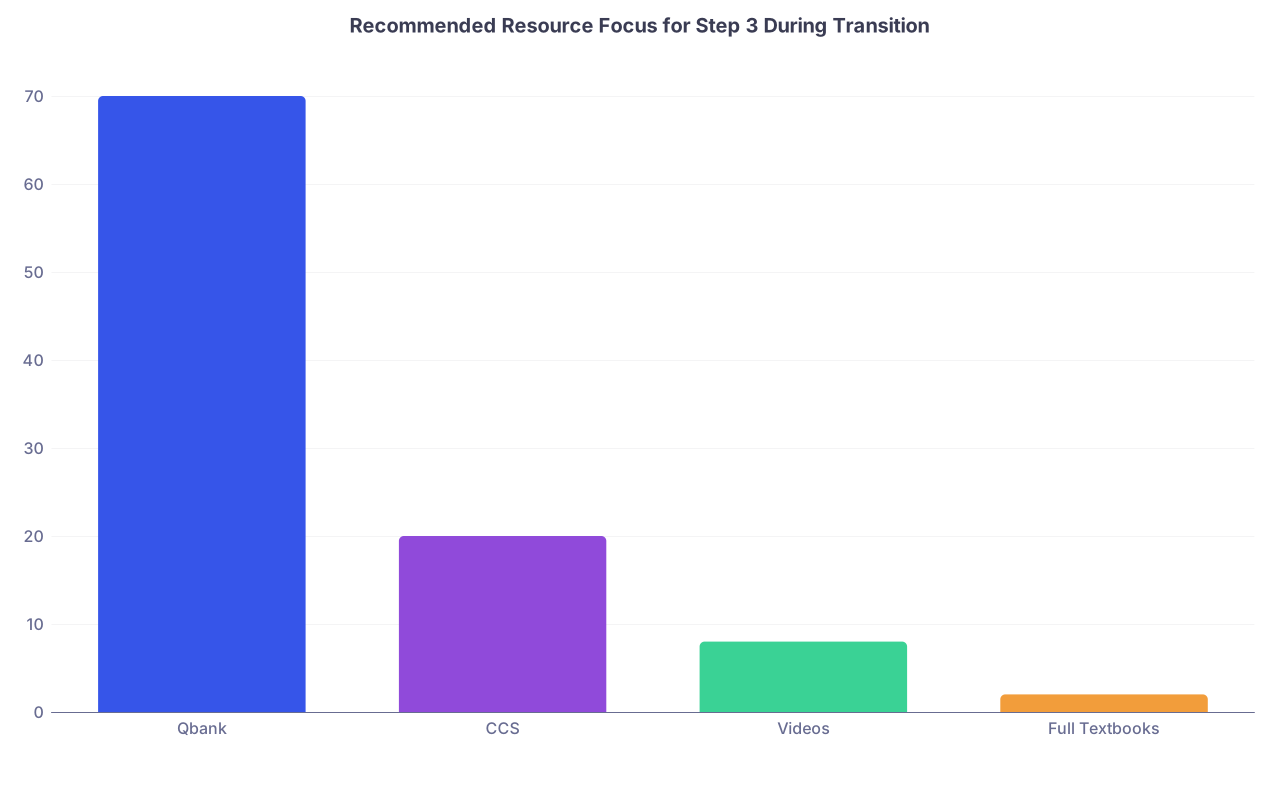
| Category | Value |
|---|---|
| Qbank | 70 |
| CCS | 20 |
| Videos | 8 |
| Full Textbooks | 2 |
Skip:
- Multiple full Qbanks “for extra security”
- Long-winded video lecture series unless you have a very long gap before residency
- Giant internal medicine textbooks “just to shore up knowledge”
You don’t have that kind of bandwidth. You need targeted, test-specific work.
One trick that works well in a transition year:
On new rotations, build a mini “Step 3 list” of topics that keep coming up—like syncope workup, anticoagulation around procedures, COPD outpatient meds. Search those in your Qbank and do targeted sets.
You’re already learning them for real patients. Lock them in for the exam at the same time.
9. If You’re an IMG or Been Away From Exams for a While
If you’re an IMG starting your first U.S. residency, or someone who had a “gap” before residency/Step 3, you’re in a different boat.
You may feel rusty. The language, guidelines, and style of questions can feel foreign again. That’s fixable but requires more patience early on.
Specific moves:
- Start prep earlier than your U.S. MD/DO peers if possible (2–3 months instead of “I’ll start next month”)
- Do more questions in tutor mode initially to recalibrate to style and pace
- Force yourself to read the explanations for correct answers too—the distractors often teach the style of traps used on Step 3
If you’ve been away from high-stakes exams for >2 years, you’ll likely need more volume but not more different resources. Stick to one Qbank and hit it consistently rather than hopping around.
Final Tight Summary
Three points and we’re done:
- Build your Step 3 plan around your actual transition reality—deadlines, rotation types, and energy levels—not around some fantasy of endless free time.
- Commit to a realistic daily “floor” of questions plus a rotation-based intensity plan, and protect one primary study window each day like it’s non-negotiable.
- Do enough CCS and targeted Qbank work to pass comfortably, not perfectly, and if your timing and scores are clearly off, reschedule once rather than walking into a likely failure during an already stressful program transition.