
Most residency applicants waste their first 30 seconds on fluff—and pay for it all day.
You do not have unlimited time on Zoom. Faculty are busy, distracted, and already half-deciding about you in the opening minute. That 30‑second introduction is not small talk. It is your frame. If you do not control it, they will.
Let me break this down very specifically: what to say, how to say it, and what absolutely ruins it.
Why Your 30-Second Intro Matters More Than You Think
I have watched faculty during virtual interview days. Here is the uncomfortable truth: many of them decide “probably rank high / mid / low” in the first 1–2 minutes, then spend the rest of the time subconsciously looking for confirmation.
Your intro does three jobs fast:
- Establishes who you are in one line.
- Signals whether you fit the specialty and program.
- Gives them 1–2 hooks they can use to build the conversation.
If your intro is: “Hi, I’m Sarah, 4th year at X, interested in internal medicine, thanks for having me,” you have given them nothing. They will fall back on generic questions and your interview will blur with 30 others.
If your intro is sharp, specific, and aligned with their program, you make their job easier and your life better.
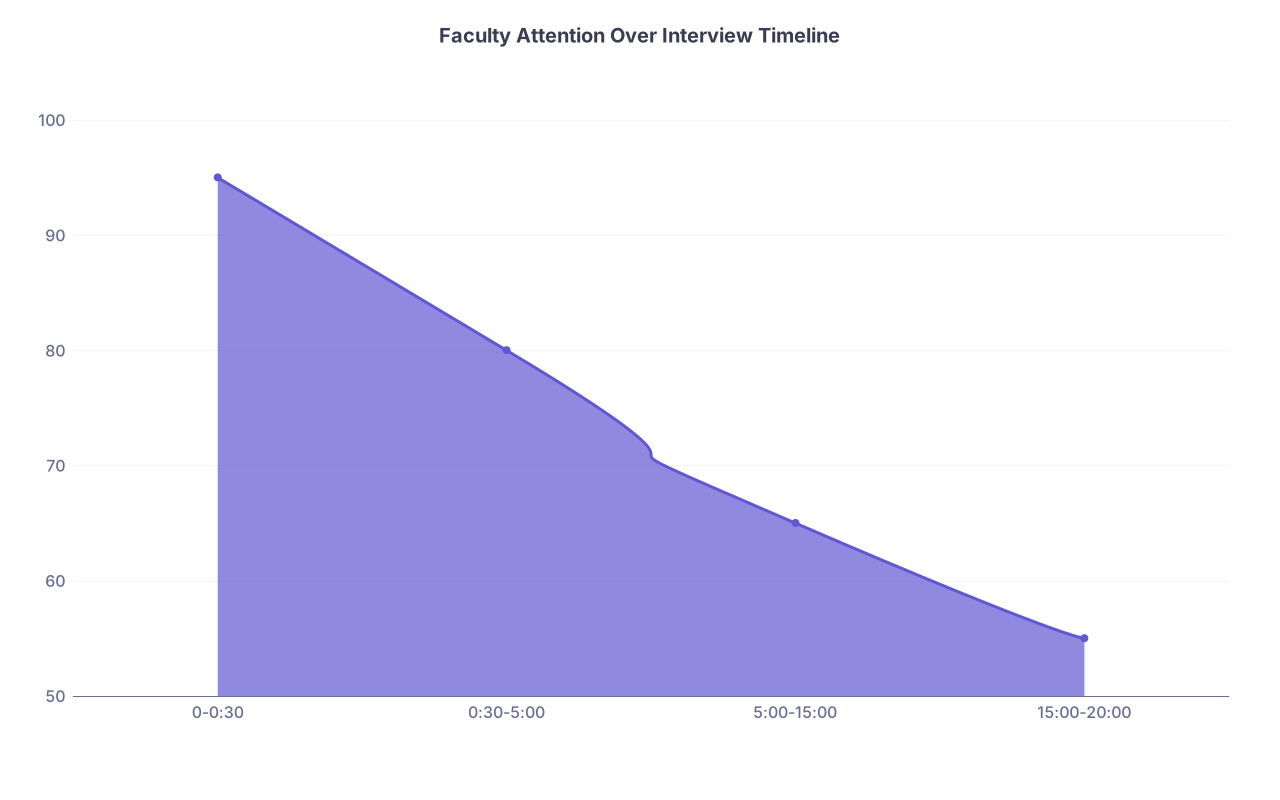
| Category | Value |
|---|---|
| 0-0:30 | 95 |
| 0:30-5:00 | 80 |
| 5:00-15:00 | 65 |
| 15:00-20:00 | 55 |
Most engagement is frontloaded. Use it.
The Exact Structure Of A High-Impact 30-Second Intro
You have roughly 75–90 words. That is it. So you need a formula.
I use a 4-part structure:
- Identity line (who you are, where you are, what you are applying for)
- Thematic focus (your “angle” within the specialty)
- Evidence snapshot (1–2 concrete things that back up that focus)
- Forward link (why this program / what you are excited to discuss)
Think of it as a compressed personal statement, not a roll call.
1. Identity Line: Clean, Not Boring
You want one sentence that orients them, without wasting syllables.
Bad:
- “Hello, my name is John Smith, and first of all I just want to say thank you so much for giving me this opportunity to interview with your program today.”
That is 27 words of nothing.
Better:
- “I am John Smith, a fourth-year at Ohio State, applying into categorical internal medicine.”
Even tighter:
- “I am John Smith, MS4 at Ohio State, applying categorical IM.”
You do not need to thank them yet. You will do that at the end of the interview. Right now, use the space for information.
2. Thematic Focus: Your “Professional Headline”
This is where most people fail. They just re-state “I like your program because it’s strong clinically.” Everyone says that.
You need a one-line professional identity inside the specialty. Think of it like a targeted LinkedIn headline, not a personality tagline.
Examples by specialty:
Internal Medicine:
“I am especially focused on complex inpatient medicine and medical education.”General Surgery:
“I am drawn to high-acuity general surgery with an emphasis on trauma and critical care.”Pediatrics:
“My main interest is in community pediatrics and longitudinal care for underserved kids.”Psychiatry:
“My focus is integrated care, especially where psychiatry intersects with primary care and addiction medicine.”
The theme must be:
- Specific enough that it is memorable.
- Broad enough that you are not boxing yourself into a single fellowship on day one.
- Relevant to the program’s strengths (this is where reading their website actually matters).
3. Evidence Snapshot: 1–2 Concrete Proof Points
This is where your theme stops being talk and becomes believable.
You get one short sentence, maybe two, to back it up. Numbers and named roles help.
Examples, building on the themes above:
Internal Medicine:
- “On our wards I have gravitated to the ICUs, and I co-led our student-run physical diagnosis course for the M2s.”
Surgery:
- “I have spent the last year doing outcomes research in trauma surgery and regularly assist in the trauma OR on call nights.”
Pediatrics:
- “I have worked with our mobile clinic in rural counties for three years, focusing on asthma management and preventive visits.”
Psychiatry:
- “I coordinate a collaborative care project between our student-run clinic and the county mental health services, mostly around substance use disorders.”
Each of these does three things:
- Shows longitudinal involvement.
- Ties directly to the theme.
- Gives faculty something specific to ask about.
4. Forward Link: Why This Program / What You Want To Explore
You do not need a full “why this program” speech in the intro. Just a bridge that says: here is why this conversation makes sense.
Examples:
- “I am excited to learn more about how residents here are involved in running the ICU teaching service.”
- “I would love to talk about how your program supports residents interested in trauma and critical care.”
- “I am especially interested in how your continuity clinic is structured for underserved populations.”
- “I am looking forward to hearing how residents here work across psychiatry and primary care settings.”
Short. Program-aligned. Not obviously copy‑pasted to every program if they all heard the same thing on your pre-interview dinner.
Putting It Together: Concrete 30-Second Templates
Let me give you specialty-specific versions. These are not scripts to memorize word for word, but you want this level of density and clarity.
Example – Internal Medicine
“I am Priya Nair, a fourth-year at the University of Michigan, applying categorical internal medicine. I am especially drawn to complex inpatient medicine and teaching. Over the past two years, I have served as a sub-I on our cardiology step-down unit and co-directed our M2 clinical reasoning course. I am excited to learn more about how residents here are involved in the teaching service and the ICU.”
That is 61 words. Clean, specific, and opens multiple doors: complex inpatients, teaching, cardiology, ICU.
Example – General Surgery
“I am Daniel Ruiz, an MS4 at UT Southwestern, applying general surgery. My main interest is high-acuity emergency and trauma surgery. I spent a dedicated research year on our trauma outcomes team and routinely first-assist on overnight trauma cases. I am looking forward to hearing how your residents get exposure to trauma early and how they are involved in critical care.”
You can hear the attending in trauma or SICU thinking, “Okay, this one is my type.”
Example – Pediatrics
“I am Emily Chen, a fourth-year at Boston University, applying pediatrics. I am focused on community pediatrics and longitudinal care for underserved kids. I have worked with our mobile clinic in rural Massachusetts for three years, and my primary continuity site is a federally qualified health center. I would love to hear more about your community partnerships and how residents sustain those relationships over three years.”
Again: identity, theme, evidence, forward link.
Example – Psychiatry
“I am Marcus Allen, an MS4 at the University of Colorado, applying psychiatry. I am particularly interested in integrated care, where psychiatry overlaps with primary care and addiction. I coordinate a collaborative care project between our student-run clinic and the county mental health services, focused on substance use disorders. I am excited to learn how your residents work across inpatient, outpatient, and consult-liaison settings.”
Specific. Teachable. Very easy for the interviewer to pick one branch and go.
How To Adapt For Different Virtual Interview Contexts
You have not just one intro. You have variations.
There are three main scenarios you will see:
- Full interview, “Tell me about yourself” at the start.
- Brief breakout-room intros (e.g., pre-interview social, multi-applicant room).
- ACGME/ERAS virtual fair or open house style.
You need slightly different versions for each.

| Step | Description |
|---|---|
| Step 1 | Core 30s Intro |
| Step 2 | Formal Faculty Interview |
| Step 3 | Resident Social / Breakout |
| Step 4 | Virtual Open House |
| Step 5 | More Personal Detail |
| Step 6 | Program-Fit Emphasis |
1. Formal Faculty Interview
Use the full 4-part structure as above. You have space. They just asked “Tell me a little about yourself” or “Can you introduce yourself?”
Aim: 60–75 words, 25–30 seconds at a measured pace.
2. Resident Social / Group Room
Residents often start: “Let us just go around and introduce ourselves: name, school, and where you are from.”
Do not give a full polished speech here. You will sound like you are in an OSCE.
Use a lighter version:
- “I am Sarah Lee, fourth-year at UCSF, originally from Seattle. I am applying into internal medicine, mostly interested in primary care and medical education.”
That is it. You can drop the evidence and forward link. Save those for later questions like “what do you like to do outside of medicine?” or “what are you looking for in a program?”
If a resident asks, “Can you quickly introduce yourself and maybe say what you are looking for in a residency?” then you can add one short clause:
- “I am Sarah Lee, MS4 at UCSF, originally from Seattle, applying IM with an interest in primary care and medical education, and I am mostly looking for a program with strong continuity clinic and resident teaching opportunities.”
Still under 15 seconds. Fine for a group.
3. Virtual Open House / Fairs
Here faculty are scanning tons of people. Attention spans are even shorter. You want a stripped-down version that hits your theme and ask.
Example:
- “I am Jason Park, fourth-year at Emory, applying psychiatry with a focus on early psychosis and community mental health. I am curious how your program structures longitudinal community rotations for residents.”
Here the “forward link” becomes a question instead of “I am excited to learn more.” You are signaling you did your homework and you have a targeted interest.
Delivery: How You Say It On Camera Matters As Much As The Words
Content is half the equation. The other half is how your nervous system behaves once Zoom opens.
I have seen excellent intros torpedoed by:
- Lagging eye contact.
- Mumbled delivery.
- Monotone recital like an OSCE checklist.
Here is what you fix.
Camera Framing And Eye Contact
No one will take you seriously if only half your face is in frame or you are looking at a second monitor.
Basic, non-negotiable setup:
- Camera at or slightly above eye level (stack books under your laptop if needed).
- Head and upper shoulders visible; not just your forehead, not your whole torso.
- Eyes looking directly at the camera during your intro, not at your own video preview.
Do a dry run: record yourself on Zoom alone and play it back. If you would not want to talk to that person for 20 minutes, fix it.

Voice: Pace, Energy, And Emphasis
You have probably heard yourself on recording and cringed. That is normal. But you still need to train it.
Aim for:
- Pace: ~130–150 words per minute. If you are finishing your intro in 10 seconds, you are sprinting.
- Energy: 10–15 percent above your baseline conversational level. Virtual drains affect; you compensate with slightly more expressiveness.
- Emphasis: Hit your theme words and evidence with a hint of vocal weight. Not monotone.
Practice trick:
Record three versions of your intro:
- Normal.
- Deliberately too slow.
- Deliberately too animated.
The “correct” version for camera will feel like somewhere between 1 and 3 to you but will look like normal to others.
Facial Expression And Body Language
No one wants to see a frozen deadpan while you talk about how “excited” you are. Your face and words should not disagree.
Basics:
- Start with a small, genuine smile as you begin: neutrals soften with a slight upturn.
- Nod lightly once or twice as you introduce your theme or interests; it signals comfort.
- Do not fidget with pens, swivel chairs, or hair. If you do that habitually, remove the triggers: no pen in hand, lock your chair, tie hair back.
You do not need to be a TED speaker. You just need to look like someone your co-residents will not dread being on night float with.
Customizing Your Intro For Different Program Types
The content of your intro should flex slightly depending on the nature of the program: academic heavyweight vs. community-heavy vs. hybrid.
| Program Type | Emphasis In 30s Intro | Example Proof Point Type |
|---|---|---|
| Academic Tertiary | Research, teaching, complexity | Publications, QI, leadership |
| Community-Based | Continuity, service, patients | Clinics, free clinics, outreach |
| Hybrid | Balance of both | Combined research + service |
Academic Powerhouses
Think big academic centers: MGH, UCSF, Hopkins, Penn, Mayo.
Your theme should lean into:
- Complex care
- Research or scholarly work
- Teaching/education
Example:
“I am Alex Rivera, MS4 at Rutgers, applying internal medicine. I am especially interested in complex inpatient medicine and health services research. I completed a year of outcomes research in heart failure and serve as a peer tutor in our clinical reasoning course. I am excited to learn how residents here are integrated into the cardiology and outcomes research teams.”
You are signaling: I can handle the academic environment, I care about scholarship, I like complexity.
Community-Heavy Programs
Think strong community hospitals, safety-net systems, county hospitals not primarily research-driven.
Lean into:
- Longitudinal patient care
- Community engagement
- Bread-and-butter medicine or surgery
Example, Family Medicine:
“I am Laura Kim, fourth-year at Drexel, applying family medicine. My focus is full-spectrum primary care for underserved communities. I have spent three years at our student-run clinic and a community FQHC, managing continuity panels with supervision. I am looking forward to hearing how your residents are involved in outpatient continuity and community partnerships.”
Very different feel from the academic IM example, and that is the point.
Hybrid Programs
Lots of programs are in the middle: some research, high clinical volume, some community involvement.
Here you pick one primary theme but show you appreciate both.
Example, OB/GYN:
“I am Hannah Patel, MS4 at the University of Florida, applying OB/GYN. I am drawn to high-volume obstetrics with opportunities for community outreach. I have worked on a QI project aimed at reducing primary C-section rates and volunteer with a prenatal education program for underserved patients. I am excited to learn how your program combines strong surgical training with community initiatives.”
You are telling them: I see who you are; I fit into both halves.
Common Mistakes That Quietly Kill Your Intro
Let me be blunt. I have seen these patterns every year, and they all send the wrong signal.
1. Biography Dump
“Hi, I grew up in X, then moved to Y for college where I majored in Z, and then I took a gap year working as a scribe…”
No one needs the full timeline in the first 30 seconds. That can come later if they ask “tell me about your path to medicine.”
Your intro is professional, not chronological autobiography.
2. Overloaded Buzzwords
“I am passionate about leadership, advocacy, global health, and medical education…”
If your sentence has four “passions,” you have none. Pick one or two. Show concrete actions instead of buzzwords.
3. Apology Or Insecurity
“I am applying to surgery even though I do not have much research…”
“I know my Step 1 score is not the strongest, but…”
Do not do this. The intro is not your personal statement’s “addressing red flags” paragraph. You are framing yourself by your strengths, not your perceived deficits.
If they ask about a weakness later, you answer it then, calmly. You do not pre-bleed.
4. Reading From A Script
I can tell within two seconds if someone is reading.
Dead giveaway:
- Eyes sliding horizontally, then back to the camera.
- Robotic cadence.
- Micro-delays between phrases.
Write your intro. Then turn it into bullet fragments. Then practice until you can say it from memory, in slightly different words each time. The structure must be fixed; the exact phrasing can flex.
5. Overly Casual Or Joking
“Hey, I am Jake, and honestly I am just excited not to be on wards right now, haha.”
You are not talking to your roommates. Residents sometimes appreciate lightness in the social, but faculty in a formal interview expect professionalism first. You can show warmth without joking about hating clinical work.
How To Practice Without Sounding Rehearsed
You probably think, “If I drill this, I will sound fake.” That is only true if you rehearse poorly.
Here is the method I recommend:
- Draft your 4-part intro (identity, theme, evidence, forward link).
- Strip it into 4 bullet points, no full sentences.
- Hit record on Zoom or your phone.
- Say the intro 5 times in a row, intentionally changing some phrases each time while preserving the structure.
- Watch recording 2 and 5. Note:
- Did you hit all the major points?
- Where did you ramble or stall?
- How was your eye contact and pace?
You are training flexibility within a structure. That way if the interviewer interrupts or the question is slightly different (“Tell me your story” vs “Introduce yourself”), you can adapt without panicking.
Another useful variation: practice starting your intro mid-stream. Someone asks a casual question, then pivots: “Actually, let us back up—can you introduce yourself?” You do not restart your whole mental script. You just shift into your opening line smoothly.
Quick Specialty-Specific Tweaks
A few nuances based on field. Yes, stereotypes exist, and yes, faculty have them.
- Internal Medicine: Lean into curiosity, complex reasoning, teaching. Avoid sounding like you are there solely to chase a competitive fellowship unless you back it up.
- Surgery: Show grit, love of the OR, comfort with volume; do not pretend you hate research if the program is academic. Sound decisive.
- Pediatrics: Warmth and communication matter; a slight softer affect works, but keep it professional. Mention kids or families in your theme if that is truly your focus.
- Psychiatry: Insight, listening, systems of care. Avoid sounding like you chose psych just because you “like talking to people.” That is too shallow.
- Emergency Medicine: Poise under pressure, teamwork, acute care. Your intro should not sound frantic; it should sound calm in the face of volume.
- Family Medicine: Breadth, continuity, community. Show you understand full-spectrum versus narrowed focus.
FAQs
1. What if the interviewer starts with “So, who are you outside of medicine?” instead of “Introduce yourself”?
Use a modified intro. Keep your identity line short, then shift quickly to 1–2 non-medical anchors: place, hobbies, roles. For example: “I am Alex, fourth-year at X, originally from Chicago. Outside of medicine I spend most of my time trail running and playing jazz piano, and I coach a local middle school debate team.” Then let them pull whichever thread they want.
2. Should I mention my geographic ties or couples match in the 30-second intro?
Geographic ties, yes—briefly—if they are strong and relevant: “I grew up in this area and my family is still here.” Couples match, no, not in the opening. That is a more delicate conversation for later if it comes up. The intro is about your professional identity, not your logistics.
3. How different should my intros be between programs?
The core identity and theme stay the same. You tweak 1–2 words in the forward link and, if needed, slightly adjust which proof point you highlight. You should not sound like a completely different person at a community program versus an academic one, but your emphasis can shift from “research and ICU” to “continuity clinic and community partnerships.”
4. Is it a problem if my intro theme does not perfectly match what I end up doing (e.g., I say “critical care” but later choose cardiology)?
No. Faculty understand that interests evolve. The point of the theme is to demonstrate you have thought about how you want to engage with the specialty and program, not to lock you into a binding fellowship contract. As long as your stated interest is genuine right now and backed by real experiences, you are fine.
Key points:
Your 30-second virtual introduction is not small talk; it is the frame that shapes everything that follows. Use a tight 4-part structure—identity, theme, evidence, forward link—and deliver it with on-camera professionalism. Practice until it feels natural, not memorized, and tune the emphasis subtly for the type of program in front of you.


