
Most applicants prepare for content; the smart ones prepare for group dynamics.
Virtual group interviews expose every weakness in how you think, listen, and share space with others. Programs know this. That is why they are using them more aggressively.
Let me break down how to stop being the forgettable face in a Zoom tile and start looking like the resident they want to work with at 3 a.m.
1. What Programs Are Really Testing In Virtual Group Interviews
Virtual group interviews are not about who can shout the cleverest answer. They are structured stress tests for:
- Professionalism and courtesy under time pressure
- Team interaction and “shared airtime”
- Clinical reasoning in front of peers
- Leadership that does not bulldoze
- How you function when you are not the one talking
If you think this is just “another Zoom,” you will get quietly downgraded.
Programs use several formats:
| Format Type | Typical Group Size | Who Is Present |
|---|---|---|
| Faculty Panel, 1 Applicant | 3–6 faculty | Program leadership, core |
| Multiple Applicants + 1–3 Faculty | 3–6 applicants | PD/APD + faculty |
| MMI Breakout with Groups | 3–5 applicants | 1 faculty per station |
| Scenario-Based Group Discussion | 4–8 applicants | 2–4 faculty observers |
| Resident-Led Group Session | 4–10 applicants | 2–6 residents |
They are watching for patterns, not one-liners:
- Do you acknowledge others or only reference your own ideas?
- Do you build on weak comments without making someone look foolish?
- Do you visibly listen, or stare at your own video tile?
- Do you handle interruptions or tech issues calmly?
Panel interviews (multiple faculty, single applicant) test your stamina, structure, and poise. Group interviews (multiple applicants, 1–3 faculty) test your social and professional instincts in a crowd. You need a different strategy for each.
2. Technical and Physical Setup: Baseline or You Are Done
You cannot look “collegial and competent” if your audio cuts out and your face is in shadow. This is not superficial; it is basic operational reliability. Residents who cannot manage a webcam rarely manage a night float cleanly.
Non‑negotiables for virtual professionalism
You need four things solid:
- Audio that is crisp and close
- Camera that is eye‑level and stable
- Lighting that shows your face clearly
- Background that does not distract
Do this, not that:
| Element | Strong Setup Example | Weak Setup Example |
|---|---|---|
| Audio | USB mic or wired earbuds, minimal echo | Laptop mic in echoing room |
| Camera | Laptop on riser, lens at eye level | Looking down, nose‑hair angle |
| Lighting | Front light (window or lamp), no backlighting | Bright window behind you, face dark |
| Background | Plain wall or tidy shelf, no movement behind | Open door, people walking past |
Record yourself in a mock Zoom with 3–4 friends in a grid. Check:
- When you speak, are you too soft or overly loud compared with others?
- Is your eye line aimed at the camera or constantly drifting?
- Does your face look engaged when you are not speaking, or dead/checked out?
Fix it before interview day, not the morning of.
3. Strategy For Faculty Panels (Multiple Faculty, One Applicant)
Panel interviews are a different sport than regular one‑on‑one. You are managing a small audience of high‑stakes evaluators simultaneously. They often include: PD, APD, core faculty, maybe a psychologist or chief resident.
Rule 1: Always respond to the group, not just the questioner
Common amateur move: faculty on the left asks a question; you lock onto that one person like a laser and ignore the rest.
Better: let the question come from that faculty, but answer to the whole panel.
Concrete approach:
- As they ask: look at their tile and listen.
- As you start: shift your gaze to the camera so everyone feels included.
- During the answer: occasionally glance (visibly) at other tiles to re-engage them.
You are signaling, “I know I am talking to the entire team, not just one friendly face.”
Rule 2: Structure your answers clearly – panels hate wandering
Panels are time‑pressed. If you ramble, one of them mentally checks out. That is a lost vote.
Use a predictable skeleton:
- One clear thesis line.
- Two to three supporting points.
- One tight closing line tying it back to the program/patient impact.
Example – question: “Tell us about a conflict with a team member.”
Weak: 3‑minute story with every detail of the rotation schedule.
Strong:
- One sentence context.
- The conflict.
- What you specifically did.
- What changed.
- What you do differently now.
If your answers regularly cross the 90‑second mark, they feel long on a panel. Aim for 60–75 seconds for standard questions, 90 seconds max for complex ethical/clinical scenarios.
Rule 3: Anticipate divergent faculty agendas
On panels, not everyone wants the same thing:
- PD: reliability, red flags, fit with program culture
- Research faculty: academic potential, curiosity
- Clerkship director: team skills, work ethic
- Psychologist/behavioral: emotional regulation, insight
So mirror back to each what they care about without whiplash.
Example scenarios:
Research‑heavy faculty asks: “Tell me about a time you struggled with a project.”
Bring in your process, resilience, and how you revised your methods.APD asks: “How do you handle high workload nights?”
Talk about systems, communication with seniors, and patient safety.
You are still the same person, but you strategically highlight different facets.
Rule 4: Use “multi‑addressing” when answering compound questions
Panels love double‑barreled questions: “Why our program, and how do you see your career in 10 years?”
Do not blur them into one vague paragraph. Show you can think in organized chunks:
“I think about that in two parts. First, why your program. Second, how I see my career.”
Then answer each part distinctly. Faculty silently score you on clarity of thought. You just made their job easier.
4. Strategy For Multi‑Applicant Group Interviews (The Real Minefield)
This is where most good candidates quietly lose ground. You are not just delivering content; you are demonstrating how you function in a small team of strangers under observation.
The real scoring domains
In a group interview with 4–8 applicants and 1–3 faculty, typical rubrics include:
- Respect for others’ speaking time
- Clarity and brevity
- Collaboration or “building on” others’ comments
- Leadership without dominance
- Nonverbal engagement
No one tells you this, but after the call, faculty often say things like:
- “She was sharp but steamrolled everyone.”
- “He barely spoke unless called on.”
- “She helped quieter applicants get space to talk. I’d work with her.”
You want that third sentence.
5. Tactics For Group Dynamics: Controlling Airtime Without Being That Person
Let’s be very specific. In a 30‑minute group interview with 6 applicants, you want:
- To speak early (within the first 1–2 questions)
- To contribute 2–3 substantial comments/answers
- To ask 1 solid, specific question
- To have at least one moment of explicit collaboration with a peer
That is usually enough for faculty to form a stable, positive impression.
How to enter the discussion early (without barging in)
On the first open‑ended question (“Tell us why you chose internal medicine”), applicants freeze. One extrovert jumps in. Two others pile on. Everyone else waits.
Do this instead:
- When the question ends, give a 1‑second pause.
- If no one speaks, say: “I can start us off, if that is alright.”
- Then give a concise, well‑structured answer, 45–60 seconds.
- At the end, you can even say, “I am interested to hear how others thought about this too.”
You just did three things: took initiative, modeled brevity, and invited others in. That reads as leadership, not dominance.
The “stacking” trick to handle overlapping starts
Zoom delays create this: faculty asks a question, you start, someone else starts, both stop, awkward silence.
Use a simple script:
- If you hear someone start at the same time, quickly say:
“Go ahead, please — I can go after you.” - Or, if you already got acknowledged by faculty:
“I can share my thoughts first, and then I would like to hear what you think, [Name].”
You look gracious and in control. Not anxious.
6. How To Build On Other Applicants’ Answers (Without Sounding Fake)
Faculty are specifically listening for whether you can integrate and acknowledge others’ ideas. This is low‑hanging fruit that people ignore.
Three practical patterns:
Agreement + addition:
“I agree with what Alex mentioned about communication with nurses. I would add that on my MICU rotation, I found structured check‑backs really reduced errors.”Contrast politely:
“I had a slightly different experience from what Priya described. On my sub‑I, what helped me was…”No “I disagree with her,” no undercutting tone. Just a different lens.
Synthesis move:
“It sounds like we are all circling around two themes: clear expectations and psychological safety. For me, the resident who did this best…”
Two or three of these moments and faculty will quietly label you as “team‑oriented” and “a natural senior resident type.”
7. When And How To Step Back
If you have already given two good answers and notice you are speaking more than others, say it out loud in a way that helps you:
After a question:
“I have a couple of thoughts, but I am happy for someone else to jump in first.”
If the group is silent for 4–5 seconds and you have already been prominent, you can balance contribution with space:
“I can share something quickly, and then I would really like to hear others’ experiences too.”
Panicking and going quiet for 20 minutes is not “being considerate.” It just looks like you disengaged. You want visible, intentional balancing.
8. Handling Ethical / Clinical Scenarios In A Group
Group scenario: 5 applicants, 2 faculty, prompt on screen about an impaired resident, a medication error, or an unprofessional attending.
Here is how to avoid the common mess.
Step 1: Show you understood the prompt before jumping to solutions
Start with a one‑sentence framing:
“This scenario raises two main issues to me: patient safety and supporting a struggling colleague.”
Then you talk action. That framing buys you credibility.
Step 2: Use structure everyone can follow
In a group, unstructured answers feel especially chaotic. Try:
- Immediate priority (what do you do in the next 5–10 minutes)
- Next steps (who you inform, how you document)
- Longer term (systems / reflection / prevention)
Example, medication error scenario:
- “My immediate priority is the patient’s safety – assess for harm, monitor vitals, get the correct medication started.”
- “Then I would promptly inform my senior and attending, be transparent about the error, and help ensure accurate documentation.”
- “Long term, I would want to understand how this happened – whether it was my process, the EMR, or the environment – and bring that up in a blame‑free way so we reduce risk next time.”
Step 3: React to others intelligently
If you speak later in the sequence, do not repeat the entire algorithm someone else already said. Expand or refine:
“As others have covered the immediate safety steps well, I will focus on the communication piece. In my experience, how we disclose errors to patients and families really affects trust…”
You just signaled listening, judgment, and efficient use of air time.
9. Multiple Faculty, Multiple Applicants: The Hybrid Beast
A lot of programs run something like this: 3–4 applicants, 2–3 faculty. They alternate who asks questions, then sometimes pivot to a group prompt.
Your job in this chaos:
- Track names early. Use them. “Building on what Dr. Chen asked earlier…”
- Notice which faculty member is more reserved. At least once, orient an answer a bit toward them. That person might be the most influential voice in the debrief.
- In transitions (“We have a few minutes left; any questions for us?”), step in with a concise, specific question if the group goes flat.
If you over‑optimize for “not interrupting,” you will disappear. The bar is not perfection; it is functional assertiveness.
10. Residents Watching: Treat It As An Interview, Because It Is
Programs love “informal” resident group sessions on Zoom. The lie is in the word “informal.” This is data collection. Residents talk.
They are not using a detailed rubric, but comments like:
- “She kept looking at herself on screen.”
- “He talked over people a lot.”
- “She asked the only thoughtful question about night float.”
Those comments move your rank. So:
- Stay “on” the entire time, even if they say “this part is not evaluated.”
- Ask 1–2 questions that show you understand how residency actually functions (scheduling, support on bad nights, educational culture), not brochure fluff.
- Do not complain about prior programs, classmates, or exam processes. Residents have a low tolerance for drama in future colleagues.
11. Question Strategy: What To Ask In Group Settings
The questions you ask in a group setting show how you think and what you value. Avoid generic, copy‑paste questions if others can hear you.
Better categories:
- Process and feedback: “How does feedback actually get delivered on busy rotations?”
- Responsibility and autonomy: “What kind of decisions are interns expected to make independently by mid‑year?”
- Culture under stress: “What happened here the last time the ICU was overwhelmed? How did leadership support residents?”
In a group, you do not want to eat the entire Q&A. One good, well‑targeted question is plenty. If your question sparks a longer, interesting answer and follow‑up, you did your job.
12. Practice That Actually Works (And Practice That Wastes Time)
Watching YouTube videos about “top 20 residency interview questions” is marginally useful. It does not train the skill you need for group dynamics.
You need live reps in actual small‑group video calls. Structure them:
- 4–6 applicants or friends on Zoom.
- One person plays “faculty” for 20 minutes, using a question list.
- Rotate roles. Everyone gets to be the candidate in the group seat.
- Record one session. Watch how often you speak, how often you nod, whether your “I’m listening” face looks angry or disinterested.
You will see your tells:
- Talking with your mic muted.
- Raising your hand awkwardly then giving up.
- Over‑smiling when others are answering.
Fix them now. On game day, you should already know your virtual body language.
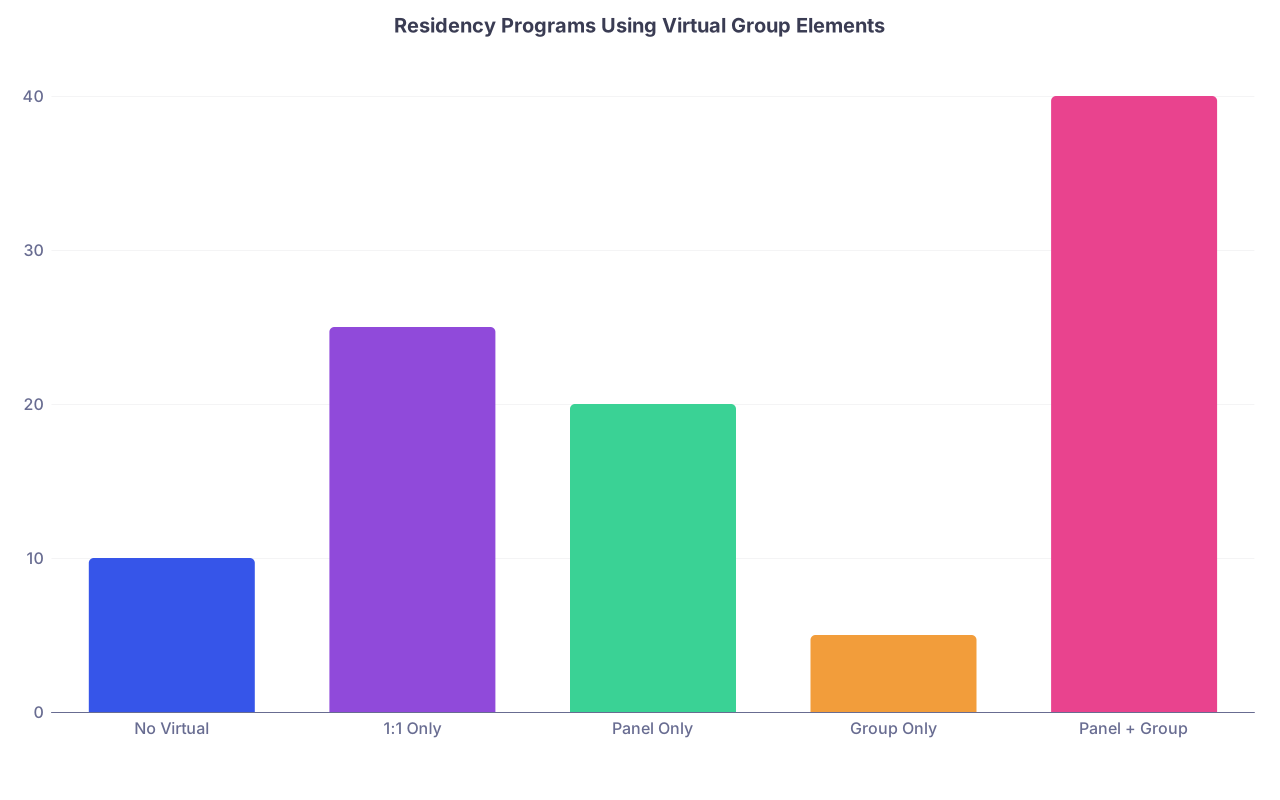
| Category | Value |
|---|---|
| No Virtual | 10 |
| 1:1 Only | 25 |
| Panel Only | 20 |
| Group Only | 5 |
| Panel + Group | 40 |
13. Red Flags You Probably Do Not Realize You Are Sending
You might think you are doing fine. Faculty see something else.
Common red flags in virtual group / panel settings:
- Smirking or visibly eye‑rolling at others’ answers. Instant “no.”
- Glancing down at phone or typing audibly while others speak. Looks like you do not care.
- Taking 90 seconds to answer “Tell us about yourself.” That is a 30–45 second question.
- Over‑correcting: “As the previous answer was not entirely correct…” Absolutely not.
- Being completely silent in a group unless cold‑called.
If you recognize yourself in any of these, fix it. Now.

| Step | Description |
|---|---|
| Step 1 | Login & Tech Check |
| Step 2 | Introductions |
| Step 3 | Standard Questions |
| Step 4 | Group Scenario Discussion |
| Step 5 | Applicant Questions |
| Step 6 | Closing & Logistics |
14. Rapid‑Fire Adjustments For Common Problems
Problem: Others keep answering before you in group questions.
Fix: Be ready with a clean, “I can start us off” within 1–2 seconds. If you always wait 4–5 seconds, you train others to fill the gaps.
Problem: You talk too long.
Fix: Write key behavioral stories as tight 60‑second narratives. Practice out loud with a timer until they fit.
Problem: You freeze after other strong answers.
Fix: Use one of the building patterns: “I agree with X, and I would add…”, or, “One angle we have not discussed yet is…”
Problem: You feel fake when using names or building on answers.
Fix: Practice it so it becomes part of your normal speaking style. Authenticity comes from comfort, not from avoiding all structure.
FAQ (Exactly 6 Questions)
1. What is the biggest difference between preparing for 1:1 and group virtual interviews?
For 1:1, you mainly optimize content and personal narrative. For group interviews, the priority shifts to how you share space: brevity, timing, listening, and visibly engaging with others. You can have perfect stories and still score poorly if you dominate airtime, speak last every time, or never acknowledge others’ contributions. Your “interpersonal operating system” gets evaluated more than your polished monologue.
2. How much should I speak in a 30‑minute multi‑applicant group interview?
As a rough benchmark with 5–6 applicants: aim for 2–3 substantial answers (45–75 seconds each), plus 1 thoughtful question or short comment building on someone else. That usually gives faculty enough to evaluate you without you hogging the discussion. If you realize you have spoken on the last two questions, consciously pause and give others first shot on the next one before you add a brief point.
3. What do I do if someone in the group keeps interrupting or dominating?
Do not try to “fight” them; you will both look bad. Instead, be crisp and decisive when you do speak (“I can share briefly…”), give structured answers, and model courtesy. You can also gently redirect: “I agree with what John said earlier, and one additional piece I would highlight is…” Faculty can see the bulldozer. They are usually not impressed by it. They will notice that you stay effective and respectful despite the dynamic.
4. How should I handle it if my internet glitches during a panel or group interview?
Have a backup plan ready: phone hotspot, tablet, or alternate device. If you freeze or drop, rejoin as fast as possible and give one clean sentence: “Apologies, I had a brief connection issue; I believe you were asking about X.” Then answer succinctly. Do not over‑apologize or spiral. Programs understand occasional tech problems; they care more about your composure and recovery than the glitch itself.
5. Are resident‑only virtual sessions really part of the evaluation?
In practice, yes. Officially they might be called “informal,” but residents share impressions with faculty. You do not need to be formal or stiff, but you do need to be respectful, engaged, and consistent with your professional persona. Ask real questions about workflow, education, and support. Do not vent about other programs, exams, or classmates. Residents are testing one simple thing: “Would I want this person on nights with me?”
6. How can I quickly improve before upcoming virtual group interviews if I feel behind?
Do two things this week. First, run at least one 30‑minute mock group session with peers on Zoom, record it, and watch your airtime, facial expressions, and interruptions. Fix the obvious issues. Second, script and rehearse 6–8 core stories (conflict, mistake, difficult patient, leadership, feedback, etc.) into 60‑second versions. That combination—clean group behavior plus tight story inventory—raises your floor dramatically, even with limited time.
Key takeaways:
Virtual group and panel interviews are not content contests; they are controlled experiments in how you function as part of a team under observation. Structure your answers tightly, share airtime intelligently, and show that you can listen, build, and lead without dominating. Programs are not hunting for perfection. They are hunting for residents they can trust at 3 a.m.—make every tile on that screen see you as one of them.


