
It is 8:27 p.m. Your first virtual residency interview is in five days.
Your laptop camera shows a washed-out version of you. Your answers feel long, scattered, and somehow still incomplete. You keep ending with, “I think that’s it,” which you know is terrible.
You do not need more generic advice. You need a plan. A rehearsal protocol. Something you can run for 3–5 days and reliably walk into interviews sharper, tighter, and calmer.
That is what this is: a structured, step-by-step rehearsal plan to make your virtual answers cleaner, more concise, and more confident. Not theory. A schedule you can actually follow.
Step 1: Build a 5‑Day Rehearsal Schedule
Stop “practicing when you have time.” That is code for not really practicing.
You need a short, focused daily block with specific tasks. Think like board review: time-boxed, high-yield, and repetitive.
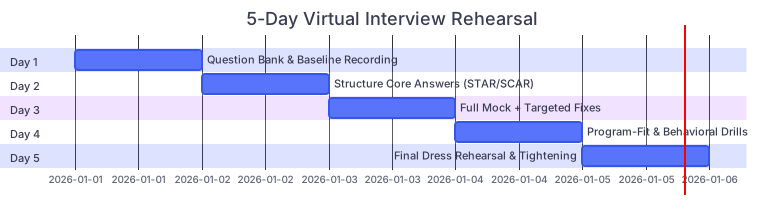
| Task | Details |
|---|---|
| Day 1: Question Bank & Baseline Recording | a1, 2026-01-01, 1d |
| Day 2: Structure Core Answers (STAR/SCAR) | a2, 2026-01-02, 1d |
| Day 3: Full Mock + Targeted Fixes | a3, 2026-01-03, 1d |
| Day 4: Program-Fit & Behavioral Drills | a4, 2026-01-04, 1d |
| Day 5: Final Dress Rehearsal & Tightening | a5, 2026-01-05, 1d |
Here is the basic framework:
- Daily time commitment: 60–90 minutes, max
- Environment: Same setup you will use on interview day (camera, mic, lighting, chair)
- Tools:
- Your laptop (or whatever you will actually use)
- A simple document/Google Doc
- A timer
- Recording software (Zoom, Loom, QuickTime, or just your phone video)
You are going to:
- Build a focused question bank.
- Decide on answer structures.
- Record → review → adjust, every day.
- End with a full “dress rehearsal” at least once.
If you follow this for even 3 days, you will sound like a different person on camera.
Step 2: Build a Ruthless Question Bank (Day 1)
You do not need 200 questions. You need 30–40 high-yield prompts that cover 90% of what you will actually get.
Here is the minimum set:
Core personal questions (you will get these)
- Tell me about yourself.
- Why this specialty?
- Why our program?
- What are your strengths?
- What are your weaknesses?
- Where do you see yourself in 5–10 years?
Clinical / professionalism
- Tell me about a challenging patient interaction.
- Describe a time you made a mistake in patient care.
- Tell me about a time you received critical feedback.
- Describe a conflict with a team member and how you handled it.
- An example of when you went above and beyond for a patient.
Resilience / stress / wellness
- How do you manage stress and avoid burnout?
- Tell me about a time you were overwhelmed and what you did.
- How do you handle long hours and high workload?
Ethical / judgment
- Tell me about an ethical dilemma you faced.
- What would you do if you saw a colleague cutting corners?
- How do you handle situations when you disagree with an attending?
Red flags / narrative issues (if they apply to you)
- Can you tell me about the gap in your CV?
- What happened with your Step failure / leave of absence?
- Why the switch in specialties?
Program fit / alignment
- What are you looking for in a residency program?
- What makes you a good fit for our program?
- How will you contribute to our program’s culture?
Research / teaching / leadership (tailored to you)
Pick 4–6 that match your profile:
- Tell me about your research.
- Tell me about a time you led a team.
- Describe a time you taught someone something important.
- What does leadership mean to you?
Copy these into a document. This is your Rehearsal Question Bank.
Now add program-specific variants for your top 5–10 programs:
- “Why [Program X]?”
- “What drew you to [City/Region]?”
- “How would you take advantage of [Program X’s unique feature]?”
You should end Day 1 with:
- 30–40 questions in a document
- Starred/highlighted:
- Top 6 “must-crush” questions (e.g., Tell me about yourself, Why this specialty, Why our program, Strengths, Weaknesses, A challenging patient case)
- 2–3 “red flag” questions if relevant for you
That is your target list.
Step 3: Choose a Simple Answer Structure (Day 2 Focus)
Most residents ramble because they think while talking. You will not. You are going to plug your answers into simple, repeatable frameworks.
Use these two:
1. For stories: SCAR (my preferred tweak on STAR)
- S – Situation: Brief context
- C – Challenge: The specific problem
- A – Action: What you did
- R – Result/Reflection: Outcome + what you learned
Why SCAR instead of STAR? Because in medicine the “Task” is often obvious. The “Challenge” is where the story becomes interesting.
Example prompt:
“Tell me about a time you had a conflict with a team member.”
Bad answer: 3 minutes of rambling, no clear resolution.
SCAR answer (aim for 60–90 seconds):
- Situation: “On my surgery rotation, I was the MS3 on a busy trauma service…”
- Challenge: “A senior resident repeatedly criticized my notes in front of the team…”
- Action: “I asked to speak one-on-one, clarified expectations, created a template, and started pre-rounding 20 minutes earlier…”
- Result/Reflection: “My notes improved, feedback became constructive, and I learned to address tension early and privately.”
2. For non-story, conceptual questions: 2–3 Point Structure
- Direct answer / thesis (1 sentence)
- 2–3 supporting points (brief, concrete)
- 1 sentence tie-back (to program/patient care/your growth)
Example prompt:
“What are your strengths?”
You:
- Direct answer: “My three greatest strengths are preparation, calm under pressure, and clear communication with patients and teams.”
- Point 1: One sentence + micro-example.
- Point 2: One sentence + micro-example.
- Point 3: One sentence + micro-example.
- Tie-back: “These traits let me function dependably on busy services and support both patient safety and team efficiency.”
Today’s task (Day 2):
- Take your top 10 questions.
- For each, decide: SCAR story vs 2–3 point structure.
- Outline only. Not full scripts.
- 1–2 bullet words for each SCAR component
- 3 bullet strengths/points for conceptual answers
If your document looks like a speech, you went too far. You want skeletons, not essays.
Step 4: Establish Your Answer Timing Targets
Virtual interviews punish long answers more than in-person. People tune out faster on screen.
You need hard limits:
- Most answers: 60–90 seconds
- Big, open questions (“Tell me about yourself”, “Why this specialty?”): 90–120 seconds
- Rapid-fire / clarifying questions: 20–40 seconds
Use a timer during rehearsal. Your future self will thank you.
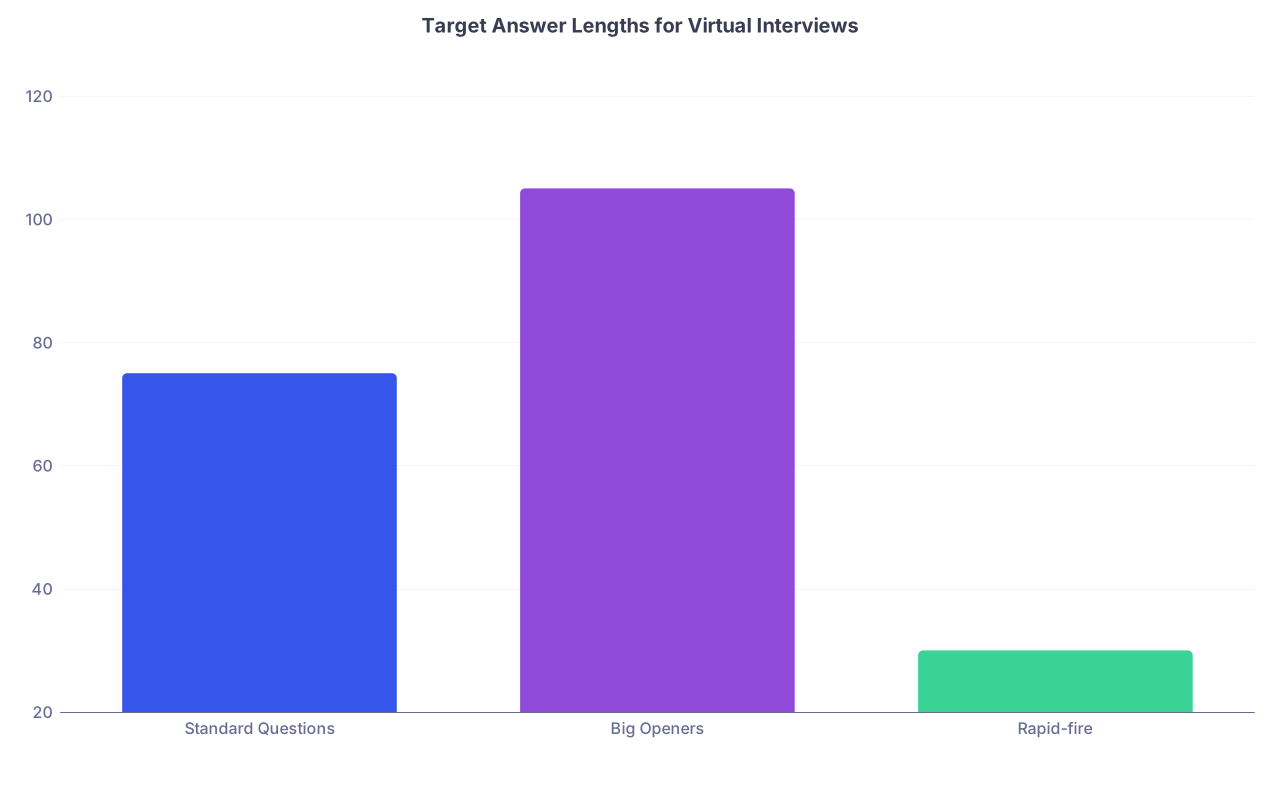
| Category | Value |
|---|---|
| Standard Questions | 75 |
| Big Openers | 105 |
| Rapid-fire | 30 |
If you are consistently over 2 minutes for standard questions, you are not “thoughtful.” You are unfocused.
Step 5: Day 1–2 Rehearsal: Baseline + Structural Fix
Here is exactly what to do on the first two practice days.
Part A: Baseline Recording (Day 1, 20–30 minutes)
- Open Zoom (or whatever platform your interviews use).
- Start a meeting alone, hit record.
- Ask yourself out loud and record answers to just 5 questions:
- Tell me about yourself.
- Why this specialty?
- Why our program? (Pick one program you care about.)
- Tell me about a challenging patient.
- What is a weakness of yours?
No stopping and restarting. One continuous take. Like the real thing.
- Watch the recording immediately. With a notebook.
As you watch, look for:
- Timing: Are you above 2 minutes on everything?
- Structure: Can you easily see the S, C, A, R? Or any clear points?
- Verbal tics: “Um,” “Like,” “You know,” “I think…” every other sentence.
- Energy: Do you sound engaged or half-asleep?
- Non-verbals: Eye contact with camera, posture, fidgeting, head tilt, “thinking up to the right” for 10 seconds at a time.
Write down 3 specific problems. Not “I was bad.” More like:
- My “Tell me about yourself” answer was 3:10 and wandered.
- I never mentioned anything specific about [Program].
- I said “um” every 3–4 words on the patient question.
Those become your fix targets for the next days.
Part B: Structural Practice (Day 2, 45–60 minutes)
- Re-open your top 10 questions and their SCAR / 2–3 point outlines.
- For each:
- Glance at your outline for 10 seconds.
- Close your eyes, take a breath.
- Answer out loud, no script, aiming for your time target.
- After 10 questions, record yourself answering 3 of them on video.
Then watch the recording (painful but necessary) and check 3 things only:
- Did I follow SCAR / clear point structure?
- Was I within the time window?
- Did I end cleanly (not with “So… yeah” or “I guess that’s it”)?
If you are short on time, just fix big things:
- Cut an extra example.
- Tighten your S and C.
- Add a 1-sentence conclusion: “So that experience really shaped how I approach…”
By end of Day 2: your answers should already feel less chaotic.
Step 6: Day 3 – Full Mock + Targeted Feedback
Now you simulate the real thing.
Part A: 20–30 Minute Mock Interview
Option A (ideal): Get a friend, resident, or advisor on Zoom.
Option B (still effective): You ask the questions, leave 5 seconds, then answer as if someone else asked.
Run a 20–25 minute mock:
- 2 warm-up questions (Tell me about yourself, Why this specialty)
- 4–6 mixed questions (behavioral, clinical, resilience, weakness, ethical)
- 1–2 program-fit questions (“Why our program?”, “What are you looking for in a program?”)
Record it.
Part B: Ruthless Review
Watch the mock once without pausing. Then again, with these specific checks:
Question-by-question timing
- Mark anything >2 minutes (except your 1–2 big openers). Those must be trimmed.
Answer structure compliance
- For every story: Can you identify S, C, A, R? If not, your “Situation” or “Result/Reflection” is probably missing.
- For conceptual questions: Was there 1 clear thesis sentence up front?
Content gaps
- Are your patient stories always the same type? (e.g., only “difficult family conversations”)
- Do you ever mention collaboration, systems issues, or interprofessional work?
- Are you avoiding certain topics because they are uncomfortable? Those usually become big weaknesses.
Persona check
- Do you come across as bitter, boastful, or bland?
- Are you smiling at least occasionally?
- Would you want to work a 28-hour call with this person?
Write down 3–5 fix targets for the next day. Example:
- My “weakness” answer sounds like a fake strength.
- I apologize too much when I talk about mistakes.
- I never mention what I learned or how I changed.
- I look away from the camera constantly.
Tomorrow is about drilling these specific weaknesses.
Step 7: Day 4 – Targeted Drills for Persistent Problems
Day 4 is not another full mock. It is surgery day. You fix the things you keep doing wrong.
Drill 1: Tighten One Story Three Times
Pick one important behavioral prompt you keep fumbling, like:
- “Tell me about a time you made a mistake.”
Do this:
- Answer it once (SCAR) with no time limit. Note the time.
- Immediately answer again, forced under 90 seconds. You are allowed to cut details, not the core.
- Answer a third time, aiming for the cleanest, simplest version.
You will feel the answer tighten in real time. That is the point.
Lock in the short version as your default.
Drill 2: Fix “Weakness” and “Red Flag” Questions
You cannot improvise these. It shows. Program directors have heard a thousand fake weaknesses and vague Step explanations.
Structure for weakness:
- Clear, real weakness (no “I care too much”).
- 1–2 sentence example from clinical or academic life.
- Concrete steps you have taken to improve (systems, not just “try harder”).
- Current status (“This is still something I monitor, but now…”).
Example skeleton:
- “A weakness earlier in medical school was over-preparing individually instead of clarifying expectations with the team. On my medicine clerkship…”
- “I now use a weekly check-in with seniors/attendings and clarify goals at the start of rotations…”
- “It’s still something I pay attention to, but now it helps me align more quickly with team needs.”
For red flag questions (Step failure, LOA, remediation):
- One sentence acknowledgement (no dodging).
- Brief context, not an essay of excuses.
- Specific changes you made (study strategy, wellness, time management, seeking help).
- Evidence of improvement (later scores, clerkship performance, consistency).
- Short reflection on what you learned about yourself.
Drill these 3–4 times out loud until you can say them calmly, without sounding defensive or overexplaining.
Drill 3: Program-Fit Mini-Rounds
For your top 5 programs:
- Write 3 things you genuinely like about each (specific, not “strong clinical training”).
- Write 1 way you will contribute to each program’s unique strengths/needs.
Then practice:
- “Why our program?” for each, 60–90 seconds.
Rotate through 3–4 different programs in one session. You want to train flexible, not memorized, responses.
Step 8: Day 5 – Dress Rehearsal in True Conditions
This is non-negotiable. You will do a full run as if it is the real interview.
Setup
- Wear exactly what you plan to wear.
- Same device, camera angle, audio, and background.
- Same time of day as your interview if possible (so you know your energy level).
If you can get a faculty member, chief resident, or advisor—great. If not, a senior resident friend will do.
The Mock
- 30–40 minutes
- Mix of:
- 2–3 personal questions
- 4–5 behavioral / clinical scenarios
- 2–3 program-fit / goals questions
- 1–2 curveballs (e.g., “What is something not on your application that we should know?”)
Record it.
The Review (Same Day)
This time you are not rewriting your whole approach. You are doing micro-adjustments:
- Identify the 2 worst answers (in your opinion).
- Re-answer just those two immediately, out loud, once each.
- Make microscopic tweaks: remove one extraneous detail, add one reflection sentence, fix your closing line.
Then stop. Do not cram 50 more questions the night before. You want your brain rested, not flooded.
Step 9: On-the-Spot Answering Protocol (Interview Day)
You have your structure and practice. Now you need an in-the-moment protocol to keep answers sharp when anxiety spikes.
Use this 5-second routine for every question:
Listen fully.
Do not start planning your answer on the first word and then miss the actual question.Pause 1–2 seconds.
This is normal. It makes you look thoughtful, not unprepared.Choose a lane:
- Story? → SCAR.
- Conceptual? → 2–3 points.
Mentally name your points.
“Okay, three reasons: preparation, teamwork, communication.” That is it.End intentionally.
Last sentence should connect back to:- What it says about you as a resident, or
- How it impacts patient care / team function, or
- Why it makes you a good fit for the program.
One more thing. If you get a question that stumps you:
- Say: “That is a good question; let me think for a moment.”
- Take 2–3 seconds.
- Either:
- Narrow it (“There are a few directions I could go—clinically, I would say…”), or
- Ask for clarification if it was truly unclear.
Panicked guessing is worse than a controlled pause.
Step 10: Non-Verbal and Technical Rehearsal (Do This Once)
Virtual interview performance is not just words. Your tech and non-verbals can sabotage strong content.
Run this checklist during any practice session:
| Area | Target State |
|---|---|
| Camera | Eye level, arms-length distance |
| Lighting | Light in front, not behind |
| Audio | Clear, no echo, test recording OK |
| Background | Simple, uncluttered, neutral |
| Framing | Head and upper torso visible |
Non-verbal habits to correct:
- Nodding constantly like a bobblehead.
- Fix: Nod once, then hold neutral expression.
- Looking at your own thumbnail instead of the camera.
- Fix: Move your self-view closer to the camera or minimize it.
- Talking with your hands off-frame, creating weird shadows.
- Fix: Keep gestures within the screen frame, moderate movements.
- Leaning back in a swivel chair.
- Fix: Sit slightly forward; plant your feet.
Do a 2-minute recording where you are only allowed to:
- Answer one question,
- Focus on looking at the camera,
- Maintain open posture and controlled gestures.
Re-watch with the sound off and ask: “Would I trust this person in my ICU at 3 a.m.?”
Step 11: Maintenance Between Interviews
You are probably not doing just one interview. You might have 5, 10, 15 scattered over weeks.
You do not need to repeat the full 5-day plan for each. Use this maintenance protocol instead:
Night before each interview (20–30 minutes)
- Skim your question bank.
- Out loud:
- “Tell me about yourself” ×1
- “Why this specialty?” ×1
- “Why our program?” (specific) ×1
- Your weakness answer ×1
- Any red-flag question (if relevant) ×1
Morning of interview (5–10 minutes)
- One SCAR story (patient or conflict)
- One conceptual (strengths or program fit)
- Micro-check camera, audio, lighting.
Think of it like warming up before a long case. You are not relearning anatomy; you are just getting your hands ready.
The Line Between “Rehearsed” and “Fake”
Yes, there is a risk: over-rehearsal can make you sound robotic. The solution is structured practice with flexible wording.
You should:
- Know your story skeletons cold (S/C/A/R, your 3 strengths, your real weakness).
- Not memorize sentences. Ever. If you catch yourself reciting, force yourself to change 2–3 words each time you rehearse.
On interview day, the goal is:
- Familiar content.
- Fresh phrasing.
- Stable structure.
Program directors can tell the difference between prepared and scripted. You want the former.
Your Next Action Today
Do not plan to “start practicing later this week.” That is how you end up rambling into a webcam at 7 a.m. in a suit you have not worn in a year.
Here is your one concrete step for today:
Open a blank document right now and build your Rehearsal Question Bank of 30–40 prompts.
Star your top 6 must-crush questions. Then schedule a 30-minute block in the next 24 hours for your first baseline recording.
Once the bank and first recording exist, the rest of this plan becomes straightforward execution.