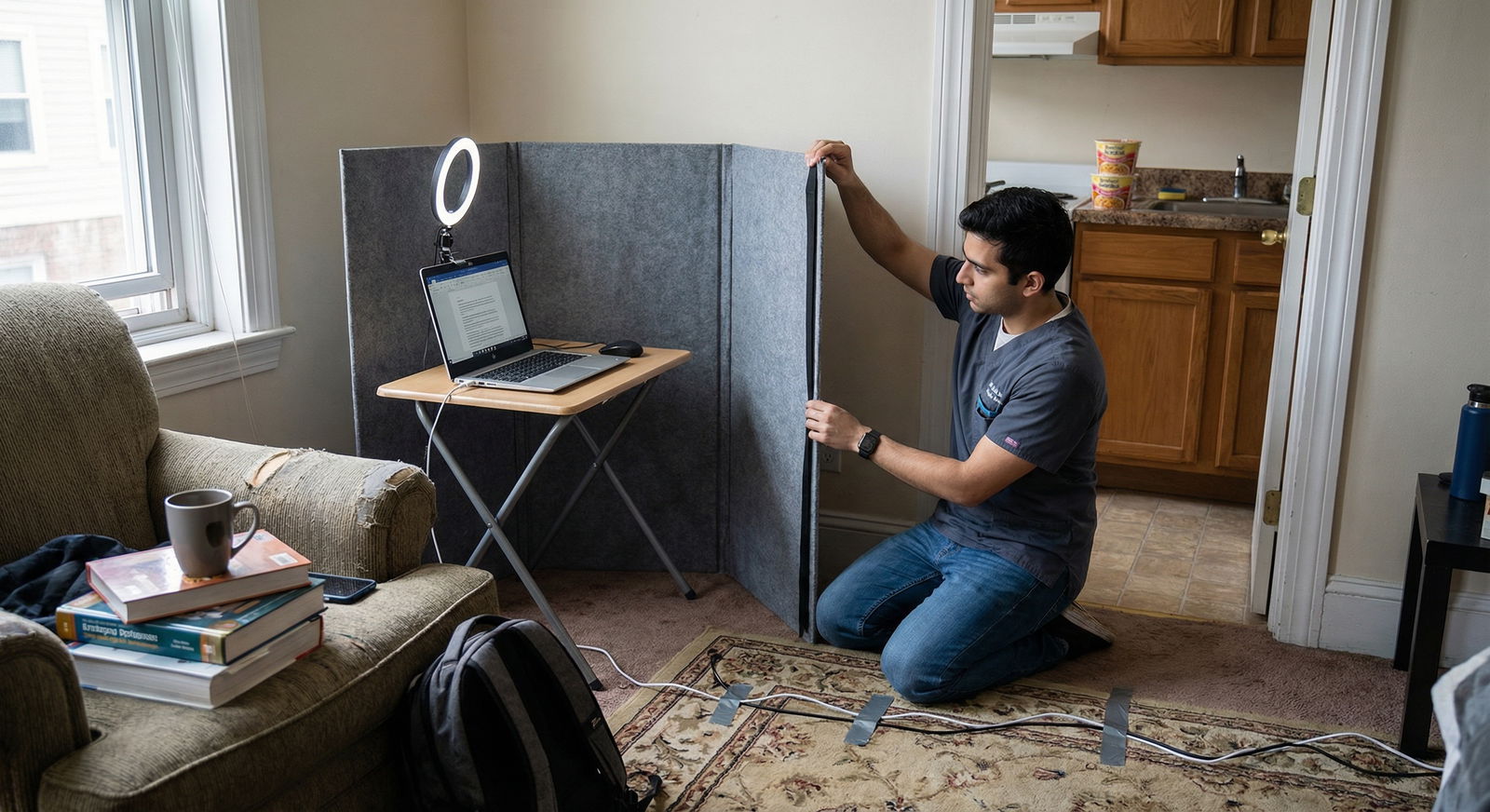
Back-to-back video interviews will break you if you treat them like normal Zoom calls. They are not. They are performance, repetition, emotional labor, and decision-making — stacked into 6–10 hours of staring into a camera.
You are not tired because you are weak. You are tired because the system is poorly designed for human beings. So you need to be smarter than the system.
Here is how you get through multi-interview days without frying your brain or tanking your performance.
Step 1: Design Your Interview Day Like an OR Schedule
You would not walk into a 12-hour OR day without a plan. Same rule here.
You are managing:
- Cognitive load
- Eye strain
- Hydration/food
- Voice fatigue
- Emotional energy
So you set up your day like a procedure schedule, not “I’ll just log on and hope for the best.”
Build a Simple Interview-Day Blueprint
Do this 2–3 days before your first heavy interview block.
Print or write a one-page “Interview Day Map”
Include:- Program names
- Time blocks (with time zones clearly labeled)
- Zoom / Thalamus / Teams links
- Contact email/phone for tech issues
- Short 1-line note per program: “Why this place?”
Set your “no chaos” rule
Decide:- No email checking between interviews
- Phone on Do Not Disturb except family emergencies
- No studying, no charts, no side projects
Pre-assign your breaks
Between interviews, you will be tempted to “quickly look something up” or re-read notes. That is how you drain your brain by noon. Instead assign:- 5–10 minutes: bathroom + water + step away from screen
- 5 minutes: physical reset (more on this later)
- 3 minutes: mental reset script
This is about conservation. You protect your brain so it is still sharp for the last PD conversation, not just the first.
Step 2: Build a Tech Setup That You Never Have to Think About
You cannot afford tech anxiety on a day with 5–10 interviews. That low-level dread — “What if my Wi-Fi drops?” — quietly eats your focus.
You fix that upfront.
Minimum Tech Checklist (Stop Winging It)
Do this once. Then you reuse it all season.
Internet
- Use wired Ethernet if at all possible. Get a $10 cable and an adapter if needed.
- If Wi-Fi only: sit close to the router, ask others not to stream during your blocks.
Computer + Power
- Laptop plugged in. Battery-only is how people crash mid-PD interview.
- Turn off auto-updates / restarts during interview windows.
Camera
- Built-in is fine if image is clear and at eye level.
- Raise your laptop on books so camera is just above eye line.
Audio
- Use wired headphones or a solid USB headset. Bluetooth is where lag and random disconnects happen at the worst times.
- Test mic levels with the actual platform (Zoom/Teams/Thalamus) one day prior.
-
- Phone ready as hotspot if primary internet fails.
- App installed on phone with links bookmarked.
- Program coordinator email and phone easily visible on your desk.
| Component | Primary Choice | Backup Option |
|---|---|---|
| Internet | Ethernet connection | Phone hotspot |
| Audio | Wired earbuds/headset | Laptop mic + speakers |
| Video | Laptop webcam | Phone camera (app) |
| Power | Plugged-in laptop | Fully charged battery |
| Platform | Desktop app (Zoom etc) | Mobile app |
Once this is done, stop fiddling. You do not need to chase “perfect” lighting or studio-quality audio. You just need zero surprises.
Step 3: Script Your Core Answers To Reduce Cognitive Load
The mental exhaustion comes from answering the same questions with full creative energy every single time. That is unnecessary.
You standardize 70–80% of your content. Then adapt slightly for each program.
Build a “Core Answer Bank”
Open a document. Create 5 sections:
- Tell me about yourself.
- Why this specialty?
- Strengths / weaknesses.
- Conflict / challenge / failure stories.
- Why our program / what are you looking for?
For each:
- Write one base version (generic).
- Add 2–3 modifiers you can swap in depending on the program.
Example for “Why this specialty?” for Internal Medicine:
- Base core: a 60–90 second story about a formative patient encounter + your thinking style + what you enjoy clinically.
- Modifiers:
- Academic program: emphasize interest in QI/research/teaching.
- Community program: emphasize continuity, broad exposure, underserved populations.
- County/safety-net: emphasize advocacy, complex social determinants, team-based care.
You are not memorizing a monologue. You are building stable building blocks.
On a 6-interview day, you are not generating 6 different “why IM” speeches. You are pulling the same skeleton each time, with small tweaks. That saves mental energy and keeps your delivery consistent.
Step 4: Protect Your Voice and Eyes Like Your Life Depends on Them
Because on a heavy interview day, they do.
By the fourth session, I have watched candidates literally rub their eyes every 30 seconds and lose volume mid-sentence. Programs notice. They may be sympathetic, but they still rank based on what they see.
Voice Care Protocol
Start the day as if you are about to give a 2-hour lecture, not a phone call.
Hydration strategy
- Start hydrating 1–2 hours before. Not chugging water right before you log in.
- Keep a full bottle on your desk. Take small sips between questions, not giant gulps.
Warm-up (5 minutes)
Right before the first interview:- 3–5 big diaphragmatic breaths (in through nose, slow exhale through mouth).
- Say a few tongue twisters or read 4–5 random sentences out loud slowly.
- Do 3–4 “humming” runs (low to medium pitch) to wake up vocal cords.
Use your body, not your throat
- Sit upright, feet planted. Do not collapse forward as the day goes on.
- Aim your voice from your chest with steady airflow, not squeezing your throat.
- If your throat feels dry, you are behind. Sip water, slow your rate slightly.
Eye and Screen Fatigue
You will be staring at faces, your own image, and tiny reaction cues. That is draining.
Implement the 20-20-20 rule between interviews:
- Every 20 minutes (or between calls)
- Look at something 20 feet away
- For at least 20 seconds
On back-to-back days:
- Reduce screen brightness.
- Turn off “self-view” if it distracts you (in Zoom etc). You do not need to monitor your own face for 6 hours straight. That is a direct line to burnout.
- Use blue-light filter or glasses if you are sensitive.
Step 5: Create a Between-Interview Reset Routine (Not Just “Scrolling Time”)
The average applicant wastes the breaks. They doomscroll, re-analyze their answers, or start tweaking their rank list in their head. Then they wonder why they feel cooked by the afternoon.
You need a reset routine that is automatic and repeatable.
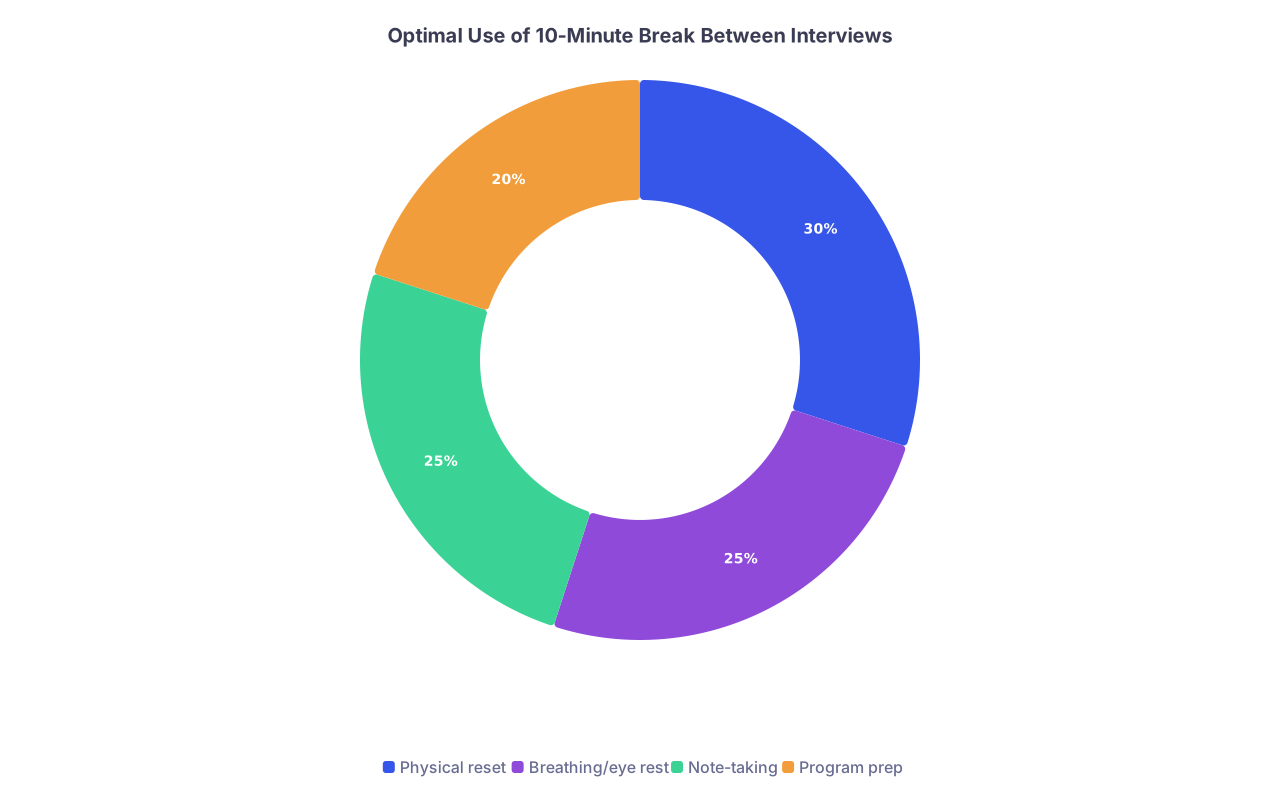
Here is a 10-minute template that actually works.
Minute 0–1: Hard stop
- End the call.
- Close the app window.
- Do not immediately open email or messages.
Minute 1–3: Physical reset
- Stand up.
- Shoulder rolls, neck stretches, 10 bodyweight squats or calf raises.
- Shake your arms out. Literally reset your posture.
Minute 3–5: Eye + breathing reset
- Look out a window or at a far wall.
- 5 slow breaths: in for 4, hold 2, out for 6.
- Relax your jaw and shoulders on every exhale.
Minute 5–7: Mental buffer
- Say out loud: “That one is done.”
- Jot down 2–3 quick notes: anything you liked about the program, any red flags, any specific faculty or topic that stood out.
- Do not dissect your performance. Just capture data.
Minute 7–10: Pre-load next program
- Glance at your one-line “why this program” note.
- Skim their schedule/structure if you have it.
- Glance at your prepared questions (you should have 2–3 standard options and 1–2 program-specific).
You are teaching your brain: “We complete, we reset, we switch context intentionally.” That is how you avoid the feeling of one long, blurry Zoom marathon.
| Category | Value |
|---|---|
| Physical reset | 30 |
| Breathing/eye rest | 25 |
| Note-taking | 25 |
| Program prep | 20 |
Step 6: Use a Simple Question Bank So You Are Never Scrambling
By interview #4 in a day, most applicants run out of decent questions for faculty. Then they default to weak, generic ones. That is fixable.
You are not improvising questions all day. You are selecting from a pre-built bank.
Build a Tiered Question Bank
Create three categories:
Core questions (usable at almost any program, for most interviewers)
Examples:- “How would you describe the culture of your residents on a tough rotation?”
- “What distinguishes successful residents in your program?”
- “How does your program support residents who struggle early on?”
Role-specific questions
- For PDs: curriculum, resident support, career outcomes, program changes.
- For APDs/chiefs: schedule realities, resident autonomy, feedback.
- For residents: call burden, actual day-to-day workflow, program responsiveness to concerns.
Program-specific questions
- Pull 1–2 questions from their website: specific tracks, clinics, research, unique rotations.
During back-to-back days, you are rotating through these, not creating new material. That keeps your brain from overheating and your questions from sounding recycled.
Step 7: Manage Your Energy Before, During, and After the Day
Burnout is not just about the interviews. It is about how you set up the 24 hours around them.
The Evening Before: No Heroics
The worst move I see: applicants trying to do deep research on every single faculty, rotation, and publication the night before a heavy day.
Stop.
The night before a 5+ interview day should look like:
- Final check of times/links and time zones.
- 10–15 minutes browsing the program website to refresh big-picture facts.
- Laying out clothes, testing lighting once.
- Going to bed at a time that gives you a real 7–8 hours.
You want calm familiarity, not last-minute cramming.
Morning Of: Warm-Up, Not Cram
Treat it like game day.
- Light breakfast with protein and complex carbs. Not just coffee on an empty stomach.
- 5–10 minute vocal + posture warm-up (as above).
- 5 minutes reviewing your core answer bank.
- 3 minutes reminding yourself of your “why” for the specialty. That anchors your authenticity when you are tired.
No deep dives into PubMed at 7:15 am. No obsessing over Reddit horror stories.
After the Last Interview: Shut It Down
This is where people self-sabotage. They:
- Rewatch themselves in their head on loop.
- Second-guess everything they said.
- Start rearranging their rank list for 3 hours.
You need a hard stop ritual instead.
Write a quick 3–5 line reflection for each program from that day:
- Pros
- Cons
- Gut feeling (yes / maybe / no)
Then explicitly stop all interview thinking for the rest of the evening:
- No rehashing answers.
- No emailing programs that night unless there was a major tech failure that needs acknowledging.
- Do something physically different: walk, cook, workout, call a non-med friend.
You are preserving energy for the next set of interviews, not trying to win the match in one evening.
Step 8: Stop Comparing Yourself in Real Time
Video interviews make comparison worse. You hear other people in Zoom waiting rooms talking about 25+ invites, away rotations at big-name places, some ridiculous research CV. You start spiraling.
Back-to-back days magnify this because you get exposed to more applicant chatter in a compressed timeframe.
Here is the reality: comparison thinking directly drains mental and emotional energy that you need for actual performance.
Your rule: No mental math during the day.
No:
- “They seem more relaxed than me.”
- “Their background looks more professional.”
- “They had a funny story; mine was boring.”
Every time you catch yourself doing it, you internally say: “Not helpful. Next.” Then focus on:
- Listening carefully.
- Answering clearly.
- Asking good questions.
- Showing up with consistent energy.
That is all programs can actually evaluate.
Step 9: Handle True Back-to-Back Scheduling Without Panicking
Sometimes programs schedule you with literally 5 minutes between rooms, or you stack two programs on the same day (not ideal, but it happens, especially IM/Family/Prelim overlaps).
Here is how to make it survivable.
If You Have Multiple Programs in One Day
This is high-risk for burnout. Only do it if absolutely necessary.
If you must:
Hard separation before each program
- Change something physical between Program A and Program B: jacket, tie, earrings, background object. It tells your brain, “New context.”
- Re-open your Interview Day Map and visually confirm: this is a new program, new goals.
Reset your talking points
- Re-anchor: “What do I actually like about this new program?”
- Adjust your “why this program” sentence. One sentence is enough.
Adjust expectations
- Your goal is not perfection. Your goal is “no major drops.”
- Prioritize being present and engaged over showing off every experience you have.
If One Program’s Schedule Is Too Tight
Say you have 5-minute transitions between rooms, and tech or faculty delays eat into that:
- Use chat or coordinators early. Do not silently panic.
- “Just to confirm, should I stay here for the next room or reconnect on the main link?” is a completely reasonable question.
- Keep water, notes, and schedule visible at all times so you do not scramble when the next faculty pops in.
Programs know virtual logistics are messy. They are not grading you on that. They are watching how you handle it.
Step 10: Recognize and Fix Early Signs of Burnout Mid-Season
If you are in the middle of interview season and already dreading every video call, you are not alone. I have seen smart, highly qualified applicants flatline in January because they ignored the early warning signs.
Here is what to watch for:
- You feel exhausted after even 1–2 interviews.
- You start resenting programs before they even start.
- You cannot remember which program you just talked to 2 hours ago.
- You find yourself snapping at family/partners on interview days.
When that shows up, you do not push harder. You adjust the system.
Concrete Fixes
Cap your weekly load
- If you are at 5–6 interview days per week and falling apart, cut to 3–4 where possible. Decline late, low-interest invites instead of trying to hoard everything.
Add non-negotiable off-days
- One full day per week with zero interview-related tasks. No emails, no rank list adjustments, no prep. Your brain needs space to consolidate.
Shorten pre-interview prep
- If you were doing 60–90 minutes of program research per interview, drop it to 20–30. Rely more on your core answer bank and question bank.
Talk to someone who is not in the Match cycle
- A mentor, therapist, family member. Burnout thrives in isolation and echo chambers (like Reddit).
If you keep trying to “outwork” burnout, your performance will decline in ways you cannot fully control: flat affect, slower responses, less warmth. Programs pick up on that long before you consciously feel “I am done.”
Step 11: Use a Simple Tracking System So Your Brain Can Let Go
One underrated source of exhaustion: trying to hold every impression, detail, and ranking thought in your head.
Do not do that. Externalize it.
Create a simple tracking sheet (spreadsheet or notebook). Columns:
- Program name
- Date of interview
- Overall vibe (1–5)
- Culture notes (short phrases)
- Pros
- Cons
- “Would I be happy here?” (Yes / Maybe / No)
You fill this out within 30 minutes after the last interview of that program’s day. Then you let your brain drop it.
This matters more on days with multiple interviews. Your memory will blur. The sheet is your backup brain.
Step 12: Remember the Goal: Consistent, Not Perfect
Perfectionism is your enemy on back-to-back video days. It pushes you to:
- Over-prepare.
- Over-analyze.
- Over-schedule.
Then you burn out, and the last PD of the day gets a tired, robotic version of you.
Your goal is simple:
- Show up on time.
- Be clear, honest, and engaged.
- Ask thoughtful, basic questions.
- Maintain enough energy that the last interview still feels like you are genuinely there.
You do not need to be the most charismatic person they see all season. You just need to avoid obvious red flags: disinterest, disorganization, clear exhaustion, or irritability.
Two Things That Will Save You
If you remember nothing else, keep these:
Standardize everything that repeats.
Core answers, tech setup, reset routine, question bank. The more you automate, the more brainpower you have left for real connection and thinking.Protect your energy like a finite resource.
Back-to-back video interviews are not normal conversation. They are a performance marathon. Plan like an athlete, not a casual Zoom user.