You wake up on interview morning, and your throat feels like sandpaper. Nose completely blocked, head pounding. You check the calendar: your top‑choice residency, virtual interview in three hours. Camera-on, multiple faculty, PD in the last slot.
Now you’re stuck in that miserable calculation:
Do you cancel and risk losing the interview (or looking flaky)?
Or do you push through and risk tanking your performance?
This is where people make panicked, bad decisions. Let’s not do that. Here’s how to handle being sick on a virtual interview day like an adult, not a martyr.
Step 1: Figure Out How Sick You Actually Are
Start with an honest status check. Not vibes. Data.
Ask yourself, concretely:
- Can I talk in full sentences without coughing fits or losing my voice?
- Can I focus and think clearly for 20–30 minutes at a time?
- Do I look reasonably human on camera with some effort (lighting, grooming), or completely wrecked?
- Am I contagious with something obvious and acute that started in the last 24–72 hours (classic viral symptoms)?
- Am I on meds (like sedating antihistamines or heavy cough syrup) that will make me slow, spacey, or weird?
Roughly, it breaks down like this:
| Situation | Recommendation |
|---|---|
| Mild cold, no fever, can speak clearly | Usually push through |
| Moderate symptoms, but can think/talk with breaks | Case-by-case |
| High fever or severe migraine | Strongly consider reschedule |
| Active vomiting/diarrhea | Reschedule |
| Voice almost gone or nonstop cough | Strongly consider reschedule |
If you’re trying to talk yourself into “it’s fine” while clearly not fine, you already know the answer. Interview performance matters more than attendance.
Step 2: Check the Stakes and the Timeline
This part people skip. They think every interview is equally sacred. It isn’t.
Look at three things:
- Where you are in your interview season
- How important this program is to you
- How rescheduling will actually play out
If it’s:
- Early in the season (November/early December)
- You have a reasonable number of invitations
- And this program is mid-tier for your list
…you have more flexibility to reschedule or even, worst case, lose it.
If it’s:
- January/February
- One of only a few interviews
- A program you’d be thrilled just to rank
…you’re going to lean harder toward pushing through if at all possible.
Now layer on the reality: programs do reschedule. But not infinitely. And they remember chronic reschedulers much more than the one-time “I got the flu” person.
Step 3: When You Should Cancel or Reschedule
Let me be blunt: there are situations where pushing through is just dumb.
You should strongly consider rescheduling if:
- You’re actively vomiting, have severe diarrhea, or legit cannot stay off the bathroom floor for 30 minutes.
- You have a fever of 101°F (38.3°C) or higher and feel like you got hit by a truck.
- Your voice is barely there or you’re in the middle of laryngitis.
- You have a relentless, hacking cough you can’t suppress for more than 30–60 seconds.
- You can’t think straight because of severe headache, uncontrolled pain, or medication side effects.
- You’re constantly dizzy, lightheaded, or at risk of fainting.
- You’ve had a major personal or family emergency in the last 24 hours and are emotionally wrecked.
Because here’s what actually happens when you push through in those states:
You ramble, you forget questions, you give flat or incoherent answers, you look miserable, and the committee writes things like “low energy,” “seemed disengaged,” or “poor communication.” They don’t write: “Probably had the flu, let’s forgive this.”
Now, if you’re rescheduling, you need to do it right.
Timing matters.
- If you know the night before: email that night. Do not wait until an hour before.
- If you wake up sick the same day: email as soon as you realize you’re not interview-capable. The 8:30 a.m. “my 9 a.m. interview won’t work” message is better than a no-show or logging in and clearly falling apart on screen.
Step 4: How to Ask for a Reschedule Without Sounding Flaky
Programs are run by humans. Many of them have been sick on key days themselves. You’re not the first.
Keep your message short, professional, and specific enough without oversharing.
Here’s a template you can actually send:
Subject: Request to Reschedule Interview – [Your Name], [Specialty]
Dear [Coordinator Name/Program Coordinator],
I was very much looking forward to interviewing with [Program Name] on [date], but I woke up this morning acutely ill with [high fever / severe flu-like symptoms / a significant gastrointestinal illness] and am not in a condition to interview effectively.
I remain very interested in [Program Name] and would be grateful for any possibility of rescheduling my virtual interview to a later date, if feasible. I understand your schedule is very tight and I appreciate any consideration you’re able to provide.
Thank you for your understanding,
[Your Full Name]
AAMC ID: [#######]
Notice what you did:
- You did not whine.
- You signaled this is acute, not a week-long vague “not feeling well.”
- You linked the illness to interview performance (which shows insight).
- You emphasized continued interest.
After sending that email, stop. Do not send three follow-ups that day. Give them a workday or two, unless the interview is same-day and they need awareness fast. If it’s same-day, I’d also call the coordinator’s office line during business hours after sending the email, leave a short voicemail referencing your email, and then leave it alone.
Step 5: When It’s Better to Push Through (And How to Do It Smart)
Now the other side. There are many situations where you should interview while mildly sick, but manage it tightly.
Typical “push through” scenarios:
- Mild to moderate congestion, runny nose, or sore throat, but you can talk normally.
- Slight cough that you can control with lozenges, water, and muting.
- Low-grade fever that’s responsive to acetaminophen/ibuprofen and you’re otherwise functional.
- You’re on day 4–7 of a viral illness, much better than peak, just not 100%.
The key question: “Can I present as my professional self for 20–30 minutes at a time with strategic breaks?” If yes, it’s usually safer to proceed—especially late in the season or for higher-priority programs.
Here’s how to set yourself up to not crash and burn:
Control symptoms aggressively—but rationally.
Use non-sedating meds if you need them. A dose of acetaminophen or ibuprofen, a decongestant if you tolerate it, throat lozenges, tissues within reach. Avoid anything that makes you groggy.Set up a ‘sick-friendly’ interview station.
Webcam at eye level, soft front lighting, neutral background. Water, tea, tissues, cough drops nearby. Trash can out of camera frame. Put your mic on something easy to mute/unmute.Plan your muting and breaks.
Zoom/Teams/Webex all have mute. Use it. Cough, clear your throat, unmute to talk. If you absolutely need a quick pause: “I apologize, may I grab a quick sip of water?” is fine.Decide if you’re going to disclose you’re sick—or not.
This one deserves its own section.
Step 6: Should You Tell Them You’re Sick?
You don’t have to. But sometimes a single sentence helps.
What not to do: start by listing your symptoms, apologizing 10 times, dramatically telling them how sick you are. That just shifts attention away from your actual interview.
Smart way to handle it (if you do mention it):
- Quick, one-sentence acknowledgement at the start with the first interviewer or PD, then move on.
Something like:
“Just a quick note—I’m recovering from a mild viral illness, but I’m doing well enough to be here today and I’ve been looking forward to speaking with you.”
Then stop. Move directly into normal conversation.
When this helps:
- Your voice sounds a bit off or nasal.
- You might cough occasionally.
- You look slightly more tired than your photo or other interview days.
When you should probably skip mentioning it:
- Symptoms are barely noticeable to others.
- You’re worried you’ll end up over-explaining and using it as a crutch for weak answers.
Remember: you don’t want “seemed sick” in the notes more than necessary. You want “good fit, thoughtful answers.”
Step 7: Energy Management During the Actual Interview
Interviewing while sick is basically doing a short performance on a low battery. So you manage battery life.
Think in chunks, not the whole half-day. Most virtual interview days break into:
- Pre-interview orientation
- 3–5 individual or panel interviews
- Maybe a resident social or Q&A
You don’t have to be “on” at 100% for all of that. You do need to peak during PD and key faculty interviews.
Here’s the tactical approach:
- Use pre-interview orientation to warm up, not impress. Camera on, pleasant face, but you don’t need to be the most enthusiastic person on screen.
- Put your max focus into the PD interview, APD, and faculty from areas you care about (e.g., ICU director if you love critical care).
- If there’s a resident social later and you’re truly wiped, you can bow out with a short message to the coordinator: “Due to not feeling well, I’m unfortunately going to miss the social tonight, but I really appreciated today’s interviews.” That’s fine.
You’re allowed to spend your limited energy where it actually matters for your rank.
Step 8: What If You Get Worse Mid-Season?
Sometimes it’s not one bad day. It’s a week or two of being sick in the middle of your peak interview block.
Here’s the honest math: one mediocre interview rarely kills a season. A streak of visibly low-energy, unfocused interviews might.
If you notice:
- Your last 2–3 interviews all felt “off”
- You’re consistently exhausted, foggy, or emotionally flat
- You’re in the middle of back-to-back days with no recovery time
You need to consider a strategic partial pause.
That might mean:
- Emailing a couple of lower-priority programs asking if there’s a later date you can switch to.
- Canceling the lowest-priority interview or two outright, if your numbers and interview count allow.
- Building even a one full rest day between clusters of interviews.
Not every interview is equally valuable. I’ve seen applicants kill themselves to attend every single invite and show up as a zombie to the places they actually wanted. That’s backwards.
Step 9: If a Program Can’t Reschedule You
Sometimes the answer is: “I’m sorry, we don’t have any additional interview days available.”
That sucks. And it happens.
If you’re truly too sick to function, you did the right thing anyway. Logging on with 102°F and giving nonsense answers would not have gotten you ranked meaningfully.
You have two options:
- Accept the loss and move on.
- If this is a true dream program, send a brief, respectful follow-up expressing continued interest.
Something like:
Dear Dr. [PD Name],
Thank you again for the opportunity to interview at [Program Name] and for your team’s understanding when I became acutely ill. I understand there are no additional interview dates this season.
I did want to express that [Program Name] remains one of my top choices given [specific reasons: training structure, patient population, fellowship opportunities, etc.]. If circumstances change and any interview spots open, I would be very eager to participate.
Regardless, I appreciate your consideration and wish you a successful match season.
Sincerely,
[Your Name]
Do not badger them. Do not send weekly follow-ups. You plant the seed and move on with the rest of your interviews.
Step 10: A Quick Visual Decision Flow
Here’s the basic decision making, simplified.

| Step | Description |
|---|---|
| Step 1 | Wake up sick on interview day |
| Step 2 | Request reschedule |
| Step 3 | Proceed, manage symptoms |
| Step 4 | Can you speak and think clearly? |
| Step 5 | High fever, vomiting, severe pain, or nonstop cough? |
| Step 6 | Top-priority or late-season interview? |
| Step 7 | Moderate symptoms or very off baseline? |
A Few Tactical Extras People Don’t Think About
A couple of small but high-yield moves:
Camera framing matters more when you look rough.
Slightly closer framing (head and upper chest) with good lighting makes you look 20% better than a far, dim wide shot where your fatigue shows more.Don’t oversell how sick you are in emails.
“Severe” and “emergency” are loaded words. Use them only when accurate. Program staff are used to hearing excuses; don’t sound like one.Don’t interview on sedating meds.
If you must choose between being a little more congested or being slow and glassy-eyed, choose congestion.Hydrate early, not just right before.
Dry cough and throat clearing get worse when you chug water at the last second. Start sipping an hour or two out.Have a backup device ready.
If your main laptop crashes mid-interview while you’re sick and stressed, having your phone or tablet logged into Zoom/Teams as a backup is sanity-saving.
One More Thing: Mental Framing
You’re going to be annoyed this is happening at all. You’ll probably catastrophize: “This was my shot, and my immune system screwed me.”
Here’s the reality:
- Every cycle, multiple people interview while sick. Programs know this.
- Committees don’t remember “slightly congested but solid answers.” They remember “awkward, rambling, or inappropriate.”
- You’re not being judged for having a virus. You are being judged on whether you act like someone who can manage reality under less-than-ideal conditions.
That’s what you’re really showing: judgment.
Cancel when you’re too sick to perform. Push through when you’re mildly sick but can still show up professionally. Communicate like a grown-up either way.
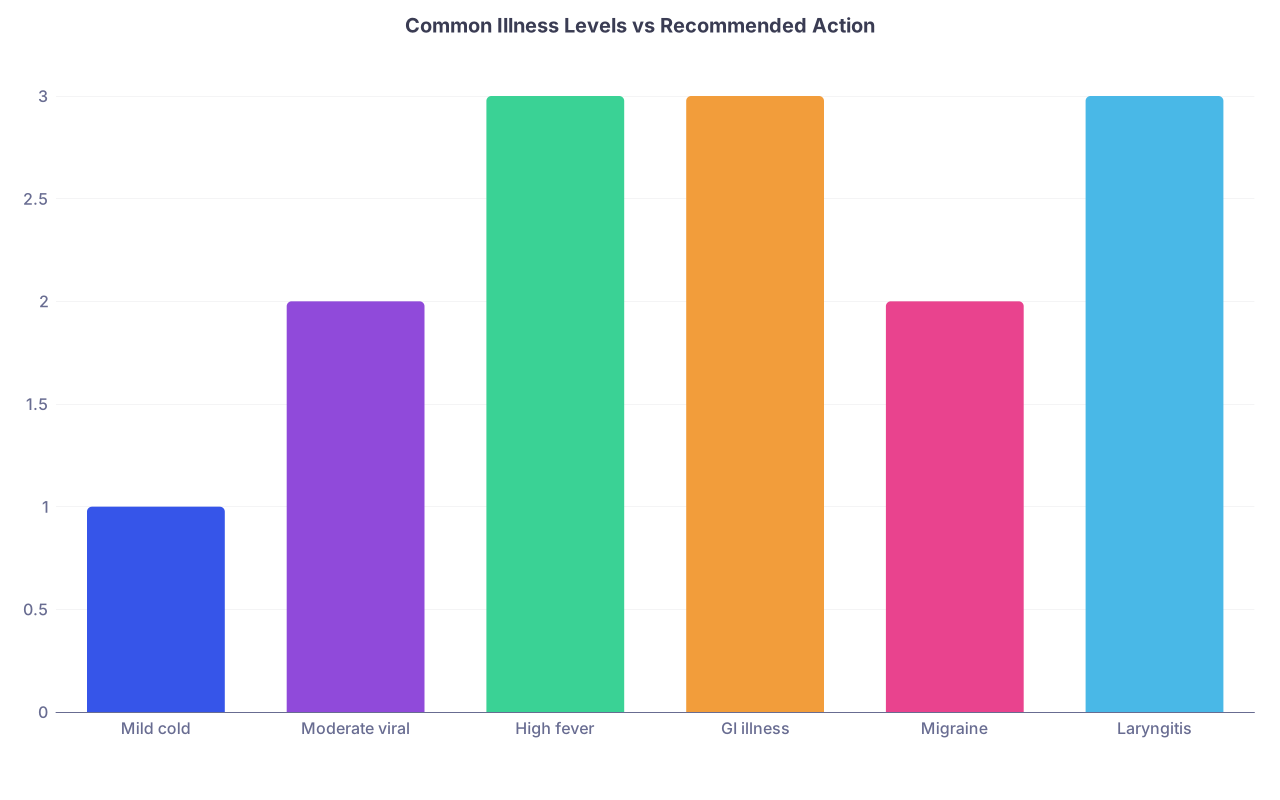
| Category | Value |
|---|---|
| Mild cold | 1 |
| Moderate viral | 2 |
| High fever | 3 |
| GI illness | 3 |
| Migraine | 2 |
| Laryngitis | 3 |
(Scale: 1 = usually interview, 2 = case-by-case, 3 = usually reschedule.)



Bottom Line: When to Cancel vs Push Through
Keep it simple:
- If you’re too sick to think, speak clearly, or stop running to the bathroom, reschedule. Protect your performance and your rank potential.
- If you’re mildly to moderately sick but can still function with smart symptom control, push through—especially for high-priority or late-season interviews.
- Communicate clearly and professionally either way. One short, well-written email is better than showing up a disaster on screen.
Make the decision like a physician-in-training, not a panicked applicant. That’s what programs want to see anyway.