

Halfway through your answer about why you love internal medicine, the attending on your screen glances down, types something, and does that little fake “uh‑huh” nod. Their eyes aren’t on you. They’re on something else. And right there, your stomach drops.
You’re still talking, but in your head you’re screaming: “They’re bored. I’m losing them. I’m bombing this.”
I’ve seen this play out more times than I can count—students walk out of a Zoom room convinced it’s over because the interviewer looked tired, checked their phone, or didn’t laugh at the one joke you thought was at least mildly funny. So let’s go straight at the fear you’re not saying out loud:
“Can I actually salvage an interview once I feel the interviewer is bored…or is it already dead?”
First: Are They Actually Bored, Or Am I Spiraling?
Let me be blunt: your brain is not a neutral observer here. It’s primed to interpret every micro‑expression as a rejection.
You see:
– They look away.
– They don’t smile.
– They don’t ask follow‑up questions.
– They sigh.
Your brain translates all of that into: “They hate me. I’m a terrible applicant. My entire career is now dependent on this one bored stranger on Zoom.”
But here’s the ugly little secret of virtual residency interviews that no one advertises on their website:
A lot of interviewers are exhausted, overbooked, and bad at hiding it.
They’re squeezing your interview in between:
– Pre-rounding and a noon conference
– Three consults in the ED
– Emails from GME about ACGME citations
– Their own kids’ school notifications pinging in the background
I’ve watched faculty literally:
– Scroll through emails while a student was giving a fantastic answer
– Turn off the camera “for a minute” and never turn it back on
– Yawn multiple times and then rank that same applicant very highly later
So here’s my first hard opinion: you’re over-interpreting a lot of normal, messy, distracted-human behavior as hatred or boredom with you.
Could they be bored? Yeah. Sometimes they are.
But usually, what you’re reading as “bored” is: tired, distracted, introverted, or bad-at-Zoom. Not “this person is terrible and I’d never work with them.”
That said, let’s take your nightmare seriously and assume the worst for a second: what if they are getting bored?
Now what?
What’s Actually Under Your Control Mid-Interview
You can’t control whether your interviewer had a brutal night on call. You can’t control their attention span, their personality, or how enthusiastic they look.
But you still have more control than it feels like in that moment.
The second you catch that “uh‑oh, they’re checked out” feeling, your instinct is to panic and either:
- Start talking faster and longer. Or
- Shut down, cut answers short, and look defeated.
Both of those read badly. The first looks like rambling. The second looks like low confidence.
The goal is to reset the interaction without visibly freaking out.
Here’s what that looks like in practice.
Concrete Ways To Salvage A “Bored” Zoom Interview
We’re going tactical now. This is the part you can rehearse.
1. Tighten Your Answers On the Spot
If you realize mid-answer, “I’m losing them,” you don’t need to keep driving that answer to its original planned conclusion. You can land the plane sooner.
You can literally do something like this:
“…and that’s when I realized I really value continuity of care.
So, to summarize, that experience taught me two things: first, I really enjoy working with patients over time, and second, I’m drawn to complex medical decision-making, which is why internal medicine feels like the right fit.”
Then stop talking.
What you just did:
– Signaled you can summarize.
– Gave them a clear “end” so they can jump in.
– Cut whatever rambling you were about to do.
Program directors love concise. Residents who can get to the point on rounds are gold. Tightening in real time doesn’t hurt you; it helps you.
2. Use a Quick Check-In Phrase
You don’t need a dramatic, “Am I boring you?” moment. Don’t do that.
Instead, if you’ve just given a chunk of an answer and they look a bit glazed, you can gently hand them control:
“…I can give a brief example of that if it’d be helpful, or I can stop there.”
or
“…That’s the broad strokes. I’m happy to go into more detail if you’d like.”
Now you look flexible and aware. If they’re bored, they’ll say, “No, that’s great,” and move on. If they were actually interested but just look dead inside (resting bored face is real), they might say, “Actually yes, tell me about that patient you mentioned.”
It gives you a read without sounding needy.
3. Shift From Monologue to Conversation
Zoom interviews tank when they become you talking at someone for 10–12 minutes straight.
When you sense they’re drifting, try to gently pivot to something more interactive. For example, if they ask: “Why this specialty?” and you’ve given your main answer, you might add:
“…and that’s my perspective so far from rotations. I’m actually curious—what do you think sets residents who really thrive in this program apart from the rest?”
Now you’re doing two things at once:
– Showing genuine interest.
– Buying a reset—because they have to talk.
Most faculty actually perk up when they get to talk about their own program or their own views. It’s easier for them than listening to 30 versions of the same memorized answer.
4. Change Your Energy, Not Your Personality
You don’t need to suddenly become a game-show host. That’s fake and obvious.
But you can bump things up 10–15%:
– Sit a little straighter.
– Look at the camera, not yourself.
– Talk just a bit more clearly and a bit less softly.
– Let yourself show a tiny bit more warmth when you talk about what you like.
Bored interviewers perk up when your energy reads like: “I actually want to be here,” not “I’m reciting because I practiced this answer 20 times.”
If they say, “Tell me about a patient that impacted you,” and your tone sounds the same as, “Tell me about a hobby,” it comes off flat. Tiny shifts help.
5. Use Specifics Instead of Vague Generalities
Boredom often comes from hearing generic, interchangeable answers:
“I like teamwork, I like teaching, I want to work with underserved populations, I value lifelong learning…”
Everyone says that. Literally everyone.
If you sense eyes glazing over, get more concrete, not more dramatic.
Instead of: “I’m really passionate about underserved care.”
Try: “On my family medicine rotation at the county clinic, I worked with a lot of uninsured Spanish-speaking patients. I remember one patient with uncontrolled diabetes who came in every three months only when her symptoms got unbearable because she couldn’t afford frequent visits. Being part of the team that got her on a plan she could follow long-term made me realize I want that kind of continuity in my career.”
Specific = more memorable. Less boring. More human.
6. Ask a Mid-Interview Question (Strategically)
If you feel like the energy is dying, you don’t have to wait until the end to ask a question. You can tuck one in naturally.
Example: they ask, “What are you looking for in a residency program?” You answer, then add:
“…One thing I’ve been trying to understand better is how different programs support resident education on busy services. How does your team balance patient volume with teaching on, say, a typical ward month here?”
Again, it forces them to engage. It shifts the rhythm. And it signals you’re picturing yourself there, not just listing generic criteria.
7. Don’t Mirror Their Apathy
This is a big one. If they’re flat, your instinct might be: “They don’t care, why should I?” and your affect drops too.
Then they walk away thinking you weren’t very enthusiastic.
You’re allowed to be the more energetic one. It doesn’t make you weird. It makes you the person who still showed up fully even when the interviewer was half‑fried from night float.
I’ve seen applicants get ranked highly by people they swore were bored stiff, simply because the applicant still came across as engaged and solid.
The Part You’re Scared To Ask: Does a “Bored” Interview Mean I’m Rejected?
Not necessarily. Often, not at all.
Here’s what people forget: your interviewer might be filling out a standardized form or quick impressions later. Those forms usually don’t have a checkbox for “I looked bored.”
They’re thinking about:
– Did this person seem normal to work with at 2am?
– Were they clear, honest, reasonably self-aware?
– Would they be okay with my patients?
– Did they show any genuine interest in this field and our program?
I’ve watched committee meetings where someone said, “Yeah, I remember that student, I was a little out of it that day but they seemed solid, good experiences, nothing concerning.” And that applicant ended up ranked in the top half.
On the flipside, I’ve also seen:
– The overly polished applicant who went on for 4 minutes per question, never reading the room.
– The one who clearly shrank inside once they perceived “boredom,” and their answers got clipped and nervous.
Those do hurt. Not because the interviewer was bored. But because of how the applicant reacted to that feeling.
So no, a flat interviewer doesn’t doom you. Your response to that flatness matters more than the flatness itself.
After the Call: How Much Should You Obsess?
You already know the answer: you’re going to overanalyze it anyway.
But if you want to stay sane, there are a few rules I’d use:
– Don’t rewatch the Zoom if it was recorded by you. That’s just self-punishment.
– Don’t text five friends for “Was that bad?” validation. They weren’t in the room.
– Do write down 1–2 specific things you think you can do better next time (“shorten stories,” “have one patient example ready for each major question”).
– Then move on.
Also, remember: interviews are graded on overall performance across all your meetings, not one 20-minute slot with a tired associate program director who was answering Epic messages off-camera.
If most of your interviews felt okay and one felt off? Committees see the pattern, not the outlier.
A Quick Reality Check: What Programs Actually Care About
Let me put some structure to this, so it’s not just vibes.
| Factor | Impact on Your Evaluation |
|---|---|
| Professionalism (on time, respectful) | High |
| Clarity and conciseness | High |
| Genuine interest in specialty/program | High |
| Nonverbal energy (engaged vs. slumped) | Moderate |
| Whether they looked bored themselves | Low to none |
Most faculty aren’t sitting there thinking, “Was I visibly enthusiastic enough?” They’re thinking, “Did this person seem like someone I wouldn’t dread being on call with?”
You can absolutely survive—and even score well—on an interview where your internal monologue is screaming, “They hate me.”
If you stayed composed, answered clearly, and didn’t shut down, you probably did better than you think.
What You Can Rehearse Before the Next Zoom
If you’ve had one of these “oh god, they’re bored” interviews already, you can build some muscle memory for the next one.
Practice:
– Giving a 60–90 second version of your main answers (why this specialty, why this program, tell me about yourself)
– Ending with a natural check-in line: “I can give a quick example if you’d like.”
– Adding one specific detail to generic answers.
– Asking one on-the-fly question mid-interview if it fits the flow.
You’re not trying to control the interviewer. You’re building your ability to pivot when things feel off, so you don’t derail yourself.
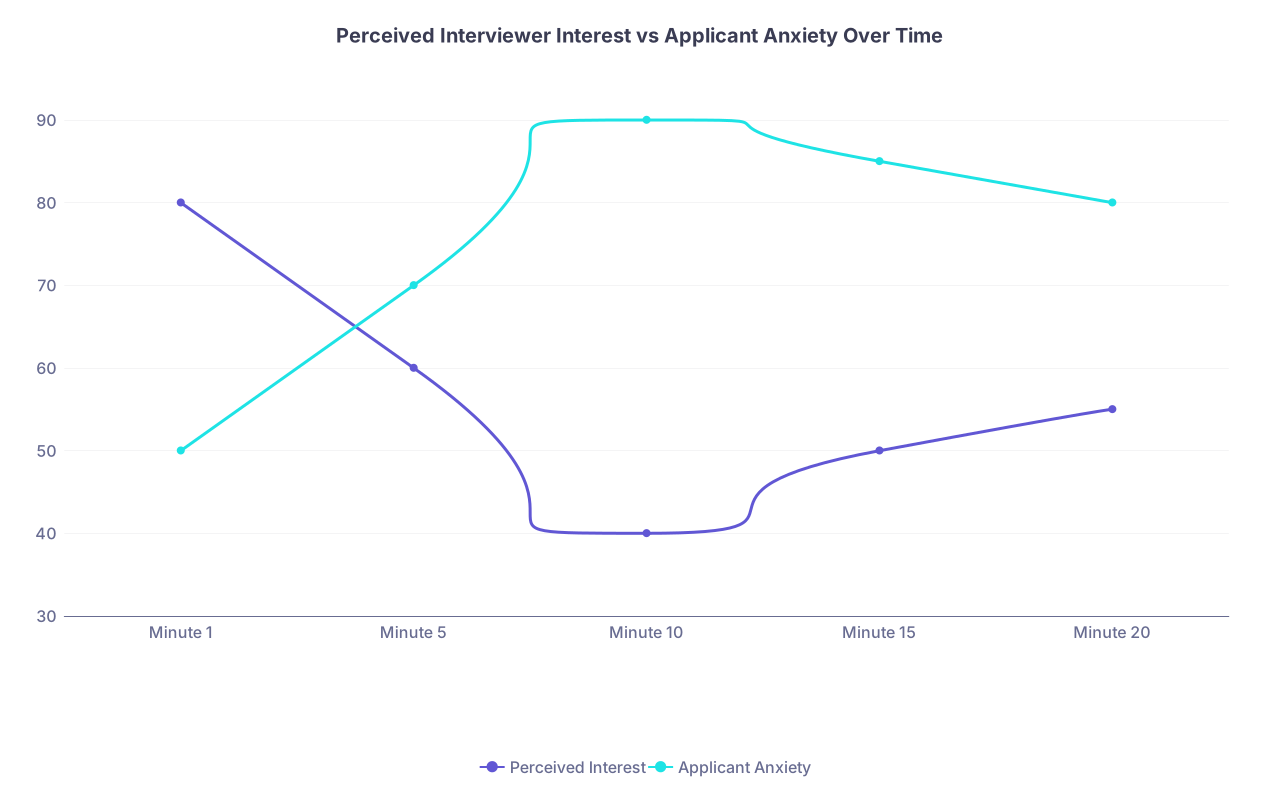
A Visual of How Your Panic Actually Spikes
Just to normalize how nonlinear this feels:
| Category | Perceived Interest | Applicant Anxiety |
|---|---|---|
| Minute 1 | 80 | 50 |
| Minute 5 | 60 | 70 |
| Minute 10 | 40 | 90 |
| Minute 15 | 50 | 85 |
| Minute 20 | 55 | 80 |
See how your anxiety spikes as you think their interest is dropping? That doesn’t mean their actual evaluation is plummeting with it. Those lines don’t mirror each other in real life.
Zoom Weirdness Is Not a Moral Judgment on You
Last thing, because it’s easy to forget this: Zoom is a deeply unnatural way to decide where you’ll spend the next 3–7 years of your life.
There are lag issues. People talk over each other. Cameras freeze. Kids scream in the background. Someone’s pager goes off. Someone forgets to unmute and you both do that awkward wave-and-mouth-“Can you hear me?” thing.
None of that means you’re unworthy.
The programs know this process is weird. They factor it in. They’ve had incredible residents who were mediocre interviewers. They’ve had blazing, charismatic interviewees who turned out to be passive or unreliable when the real work started.
You’re not being judged on whether you can read a micro-expression over a sketchy Wi‑Fi connection and perfectly adjust. You’re being judged on whether, overall, you look like a reasonably thoughtful, teachable, non‑disastrous human.
And you don’t need every single interviewer to love you. You just need the right ones to see you clearly.
FAQs
1. If I see the interviewer checking their phone or email, should I say anything?
No. Don’t call it out, don’t awkwardly stop and wait. Just keep your answer going, then end it a bit more concisely and give them an easy handoff like, “That’s the main example that comes to mind.” Their distraction is about them, not you. Your best move is to stay composed and avoid showing visible irritation or insecurity.
2. Is it okay to change my answer mid-way if I realize I’m rambling?
Yes, absolutely—and it usually looks better than forcing a long, over-rehearsed story. You can cut yourself off gracefully by saying something like, “I realize that was a longer answer—big picture, what that experience taught me was…” and then give your 1–2 key takeaways. That shows self-awareness and the ability to self-edit, which is exactly what people want in a resident.
3. What if they don’t smile or react to anything I say the whole time?
Some interviewers are just flat on Zoom. It might be their personality, their day, or the tenth interview they’ve done this week. Don’t chase their approval with jokes or oversharing to “get a reaction.” Keep giving clear, specific answers, show steady interest, and assume their internal impression may be warmer than their facial expression suggests.
4. I had one interview where I’m sure I lost them—will that ruin my rank at that program?
One lukewarm interview rarely destroys you, especially if other interviewers at the same program liked you. Committees look at the overall pattern of feedback. If most of your interviews are described as “engaged, solid, nice to work with,” and one is “okay, a bit nervous,” that’s not a death sentence. It becomes a data point, not your entire identity.
5. Can sending a thank-you email fix a bad or boring-feeling interview?
A thank-you email won’t magically erase a truly awful interaction, but it can reinforce a neutral or mildly positive one. If you send a short, specific note (“I appreciated hearing about your approach to resident autonomy on the ICU”) you might nudge their memory of you slightly upward. Just don’t treat it like a second interview—no long explanations or apologies for how nervous you were. Say thanks, be specific, and let it go.
Years from now, you won’t remember exactly how many times an attending glanced at their inbox during your Zoom interview. You’ll remember that you kept showing up, answer after answer, even when your brain whispered, “They’re bored.” That’s the part that actually carries you through residency.


