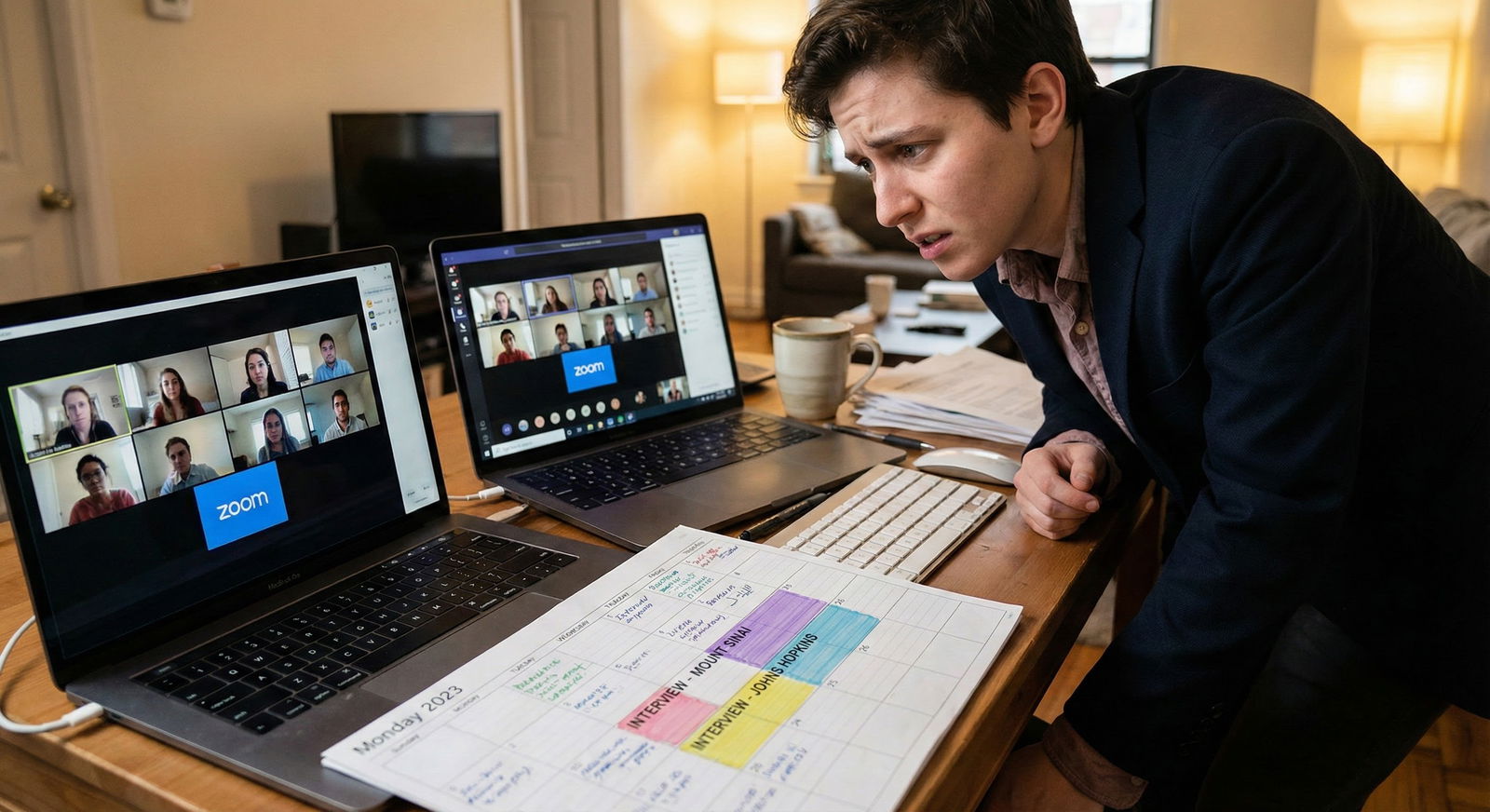
It’s 7:12 p.m. You just refreshed your email for the thousandth time, and there it is — a new virtual interview invite from a program you actually really want. You open it, hands slightly shaking, and your stomach drops.
The date.
You already have an interview that day.
Your brain immediately goes to: “I’m screwed. I can’t say no. I can’t reschedule. If I ask to reschedule, they’ll think I’m not interested. If I don’t ask, I’ll have to pick one and blow up the other. And if I try to do both, I’ll look unprofessional and get blacklisted forever.”
Yeah. Welcome to October–January of residency season.
Let’s untangle this without sugarcoating it.
First: You’re Not the First Person This Has Happened To
Programs absolutely know interviews overlap. They know you’re applying to multiple places. They literally stack interviews all on the same weekdays for months. Of course there are conflicts.
I’ve watched people:
- Have three interviews scheduled the same day
- Get offered a time that overlaps a mandatory exam
- Accidentally double-book themselves into two interviews that literally start at the same time
No one’s career imploded. No one got “blacklisted from the match.” The fear is bigger than the actual risk.
Does that mean you can be sloppy? No. But you do have options. Real ones.
Step 1: Get Calm and Get Data (Not Drama)
Before spiraling into “I’ll never be a doctor,” you need actual facts.
Open your calendar and write down the details:
- Program A: date, time (with time zone), platform (Zoom/Thalamus/Teams), schedule details if you have them
- Program B: same thing
Confirm time zones. This sounds insultingly obvious, but every year someone panics about a conflict that isn’t real because one is EST and one is CST.
If you can, map out the blocks like this:
| Program | Time (local) | Components Included |
|---|---|---|
| A | 8:00–12:00 | Orientation + 2 interviews |
| B | 10:30–2:30 | Interviews + resident lunch |
Then look for:
- Actual direct overlap (e.g., both 9–1)
- Partial overlap (e.g., 8–12 and 10–2)
- Potential wiggle room (e.g., one has a “social lunch” you could miss if absolutely necessary)
You need this reality check before you start emailing anyone.
Step 2: Decide Your Priority (Yes, You Have to Pick One)
This is where people freeze. You want both. Obviously.
But if push comes to shove and you can only fully attend one, which one wins?
Think about:
- How you’d feel if you lost Program A forever
- How you’d feel if you lost Program B forever
Whichever loss makes your chest tighten more — that’s your priority.
You’re not locking anything in yet; you’re just being honest with yourself. It matters, because that’s the one you’re going to fight hardest to protect.
If both feel equal, that’s fine. But avoid the “I love them all the same” fantasy. When the emails start, you’ll need clarity.
Step 3: Can You Logistically Do Both Without Being Sketchy?
Here’s the part everyone secretly thinks about: “Can I kind of… do both interviews… at the same time?”
Usually? No. Not without looking scattered or rude somewhere.
But sometimes you actually can do both ethically and professionally, if:
- One program’s schedule has big breaks and
- The other can offer you a shorter block or slightly off-time slot
You need to see the structure first. A lot of invites don’t include the full itinerary. It’s perfectly normal to email and ask.
Something like:
Hi Dr. Smith,
Thank you very much for the invitation to interview at [Program]. I’m very excited about the opportunity.
I wanted to ask a quick scheduling question — could you share the approximate time frame and structure of the interview day (orientation, interviews, breaks)? I want to make sure I can be fully present and avoid any conflicts.
Thank you again,
[Name], AAMC ID [#######]
This doesn’t reveal the conflict yet. It just gets intel. Programs send this info all the time.
Once you know the structure, you’ll see whether doing both is actually realistic or just your anxiety trying to negotiate with time.
Step 4: Rescheduling — The Thing You’re Terrified to Ask For
Let me be blunt: asking to reschedule one interview is normal. Everyone acts like it’s some fatal insult. It isn’t.
Where people screw up is either:
- Waiting too long
- Writing weird, overly vague or sketchy emails
- Asking for something impossible (like “only that one Friday afternoon slot that everyone wants”)
Your email should be:
- Prompt (within 24 hours of seeing the conflict, ideally)
- Polite
- Short
- Honest, but not oversharing
Do not say you have “another residency interview” if you’re scared that sounds bad. You don’t owe them that level of detail. Programs assume you’re interviewing elsewhere.
You can say “I have a prior professional commitment I can’t move.” Which is true.
Here’s a template:
Subject: Interview Date – Schedule Conflict
Dear [Coordinator/Dr. X],
Thank you very much for the invitation to interview at [Program]. I’m truly excited about the opportunity and very interested in your program.
I’m writing because I have a conflicting professional commitment on [original date] that I’m unable to move. I was wondering if there might be any alternative interview dates or sessions available. I’m happy to be flexible with time and join any group that has an opening.
I completely understand if rescheduling isn’t possible, but I wanted to check in case there were any other options.
Thank you again for your time and consideration,
[Name], AAMC ID [#######]
That’s it. You don’t need to send them your entire life story.
Step 5: What If There Are No Other Dates?
This is the nightmare scenario your brain jumps to immediately: “What if they say no and that’s it and I blew my only chance?”
Sometimes there really aren’t other dates. Or they’ll say, “We’re fully booked; we’ll put you on a waitlist for cancellations.”
Here’s the uncomfortable truth: occasionally you will lose an interview. It sucks, but it doesn’t destroy your match chances by itself.
When that happens, you go back to the priority call:
- If the higher-priority program is the one you can attend → you accept that you’re sacrificing the other
- If the higher-priority program is the one that won’t reschedule and you’re currently committed to the other → then you make a decision: cancel the lower-priority one or not
Canceling an interview is emotionally brutal the first time, but people do it every cycle. You are allowed to protect the option that actually matters more to you.
And no, cancelling one interview, politely, does not send your name to some secret national blacklist.
You send something like:
Dear [Coordinator/Dr. X],
Thank you again for the opportunity to interview at [Program]. Unfortunately, an unavoidable professional conflict has arisen on [date], and I will no longer be able to attend my scheduled interview.
I sincerely appreciate your time and consideration, and I’m very sorry for any inconvenience this causes.
Best regards,
[Name], AAMC ID [#######]
You don’t ask to be reconsidered. You don’t ramble. You accept that this one is gone and you focus on what’s still on the table.
Step 6: The “Split Day” Option (High-Stress, Use Sparingly)
Sometimes, you’ll hit this gray zone:
- Program A: 8–12, interviews 8:30–10:30, social/time filler 10:30–12
- Program B: 12–4, interviews 1–3, orientation 12–1, social 3–4
Is it technically possible to do both? Yes. Is it ideal? Not really. But the match is not ideal. It’s survival mode.
If you’re going to attempt a split day:
- Do not try to secretly skip core interviews at either program.
- If you must miss a “social” or optional event, let the coordinator know ahead of time and give a brief, respectful reason.
- Leave buffer time between blocks. You need bathroom/food/mental reset.
For example:
Dear [Coordinator],
Thank you again for the detailed schedule. I wanted to mention that I have an unavoidable commitment later that afternoon, and I may need to step away by [time]. I will, of course, be fully present for all core interviews and program presentations. Please let me know if that will pose any issues.
Best,
[Name]
You don’t spell out that you’re jumping to another interview. They already suspect these conflicts exist. You just show you’re proactive and respectful.
But honestly? If trying to do both means you’ll be distracted, sweaty, glitching audio, and not performing well at either, pick one. A strong performance at one program beats a mediocre performance at two.
Step 7: Stop Imagining They’re Judging You as a Person
A lot of the anxiety here is story-based, not fact-based. You’re imagining:
- The PD seeing your reschedule email and saying, “Clearly not committed. Reject.”
- Coordinators whispering to each other about you
- Some magical note added to your file: “Asked to reschedule — red flag”
Let me be real. Most of the time, your email is one of fifty they got that morning. They skim it between putting together Zoom links and chasing a faculty member who hasn’t replied in three weeks.
Reschedule requests are common. Conflicts are common. People getting sick is common. Programs understand that.
Where you stand out is:
- Being prompt
- Being professional
- Not making their lives harder than they already are
You don’t need to be perfect. You just need to not be chaotic.
What If You Mess Up and Double-Book Anyway?
Say worst case happens:
- You accept two interviews for the same time
- You realize it late
- You feel like garbage
You still have to fix it. Quickly.
You apologize. You don’t write a novel about how burned out you are and how your cat is sick and how ERAS is confusing.
Something like:
Dear [Coordinator],
I’m so sorry — I just realized that I mistakenly scheduled another commitment at the same time as my interview on [date/time]. This was entirely my error.
I understand if rescheduling isn’t possible, but I wanted to reach out as soon as I noticed the conflict to see if there might be any alternate times or dates available.
I apologize again for the confusion and appreciate your understanding.
Best regards,
[Name]
You will feel like an idiot sending that. You’ll hit send and then stare at your email like you just detonated your career.
But in reality, I’ve seen this exact situation play out dozens of times. Usually they offer another slot if they have one. Sometimes they can’t. And everyone moves on.
Quick Reality Check: How Bad Is This Actually?
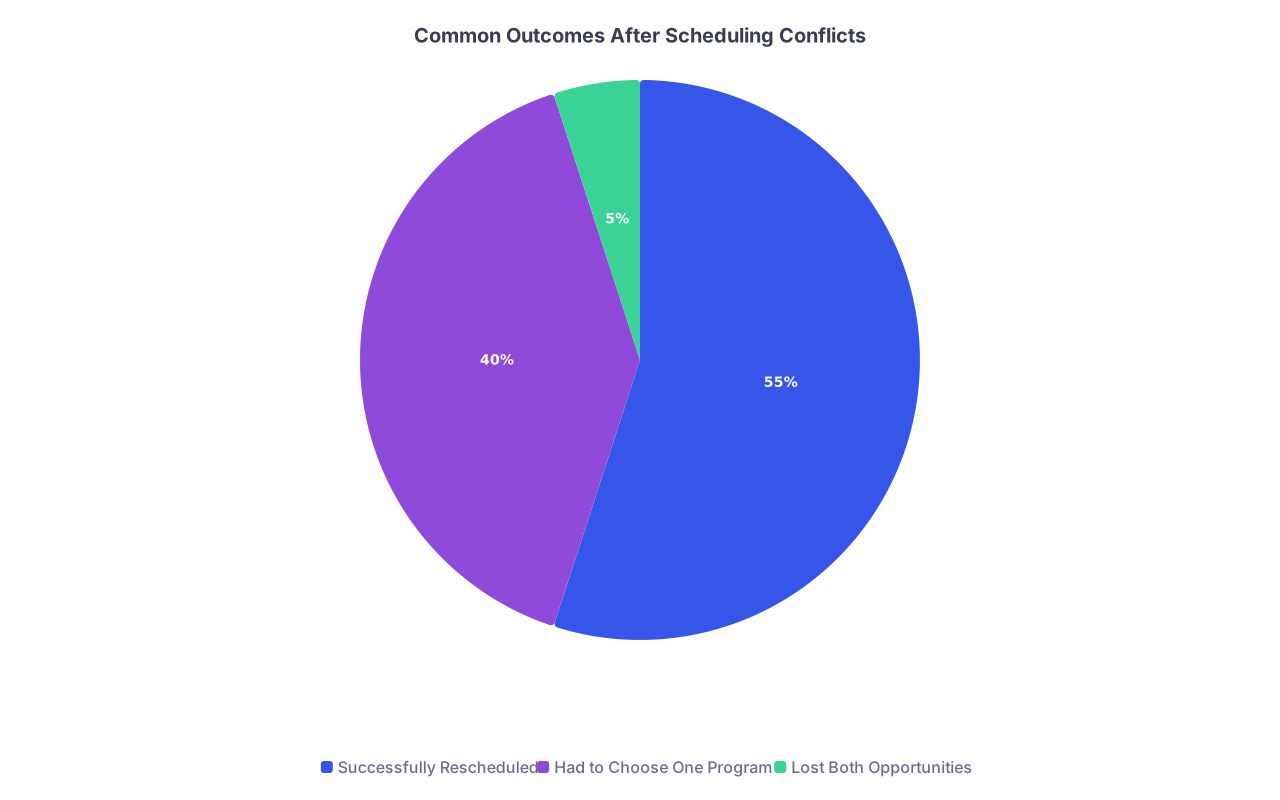
Let’s put your fear up against reality for a second.
| Category | Value |
|---|---|
| Successfully Rescheduled | 55 |
| Had to Choose One Program | 40 |
| Lost Both Opportunities | 5 |
That’s roughly what I’ve seen, anecdotally, across multiple cycles with students:
- Most people get at least one program to adjust
- Some people are forced to pick one program
- Very few people end up totally empty-handed from the whole mess
The match is about patterns, not single events. One lost interview doesn’t define your entire season.
How to Protect Yourself Going Forward
Is this preventable? Not completely. But you can reduce the chaos.
Use one central, living calendar — not a mix of sticky notes, screenshots, and mental tracking. And block interview days, not just hours. If a day is already taken and a new invite comes in for that same day, you immediately know you’ll probably need to reschedule one.
Also, before you click any automatic “self-schedule” link on Thalamus/Interview Broker/whatever, pause and check your calendar first. Those systems let you grab slots fast, which is great, but they also let you lock yourself into bad conflicts in 10 seconds flat.
And if you’re really overwhelmed, literally write it out by week on paper. I’ve seen people walk into my office with a color-coded legal pad; it wasn’t pretty, but they weren’t double-booked.

| Step | Description |
|---|---|
| Step 1 | Receive Second Interview Invite |
| Step 2 | Check Calendar & Time Zones |
| Step 3 | Accept Both |
| Step 4 | Get Full Schedules from Programs |
| Step 5 | Plan Split Day Carefully |
| Step 6 | Choose Priority Program |
| Step 7 | Request Reschedule from Lower Priority |
| Step 8 | Confirm New Date |
| Step 9 | Decide Whether to Cancel One |
| Step 10 | Actual Overlap? |
| Step 11 | Can You Attend Both Fully? |
| Step 12 | Reschedule Possible? |
FAQs
1. Will asking to reschedule an interview hurt my chances at that program?
Probably not, if you do it politely and promptly. Programs expect conflicts. A brief, respectful reschedule request with clear interest in the program doesn’t read as “red flag,” it reads as “normal applicant.” What does hurt you is ghosting, last-minute chaos, or sounding entitled about specific time slots.
2. Should I tell them the conflict is another residency interview?
You don’t have to, and I usually don’t recommend it. Not because it’s some scandal, but because it adds nothing. “Unavoidable professional commitment” is enough. If a PD directly asks (rare), you can be honest and say, “Yes, I had another interview that day” without drama. They know you’re applying broadly.
3. Is it okay to miss the social/resident lunch part to fit two interviews in one day?
It’s not ideal, but it’s sometimes the least bad option. If you must miss a social event, email ahead of time, frame it as a schedule constraint, and make sure you attend all core interviews and program presentations. Just remember: those social parts are where you really feel program culture, so skipping all of them at multiple places has a cost.
4. What if I don’t realize the conflict until really late, like the week of the interview?
Then you still fix it — immediately. Apologize, own the mistake briefly, and ask about alternatives. Late is worse than early, but it’s still recoverable. I’ve seen programs squeeze people in on backup days or shorter alternate sessions when they liked the applicant and had any flexibility at all.
5. Can I rank a program highly if I had to cancel or reschedule once?
Yes. Your rank list is your business. Programs are not tracking “requested reschedule” as some permanent strike against you. As long as you ultimately interviewed and didn’t behave unprofessionally, you can rank them wherever they honestly belong. The match algorithm doesn’t care that you moved your interview from November 10 to November 28.
6. What if I lose an interview at a program I really liked — is there anything I can do?
Realistically, not much. You can send a brief, sincere note of appreciation and regret when you cancel or when they can’t accommodate rescheduling, but you don’t beg for exceptions or ask for “future consideration.” Then you redirect that energy to doing as well as possible at your remaining interviews and possibly broadening your list with additional applications if it’s still early enough.
Bottom line:
You are allowed to have scheduling conflicts.
You are allowed to ask to reschedule without tanking your chances.
And if you do lose one interview, it’s a setback, not a sentence.
Handle it quickly, politely, and without drama — then move on to the next thing that actually needs your energy.