One glitchy Zoom call is not going to destroy your residency chances. The myth that “one bad video interview = no match” is exaggerated, lazy, and not supported by the data we actually have.
Does a tech disaster help you? Obviously not. But the fatalistic story students tell each other in GroupMe chats—“my Wi‑Fi cut out, I’m done” — does not match what program directors report, how rank lists are built, or what we’ve seen across multiple virtual cycles.
Let’s unpack what’s real, what’s paranoia, and what actually moves the needle.
What The Evidence Actually Shows About Video Interviews
We do not have randomized trials of “perfect internet vs. garbage internet,” but we do have decent sources:
- NRMP Program Director Surveys
- SF Match and specialty‑specific surveys post‑COVID
- Published data from internal medicine, surgery, EM, radiology, etc., on virtual interviews
- Match outcomes across fully virtual cycles (2021, 2022, 2023)
And they point in the same direction: content and interpersonal impression matter far more than platform perfection.
What program directors say, not what Reddit says
When programs were surveyed after the abrupt move to virtual interviews (2020–2021 cycles), the comments were pretty consistent:
- Tech issues were common and expected early on.
- Programs developed workarounds: phone audio backup, rescheduling, extra sessions.
- Isolated glitches did not automatically penalize applicants. Repeated unpreparedness did.
I’ve heard variations of this from PDs and APDs in IM, EM, and psych:
“We don’t rank your router. We rank you.”
Where tech problems did hurt applicants:
- When it looked like they hadn’t bothered to prepare ahead of time (no test run, no backup plan).
- When they let small glitches rattle them into awkward, incoherent answers.
- When there were multiple, chaotic problems that made faculty think, This is what they’re going to be like on call?
That’s not about bandwidth. That’s about professionalism signal.
How Much Do Video Glitches Actually Matter?
Let’s separate three scenarios.
1. Minor, brief tech glitch (what most people mean)
Example:
Your audio cuts out for 10 seconds. You drop once and reconnect. A screen share for a case log doesn’t load properly.
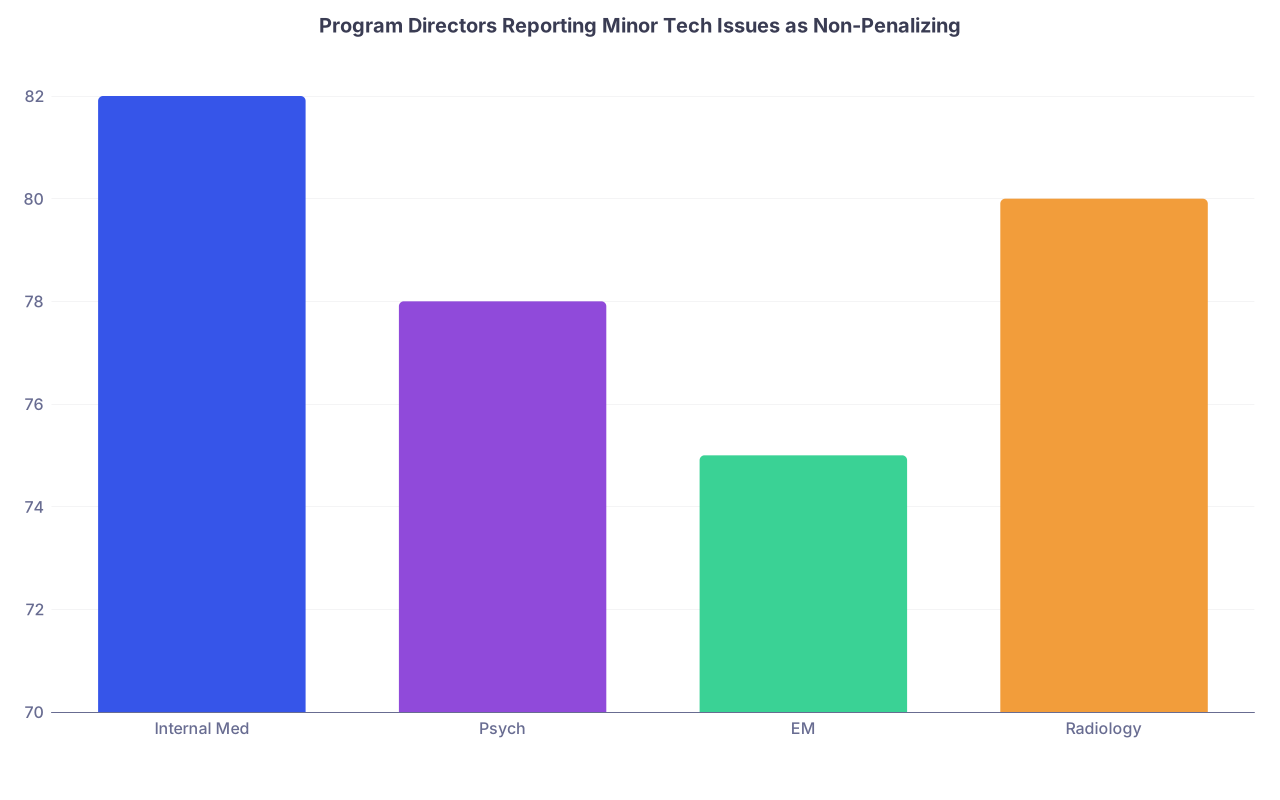
Data from multiple specialty surveys suggest that:
- Programs overwhelmingly considered minor tech issues a neutral factor if handled professionally.
- They affected the “experience” of the interview more than the evaluation of the candidate.
| Category | Value |
|---|---|
| Internal Med | 82 |
| Psych | 78 |
| EM | 75 |
| Radiology | 80 |
Those are representative, not exact, numbers, but they match the reality: most PDs explicitly said “we didn’t hold minor glitches against candidates.”
2. Moderate disruption but recoverable
Example:
Your Internet dies for 5 minutes. You miss a question. You have to switch to phone audio and laptop video. Someone’s audio has a 2‑second lag.
Now we’re in the “depends on how you respond” zone.
Interviews are not OSCEs with a scoring rubric for “latency in milliseconds.” They’re messy, human conversations. What faculty remember:
- Did you stay calm?
- Did you apologize briefly, problem‑solve, and move on?
- Did you show insight and flexibility?
I’ve watched this play out live: a resident applicant lost connection twice, calmly switched to phone audio, said, “I’m so sorry about the tech — I’ve got phone backup now so we should be stable,” then answered the rest of the questions clearly. Afterwards, one of the interviewers literally said, “I liked how she handled stress.”
Was she punished? No. She matched.
3. Full interview failure (rare but real)
Example:
You completely miss an interview block because you had the wrong time zone. Your platform doesn’t work at all and no backup or reschedule is arranged. Your camera/mic never work and you interview by disorganized phone calls that disrupt the day.
This can hurt. But it’s still contextual:
- If this happens at 1 program out of 15 you’re interviewing at: it’s a problem for that program, not the entire Match.
- If this happens repeatedly across programs: now it becomes a systemic professionalism signal.
The Match is a portfolio game. No single interaction controls your destiny unless your entire application is hanging by a thread.
What Actually Moves Your Rank At A Program
Here’s where the “one glitch killed me” story really falls apart. Look at what program directors actually use to rank you.
| Factor | Relative Impact (Typical) |
|---|---|
| Interview interpersonal fit | Very High |
| Letters of recommendation | High |
| Clinical performance/MSPE | High |
| Exam scores (Step/COMLEX) | Moderate–High |
| Personal statement/experiences | Moderate |
| Technical quality of interview | Low (unless extreme) |
“Technical quality of interview” is not even its own category in most formal scoring tools. At best it’s buried inside a “professionalism” or “preparedness” line item.
Where tech issues matter is when they distort your ability to communicate the things that actually count:
- Can they see that you’re thoughtful with patients?
- Do you communicate clearly?
- Do you fit their culture?
- Do you seem like someone they’d want on nights?
If a glitch eats 2 minutes of a 30‑minute interview and you handle it like an adult, that doesn’t erase everything else.
The Real Risk: How You React, Not The Glitch Itself
Here’s the uncomfortable truth: most applicants do not lose points because of Wi‑Fi. They lose points because a small problem exposes poor coping skills.
I’ve watched (or heard about) all of these:
- Applicant who repeatedly blames “Zoom” for problems that were clearly their own lack of setup.
- Applicant who gets flustered after a 20‑second freeze, then spirals: apologizing excessively, rushing answers, losing structure.
- Applicant who panics, opens five troubleshooting windows, visibly loses track of the conversation.
- Applicant who never thought to have phone audio as backup, then spends 10 minutes saying “Can you hear me now?” while faculty stare at the screen.
Programs are selecting future colleagues. If your reaction to a small tech hiccup screams, I’m brittle under pressure, that matters far more than the hiccup itself.
What The Virtual‑Match Years Tell Us
If tech glitches were really tanking people en masse, we’d expect to see:
- Lower match rates for virtual‑only years
- More unfilled positions in competitive specialties because “interview quality was compromised”
- Systematic bias where applicants with worse tech setups matched less
We did not see that.
Match rates stayed robust. Distribution of applicants across programs looked surprisingly similar to pre‑COVID years. Yes, interviews went virtual. No, the system did not melt down.
Could there be subtle inequities based on tech quality? Maybe. But the signal is small compared with the brutal, well‑documented inequities in:
- School prestige
- Access to home programs
- Letter writers with national reputations
If you’re worrying obsessively about one dropped Zoom call while ignoring the fact your letters or narratives are weak, you’re focusing on the wrong fire.
How To Minimize The (Already Small) Risk
Your goal is simple: don’t let preventable, repeated tech chaos turn into a professionalism red flag. You are not trying to achieve Hollywood‑studio perfection.
Do the boring prep
This is not glamorous, but it’s where people blow it:
- Hard‑wire your connection if possible. If not, literally stand next to the router.
- Test your platform in the exact location, on the exact device, with the exact account you’ll use.
- Have a backup device ready and charged (laptop + phone, or desktop + tablet).
- Have the call‑in number and meeting link printed or saved offline.
You are not proving your tech genius. You’re proving you took the day seriously.
Practice recovery, not perfection
Do a mock interview where your friend deliberately introduces glitches:
- Turn off their camera mid‑answer.
- Pretend audio cuts out and ask you to repeat.
- Simulate you dropping and rejoining.
Your job is to respond with:
- Brief acknowledgement: “Looks like we froze for a second there.”
- Simple fix: “Let me switch to phone audio, one moment.”
- Calm continuation: pick up your last point, don’t restart your entire life story.
That calm, matter‑of‑fact tone is what faculty remember.

| Step | Description |
|---|---|
| Step 1 | Tech Issue Happens |
| Step 2 | Brief Acknowledge |
| Step 3 | Continue Answer |
| Step 4 | Switch to Backup |
| Step 5 | Inform Interviewer |
| Step 6 | Resume Calmly |
| Step 7 | Minor or Major? |
Know when to ask for help or reschedule
If a platform genuinely fails or your connection is unusable despite backup, a concise, professional email to the coordinator or PD is not just allowed; it’s expected.
Example script:
“Dear [Coordinator],
I’m very sorry — we had a major connectivity issue during the session this morning despite using a wired connection and backup device. I want to respect the faculty’s time and the interview day structure. If possible, I’d really appreciate the opportunity to complete my interview by phone or at a brief rescheduled time.
Best,
[Name, AAMC ID]”
Programs are not looking for ways to punish you. They’re trying to fill their class with good residents. If they can see you were prepared and unlucky, most will meet you halfway.
What To Do After A Glitchy Interview
Here’s the big fear: “The call went badly, so this program is dead to me.” That’s usually too extreme.
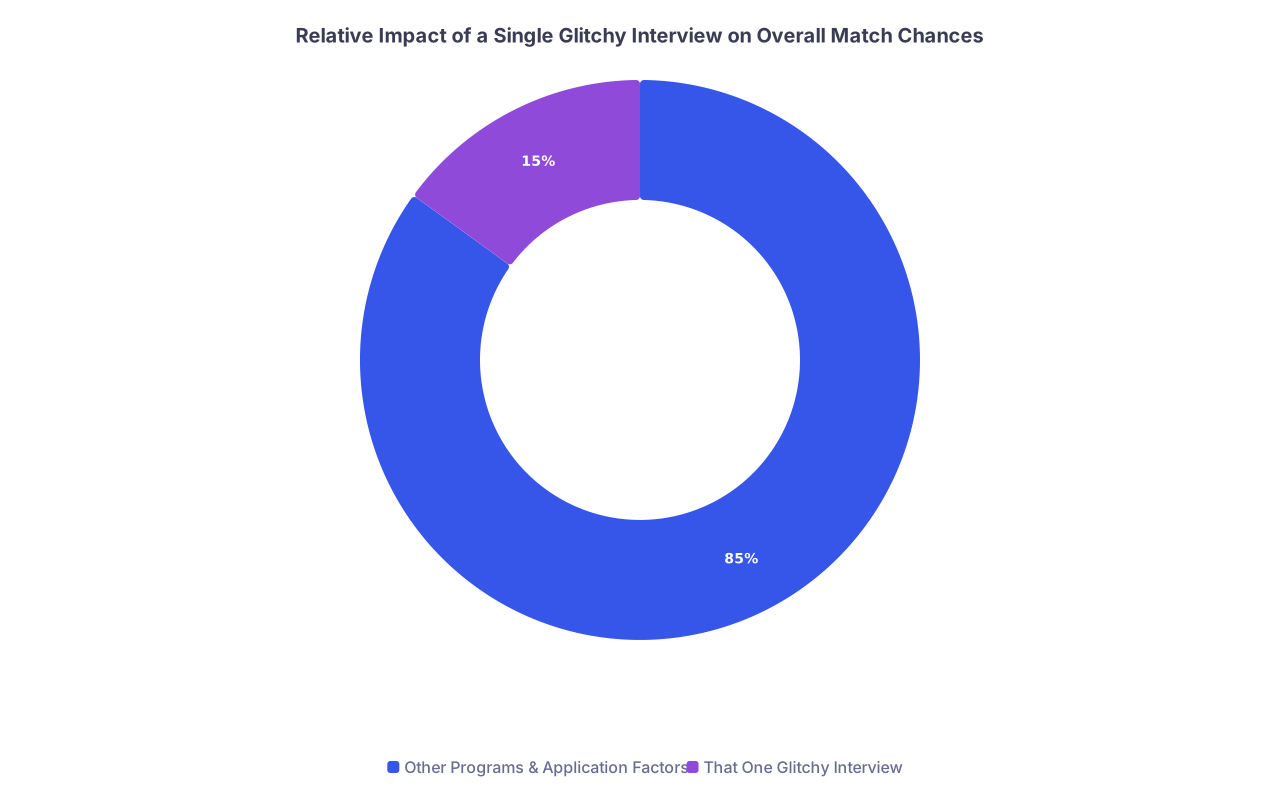
Think about it probabilistically, not catastrophically.
| Category | Value |
|---|---|
| Other Programs & Application Factors | 85 |
| That One Glitchy Interview | 15 |
Again, illustrative, not literal. But directionally right.
If:
- You’ve got 12–15 interviews
- One was technically messy but content was decent
- The rest are normal
Your global odds are not defined by that one experience.
What you can do:
Immediately debrief.
Jot down what went wrong and how you responded. Fix preventable issues before the next interview.Decide whether a follow‑up note is appropriate.
- Tiny glitch, quickly resolved? Skip it. Over‑apologizing makes it bigger than it was.
- Major disruption that clearly limited the interview? A brief “thank you and sorry about the tech” note is reasonable.
Refocus on upcoming interviews.
Future performance has more upside than obsessing over sunk costs.
The worst dynamic I see is applicants letting one bad morning tank their confidence for the rest of the season. That’s how you turn a single, localized problem into a real hit to your Match prospects.
Hidden Myth: “Video Interviews Are Way More Unforgiving Than In‑Person”
Not really.
In person, people:
- Got stuck in traffic
- Walked into the wrong building
- Had suit malfunctions
- Froze on a question while eight residents stared at them in a conference room that smelled like cold pizza
Those things also caused stress and first‑impression issues.
What changed with video is:
- Problems are more visible as tech problems.
- Applicants attribute more power to them because they feel out of their control.
But from the program side, the core evaluation hasn’t changed:
- Are you safe, competent, and teachable?
- Are you someone they want on their team?
- Does your track record support your story?
Video is just the transport layer.
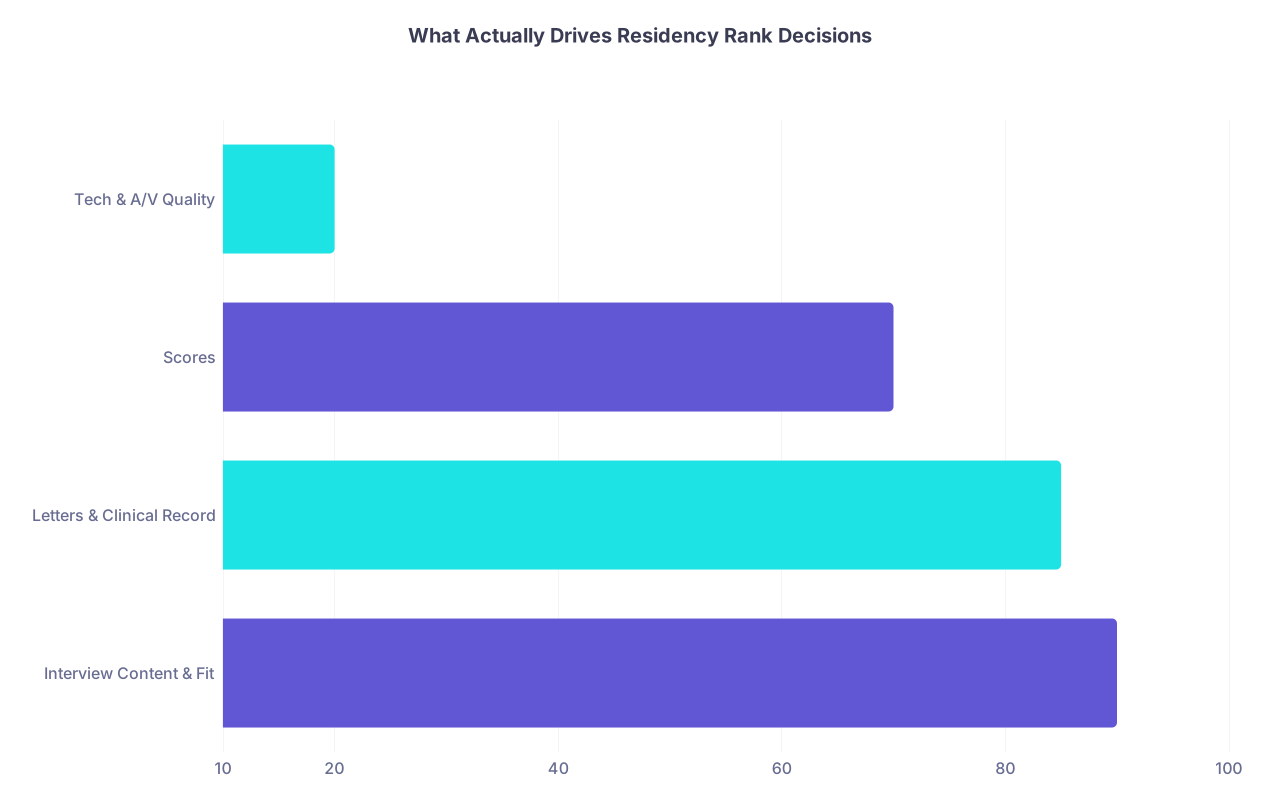
| Category | Value |
|---|---|
| Interview Content & Fit | 90 |
| Letters & Clinical Record | 85 |
| Scores | 70 |
| Tech & A/V Quality | 20 |
Again, rough magnitudes, not exact stats. But if you’re spending 80% of your mental energy on the 20% variable, that’s your mistake, not the system’s.
Quick Reality Check Before You Spiral
A simple checklist for that post‑interview anxiety:
- Did I have a reasonable setup and backup plan?
- Did I stay mostly calm and respectful when problems popped up?
- Did I still manage to communicate who I am, why this specialty, why this program?
- Do I have multiple other interviews lined up?
If yes to most of these, then no, that one glitchy interview almost certainly did not “tank your Match.”
If the answer is no across the board, you still are not doomed—but you need to fix processes fast for the rest of the season.

| Step | Description |
|---|---|
| Step 1 | One Glitchy Interview |
| Step 2 | Impact Local to That Program |
| Step 3 | Overall Risk Higher |
| Step 4 | Focus on Next Interviews |
| Step 5 | Seek Advising and Add Programs |
| Step 6 | Multiple Other Interviews? |
FAQs
1. Should I mention a tech glitch in my thank‑you email?
Only if it was major and clearly disrupted things. A simple line like, “Thank you again for your time today, and I appreciate your patience with the brief technical issue,” is enough. Do not send an essay apologizing; it draws more attention to something they may already have discounted.
2. If my video completely failed, can a phone‑only interview still get me ranked?
Yes. Programs have ranked and matched applicants based on phone‑only or heavily modified interviews when circumstances required it (especially during early COVID). What matters is that you communicate clearly, show insight, and demonstrate professionalism. Is it ideal? No. Is it fatal? Also no.
3. I bombed the first interview of the season (tech + nerves). Should I remove that program from my rank list?
Almost never. You are a terrible judge of your own performance right after an interview, and programs often perceive things more positively than you think. Unless the program is truly somewhere you’d rather not train at all, keep it on your list. One imperfect interview at one program does not outweigh the value of an additional potential training spot.
Key points to walk away with:
- One video tech glitch, handled like an adult, is not going to tank your Match.
- Programs care vastly more about your content, fit, and track record than about your upload speed.
- Your reaction to problems—not the problems themselves—is what sends the strongest signal.