
How Do I Decide Between Two Backup Specialties I Genuinely Like?
What do you do when your “backup” specialties stop feeling like backups and start feeling like two legitimately good lives you could live?
Let me be direct: this is a good problem. But if you handle it sloppily, you can tank your match odds or end up in a field that doesn’t actually fit how you want your life to look at 38 with kids and a mortgage.
Here’s how to pick between two backup specialties you genuinely like—without overthinking yourself into paralysis.
Step 1: Admit What Game You’re Actually Playing
“Backup” specialty means one of two things:
- Your dream specialty is highly competitive (derm, ortho, plastics, ENT, urology, rad onc, etc.), and you’re choosing a safer parallel plan.
- You’re not totally sure what you want, so you’re hedging between two moderately competitive fields (say anesthesia vs EM, psych vs peds, IM vs neurology).
Your strategy changes based on which game you’re playing.
| Primary Goal | Backup Pattern A | Backup Pattern B |
|---|---|---|
| Derm/Plastics | IM | Path |
| Ortho/ENT | Anesthesia | IM |
| Radiology | IM | Neurology |
| EM | IM | Anesthesia |
| Road to lifestyle | Psych | FM |
If you’re still pretending both are “just in case” options, you won’t do the honest thinking you need. Assume this:
You might spend your entire career in this backup specialty.
If that sentence makes your stomach drop for Specialty A but not Specialty B, you already have your answer.
Step 2: Strip Away the Branding and Look at the Work
Forget the vibe. The jackets. The memes. The social media identity of the specialty.
Ask this question:
“If no one knew or cared what my specialty was, and my paycheck was the same, which day-to-day work would I rather do?”
Break it down in very concrete terms:
- How much time is actually patient-facing vs computer-based?
- Are you mostly:
- Thinking and consulting?
- Proceduring?
- Managing crises?
- Longitudinally following patients?
- How much of the work is:
- Cognitive pattern recognition
- Manual skill
- Communication-intensive
- Emotional labor (e.g., psych, peds oncology, ICU family meetings)?
Make yourself write two brutally honest one-day vignettes:
“A Tuesday in Specialty A”
Start with waking up, commute, first patient, the kinds of decisions you make, the annoyances (not the Instagram version, the real one: note bloat, consult pages, turf wars, families yelling, endless pre-op clinics), and when you leave.
“A Tuesday in Specialty B”
Same exercise.
Put them side by side. Which Tuesday feels less draining and more “of course I’d do that 200 times a year”?
If the answer is obvious, stop. That’s your specialty.
If it’s not obvious, move on.
Step 3: Use a Ruthless Lifestyle–Values Matrix
This is where most students are too vague. “Good lifestyle” is meaningless. You need specifics.
Rank these for yourself from 1 (don’t care) to 5 (non‑negotiable):
- Predictable schedule
- Control over nights/weekends
- Ability to go part-time later
- Longitudinal relationships with patients
- Procedural content
- High-acuity / adrenaline
- Time for research/academics
- Ability to work in any city
- Income ceiling
- Flexibility for family life
Now rate each specialty from 1–5 on how well it realistically offers each. Not aspirationally. Realistically. Based on what attendings actually complain about.
You’ll end up with something like this (example):
| Factor | Anesthesia | Internal Med |
|---|---|---|
| Predictable schedule | 3 | 2 |
| Nights/weekends control | 3 | 2 |
| Part-time later | 4 | 3 |
| Longitudinal relationships | 1 | 4 |
| Procedural content | 5 | 2 |
| High acuity | 4 | 3 |
| Any city jobs | 5 | 5 |
| Academic opportunities | 4 | 4 |
| Income ceiling | 4 | 3 |
| Family flexibility | 3 | 3 |
You don’t need a perfect scoring system. You need tension. If your values scream 4–5 for longitudinal care and zero procedures, and one of your backups is EM, you’re lying to yourself about who you are.
Patterns matter more than total points. Look for where one specialty matches your top 3–4 non‑negotiables better.
Step 4: Be Cold‑Eyed About Competitiveness and Risk
Some backup specialties are not actually “safe.”
You cannot treat anesthesia, EM, or even some IM subs (cards, GI) like family medicine. You’re not just picking a field; you’re picking a risk profile.
Here’s the basic idea:
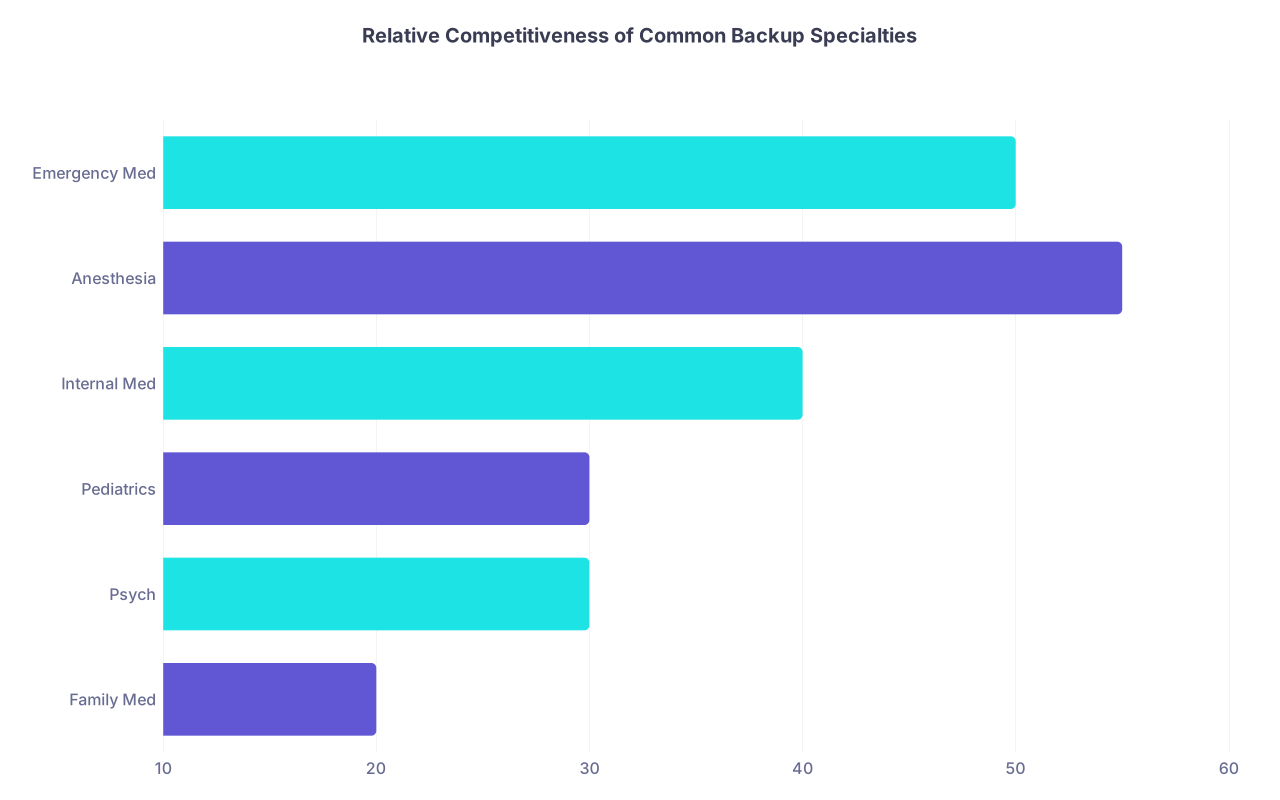
| Category | Value |
|---|---|
| Family Med | 20 |
| Psych | 30 |
| Pediatrics | 30 |
| Internal Med | 40 |
| Anesthesia | 55 |
| Emergency Med | 50 |
(Think of those numbers as “competitiveness units,” not exact match rates.)
Ask yourself:
- What’s my Step/COMLEX performance relative to that field’s usual range?
- Do I have home‑program support and strong letters?
- Am I geographically flexible or locked to one region?
- Do I need to match this year no matter what?
If your priority is “I absolutely must match this cycle,” then a slightly less-liked but safer specialty might be the right pick. If you’re willing to tolerate a bit more risk to land in something you truly love, you can aim a little higher.
But don’t be delusional. I’ve watched people dual-apply to two moderately competitive “backups” with mediocre scores and almost no geographic flexibility. They were “keeping options open.” They ended up unmatched.
If one specialty is:
- meaningfully less competitive,
- still acceptable to you long-term, and
- aligns decently with your values,
that’s often your better backup choice.
Step 5: Decide Your Application Strategy Before ERAS Opens
This is where most people screw up. They think the decision is “which specialty do I like a bit more?”
The real decision is: “How am I going to structure my applications so I don’t look half‑committed to both?”
You have three basic models:
Model A: Primary + True Backup
- You apply fully to your dream specialty.
- You also apply fully to one backup specialty you’d actually be okay doing forever.
- You commit on paper to each program as if it’s your only field (separate letters, tailored PS, etc.).
If you’re stuck choosing between two backups you genuinely like, you probably cannot aggressively apply to three fields without looking scattered. So pick one true backup here.
Model B: Dual‑Apply With Weighted Preference
Let’s say you like IM and psych as backups, and you’re coming off a failed derm attempt or you’re nervous about your numbers.
You might:
- Apply to ~40 IM programs, prioritize university and academic places
- Apply to ~20 psych programs mostly in regions you’d love
- Decide in advance which you’d rank higher if you get similar numbers of interviews
This only works if:
- Your personal story/PS can be cleanly adapted to both.
- Your letters aren’t obviously skewed to just one side.
Model C: Commit to One Backup and Stop the Mental Gymnastics
For many people this is the sanest answer. If you could be happy in either of the two backups, pick the one that:
- Fits your top life values slightly better, and
- Gives you a safer match profile.
Then let yourself go all in. No “maybe I’ll still try to sneak in some apps in the other one too.” That half-commitment bleeds into how you talk on interview day. Program directors can smell it.
Step 6: Pressure‑Test With Real Humans (Not Just Your Friends)
Ask three types of people:
- An attending in Specialty A
- An attending in Specialty B
- Someone who knows you well and doesn’t care what field you pick
And ask each version of this question:
“Given what you know about me—my personality, tolerance for stress, what I complain about on rotation—which of these two fields do you actually think I’ll be less miserable in at 2 am five years from now?”
Not “Which is more prestigious?” or “Which has better money?”
Which one will make you less miserable in the worst moments.
I’ve watched this question completely change people’s decisions. Because the answer is often blunt:
- “You hate chaos. Why are you even considering EM?”
- “You get bored on long ward rounds; why would you choose IM over anesthesia?”
- “You’re deeply affected by sad stories. Psych will wipe you out.”
Listen. You do not have to follow their vote. But you should at least wrestle with it.
Step 7: Use a Tie‑Breaker Framework That Is Not Dumb
If, after all of that, you’re still torn, you need tie‑breakers that aren’t random.
Use this sequence:
10-year future self test
Picture yourself 10 years out, fully trained in Specialty A vs Specialty B. Forget salary. Which identity makes you feel more like “yes, that’s who I became”?Regret test
If you end up in A and never practice B, vs end up in B and never practice A—where does the regret feel heavier?Exit options
Which specialty gives you more ways to pivot later (hospital admin, industry, outpatient, teaching, niche subspecialty)? This matters more than you think.Geography test
If you’re tied, and one specialty is more in demand where you ultimately want to live long-term, choose that one. Daily life beats abstract passion.Gut discomfort vs calm
Sit with the decision “I choose Specialty A” for three days. Don’t talk about it. Notice your body. Then erase it mentally, and live three days as if you’ve chosen B. Which version feels calmer?
And yes, sometimes it’s that subtle.
Step 8: Translate the Decision into Concrete Application Actions
Once you pick, you’re not done until you operationalize it. That means:
- Personal statement: written as if this is your only field
- LoRs: at least 2–3 strong specialty‑specific letters for the one you’re actually backing
- ERAS activities: framed in a narrative that makes sense for that field
- Interview answers: stop saying “I was considering X and Y.” Programs don’t want to hear that you almost applied somewhere else. They want to hear why their field is the right one now.
Map it out clearly:

| Step | Description |
|---|---|
| Step 1 | Choose Backup Specialty |
| Step 2 | Clarify Values and Risk |
| Step 3 | Pick Single or Dual Apply Strategy |
| Step 4 | Align PS and Letters |
| Step 5 | Target Programs by Competitiveness |
| Step 6 | Practice Consistent Interview Story |
| Step 7 | Build Rank List Based on Fit and Safety |
If your actions don’t reflect your decision, then you haven’t actually decided. You’re just thinking about deciding.
Quick Reality Checks I Give Students All the Time
A few blunt observations from watching many cycles:
- If you say “I like procedures,” but every time you’re in the OR you’re bored and scrolling your phone during closure, you do not like procedures. You like the idea of being procedural.
- If you say “I want lifestyle,” and your backup choices are EM vs surgery prelim, you’re not being honest about what lifestyle looks like.
- If both specialties are genuinely acceptable to you, don’t let prestige be the tie‑breaker. That’s how you end up in the wrong field with a fancy title.
- One solid, coherent backup plan beats two half‑baked ones every time.
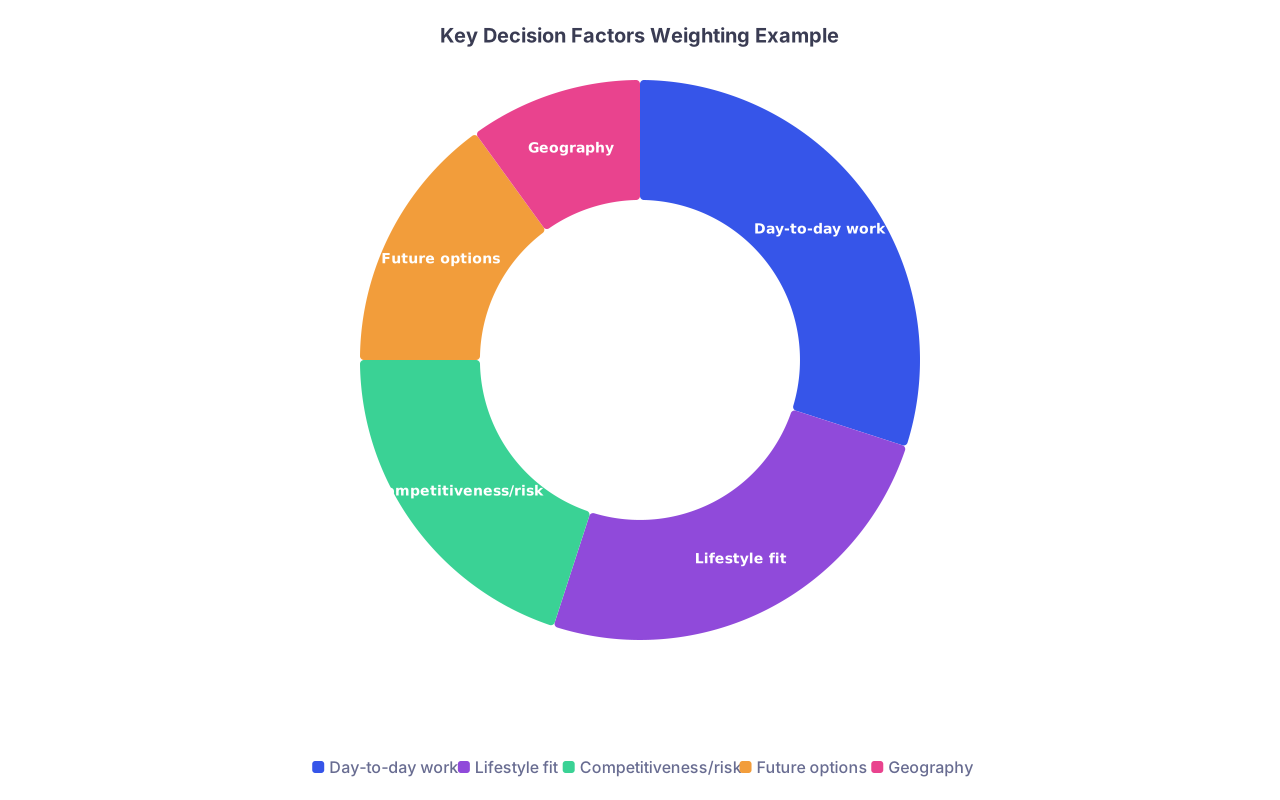
| Category | Value |
|---|---|
| Day-to-day work | 30 |
| Lifestyle fit | 25 |
| Competitiveness/risk | 20 |
| Future options | 15 |
| Geography | 10 |
That’s roughly how much weight I’d give each domain if I were deciding between two backups today.

FAQs: Choosing Between Two Backup Specialties
1. Is it a bad idea to dual‑apply to both backup specialties?
It’s risky unless:
- Your metrics are strong for both fields,
- Your story can logically support both without sounding flaky, and
- You’re willing to limit the number of programs in each.
If you’re already dual‑applying to a very competitive primary plus a backup, adding a second backup is usually a bad idea. You’ll look unfocused and under‑committed everywhere.
2. Should I pick the backup specialty that’s easier to match into even if I slightly prefer the other?
If matching this year is absolutely critical—for financial, visa, or personal reasons—then yes, the safer backup with decent fit beats the riskier option you only “slightly” prefer. If the preference is strong, and your application is reasonable for both, you can justify taking more risk. The line is personal, but be honest about your tolerance for an unmatched outcome.
3. How much should money/income factor into my decision between two backups?
Enough to keep you out of long‑term regret, not enough to override everything else. Between two reasonable specialties, income differences often matter less than:
- Call burden
- Where you can live
- Whether you like your daily work.
If one field would put you under constant financial strain in your ideal city and family plan, that’s a real factor. But chasing the extra $50–100k while hating your work is a trap.
4. What if I like one specialty more as a resident but the other more as an attending?
Then decide which phase of life you care more about optimizing. Residency misery is temporary but intense. Attending life is longer but more malleable. In practice, I’d lean toward the field you can see yourself enjoying as an attending, as long as the residency is survivable for your personality and mental health.
5. I worry I’ll get bored in the “safer” specialty. Is boredom a valid reason to choose the other?
Yes, but be specific about “bored.” Do you mean:
- Not enough acuity?
- Repetitive clinic?
- Too much documentation?
If boredom means you disengage and provide worse care, that’s important. But some people confuse “not constantly stressed” with “bored.” That’s not boredom—that’s a sustainable job. Clarify the difference before you chase adrenaline.
6. Can I switch later if I pick the wrong backup specialty?
Sometimes. But it’s not guaranteed, and it can be painful—socially, financially, and professionally. Also, once you’re in one field, inertia is real. Yes, people switch from IM to anesthesia, EM to psych, peds to FM, etc. But you shouldn’t plan on switching as your primary strategy. Choose like you’re stuck with it.
7. If I’m still 50/50 after all this, what should I do?
Force a decision and live with it for a week before locking ERAS. Tell yourself, “I’m an [X] person.” Update your personal statement draft to match. See how it feels. Then swap and try the other identity for a week. Whichever feels more “off” when you abandon it is probably the one you actually want. And then commit on paper—PS, letters, application list—to that choice.
Key takeaways:
- Stop treating backup specialties like abstract safety nets; assume you might live in that field forever.
- Choose based on actual day‑to‑day work, your core life values, and a realistic read of competitiveness—not prestige or vibes.
- Once you decide, align your entire application and story behind that decision; a single clear backup is almost always better than two half‑hearted ones.