
The way most applicants “read” residency program websites is dangerously wrong.
You skim the “Program Highlights,” glance at the call schedule, check if they say “resident wellness,” and then—worst of all—you start building backup specialty plans on half-baked assumptions from marketing blurbs and outdated pages.
That’s how really strong applicants quietly sabotage their own Match.
Let me be blunt: misreading program websites is one of the top reasons people pick terrible backup specialties, over- or under-apply, and end up in a program or field they hate. Not because programs lied—because you didn’t read their signals correctly.
Let’s fix that before you burn a whole application cycle.
The Core Mistake: Treating Program Websites Like Brochures, Not Data
You are not a tourist browsing hotel photos. You’re running an experiment with your career on the line.
The big mistake:
Using vague website language to justify your fantasy rather than test your assumptions.
Common version of this:
- “They say they ‘welcome applicants from diverse backgrounds’ → so they’ll probably be open to my backup specialty switch.”
- “They mention ‘graduating residents successfully match into competitive fellowships’ → so this IM program must be a good springboard if I don’t match Derm.”
- “They don’t explicitly say they avoid ‘applicants who failed Step 1’ → so I’m probably okay.”
That’s delusion, not strategy.
Here’s the mental shift you need:
Every line on that website is either:
- Marketing copy (designed to sound nice but say nothing concrete), or
- A hard signal you’d better believe.
You keep confusing the two.
Backup Specialty Assumption #1: “Any Decent IM Program Is a Good Backup for Competitive Fields”
No. This one hurts people every year.
The assumption:
“If I’m shooting for Dermatology, Ortho, Plastics, ENT, etc., I’ll just apply to some solid Internal Medicine programs as a backup. If I want, I’ll later pivot to fellowship or eventually switch back.”
Here’s where you misread websites and wreck your backup:
You see: “Our residents match into top fellowships.”
You assume: “They’ll set me up for heme/onc, GI, cards, maybe even Derm later.”
Reality: Sometimes that sentence means exactly two cards spots in the last five years. From their home fellowship. For their home-grown stars.You see: “Strong focus on academic medicine and research.”
You assume: “They’ll have infrastructure for me to rebuild my competitive CV.”
Reality: “Academic focus” can mean one tired faculty member doing retrospective chart reviews with residents at 10 p.m. on a Sunday.You don’t see: Concrete fellowship match lists for the last 3–5 years.
You assume: “They’re just bad at updating their website.”
Reality: Programs that are proud of their fellowships plaster that list all over. If it’s missing or vague, that is a signal.
If you want IM as a tactical backup for a competitive specialty, you absolutely cannot just go by slogans.
You need proof in writing:
- A real list of fellowships and locations for recent grads
- Evidence of mentorship in the specialty pathway you’re considering
- Serious research support, not buzzwords like “scholarly activity is encouraged”
Otherwise, you’re not choosing a backup—you’re choosing a dead end.
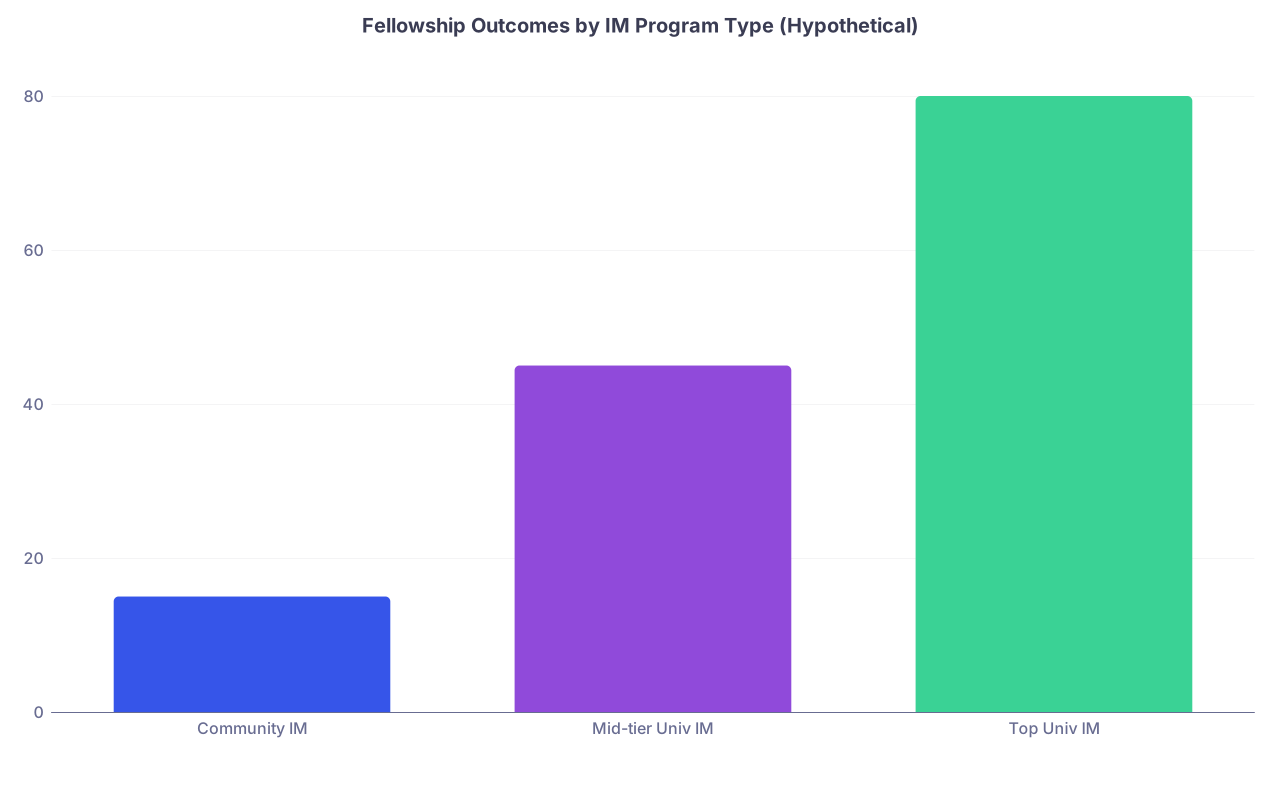
| Category | Value |
|---|---|
| Community IM | 15 |
| Mid-tier Univ IM | 45 |
| Top Univ IM | 80 |
(Values = % of residents entering competitive fellowships like cards, GI, heme/onc from each type. Huge spread. This matters.)
Backup Specialty Assumption #2: “If They Don’t Explicitly Exclude Me, I’m Competitive”
This one is brutal for borderline applicants.
You go to a program’s website. You see no explicit cutoffs for:
- Step 1/2 scores
- Number of attempts
- Year of graduation
- Visa status
And you think, “Nice, they’re holistic.”
Here’s the trap:
Programs often intentionally don’t publish hard cutoffs, but still use them. Or they use “soft” cutoffs that are even worse because you can’t see them.
Red flags you’re ignoring:
They list: “Average Step 2: 250+”
You think: “Average means there’s a range. My 224 might still be okay.”
Reality: You’re kidding yourself. You’re almost certainly in the auto-screen pile.They show: Resident bios with endless AOA, PhDs, T32, Ivy med grads
You think: “They might want diversity of background.”
Reality: Their “diversity” often means different undergrad states, not score profiles.They have: Zero mention of “we consider applicants with attempts or failures”
You think: “At least they didn’t say no.”
Reality: Lack of inclusion language usually means exclusion.
When should you treat websites as hard “no” even if they don’t say “no”?
- If their resident roster looks nothing like you on scores, school type, or background
- If their “minimum” Step score is only a hair under their “average” and your score is far below
- If you are an older grad or IMG and they list mostly fresh US grads and zero IMGs
Do not use silence as permission.

Backup Specialty Assumption #3: “Website Case Mix Descriptions = My Future Training”
You see a program’s website say:
- “Our ED sees high acuity patients.”
- “We serve a diverse, underserved population.”
- “Robust procedural experience with… [nice long list].”
You extrapolate this to both your primary and backup specialties. You think, “This is solid training no matter what I end up doing.”
Here’s where you get burned:
You don’t separate advertised exposure from resident-controlled experience.
A website listing “our hospital has a level I trauma center” doesn’t tell you if residents get those cases or if they’re locked down by fellows.You equate “we have this specialty” with “we train you in this specialty.”
Example: You’re thinking about EM as backup. An IM program shows “strong ED exposure.”
You assume: “That would help me if I pivot to EM fellowship or urgent care work.”
Reality: You may be doing admits and floor calls, never actually running rooms or managing undifferentiated patients.You see “high volume” and forget to ask “high autonomy?”
Most program websites do not tell you how often residents are basically scribes for attendings or fellows.
When you’re picking backup specialties based on “well-rounded training,” you need to interpret case-mix descriptions like a skeptic.
Watch for these slippery phrases:
- “Exposure to…” → Often means you stand in the corner and watch.
- “Opportunities for…” → Translation: If you fight hard, beg seniors, and schedule your vacation around it, you might get one.
- “Residents may participate in…” → Not guaranteed. Optional. Sometimes code for “never happens.”
Backup Specialty Assumption #4: “Lifestyle Language Is Universal Across Specialties”
People read one EM or FM site and start projecting that vibe onto everything.
“I’ll apply to EM as my backup because all the EM websites say they support work–life balance, shift-based schedules, and wellness.”
Then they see IM sites using similar words: “Resident wellness,” “time for personal pursuits,” “protected time,” and they assume the backup field has similar lifestyle potential.
Terrible logic.
You’re forgetting that lifestyle is specialty-dependent first, program-dependent second, and website-dependent basically never.
Some misleading patterns:
“Our graduates enjoy long and fulfilling careers in community practice.”
This doesn’t mean 3–4 day workweeks, outpatient only, or part-time flexibility.“We value resident wellness.”
This is on every site now because they know you’re burned out. It is not data.“We have a night float system.”
Sounds nice, right? Could still mean 6–7 nights in a row of brutal cross-cover.
If your backup specialty is chosen primarily for lifestyle reasons, program websites will seduce you with soft language. Do not base the choice on:
- “Wellness committee”
- “Retreats”
- “No 24-hour call” (then you find out about 28-hour “short call”)
- “Reasonable workload”
You need actual numbers and structure.
| Signal Type | Typically Trust? | Example Phrase |
|---|---|---|
| Hard numbers (duty hours) | More | "Average 60–65 hrs/week, capped at 80" |
| Rotation structure | More | "ICU: 3 months PGY-1, 2 months PGY-2" |
| Call schedule specifics | More | "1 in 4 short call, no 24-hr q3" |
| Vague wellness claims | Less | "We value resident wellness" |
| Buzzword-heavy slogans | Less | "Wellness is in our DNA" |
| Unquantified “balance” | Less | "Good work–life balance" |
Backup Specialty Assumption #5: “Backup Programs Don’t Care That I’m Using Them as Backup”
You might think you’re subtle, but programs can smell “I’m only here because Derm ghosted me” straight through your application.
Where you misread the website:
You look at their “ideal candidate” language and think it’s generic. It’s not.
Look carefully at these sections:
- “We seek applicants who…”
- “Our residents go on to…”
- “We value applicants who demonstrate…”
This is where programs quietly tell you whether they want:
- Lifers in their specialty
- People bound for academic careers
- Community-oriented folks
- Research-heavy candidates
- Or, occasionally, “we’ll take strong people going into any direction”
If you’re applying to, say, Family Medicine as a backup while clearly having a surgery-heavy CV, and the FM website says:
- “We are committed to training full-spectrum family physicians serving rural and underserved communities,”
- “We especially value applicants committed to primary care careers,”
…you can’t just ignore that and assume they’ll be happy to be Plan B while you angle for hospitalist work or EM later.
On the flip side, some programs are clearly okay being “launchpads”:
- “Our graduates match into a wide variety of fellowships and diverse practice settings.”
- “We support residents pursuing both primary care and subspecialty careers.”
If your backup specialty plan hinges on using the residency as a bridge rather than a destination, the website language about graduate outcomes is not fluff. That’s where the landmines are.
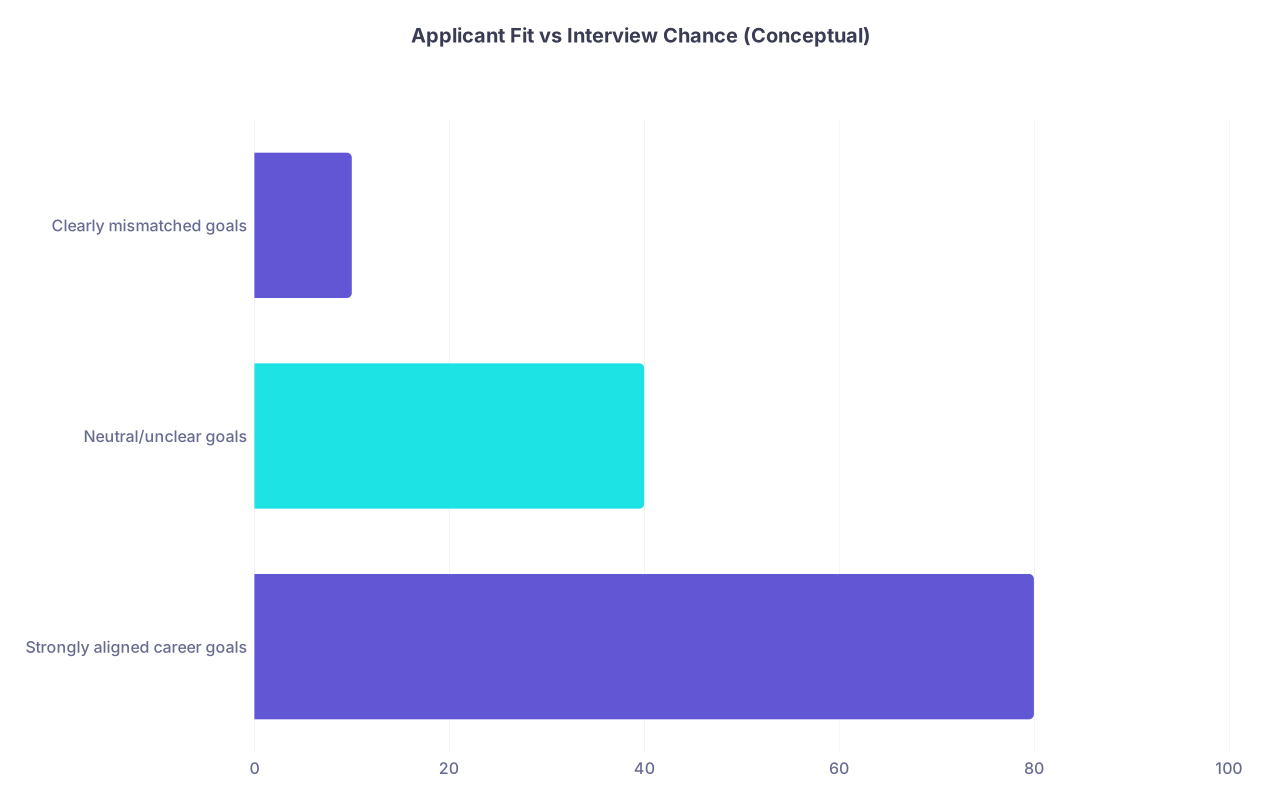
| Category | Value |
|---|---|
| Strongly aligned career goals | 80 |
| Neutral/unclear goals | 40 |
| Clearly mismatched goals | 10 |
Programs don’t say this out loud. But they act on it.
How to Actually Read Program Websites Like a Strategist
Now the part you probably haven’t been doing. Here’s how you avoid the traps and pick backup specialties without lying to yourself.
1. Separate Marketing Copy from Hard Data
Print the page or open a doc and literally mark:
- In one color: Numbers, lists, concrete outcomes (“8 residents/year,” “80% fellowship rate,” “List of fellowships: …”).
- In another: Vague values and slogans (“supportive culture,” “diverse opportunities”).
You only build strategy from the first category.
If your backup specialty reasoning is 80% slogans, you’re about to make a bad decision.
2. Read the Resident Roster Like a Pattern, Not a Directory
Stop just looking for “Do they have any DOs/IMGs?” and move on.
Look for:
- Proportion of DOs vs MDs vs IMGs
- Distribution of med schools (all top 30? mixed? lots of state schools?)
- Research experiences listed (gap years? PhDs? major publications?)
- Nontraditional paths (career changers? older grads?)
Ask yourself honestly:
“If I anonymized my own CV and put it on that roster page, would it blend or stick out as an obvious outlier?”
If you clearly don’t fit their pattern—even if they “value diversity”—that’s not a great backup.

3. Check for Evidence Your Backup Path Actually Exists
If your thought is: “I’ll do IM then cards” or “FM then sports med,” don’t just see that the fellowship exists; you need to know residents actually get there.
Look for:
- Fellowship match lists with names and destinations
- Explicit mention of “Our graduates match into…” with a list that matches your goals
- Faculty in that subspecialty with track records of mentoring residents
If all you see is “we have a cardiology department and some optional electives,” that’s not a reliable bridge for your backup plan.
4. Compare What Programs Say vs What Residents Say
Cross-check the website with:
- Residency Reddit threads
- Specialty-specific forums
- Residents’ LinkedIn profiles or institutional bios
- Zoom open houses Q&A
Pattern to watch:
If the website screams “strong research,” but resident LinkedIns are almost empty… that disconnect tells you what you actually get.
The “Backup Specialty Website Sanity Check” in 10 Minutes
Before you commit to a backup specialty based on website impressions, do this for any program/specialty you’re considering:

| Step | Description |
|---|---|
| Step 1 | Open Program Website |
| Step 2 | Deprioritize as strategic backup |
| Step 3 | Check resident roster pattern |
| Step 4 | Count as reach only |
| Step 5 | Review outcomes section |
| Step 6 | Check lifestyle and structure claims |
| Step 7 | Seek external verification |
| Step 8 | Program viable for backup list |
| Step 9 | Concrete data present? |
| Step 10 | Do you fit pattern? |
| Step 11 | Outcomes match your backup plan? |
| Step 12 | Backed by numbers? |
If a program fails at multiple steps, it may still be worth an application. But not as a key piece of your backup field strategy.
Subtle Website Red Flags That Should Make You Pause
These are small things people ignore, then regret later.
“Website last updated: 2019” in the footer
If they can’t update basic info, resident life and culture may also be neglected.“Under construction” or missing sections about resident life
Either they’re disorganized, or they don’t want you to see something.No list of current residents at all
That’s not just “privacy.” It often signals churn, difficulty recruiting, or embarrassment about profiles.Extreme emphasis on one feature (e.g., research) with no evidence of normal stuff (teaching, didactics, wellness)
You’re signing up for a single-track experience whether you want it or not.
The Big Picture: Backup Specialty ≠ Dumping Ground
The worst assumption of all:
“That backup specialty sites don’t need as much scrutiny because it’s ‘just in case.’”
You know what happens?
You under-read the websites in your backup field, over-assume they’ll accept you and fit your life, then on Match Day you end up exactly where you didn’t bother to vet.
And suddenly your “just in case” becomes your actual career.
You cannot afford to be lazy with backup specialty research. In some ways, you have to be even more careful, because:
- You might have weaker fit signals (fewer home rotations, less research in that field).
- You’re more likely to rationalize (“at least I matched”).
- You’ll be tempted to tell yourself stories based on pretty websites instead of cold facts.
FAQ (Read These Before You Click “Submit”)
1. If a program doesn’t list any score cutoffs, should I email to ask before applying?
Usually, no. Programs rarely reply with honest numbers, and sometimes your email just adds you to their “extra-needy” mental list. Instead, read the resident roster and any “average scores” language. If your metrics are dramatically below what you see, treat that program as a long shot and don’t build your backup around it.
2. How many programs in my backup specialty should I research in this level of depth?
At least the top 15–20 where you’d realistically be happy to match. You don’t need to dissect all 60 FM programs you apply to, but the ones you’d most likely rank high? Those deserve deep scrutiny. If you’re too “busy” to do this, you’re not actually serious about that specialty as a backup.
3. What if a website looks weak, but I’ve heard good things from residents?
Trust the humans over the HTML—but with nuance. If multiple current residents independently describe strong mentorship, sane hours, and good outcomes, you can override a mediocre site. Just make sure their experiences actually align with your goals (fellowship vs community, procedures vs clinic, etc.).
4. I’m late in the cycle and already picked a backup specialty. Is it too late to fix these mistakes?
No, but you do not have time to cling to illusions. Today, pick 5–10 programs in your backup field, re-read their websites with this lens, and adjust your rank list or outreach. You may realize some “safeties” are actually fake and some quieter programs are better aligned. Rapid correction now beats silent regret in March.
Open one program website from your planned backup specialty right now and go line by line: circle every concrete piece of data and cross out every empty slogan. Then ask yourself—honestly—would you still choose this as your backup if the slogans disappeared?