The old rules for “backup specialties” died the day Step 1 went pass/fail. Most applicants just have not realized it yet.
For a decade, the backup plan was easy: crush Step 1, aim high, and if it did not pan out, slide into a “less competitive” field that looked safer on paper. That logic depended on a numerical filter. Once Step 1 went pass/fail, programs lost their favorite blunt instrument. And the data since then show something uncomfortable: backup specialties have quietly become more competitive, more Step 2–driven, and more sensitive to the rest of your application.
Let me walk through what the numbers actually say—and how to pick backup specialties in 2025+ without lying to yourself.
1. The Old Backup Model Was Built on Step 1
Before Step 1 went pass/fail (January 2022), the backup game looked something like this:
- Target specialty: super competitive (Derm, Ortho, Plastics, ENT, Ortho, Rad Onc at its peak).
- Step 1: if ≥240–245, proceed; if <230, strongly consider a backup.
- Backup specialties based on historical match rates: IM, Peds, FM, Psych, Anesthesia, PM&R, Pathology, sometimes Neurology.
Programs used Step 1 as a hard triage filter. You know the stories:
- “Our PD sets 230 as a hard cut. I do not even open files below that.”
- “We get 1,000 applications. The first pass is Step 1, then everything else.”
So applicants did something rational: they used Step 1 as their own decision threshold. Once the score was in, the backup conversation began.
The result: backup specialty choice was mostly about mean Step 1 score and fill rate. Not about Step 2. Not about AOA. Not about research.
That is gone.
2. What Changed After Step 1 Went Pass/Fail
Step 1 pass/fail affected three things that matter for backup planning:
- Signal loss for programs.
- Compression of perceived competitiveness.
- Re-weighting of Step 2 CK and everything non-test.
Let’s anchor this with some data. The NRMP Charting Outcomes in the Match (U.S. MD/DO) and NRMP Main Match Results between 2018–2024 show consistent patterns:
- Step 2 CK is now the de facto numerical gatekeeper.
- Previously “safer” specialties have seen:
- Higher mean Step 2 CK for matched applicants.
- Rising fill rates by U.S. seniors.
- Lower match rates for “late” switchers with weak alignment.
Add to that the basic arithmetic: when Step 1 went pass/fail, top-of-the-distribution applicants still needed something to differentiate themselves. They migrated that pressure to Step 2 CK, research, and away rotations.
So the backup specialties that used to be forgiving for an average or slightly below-average Step 1 are now absorbing a wave of stronger applicants who want optionality.
In other words, your backup plan is competing with other people’s primary plan.
3. How Competitiveness Has Shifted: The Numbers
Let us talk concrete trends. I will use approximate ranges here—NRMP updates every cycle, but the directions are clear and stable.
3.1 Rise of the “Middle-Competitive” Backup
There is a cluster of specialties that historically sat between the very competitive (Derm, Ortho, ENT, Plastics, Ortho, integrated IR) and the classic “safety” fields (FM, IM categorical, Peds):
- Anesthesiology
- Emergency Medicine
- PM&R
- Neurology
- Pathology
- Psychiatry
These were the go-to backups for applicants targeting more competitive procedural or lifestyle-driven fields.
What has happened post–Step 1 pass/fail:
- Mean Step 2 CK for matched U.S. MDs in these fields has crept up into the mid- to high-230s and often 240+.
- U.S. senior fill rates in several of these specialties have increased.
- The number of programs per applicant applied to has gone up across the board, amplifying perceived competition.
Now layer one more effect: Emergency Medicine and Anesthesia got hammered temporarily by market panic (job forecasts, COVID waves, EM oversupply discourse). That pushed some applicants away and some into these fields as “second-choice,” producing local volatility. But even with that, backup reliability is not what it used to be.
Here is an approximate comparison of “backup” specialties pre- vs post–Step 1 P/F, focusing on U.S. MD seniors.
| Specialty | 2018–2019 Mean Step 2 CK Match Range | 2023–2024 Mean Step 2 CK Match Range | Trend |
|---|---|---|---|
| Anesthesiology | 240–244 | 244–248 | Up |
| Emergency Med | 238–242 | 243–247 | Up |
| Psychiatry | 233–237 | 240–245 | Up |
| PM&R | 235–240 | 242–247 | Up |
| Neurology | 234–238 | 240–244 | Up |
| Pathology | 233–237 | 238–243 | Up |
Numbers vary slightly by year, but the pattern is blunt: the middle tier is rising.
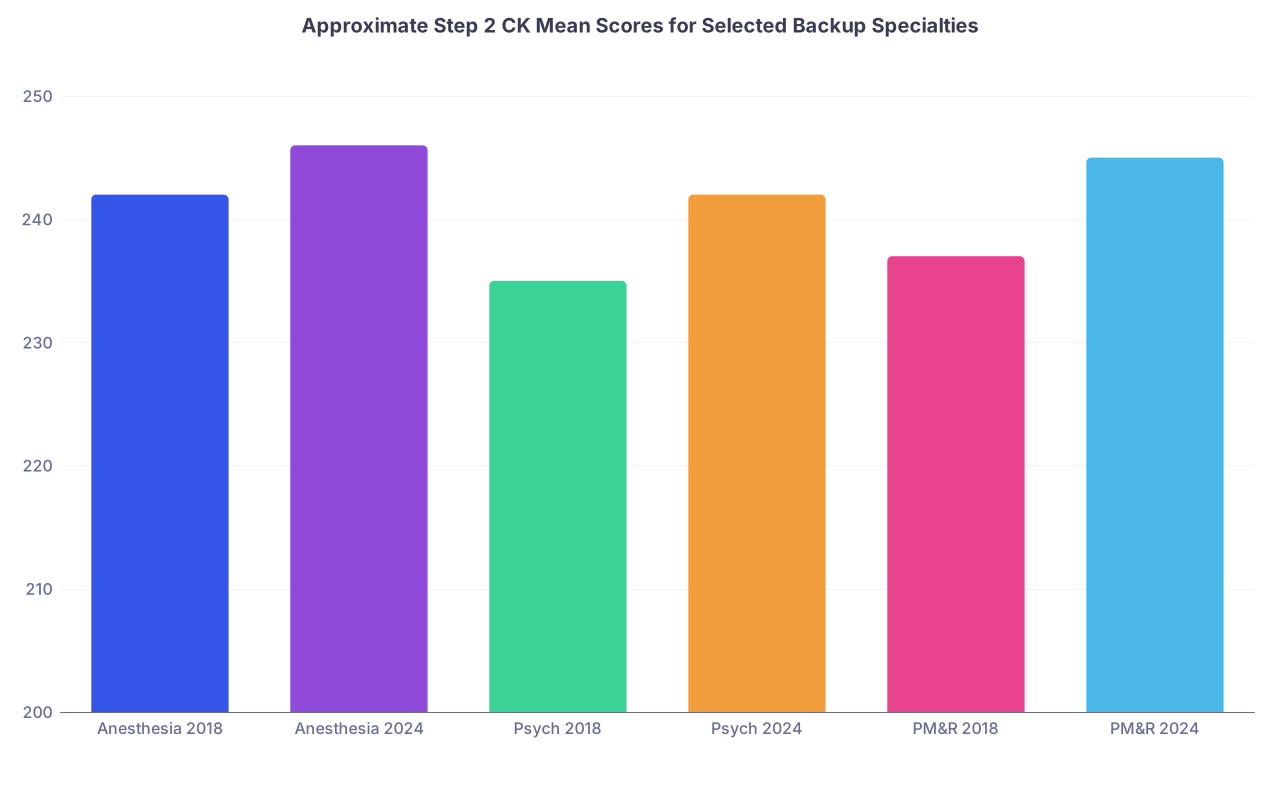
| Category | Value |
|---|---|
| Anesthesia 2018 | 242 |
| Anesthesia 2024 | 246 |
| Psych 2018 | 235 |
| Psych 2024 | 242 |
| PM&R 2018 | 237 |
| PM&R 2024 | 245 |
3.2 Classic “Safe” Fields Are Less of a True Safety
Family Medicine, Internal Medicine categorical (non-EM/CC heavy), and Pediatrics still have relatively high match rates. But the idea that you can casually pivot into one of these as a backup without doing any tailored work is weaker every year.
What the data show:
Internal Medicine:
- U.S. MD match rates remain high, but the gap between matched and unmatched in terms of Step 2, number of contiguous ranks in IM, and having IM letters is clear.
- “I applied to 5 IM programs as a backup with no IM LORs and only did Derm research” is increasingly punished.
Family Medicine:
- Still relatively forgiving, but:
- More programs are looking at Step 2 CK ranges, not just “Pass.”
- Holistic review amplifies red flags (failed attempts, large gaps, professionalism issues).
- Still relatively forgiving, but:
Pediatrics:
- Solid match rates, but the peds applicant pool has grown slightly stronger academically.
- Again, poor specialty alignment stands out.
So yes, IM/FM/Peds are still easier to match than Orthopedic Surgery or Dermatology. But they are not insurance policies against a poorly aligned or late backup strategy.
4. The New Kingmaker: Step 2 CK as Backup Filter
If you want to understand backup specialty dynamics now, track Step 2 CK, not Step 1.
Programs lost their favorite sort tool. They replaced it with:
- Step 2 CK score
- Number and type of specialty-aligned letters
- Clerkship grades (especially core clerkships)
- Research / scholarly activity in the field
Let me be more direct. If you are planning a backup specialty and your Step 2 CK is weak relative to that field, your “backup” might actually be more competitive for you than your primary.
4.1 Rough Step 2 CK Bands by Specialty Tier
These are broad approximations for U.S. MDs matched in 2024-ish cycles. Do not treat them as exact cutoffs; treat them as where the bulk of matched applicants sit.
| Specialty Tier | Example Specialties | Typical Matched Step 2 CK Band |
|---|---|---|
| Very High | Derm, Plastics, Ortho, ENT, IR | 250+ often, many >255 |
| High | Rads, Gas, EM, Urology, Ophtho | 245–255 |
| Mid | Psych, PM&R, Neuro, Path, OB/GYN | 238–248 |
| Broad Access (but not “easy”) | IM, Peds | 235–245 |
| Broadest Access (U.S. MD) | FM | 225–240 |
The point is not the absolute number. It is the overlap.
If you aim for a high-tier procedural field and plan Anesthesia or EM as a backup, you are effectively staying in a similar Step 2 CK band. Not stepping down.
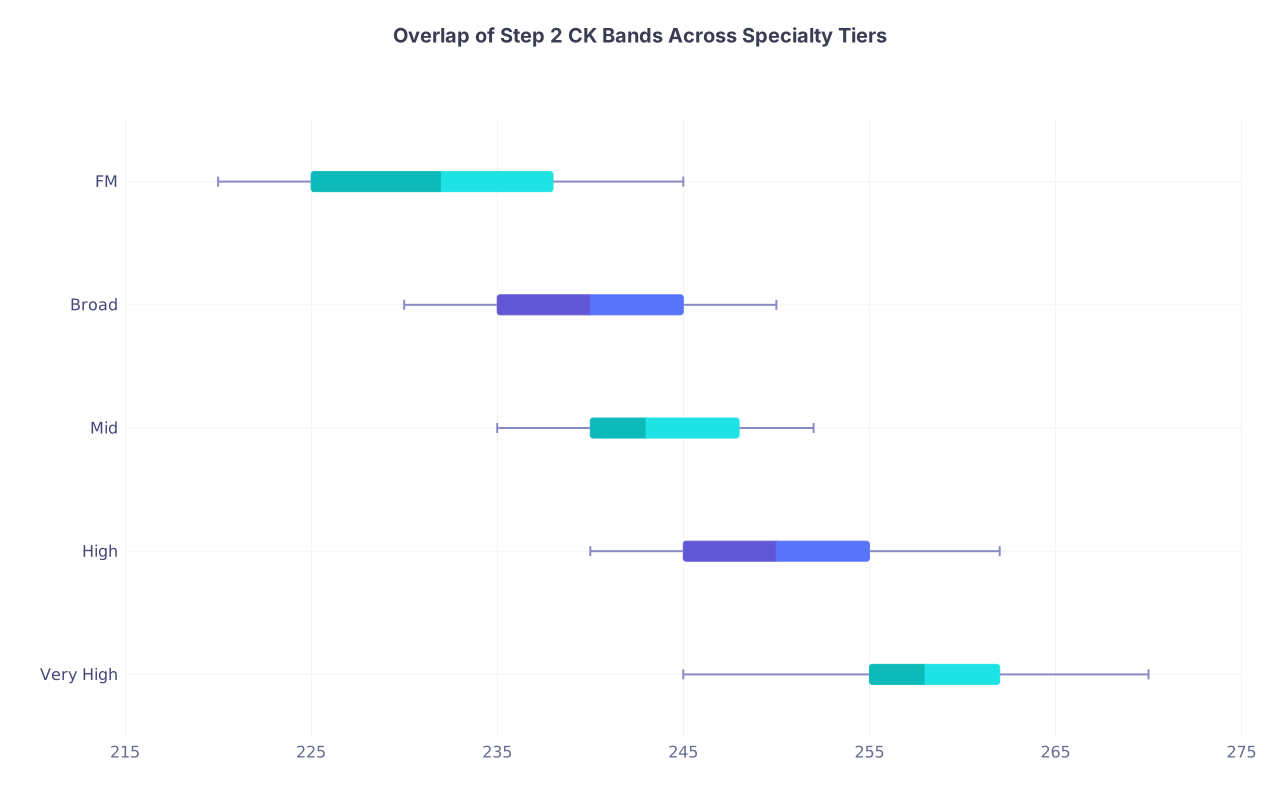
| Category | Min | Q1 | Median | Q3 | Max |
|---|---|---|---|---|---|
| Very High | 245 | 255 | 258 | 262 | 270 |
| High | 240 | 245 | 250 | 255 | 262 |
| Mid | 235 | 240 | 243 | 248 | 252 |
| Broad | 230 | 235 | 240 | 245 | 250 |
| FM | 220 | 225 | 232 | 238 | 245 |
So choosing a backup now is less about “lower prestige” and more about “different score distribution and different emphasis.” If your Step 2 CK is 230 and your primary field’s matched mean is 252, Anesthesia is not a backup. It is another stretch.
5. How Backup Specialty Behavior Has Shifted in Practice
Let me describe what I actually see when applicants try to do this wrong.
5.1 The Late Panic Pivot
Scenario:
- Applicant targets Ortho.
- No serious thought given to backups until September of M4.
- Step 2 CK: 236.
- Ortho away rotations done, strong Ortho LORs, almost no IM/PM&R exposure.
- In October, they panic and apply to PM&R and Anesthesia “just in case.”
The data problem:
- PM&R matched Step 2 CK averages now hover in low-mid 240s for U.S. MDs.
- Anesthesia matches are often mid-high 240s.
- Their letters are almost entirely Ortho.
- Interview invites in PM&R/Anesthesia go preferentially to those who look like they truly want the field.
Result: they are “hedged” on paper but not in reality. The backup is misaligned with both their Step 2 CK and their actual application content.
5.2 The Overshoot Backup
Another pattern:
- Primary target: Plastic Surgery.
- Step 2 CK: 254, strong research, strong letters, but extremely limited number of Plastics interviews (field is small, stochastic).
- Backup chosen: Dermatology.
This is not a backup. This is a second hyper-competitive specialty with a similar or worse position in terms of available spots, research expectations, and score pressures. The data show:
- Match rates in Derm and Plastics are among the lowest.
- U.S. MD applicants in both fields average Step 2 CK scores at the very top of the distribution.
- Both fields are saturated with heavy research CVs.
That applicant is just running two lottery tickets instead of one, not building a fallback.
5.3 What Works Better Statistically
Patterns I see that actually move the needle for people:
High-scoring, research-heavy procedural applicant (e.g., 255 Step 2) targeting Ortho also builds a convincing Anesthesia or PM&R story with:
- At least one rotation in that field.
- 1–2 genuine letters from that specialty.
- Some scholarly activity or QI projects in that backup field.
Mid-range Step 2 (235–240) applicant targeting EM or Anesthesia uses:
- Internal Medicine or Family Medicine as a structurally safer backup.
- Real rotations and letters in those fields, not just generic “hard worker” notes.
- Broad geographic application in the backup.
There is nothing theoretical about this. When you look at NRMP data, the strongest predictors of matching in a field—beyond Step 2 CK—are:
- Number of contiguous ranks in that specialty.
- Number of programs applied to in that specialty.
- Having at least one specialty-specific SLOE/letter (for EM) or strong letters from core services aligned with that field.
Backup specialties that you half-commit to show up as low contiguous rank counts, thin letters, and weaker apparent interest. That correlates with lower match probability. Strongly.
6. How to Choose Backup Specialties Rationally in the Step 1 P/F Era
Now the practical part. You want a backup strategy that respects the data, not vibes.
6.1 Step 1: Map Your Stats Against Specialty Distributions
Start with a brutally honest view of your Step 2 CK.
Ask:
- Where does my Step 2 CK sit relative to the mean for my target specialty?
- Am I above the 75th percentile, around the mean, or below?
Then compare the same score against potential backup specialties. You want at least one backup where:
- Your Step 2 CK is at or above the historical mean of matched applicants.
- You are not trying to “back up” into something equally or more score-driven.
If your Step 2 CK is:
- 255+: You can reasonably back up from a hyper-competitive field into many high/mid fields, assuming you build alignment.
- 245–254: Your primary might be high-tier; your backups should probably sit in high/mid or broad-access tiers.
- 235–244: Back up from high into broad or mid; avoid thinking EM/Anesthesia are “safe” unless your file is otherwise very strong.
- <235 (U.S. MD): Think carefully about fields with broader access (IM, FM, Peds, possibly Psych or Path if your alignment is excellent).
6.2 Step 2: Choose Backup Fields that Fit Your Profile, Not Your Ego
The data show a consistent mistake: trying to maintain status signaling with your backup instead of match probability.
Better approach:
If you are targeting Ortho/Plastics/ENT and your Step 2 is solid but not elite, the most rational backups are often:
- Anesthesia
- PM&R
- Possibly General Surgery (if you can tolerate it)
- Occasionally EM (if the market stabilizes and your SLOEs are good)
If you are targeting Derm/Rads/Ophtho, sensible backups include:
- Internal Medicine
- Neurology
- Psychiatry
- Pathology (for those comfortable with non-patient-facing work)
If you are targeting EM/Anesthesia primarily, backups with higher match rates and broader score distributions:
- Internal Medicine
- Family Medicine
- Psychiatry
- Pediatrics
Is this glamorous? No. Does it respect the probability distribution you are actually living in? Yes.

6.3 Step 3: Build Early, Parallel Alignment
The people who do best with backups in the Step 1 P/F era start building them by late M3, not in October of M4.
Concrete behaviors that correlate with better match odds in backups:
- Doing at least one rotation or elective in the backup field.
- Securing 1–2 letters from faculty in that backup.
- Mentioning that backup specialty credibly in your personal statement or a targeted secondary statement.
- Applying to enough backup programs to have a meaningful rank list (≥8–10 programs in that backup field as a bare minimum; many will need 15–20+).
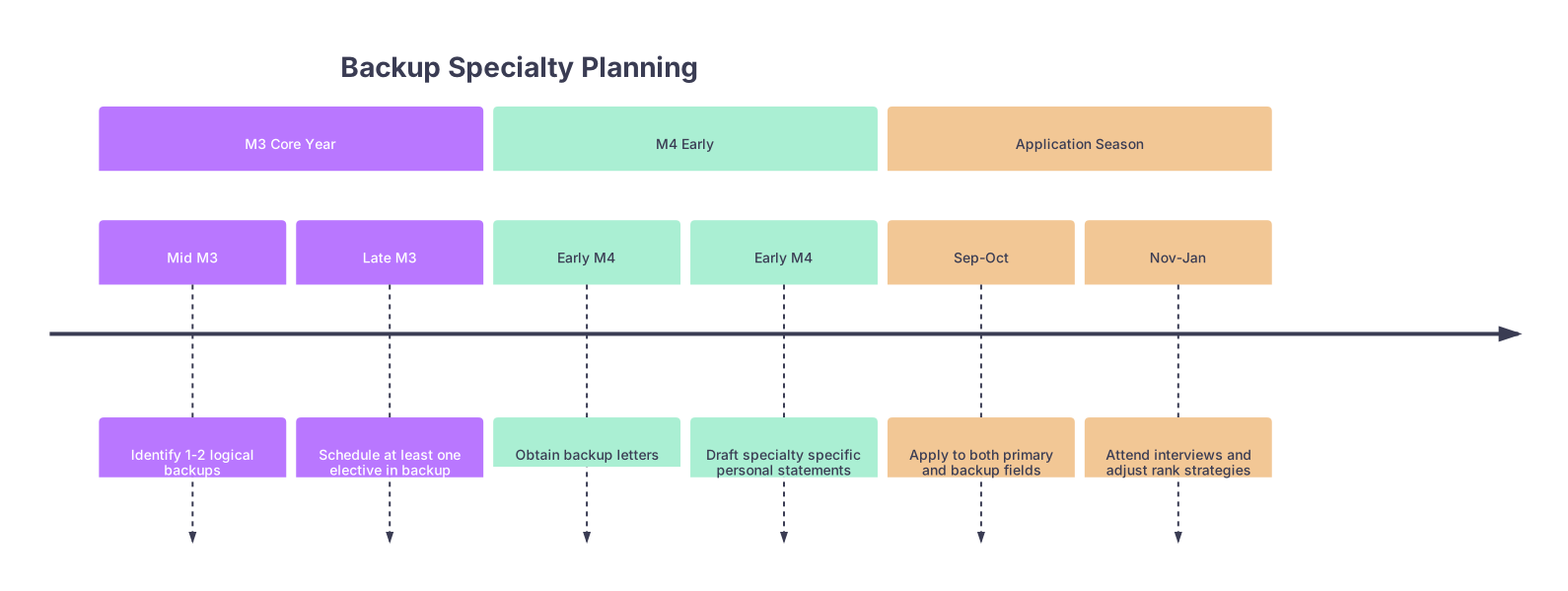
| Period | Event |
|---|---|
| M3 Core Year - Mid M3 | Identify 1-2 logical backups |
| M3 Core Year - Late M3 | Schedule at least one elective in backup |
| M4 Early - Early M4 | Obtain backup letters |
| M4 Early - Early M4 | Draft specialty specific personal statements |
| Application Season - Sep-Oct | Apply to both primary and backup fields |
| Application Season - Nov-Jan | Attend interviews and adjust rank strategies |
7. A Quick Reality Check by Data, Not Hope
The NRMP’s own cross-specialty graphs tell a harsh story: unmatched U.S. MD and DO numbers are creeping up, and unmatched applicants often share a pattern—high ambition, minimal backup structure, and overreliance on a single specialty.
You cannot fix that after ERAS opens. You fix it when you realize:
- Step 1 will not rescue you with a surprise 260.
- Step 2 is now your primary quantitative lever, and it is already written by the time you finalize your specialty list.
- Backup specialties must be:
- Score-appropriate.
- Document-supported (letters, rotations).
- Numerous enough (program count) to actually generate ranks.
If you remember nothing else, remember this: backup specialties in the Step 1 P/F era are no longer “just in case” buttons. They are full, parallel mini-applications that the data clearly reward when you treat them seriously.
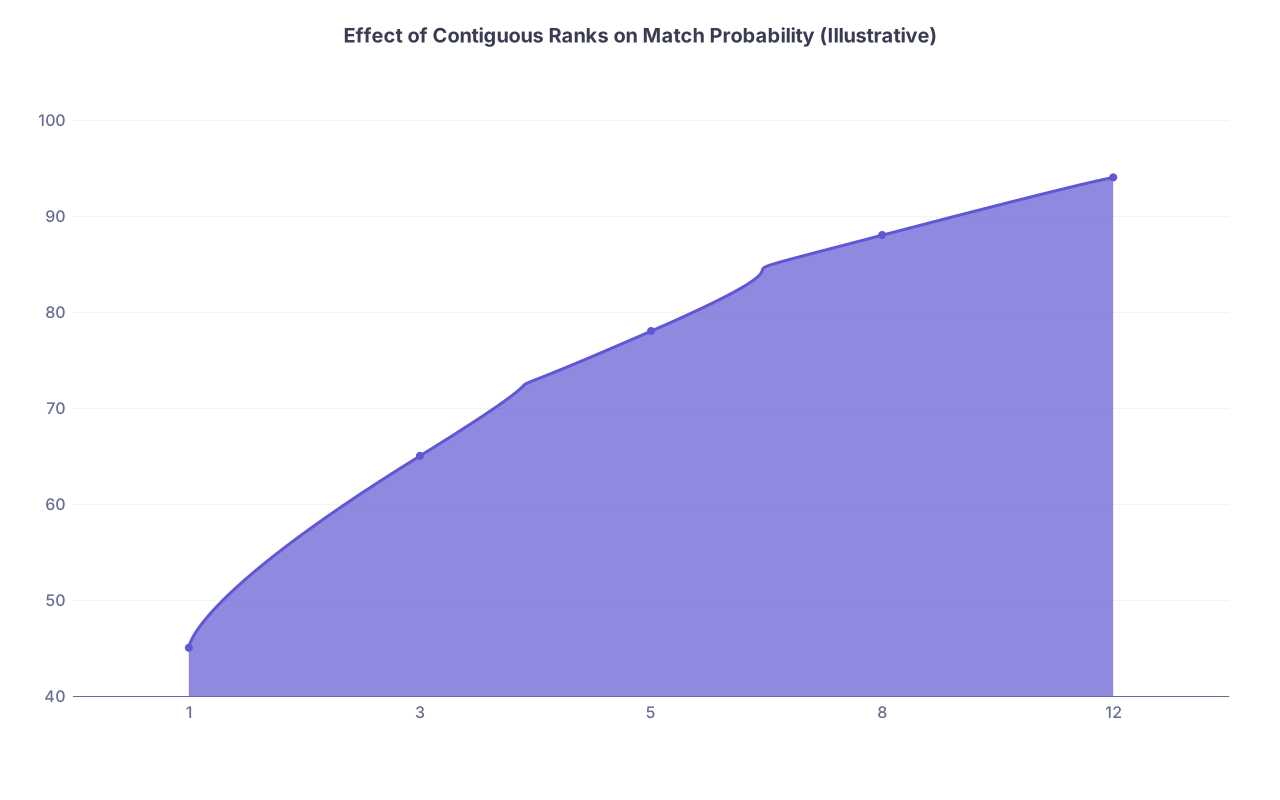
| Category | Value |
|---|---|
| 1 | 45 |
| 3 | 65 |
| 5 | 78 |
| 8 | 88 |
| 12 | 94 |
In NRMP data, match probability climbs sharply with more contiguous ranks in a specialty. Applying to 3 token backup programs is statistically theater, not strategy.

8. What This Means For You—Going Forward
Step 1 going pass/fail was sold as a wellness play. For backup specialties, it acted more like a tectonic shift. The scoring pressure did not disappear. It moved.
The data now show:
- Step 2 CK is the new hard filter.
- Mid-competition specialties have tightened and absorbed many applicants who used to lean on Step 1 as a differentiator.
- Traditional “safe” fields still exist, but their openness depends heavily on how seriously you treat them—early rotations, letters, and enough programs to build a real rank list.
Your job is not to guess. It is to read the distributions and place yourself honestly on the curve.
If you do that, you can still aim high and build a real safety net beneath you. If you ignore it and cling to the old myths of “I’ll just back up into X,” you are betting against a dataset that gets larger and more unforgiving every March.
You have the numbers. Use them. The next step is revisiting your own Step 2 score, your rotations, and your letter strategy—and then building a primary-plus-backup plan that actually matches your profile. How to convert that into a rank list that maximizes your odds? That is another layer of analysis, and another conversation.
FAQ (Exactly 5 Questions)
1. Is Emergency Medicine still a good backup specialty in the Step 1 pass/fail era?
It depends on your Step 2 CK and your file. EM is no longer a soft landing; it sits in a high Step 2 band and requires strong SLOEs. Recent volatility in EM job markets and the match (temporary lower fill rates and then recovery) makes it risky as a “casual” backup. If you have competitive EM SLOEs, a solid Step 2 CK (often mid-240s+), and genuine interest, it can function as either a primary or high-tier backup. Without those pieces, it is not a reliable safety net.
2. If my Step 2 CK is below the mean for my primary specialty, should I always choose a different backup field?
If you are below the mean but within striking distance (for example, 242 with a 247 mean) and have an otherwise strong file, you can still pursue that field as primary. However, your backup should live in a band where your score is at or above the mean. Backing up into a field that expects the same or higher Step 2 is usually a poor risk decision. You want at least one specialty where your numerical profile puts you in a favorable part of the distribution.
3. How many programs should I apply to in my backup specialty for it to be meaningful?
NRMP data show match probability increasing steeply with more contiguous ranks. For a backup to be meaningful, most U.S. MDs should aim for at least 8–10 ranks in that field, and many will need 15–20+, depending on competitiveness and geographic flexibility. Applying to 3–5 programs as a hedge typically produces very few interviews and an anemic backup rank list.
4. Can I use the same personal statement for my primary and backup specialties?
You can, but it usually weakens your signal. Programs in a competitive Step 2 environment are sensitive to perceived commitment. A generic or obviously dual-purpose statement makes you look less serious in both fields. A better approach is a primary statement for your main specialty and a tailored, shorter backup statement that clearly articulates why that field fits your skills and experiences, referencing at least one concrete clinical or academic exposure.
5. What if I decide on a backup specialty late (after ERAS opens)? Is there any data-driven way to salvage it?
Late decisions are always at a statistical disadvantage, but you can still improve your odds. The data favor increasing your number of applications in the backup field, rapidly securing at least one letter from that specialty (even from a short elective), and explicitly ranking a meaningful number of programs if you receive interviews. It will not fully compensate for the lack of early alignment, but expanding program count and building whatever authentic specialty signal you can still provides a measurable boost over a token, minimalist backup.