
The usual “just add a backup specialty” advice completely falls apart when you’re stuck in one place.
(See also: If You Have Visa Constraints: Choosing Backups with Sponsoring Programs for more details.)
If your partner has a non-movable job, your kid has medical needs tied to one hospital, your visa locks you to one state, or your parents genuinely depend on you nearby—your backup options get brutally limited. You are not choosing from 150 programs nationwide. You’re choosing from…maybe 3. Sometimes 1. Sometimes none.
This is the article for that situation.
You already know the generic advice: “Cast a wide net, apply broadly, keep an open mind.” That’s useless when you must be in Boston because your spouse is mid-fellowship, or you cannot leave the Bay Area because of custody arrangements. What you need is a concrete, reality-based plan that respects your actual constraints instead of pretending you’re a free agent.
Let’s walk through how to handle backup specialties when your family or location ties make real backup options scarce, messy, or dangerous.
Step 1: Get Brutally Honest About Your Actual Geographic Box
Before you can pick a backup specialty, you need to know your true sandbox. Not your “ideal.” Your real, non-negotiable constraints.
Ask yourself—in writing, not just in your head:
- What exact cities or regions am I truly willing/able to be in for residency?
- What would I actually sacrifice to increase that radius? (commute, separate housing, long-distance marriage, switching child custody agreements, etc.)
- What’s truly non-negotiable vs. just painful?
Most people lie to themselves here. They say “I have to be in X city” when the truth is: “I really, really want to be in X city, but I could do a 2-hour commute or live apart from my partner 3 days a week if I absolutely had to.”
That difference matters, because it may be the only thing separating “no backup specialties at all” from “two realistic backup specialties in a broader area.”
Do this concretely. Example:
- Partner in law school in Chicago, cannot move for 3 more years.
- You have one child in daycare; no major medical issues.
- Both sets of parents out of state.
Your actual options might be:
- Live together: Chicago proper + nearby suburbs
- Live separately 2–3 days/week: add Milwaukee, Madison, maybe down to Peoria
- Live separately full-time: entire Midwest opens up
You may still choose “live together only.” That’s valid. But you’ve at least seen the trade-offs instead of defaulting to “no choice.”
Step 2: Map Your Region vs. Specialty Reality (Not Fantasy)
Once you know your geographic box, you need hard data: which specialties are truly viable where you can actually live.
This is where people screw up. They pick a “backup” specialty based on national competitiveness and vibes, not on local program structure.
You’re not applying nationally. You’re applying to a micro-market.
Here’s how to map it out:
- List every residency program within your actual geographic radius (by city, not just “top hospitals”).
- For each, list:
- Your primary specialty
- 2–3 reasonable backup specialties
- Mark:
- How many programs of each exist
- How many positions per year
- Whether you’re remotely competitive there
Do it in a rough table like this:
| City/Region | Specialty | # Programs | Est. Spots/Year |
|---|---|---|---|
| City A | Internal Med | 3 | 60 |
| City A | Family Med | 2 | 26 |
| City A | Neurology | 1 | 6 |
| City A | Psych | 1 | 8 |
Then overlay your competitiveness: Step 2 score, school reputation, red flags, any prior connections.
You might find:
- Your primary specialty: only 1 local program, very competitive, heavy Step 2 filters
- One backup: 2 local programs, moderate competitiveness, you’re solid
- Another backup: technically present (1 program, 3 slots), but full of homegrown folks who hire mostly their own rotators → not a realistic backup
Now you’re seeing the real landscape. Not the fantasy one where “FM is less competitive” means anything when the only local FM program is tiny, prestigious, and full of people who did their sub-I there.
Step 3: Decide Which Constraint Moves: Specialty, Geo, or Timeline
If you’re truly boxed in, you often cannot keep everything static. Something has to give:
- Your specialty choice
- Your geographic radius
- Your timeline (i.e., when you match)
You may hate that. Reasonable. But pretending you can keep all three rigid is how people end up SOAPing into something they never considered in a place they never wanted.
Here’s the menu of what can move and what each choice costs:
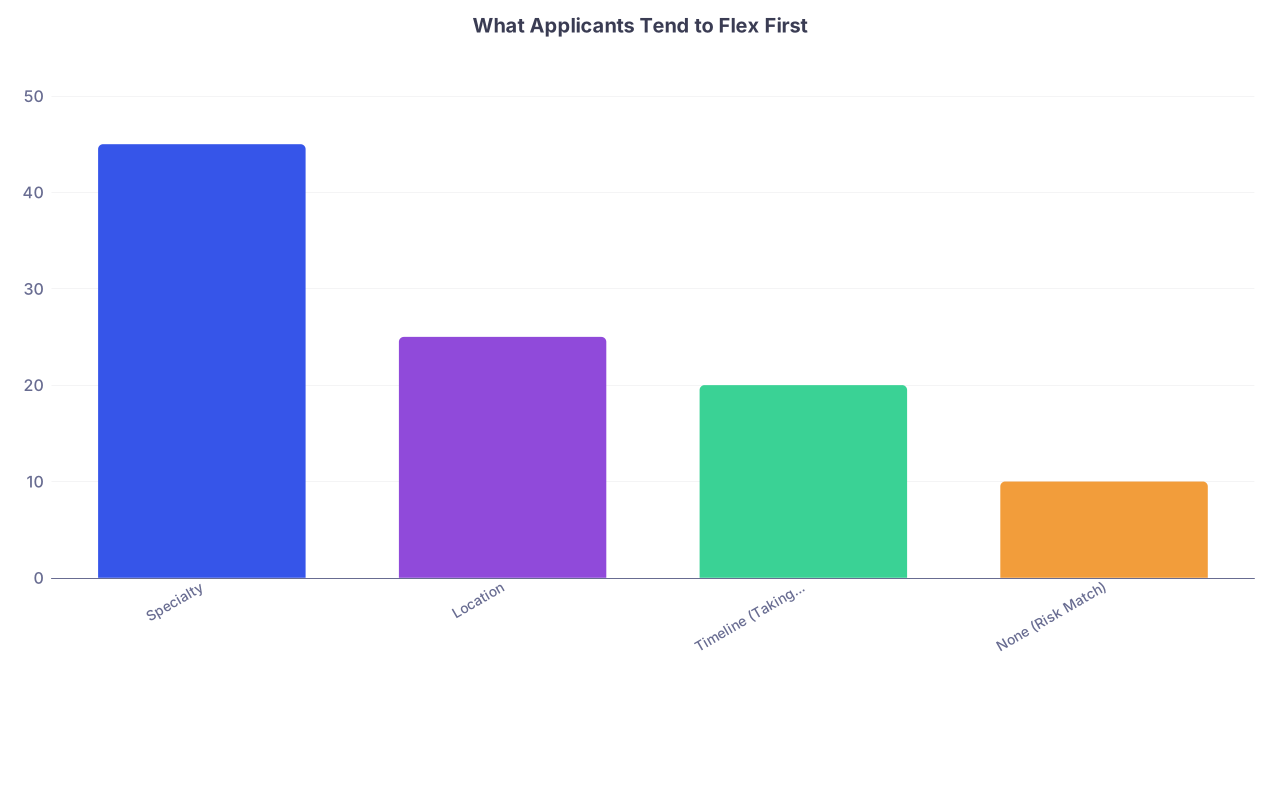
| Category | Value |
|---|---|
| Specialty | 45 |
| Location | 25 |
| Timeline (Taking Gap Year) | 20 |
| None (Risk Match) | 10 |
Rough breakdown from what I’ve seen anecdotally:
- Many will flex specialty before location.
- Some will flex location before specialty.
- A smaller but increasing group will flex timeline (take a gap year, do research, prelim + reapply).
- A stubborn minority tries to flex nothing and “just hope” → these are the ones crying in SOAP.
You need to pick consciously—not default.
If your family/location constraint is truly immovable, then specialty or timeline must be more flexible. For example:
- You’re anchored in a medium city with only IM, FM, and Psych.
- You want Derm.
- You absolutely cannot move.
Then your realistic plan looks like:
- Apply to IM and/or FM now
- Crush residency
- Either:
- Build a procedural niche (e.g., IM + rheum, FM + sports med), or
- Consider non-ACGME fellowships, or
- Accept that Derm is probably off the table unless you later move or reinvent yourself.
That sounds harsh. It’s honest. You cannot invent a Derm program in your city by wanting it more.
Step 4: Build “Tiered Backup Tracks” Instead of Just “Backup Specialty”
In your situation, “backup specialty” is too simplistic. You need tracks. Different combinations of specialty + geography + risk.
Think in 3 tracks:
- Track A: Ideal specialty, rigid geography
- Track B: Backup specialties, same geography (or slightly expanded)
- Track C: Primary or adjacent specialties, expanded geography + higher sacrifice
Here’s how that might look for a student in Houston with a spouse who strongly prefers Houston but could tolerate 2–3 hours away:
- Track A:
- Specialty: Radiology
- Geography: Houston only
- Programs: all local rads programs
- Track B:
- Specialty: IM and Neurology as backups
- Geography: Houston + 2–3 hour radius (San Antonio, Austin, College Station)
- Programs: every IM/Neuro in that bubble
- Track C:
- Specialty: Radiology and IM
- Geography: Entire state of Texas
- Plan: Live apart during the week if necessary, reassess move later
You adjust how heavily you lean into each track based on:
- Your competitiveness
- Family’s tolerance for separation/commute
- How catastrophic “no match this cycle” would be for you financially and emotionally
Step 5: Evaluate Realistic Backup Specialties for Your Region
Now the more detailed, practical piece: choosing which backup specialties make sense given you’re constrained geographically.
If you can’t apply broadly, you compensate by picking backups that locally have:
- Multiple programs
- Reasonable number of slots
- Less Step 2 obsession or less heavy filters
- Some need for warm bodies (community programs, safety-net hospitals, expanding systems)
Common “real-world” backups that exist in many metro areas:
- Internal Medicine
- Family Medicine
- Pediatrics
- Psychiatry
- Neurology
- Pathology
- PM&R (sometimes)
- Transitional Year / Preliminary IM (not a true backup, more on this later)
But you must check your specific city. For example:
- Some cities: huge psych and FM presence, almost no neurology.
- Some: robust IM and peds, but psych programs are tiny, academic, and picky.
- Some: only 1 PM&R program with 4 spots and a massive regional draw—terrible “backup.”
Do a targeted reality check:
- Look up fill rates and program types in your chosen areas.
- Scan program websites for language like:
- “We value holistic review”
- “We welcome candidates with diverse backgrounds”
- Heavy emphasis on Step scores, prestige, or home med school → not great as a safety net.
If you’re serious, email or talk to upper-levels who matched there. Ask bluntly:
- “Is your program realistic as a backup for someone with [Step, school, background] who needs to stay in [city]?”
They’ll tell you more truth over coffee than the website ever will.
Step 6: Decide How Aggressive You Need to Be With Dual-Application
You’re constrained by location. So dual-applying (primary + backup specialty in the same cycle) becomes a more serious option, not just something neurotic people do.
But you can’t do it sloppily. You can’t send the same personal statement to EM and psych and call it a day.
Here’s where dual-application makes sense in your situation:
- You are geographically constrained to a small or medium-sized metro.
- Your primary specialty is moderately or highly competitive in that region.
- There are at least 2–3 viable local backup-specialty programs.
- Not matching this year would cause serious problems (visa, finances, relationship).
A semi-reasonable dual-application structure might look like:
- 30–40 applications in primary specialty (all within your defined region(s))
- 15–25 applications in backup specialty (heavily skewed to where you’d actually go)
You must:
- Tailor PS and experiences to each field.
- Be ready to explain dual interest coherently in both interviews.
- Avoid obvious contradictions (e.g., telling IM “I’ve always wanted to be a hospitalist” and telling Anesthesia “I always knew I needed to be in the OR.”)
Is dual-app more work? Yes. But when geography is fixed, you need extra levers.
Step 7: If There Are Truly No Local Backups: Build a Two-Cycle Plan
Sometimes the honest answer is: there is no good backup specialty in your city/region for this year.
Example:
- You are locked to a small city because of custody.
- Only local programs: Gen Surg and EM.
- You want Ortho.
- Your stats are decent but not elite.
- There’s no FM, IM, psych, or peds program locally.
Then your one-cycle “backup specialty” plan is fantasy. You need a two-step.
Realistic options:
Research year / chief year / extra clinical year
- Stay in your location.
- Do a research fellowship or extra clinical role with your target department.
- Beef up your CV, integrate with the team, aim for a home-field advantage next cycle.
Prelim/TY locally + aim for advanced spot later
- Match to a prelim year in surgery or TY (if it exists in your city).
- Use that to:
- Prove yourself clinically.
- Network and re-apply to either your primary or a related field the following year.
- Risk: this is stressful and not guaranteed.
Accept a non-clinical or lower-paying year to stay put and improve application
- Work in research, QA, admin, or even non-medical work if finances demand.
- Meanwhile, strengthen your application (publications, Step 3, USCE if IMG, etc.).
This is where most people need to actually sit with an advisor who will tell them the truth, not what they want to hear.
Step 8: How to Communicate Location and Family Ties Without Torpedoing Yourself
Programs care about two things when it comes to location:
- Will you actually come here if we rank you?
- Are you going to be a problem if something goes wrong with your personal situation?
Used correctly, your family/location ties are a huge asset in that first question. They can reassure programs that you’re not just using them as a safety.
Specific ways to use this:
- In your personal statement (region-specific version), a short, direct sentence:
- “My partner works in [city], and our long-term life is centered here, which is why I am specifically focused on training in this region.”
- In supplemental ERAS geographic preference:
- Actually pick the region where you must be.
- In interview answers:
- “My parents live here and depend on me for regular help with [brief, non-dramatic explanation]. That’s a major reason I’m committed to staying in this area for residency and beyond.”
What you avoid:
- Over-sharing personal chaos.
- Making your situation sound unstable or likely to collapse mid-residency.
- Coming across as if the program is merely a box to check because you have no option.
Use your constraints as a positive:
- “I’m rooted here.”
- “I’m likely to stay in the area after training.”
- “I’m invested in this community long-term.”
Step 9: Make a SOAP-Phase Backup-of-Backup Plan Now
If you’re geographically pinned, SOAP is riskier. You can’t just grab any open slot in another state. So you need a pre-built SOAP strategy.
Do this before you submit ERAS:
Ask: “If I went into SOAP and nothing was open in my city, would I expand to:
- The wider region?
- Entire state?
- Nowhere (i.e., I’d rather go unmatched and try again)?”
Decide which specialties you’d SOAP into if forced:
- Are you willing to SOAP into FM? Psych? Peds? Prelim only?
- Or would you prefer to go unmatched and re-apply with a stronger application?
Talk to family now:
- “If I don’t match locally, would you be open to 1–3 years of long-distance? Or no?”
- Forces everyone to face reality ahead of time instead of mid-panic in March.
This isn’t fun. But you do not want to start those conversations on Match Monday.
Visual: How Constraints Choke Options
Here’s what happens as you stack constraints: your realistic number of specialty options plummets.
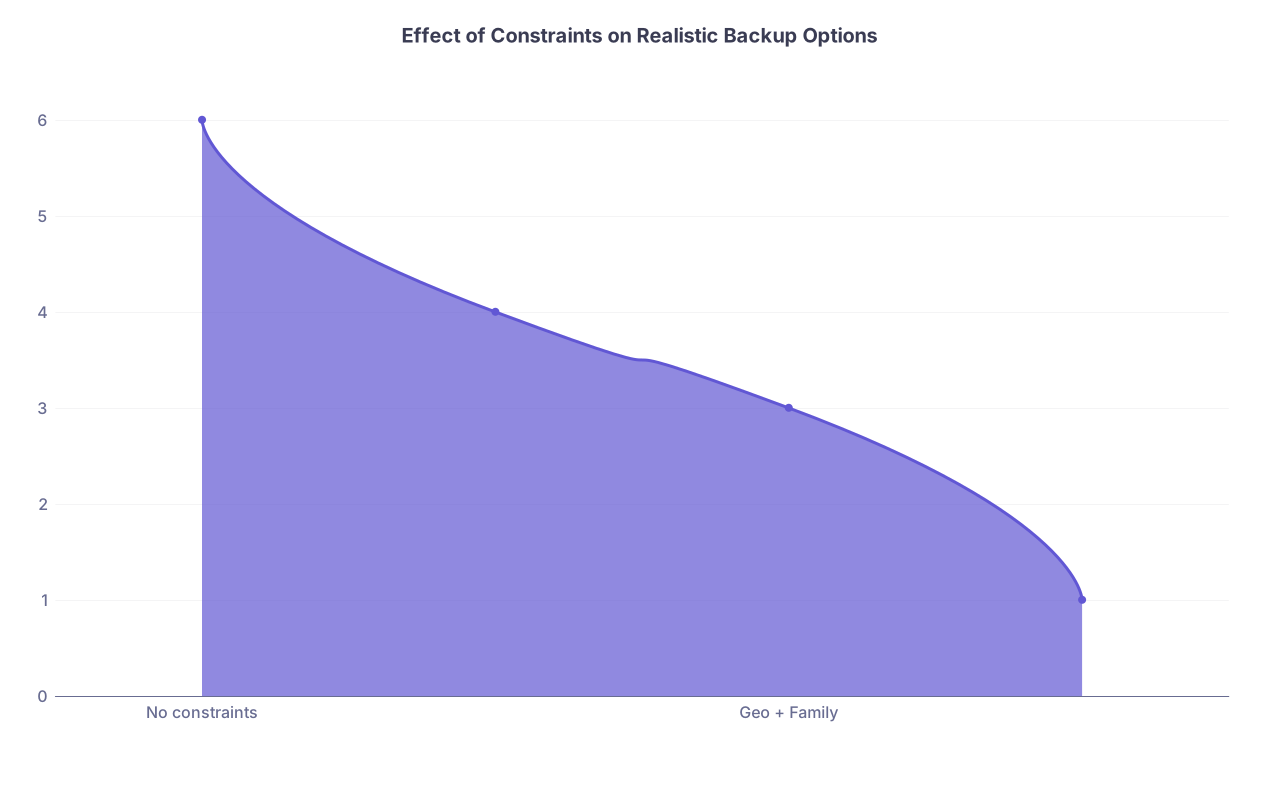
| Category | Value |
|---|---|
| No constraints | 6 |
| Geo only | 4 |
| Geo + Family | 3 |
| Geo + Family + Competitiveness Issues | 1 |
Most unconstrained students realistically consider 4–6 specialties if forced.
By the time you stack:
- Geographic restriction
- Family immobility
- Modest Step scores or red flags
You sometimes have…one. Maybe two.
You’re not a failure if your option list is short. That’s just the math of your situation. The job is not to magically create 6 new options—it’s to use those 1–2 options as effectively as possible.
Step 10: When to Seriously Consider Changing Your Primary Specialty
Sometimes the correct “backup” move is to flip the whole thing: move your original backup into the primary slot.
Signs you should at least consider this:
- Your primary specialty is hyper-competitive nationally and rare in your region (Derm, Ortho, Plastics, ENT, Rad Onc).
- Your local programs in that specialty are elite or small—no community or mid-tier options.
- Your scores / CV are borderline even for mid-tier programs, never mind the high-end ones.
- Meanwhile, you have genuine interest in a more available specialty locally (IM, FM, Psych, etc.) and strong opportunities there.
I’ve seen people stubbornly insist on staying with their dream field for years:
- 1st cycle: no match
- Research year: partial improvement
- 2nd cycle: prelim only in same city
- Re-apply: still no categorical
They eventually flip to IM or FM, are instantly loved by programs, and later tell me, “I wish someone had pushed me harder on this 2 years earlier.”
You don’t have to abandon your dream lightly. But you also don’t have infinite time, money, or emotional bandwidth—especially with family depending on you and location locked.
Sometimes the adult move is:
“Given my geography and my numbers, this backup is actually my best and most realistic primary.”
FAQs
1. Should I tell programs that family or location ties are the main reason I’m applying to them?
Yes—but with nuance. You can absolutely say, “My partner’s job / my parents / my child’s medical care are here, so I’m committed to this region long term.” Programs like geographic commitment. Just don’t make it sound like you would hate to be there if not for your family. Couple it with something about their training style or patient population that genuinely attracts you.
2. Is dual applying a red flag if I’m stuck in one city?
No, not inherently. Many programs assume applicants apply to more than one specialty, especially if they’re in a competitive field. It becomes a problem only if:
- Your story is internally inconsistent.
- Your application materials look copy-pasted or generic.
- You get caught telling two completely different “lifelong dream” stories.
If your location is restricted, dual applying can be rational risk management—just be prepared to explain the logic coherently.
3. What if my family says they’ll move or do long-distance, but I’m not sure they actually will?
Then you treat that as a partial, not absolute, flexibility. In practice:
- Make a core plan assuming limited movement (Track A/B).
- Build a “break glass” plan (Track C) where you expand geography only if absolutely required.
And most importantly, have the hard conversation now: “If my only match is 4 hours away, are we doing that or am I reapplying?” You don’t need a signed contract, but you do need everyone’s eyes open before Match Week.
Key points to walk away with:
- You’re not applying to “residency.” You’re applying to specific specialties in specific zip codes—and your family/location constraints shrink that map fast.
- When geography is fixed, you must flex something else: specialty choice, willingness to dual-apply, or timeline. Pretending you can keep all three rigid is how people end up in SOAP disasters.
- Build tracks, not fantasies: ideal plan, local backups, and an honest worst-case plan—then make decisions with your actual life, not imaginary freedom, in mind.