
The way most applicants build their rank lists is backwards. They start with anxiety, stir in group chat rumors, add a dash of prestige worship, and call it a “strategy.”
You can do better than that.
What you need is a protocol. A structured, repeatable method that takes you from “I have no idea how to rank these” to “I can explain every rank decision in one sentence.” That is the bar.
Below is exactly how to get there.
Step 1: Stop Asking the Wrong Question
The question everyone obsesses over is:
“Which program will make me the strongest applicant for fellowship / best attending / whatever?”
Wrong question. Here is the right one:
“Where am I most likely to thrive, learn, and not burn out – for 3–7 years – while still meeting my career goals?”
That change sounds subtle. It is not. It kills a lot of bad thinking:
- “This place is malignant but really strong clinically” → No, that is not a plus.
- “I hated interview day but they have a big name” → Translation: daily misery for a line on your CV.
- “My partner cannot move there but it is MGH” → You are not a disembodied CV. Your life will implode.
Your rank list is not a trophy shelf. It is a risk management document for the next phase of your life.
So the method I am giving you is built around three pillars:
- Non‑negotiables – if a program fails these, it should not be on your list.
- Weighted criteria – how to objectively compare programs you liked.
- Tiebreakers – how to handle the “I liked them all” / “I cannot decide” hell.
You are going to write things down. You will use a simple scoring system. And yes, it will feel overkill for about 30 minutes. Then your anxiety will drop about 50%.
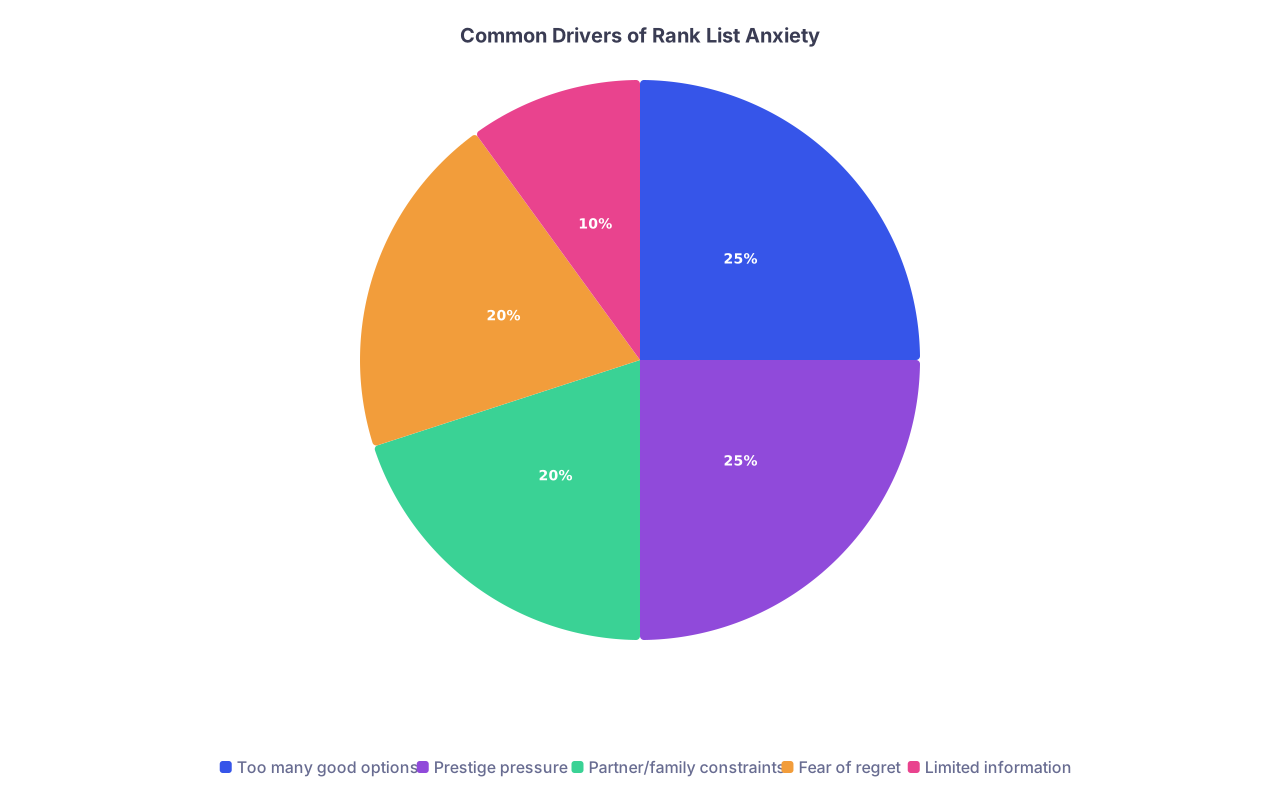
| Category | Value |
|---|---|
| Too many good options | 25 |
| Prestige pressure | 25 |
| Partner/family constraints | 20 |
| Fear of regret | 20 |
| Limited information | 10 |
Step 2: Define Your Non‑Negotiables (Before Looking at Programs Again)
If you start with the programs, you will bend your values to fit the shiniest name. I have watched this happen every year.
Start here instead. Take 15–20 minutes and answer these blunt questions in writing:
Location constraints
- Do you have to be in a certain region or city for partner, kids, visa, health, finances?
- Are there places you absolutely will not live (extreme weather, cost, safety, distance from family)?
Life constraints
- Do you need two incomes to survive? Then your partner’s job market matters. A lot.
- Do you have caregiving responsibilities?
- Do you have health needs requiring specific specialists or hospitals?
Program structure constraints
- Are you visa‑dependent (J‑1 vs H‑1B)? Then certain programs are functionally off the table.
- Are you dead set on a very competitive fellowship? Then you probably need:
- Solid in‑house fellowship or
- Strong match history + research support.
-
- No 24‑hour calls after PGY‑1?
- No programs with bad reputations for mental health support?
- Need guaranteed parental leave structure?
Make two short lists:
Must‑have list (3–6 items)
Examples:- Within 1 hour of [partner’s city]
- H‑1B sponsorship
- In‑house cardiology fellowship or strong cards match
- Cost of living that works on resident salary
Red‑flag list (3–6 items)
Examples:- Consistently toxic culture reported by >2 trusted sources
- No formal mentorship structure
- Chronic under‑staffing / unsafe patient:resident ratios
If a program violates your must‑haves or triggers red flags, you do not “drop it down a bit.” You remove it. Completely. Yes, even if it is a big‑name place. Especially then.
Step 3: Build a Simple Decision Framework (Weights + Criteria)
Now we get to the part applicants avoid because it feels “too mechanical.” That is exactly why you should do it.
You are going to assign:
- Criteria – aspects you care about
- Weights – how much each aspect matters to you
- Scores – how each program performs on each aspect
3.1 Pick Your Criteria (5–8 max)
Too many criteria and you drown in noise. Too few and you miss what matters. For most people, a solid set looks like:
- Training quality / clinical volume
- Mentorship and culture
- Fellowship match or career outcomes
- Location fit
- Schedule and lifestyle (call, nights, ICU load)
- Research / academic opportunities (if relevant)
- Support systems (wellness, childcare, mental health)
- Cost of living / salary / benefits
You do not need all of these. You pick your 5–8 biggest levers.
Common mistake: saying “Everything is important.” That is how you end up paralyzed. You are forced to prioritize.
3.2 Weight Your Criteria
Now assign each criterion a weight from 1–5 based on importance to you, not what people on Reddit care about.
Example for someone who wants academic subspecialty, no kids, flexible on location:
- Training quality: 5
- Fellowship match / reputation in subspecialty: 5
- Mentorship & culture: 4
- Research support: 4
- Location: 2
- Lifestyle: 3
- Cost of living: 2
Now someone with two kids, partner in a fixed city, aiming for general practice:
- Location: 5
- Lifestyle: 5
- Mentorship & culture: 4
- Cost of living: 4
- Training quality: 3
- Fellowship match: 1
- Research support: 1
Different life, different weights. As it should be.
Step 4: Score Each Program – Using Actual Data, Not Vibes
Once you have your criteria and weights, you can start scoring programs logically.
You will use a simple 1–5 scale for each criterion:
- 1 = Very poor
- 2 = Below average
- 3 = Average / acceptable
- 4 = Good
- 5 = Excellent
4.1 Where to Get Real Information
Use all of these, not just the shiniest website:
- Your interview notes and gut impression (yes, those matter)
- Conversations with current residents (not just the hand‑picked ones)
- Alumni from your med school who trained there
- Program websites (for structure, not culture)
- Fellowship match lists
- Geographical cold facts: rent prices, crime maps, commuting times
Red flag: if residents keep saying “We are like a family” but cannot give specifics about mentorship, wellness, or support, that is noise, not data.

4.2 Example: Weighted Scoring for 3 Programs
Let me show you a compact example. Say your criteria and weights are:
- Training quality – weight 5
- Mentorship & culture – weight 4
- Fellowship match – weight 4
- Location – weight 3
- Lifestyle – weight 3
You are comparing Programs A, B, and C.
| Criterion | Weight | Program A Score | Program B Score | Program C Score |
|---|---|---|---|---|
| Training quality | 5 | 5 | 4 | 3 |
| Mentorship & culture | 4 | 3 | 5 | 4 |
| Fellowship match | 4 | 4 | 3 | 2 |
| Location | 3 | 2 | 4 | 5 |
| Lifestyle | 3 | 2 | 4 | 5 |
Now compute weighted totals:
Program A: (5×5) + (4×3) + (4×4) + (3×2) + (3×2)
= 25 + 12 + 16 + 6 + 6 = 65Program B: (5×4) + (4×5) + (4×3) + (3×4) + (3×4)
= 20 + 20 + 12 + 12 + 12 = 76Program C: (5×3) + (4×4) + (4×2) + (3×5) + (3×5)
= 15 + 16 + 8 + 15 + 15 = 69
Your rational ranking from this analysis: B > C > A.
Notice something: Program A might be the “big name” with fantastic training but terrible location and lifestyle for you. The weighted system exposes the trade‑off clearly.
Step 5: Check Your Results Against Your Gut (And Adjust Deliberately)
Now you will hit a moment where your spreadsheet says one thing and your chest says another.
Example: The numbers say Program B should be #1, but you felt at home at Program C. Or your partner strongly prefers C. Or you just cannot picture living in B’s city.
That does not mean the system failed. It did its job: it clarified the trade‑offs.
Here is how to handle that conflict like an adult, not a spreadsheet robot.
5.1 The One-Sentence Test
For any rank change where you want to override the numbers, force yourself to write:
“I am ranking Program X over Program Y because __________.”
If you cannot fill that blank with something concrete and defensible, you are probably reacting to prestige, fear, or random noise.
Good reasons:
- “My partner has a stable job in City X and cannot move to City Y.”
- “Program C scored slightly lower on fellowship match, but I have strong existing connections that mitigate that.”
- “The culture at Program B felt unhealthy; three residents privately described burnout as ‘normal.’”
Bad reasons:
- “People on Reddit say B is more competitive.”
- “My classmates would respect me more if I matched at B.”
- “The hospital lobby at B was so nice.”
If your reason is good, adjust the rank list. Your values trump the model. But do it consciously.
5.2 Sanity Check: Grouping Programs into Tiers
Once you have initial scores, group programs into rough tiers:
- Tier 1: Top‑fit programs – would be genuinely happy there
- Tier 2: Solid options – acceptable, some trade‑offs
- Tier 3: Backup options – you can survive, but not ideal
- Tier 4: Should not be on the list – violate non‑negotiables
Within each tier, you can allow your gut to order programs, as long as it does not contradict something major (like your partner’s job or a toxic culture red flag).

| Step | Description |
|---|---|
| Step 1 | Define Non-negotiables |
| Step 2 | Select Criteria & Weights |
| Step 3 | Score Each Program 1-5 |
| Step 4 | Calculate Weighted Totals |
| Step 5 | Tier Programs |
| Step 6 | Apply Gut + Life Overrides |
| Step 7 | Finalize Rank Order List |
Step 6: Common Psychological Traps – And How to Crush Them
Even with a perfect method, your brain will try to sabotage you. Let us call out the nonsense explicitly.
6.1 Prestige Addiction
Symptom: You keep bumping a “name” program up the list even though:
- You did not like interview day
- Residents looked exhausted
- City makes no sense for your life
Fix:
- Ask: “If this program had an average name but same reality, where would I rank it?” Put it there.
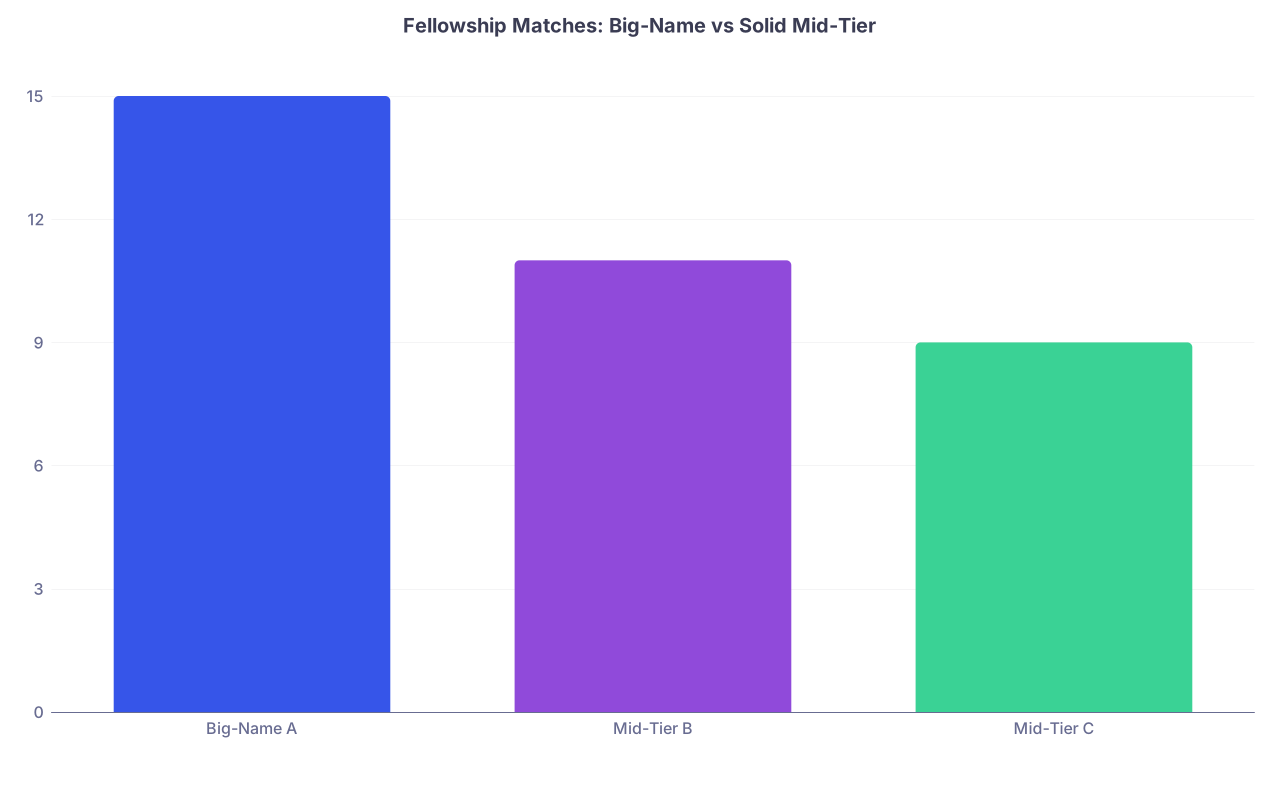
- Look at fellowship match lists. You will see people matching into top fellowships from solid mid‑tier programs every year. Because they did good work in a supportive environment.
| Category | Value |
|---|---|
| Big-Name A | 15 |
| Mid-Tier B | 11 |
| Mid-Tier C | 9 |
Numbers like that are typical: marginal differences, not destiny.
6.2 Fear of Regret / FOMO
Symptom: You rewrite your list every day, scrolling back through emails, stalking residents on Instagram, convinced that one small mis‑rank will ruin your life.
Fix:
- Set two deadlines:
- Working draft complete by Date X
- Final review and lock‑in by Date Y
- Between X and Y, you only change your list if:
- You get new substantive information (e.g., current resident calls you and describes serious issues, or partner’s job offer changes location options)
- A non‑negotiable changes (visa situation, major life event)
No changes based purely on anxiety or “thinking about it more.”
6.3 Social Comparison
Symptom: You are sliding programs up or down based on where your classmates are ranking them.
Fix:
- Ask yourself one brutal question:
“If every other person in my class disappeared tomorrow, how would I rank these programs for my life?” - Your class group chat is not a decision‑making body. It is a noise machine.
Step 7: Special Situations That Change the Equation
Some applicants have constraints that absolutely must dominate the rank list. If you are in any of these categories, you are not being “overly dramatic” by prioritizing them.
7.1 Couples Match
If you are couples matching, your method needs one extra layer.
Each of you independently:
- Defines non‑negotiables
- Weights criteria
- Scores programs
Then together:
- Identify overlapping cities and program pairs
- Create a joint list sorted by:
- Combined fit scores
- City compatibility
- Realistic match probability
General rule: It usually makes more sense for both of you to be in good‑fit programs in the same city than for one person to be at a “top” program and the other to be miserable or unmatched.
7.2 Visa Issues
If you need H‑1B or have J‑1 constraints:
- That becomes a primary filter, not a secondary detail.
- Your non‑negotiable list should include:
- Only H‑1B sponsoring programs (if that is your need)
- History of successful visa processing
If a fantastic program does not sponsor your visa type, it is a fantasy, not an option. Do not rank fantasies.
7.3 Strong Geographic Ties / Family Care
If you must be near:
- A sick parent
- A co‑parenting arrangement
- A partner with an immovable job
Then location weight is 5. Not 3. Not “depends.” It is 5. Your method should reflect that.
Step 8: Translate Your Analysis into a Final, Clean Rank List
By this point you should have:
- A list of programs that survive your non‑negotiables
- A set of weighted criteria
- Scores for each program
- Tiers (Top, Solid, Backup)
- A short list of justified overrides (gut or life‑based)
Now turn that into a final list.
- Order programs by weighted score within each tier.
- Apply justified overrides:
- Move programs up or down with clear written reasons.
- Once final, do a top‑to‑bottom read:
- For each spot, ask: “If I matched here, could I explain why this spot makes sense?”
- If you hit a program where the answer is “No, this is out of place,” fix it.
Then stop touching it. You are done.
Step 9: Behavioral Rules for Your Own Sanity
A good method does not just give you a list. It protects your brain from spiraling in the weeks before submission.
Use these rules:
No nightly re‑ranking
- Set two or three scheduled “rank review” sessions.
- Outside of those, you are not allowed to open the spreadsheet.
No new data from random forums after your draft is done
- If you have specific concerns, talk to:
- Current residents
- Alumni from your med school
- Trusted faculty
- Not anonymous strangers who love drama.
- If you have specific concerns, talk to:
Document your reasoning
- One sentence per program: “I ranked X at position Y because ___.”
- This kills a lot of last‑minute doubt, because you see the logic in your own handwriting.
FAQ (Exactly 4 Questions)
1. Should I ever rank a program I actually dislike just to have more options?
No. If you would be genuinely miserable training there or feel it is unsafe or toxic, do not rank it. The Match is a binding contract. If you match to a program you hate, you cannot just “undo it” easily. Rank only places where, if you matched, you would at least be willing to show up in July without resentment.
2. How much should fellowship aspirations influence my rank list?
It should matter, but not dominate your entire life. If you are set on a very competitive subspecialty, prioritize programs that:
- Have strong fellowship match lists in that field
- Offer protected research time, mentorship, and letters from known faculty
But if Program A has slightly better fellowship outcomes and an obviously worse culture, location, or support structure than Program B, you are usually better off at B. People match into competitive fellowships from solid programs all the time because they are happier, more productive, and better supported.
3. What if my rank list logic conflicts with my partner’s preferences?
You need to treat this like a joint optimization problem, not a battlefield. Each of you should:
- Independently rank programs based on your own method
- Then sit down and compare, explicitly listing:
- Deal‑breakers
- Nice‑to‑haves
Often the compromise is:
- Both of you in strong programs in the same city, even if each is slightly lower on your personal solo list.
If your methods produce wildly different priorities, that is not a rank‑list problem. That is a relationship negotiation problem that needs an honest conversation.
4. Is using a spreadsheet and weighting system “overthinking it”?
No. You are making a multi‑year, life‑shaping decision under uncertainty and time pressure. A simple weighted system:
- Forces you to clarify what actually matters
- Reduces random mood‑based decisions
- Lowers anxiety because you can see why Program X is above Program Y
What is “overthinking it” is changing your entire rank order at midnight because of a rumor you saw online. A structured method is not overkill. It is how you make peace with your decision.
Key takeaways, and then you are done:
- Define your non‑negotiables and weights first, or prestige and fear will quietly run the show.
- Use a simple, explicit scoring system to compare programs, then let your gut and life realities make targeted overrides.
- Once your list passes the one‑sentence test for each rank position, lock it and walk away. Your job is to build a rational list, not to torture yourself until Rank Order List certification day.