
The belief that away rotations are a golden ticket into competitive specialties is wrong. They’re a high‑variance gamble, not a magic key. And a lot of students are overpaying—financially, physically, and emotionally—for very mediocre odds.
Let me be blunt: in 2024, away rotations in competitive fields (derm, ortho, plastics, ENT, neurosurgery, IR, etc.) are heavily mythologized. The folklore is louder than the data. You hear the same lines over and over in the hallway:
- “You have to do three aways for ortho or you’re dead.”
- “You need to audition at your dream program to match there.”
- “No away in derm = no shot.”
Most of that is half‑true at best and flat‑out wrong at worst.
What actually matters is more nuanced: specialty, your baseline competitiveness, timing, and how you perform under the microscope. Away rotations can help. They can also quietly hurt you. And sometimes they’re just an expensive four‑week audition that nobody remembers by rank list time.
Let’s cut through the mythology.
What the Data Actually Shows About Aways
Step away from Reddit and look at real match data, program surveys, and what PDs actually say when they’re not performing for students.
Away rotations are most impactful in a few specific contexts:
- Fields where “fit” and letters from known faculty are heavily weighted.
- Students from lower‑reputation schools trying to break into high‑tier programs.
- Students geographically shifting—e.g., Midwest school → West Coast match.
- Applicants with borderline metrics needing another way to prove themselves.
In others, aways are massively overdone.
Here’s how different competitive specialties actually use aways, in practice:
| Specialty | Typical Aways | Relative Impact on Match* |
|---|---|---|
| Orthopedic Surgery | 2–3 | High |
| Dermatology | 1–2 | Moderate–High (letters) |
| Plastic Surgery | 2–3 | High |
| Neurosurgery | 1–2 | Moderate–High |
| ENT | 1–2 | High |
| IR (Integrated) | 1–2 | Moderate |
*Relative impact is based on PD surveys, NRMP reports, and typical program behavior—not folklore.
Notice what’s not on that table: “You must rotate where you want to match.” That’s one of the biggest lies students keep repeating to each other.
Programs do not blindly rank their rotators first. In very competitive fields, they often do the opposite: use aways to screen out people they do not want.
The Biggest Myths About Away Rotations
Let’s pull apart the major myths one by one.
Myth 1: “An away rotation is basically an extended interview.”
No, it isn’t. Interviews are structured, short, curated. Aways are four weeks of exposure where every mediocre day counts against you.
On an interview day, you’re:
- On your best behavior.
- Seen for a few hours.
- Given a script to follow.
On an away, you’re:
- Seen pre‑coffee, post‑call, and during your worst patient encounter.
- Judged not just by attendings, but by residents, coordinators, nurses.
- Vulnerable to small‑sample randomness: one bad case, one awkward interaction.
PDs consistently report something like this (I’ve heard this verbatim from ortho and ENT PDs): “Rotators are most useful to identify people we don’t want here.” Not to crown superstars. To filter out the obvious bad fits, the unprofessional, the lazy, the socially off.
Golden ticket? More like a four‑week high‑stakes stress test.
Myth 2: “If I don’t do an away, I can’t match a competitive specialty.”
Check the NRMP data and specialty‑specific match reports. Every year, plenty of people match competitive fields without aways—especially into their home programs.
Why?
- Many programs still heavily favor their home students.
- A high Step 2, strong home letters, real research, and performance on home rotations often outweigh a random four‑week appearance at another institution.
- Some specialties (e.g., derm, IR) care more about your CV and letters than whether you physically stood in their clinic for a month.
Where this myth comes from is a kernel of truth: if you are from a lower‑tier school with weak home specialty presence and you want to break into a very strong program elsewhere, an away might be your best (or only) way to be truly seen. But that is not the same as: “No away = no match.”
It’s conditional. Not universal.
Myth 3: “You must rotate at your dream program to have a shot there.”
That’s the romantic story. “I rotated there, connected with the team, and they ranked me number one.” It happens. But look at the denominator.
For every one of those stories, there are ten where:
- The rotator blends into a sea of other students.
- Residents are too overworked to advocate for another visiting student.
- Applicant is fine, not spectacular, and ends up buried mid‑rank list, if ranked at all.
Programs know the psychology: students who rotate with them are more likely to rank them highly. Programs don’t necessarily need to over‑weight those students. A silent advantage already exists.
Also, rotating at a place and then not matching there can sting more than never going. I’ve seen students spiral after that. You need to be emotionally ready for that outcome.
Matching at a place you did not rotate is absolutely standard. Across competitive fields.
Myth 4: “More aways = better odds.”
No. Past a point, more aways just means more chances to look average or screw up.
I’ve watched applicants do three straight aways in ortho, then show up exhausted in September, burned out, with mediocre letters that all say variants of “hard‑working, pleasant, good team player.” No one letter stands out. No one is strongly advocating. They’ve essentially converted three months of their life and several thousand dollars into three solid but generic letters.
You know what would’ve helped more?
- Two strong aways and four extra weeks for research output.
- Or time to crush Step 2.
- Or time to rest and then hit interviews with energy and clarity.
There’s a point of diminishing—and then negative—returns. For many, that’s beyond two aways.
When Aways Actually Help You
Enough negativity. Let’s talk about where aways do have real signal.
1. You need a powerful letter from a known name
In derm, plastics, neurosurgery, ENT, a letter from a nationally known faculty member or PD still carries real weight. If your home program doesn’t have such people, you may need to go find them.
On an away, a strong performance can get you a letter that says more than the usual filler. Something like:
“This student functioned like a sub‑intern, took ownership of patients, read on cases without prompting, and was one of the top rotators we’ve had this year.”
That kind of letter, from a respected name, can move the needle in competitive fields. But you have to earn it. And you need to give them something to concretely praise: initiative, clinical knowledge, reliability, emotional intelligence.
2. You’re from a lesser‑known school and want to prove you belong
If your home institution isn’t known for your chosen specialty—or doesn’t even have a department (yes, this still happens)—then aways let you show you can hang at a busy academic center.
This is where the “audition” metaphor partially holds. But again, it’s less “four‑week interview” and more “long‑form vetting.”
Programs will look for:
- How quickly you adapt to flow and expectations.
- How you accept feedback.
- Whether residents trust you with actual work, not just shadows.
If you can demonstrate that at a reputable program, your application looks less like a black box from a random school.
3. You’re trying to change region or aim up a tier
Aways are particularly useful if:
- You’re from a state school in the Midwest and want to land on the coasts.
- You’re at a solid but not elite institution and you’re shooting for places that historically match mostly from top‑tier schools.
Programs are risk‑averse. Taking someone from “known pipelines” is safer than gaming out unfamiliar environments. An away lets you partially bypass that bias. You become someone they “know,” not just a line on ERAS from a school they vaguely recognize.
4. You’re a late bloomer who needs a strong recent showing
If your pre‑clinical record is mediocre, Step 1 was pass‑barely, or your third‑year evals are mixed, a strong sub‑I / away in your field can help rewrite the narrative:
- “Initially struggled but now clearly ready for residency.”
- “Major upward trajectory; impressive on sub‑internship.”
This doesn’t erase serious red flags. But it can reassure borderline programs who are nervous about your earlier record.
The Dark Side: How Aways Quietly Hurt Applicants
Everyone talks about the success stories. People gloss over the slow‑motion disasters. I’ve seen these play out:
- Student does three aways → gets one lukewarm letter, one “damned by faint praise” letter, and one place that never sends a letter at all because no one really engaged with them.
- Student has one bad interpersonal interaction (snaps at a nurse, acts defensive with feedback) → residents quietly tell PD, “Don’t rank.” That’s it. No appeal process.
- Student goes to a super‑malignant program thinking prestige will shine them up → instead, they get buried, overworked, and come out with average comments because nobody had time to actually see them as a person.
And the financial/psychological cost is real:
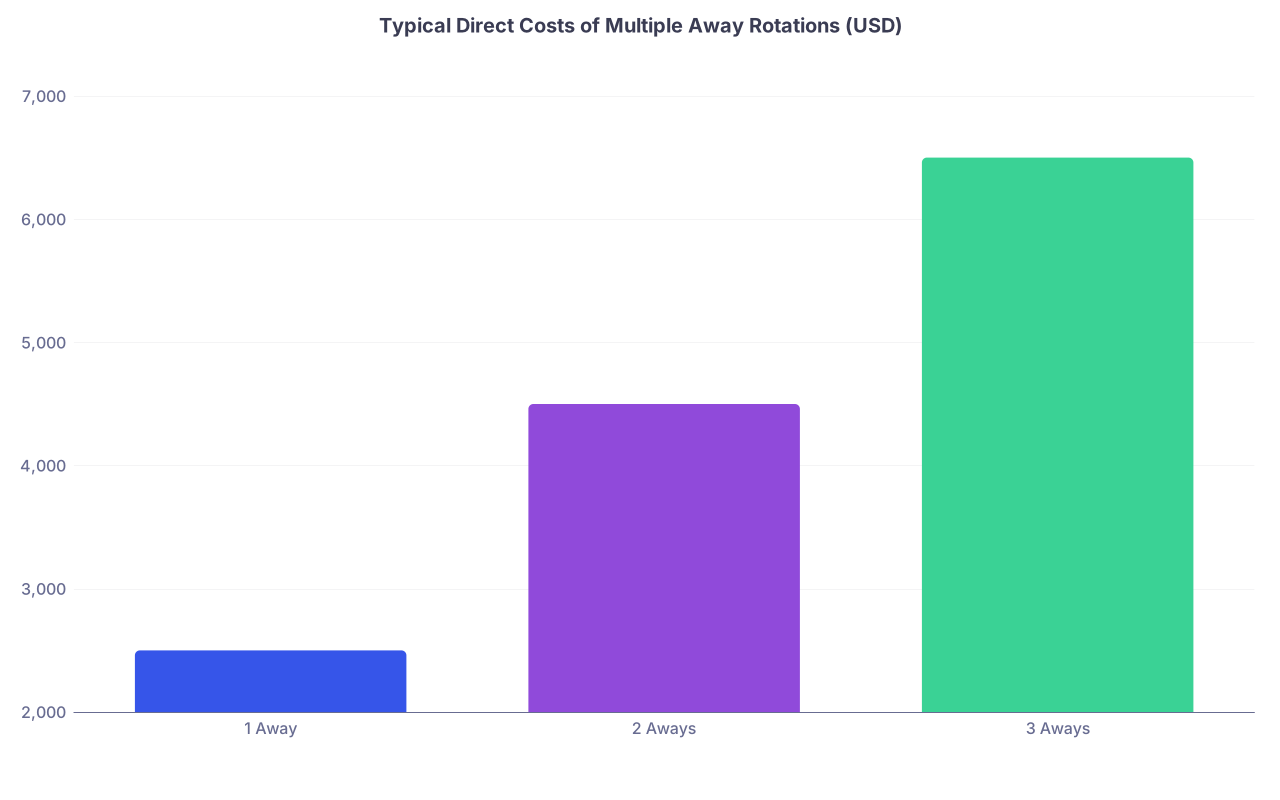
| Category | Value |
|---|---|
| 1 Away | 2500 |
| 2 Aways | 4500 |
| 3 Aways | 6500 |
This doesn’t even count lost income, emotional exhaustion, or opportunity cost for research and Step 2 prep.
If your away produces:
- No standout advocacy.
- No significant networking.
- No clear signal boost.
Then you burned time and money for marginal gain.
Strategic Use of Aways by Specialty Type
Let’s be precise. How should you actually think about aways in the big competitive fields?
Ortho / Plastics / ENT / Neurosurgery
These are the classic “audition rotation” fields.
Patterns I’ve seen:
- 2 aways is often the sweet spot for most applicants.
- Your home sub‑I matters just as much, sometimes more.
- Programs heavily trust resident opinions on rotators. If the residents do not love you, that away is not helping.
In these fields, aways genuinely can swing your odds—positively or negatively. They’re double‑edged swords. You do not casually sign up for three if your stamina, social skills, or clinical baseline are shaky.
Dermatology
Derm is weird and stats‑heavy:
- Step 2, research output, and letters are enormous.
- Many programs don’t need you to rotate there to rank you highly.
- Aways can help generate high‑power letters and show that you’re not just a lab rat.
If your CV is light on derm‑specific experiences or home mentorship, then 1–2 targeted aways can be appropriate. But a derm away where you stand quietly in clinic and no one writes you a strong letter? That barely moved your application.
Integrated IR, some subspecialty surg fields
Aways can help, but these specialties are in a transition phase. PDs are still calibrating what aways actually tell them.
For you, the question is: will anyone there really see you and advocate? If the answer is “maybe not, it’s a huge service with tons of students,” that’s a warning sign.
How to Decide If An Away Is Actually Worth It
You shouldn’t start with “aways are required.” You should start with a brutal self‑audit.

| Step | Description |
|---|---|
| Step 1 | Want competitive specialty |
| Step 2 | Consider 1 to 2 targeted aways |
| Step 3 | Do 1 away to strengthen letters |
| Step 4 | 1 to 2 aways in target region |
| Step 5 | Maybe 0 to 1 away only |
| Step 6 | Strong home program? |
| Step 7 | Home letters and subI strong? |
| Step 8 | Need region or tier shift? |
Ask yourself, plainly:
- Do I have a strong home sub‑I opportunity and likely strong letters?
- Is my school already a known pipeline to the programs I want?
- Am I trying to change region or prestige tier?
- Is there a specific person or department where a letter or connection would be uniquely valuable?
If you answer “yes” to 2 and “no” to 3–4, and you already have a legit home rotation, your ROI for multiple aways is probably low. One, maybe. Three, probably not.
If your home situation is weak, then 1–2 well‑chosen aways, where people will actually pay attention to you, can absolutely be rational.
How to Not Waste (or Tank) an Away Rotation
If you’re going to gamble four weeks of your life, at least play the game correctly.
Pick programs strategically, not aspirationally
Do not just chase brand names. Chase:
- Places that actually match from schools like yours.
- Services where visiting students are integrated, not ignored.
- Departments where you’ve had some pre‑away email contact with faculty or residents.
A “top 5” program that never meaningfully sees you is worse than a “top 30” place where residents will know your name by the end of week one.
Show value early, then sustain it
I’ve seen too many students try to “warm up” for a week. There’s no time for that. You need to:
- Be reliable from day one: on time, prepared, available.
- Read on your cases and patients the night before.
- Take ownership of a few patients or tasks and follow through relentlessly.
Residents and attendings are asking one core question: “Would I want to work with this person at 3 a.m.?” Everything else is noise.
Get feedback—and adjust
A surprisingly small percentage of students ever ask, “How am I doing? Anything I should change?” Half are afraid; half assume no news is good news. Both are wrong.
Mid‑rotation, ask a resident and an attending for concrete feedback. Then fix something they mention. People remember that.
Make it easy for someone to write you a real letter
Near the end, you should:
- Identify one or two faculty who’ve seen you actually work.
- Ask directly if they’d be comfortable writing a strong letter on your behalf.
- Offer a short summary of patients/cases you were involved in so they can anchor specifics.
If you walk away with no real advocacy, you paid full price for a very blurry signal.
The Bottom Line: Golden Ticket or Overhyped?
Away rotations are neither magic nor useless. They’re powerful but blunt instruments.
Here’s the reality in three lines:
- In truly competitive fields, aways are high‑risk, medium‑reward tools that can help if you’re intentional and already reasonably strong; they can also quietly sink you if you’re not ready.
- Doing more aways is not inherently better; beyond 1–2, you’re now trading away research, Step 2 performance, sanity, and money for increasingly marginal (or negative) returns.
- You should use aways surgically—to secure specific letters, prove yourself outside a weak home environment, or bridge geographic/tier gaps—not as a default, fear‑driven checkbox.
If you treat aways like a golden ticket, you’ll overinvest and likely be disappointed. If you treat them like a sharp tool—used selectively, with a clear goal—you actually give yourself an edge.