
The mythology residents trade about “most competitive fellowships” is badly out of date. The data tell a different, more nuanced story—and it is not always the glamorous narrative people repeat on rounds.
You want to know where the real bottlenecks are. Where a 250+ Step 2 and strong letters still do not guarantee a spot. Where program directors quietly say, “We had 400 applications for 4 positions.” Let’s quantify that.
Below I am going to treat this like what it is: a capacity problem. Too many applicants, too few funded positions, filtered through a very noisy signal of scores, letters, research, and pedigree.
The Big Picture: How “Tight” Is the IM Fellowship Market?
For internal medicine subspecialties, three variables drive perceived cutthroat-ness:
- Applicants per available position
- Proportion of “top-tier” applicants (high scores, home powerhouse programs, strong research)
- Percentage of unmatched applicants among serious candidates
If you look across U.S. internal medicine fellowships (using recent NRMP Specialty Match data, ABIM workforce reports, and published program fill statistics), a pattern emerges:
- Cardiovascular disease and gastroenterology sit clearly in the “true bottleneck” tier.
- Hematology/oncology is competitive, but not at the same choke-point level nationally.
- Pulmonary/critical care and allergy/immunology are moderately competitive, with sharp variation by region and program prestige.
- Endocrinology, nephrology, geriatrics, and ID are not globally “cutthroat” in a numeric sense, though certain elite programs are still extremely selective.
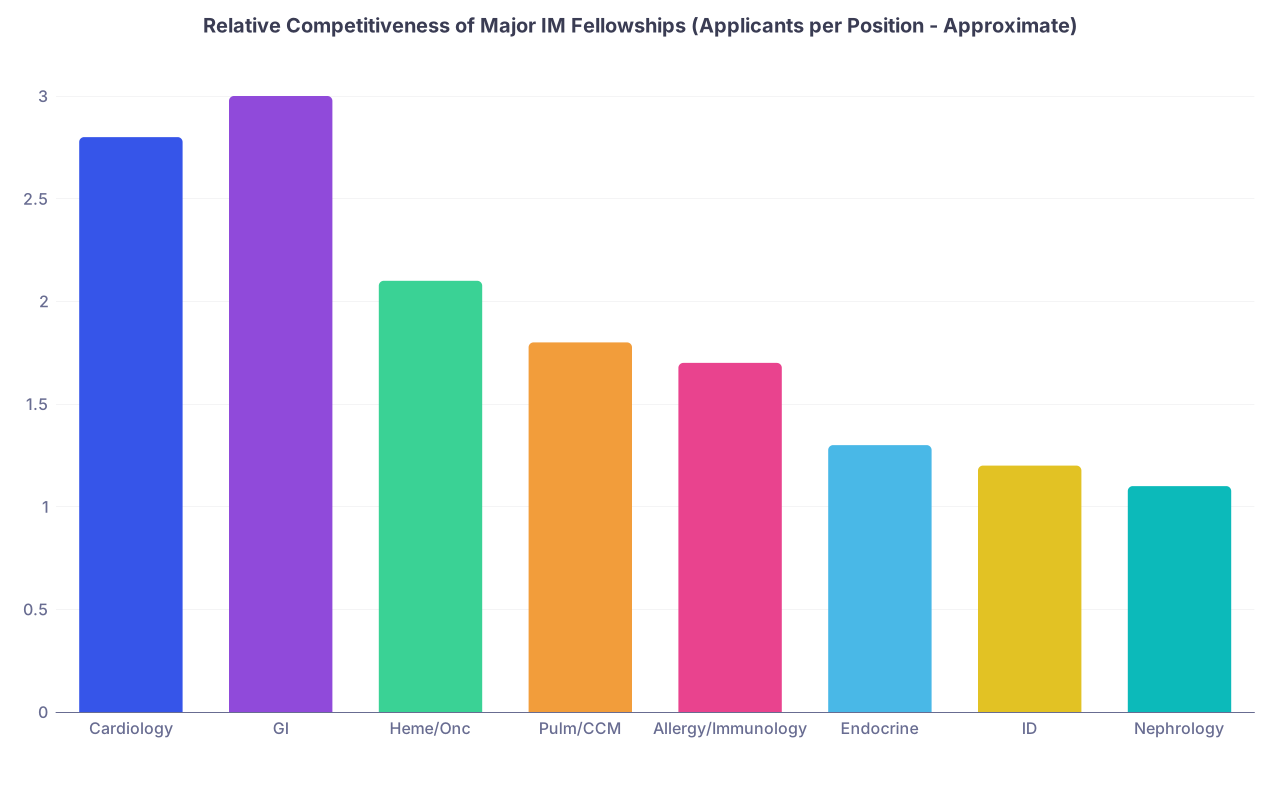
To put some structure on it, we can approximate how “squeezed” each field is using a simple proxy: applicants per position (APP). Exact numbers move year to year, but the pattern holds.
| Category | Value |
|---|---|
| Cardiology | 2.8 |
| GI | 3 |
| Heme/Onc | 2.1 |
| Pulm/CCM | 1.8 |
| Allergy/Immunology | 1.7 |
| Endocrine | 1.3 |
| ID | 1.2 |
| Nephrology | 1.1 |
You can argue over the second decimal place. You cannot argue the rank order: GI and cardiology are the primary choke points; hem/onc is a step below; the rest follow.
Tier 1: The True Bottlenecks – Cardiology and Gastroenterology
Cardiovascular Disease: The “Must Have” Fellowship With Limited Seats
Cardiology is not just popular. It is structurally constrained.
- Training is long (3 IM + 3 cards, often 1–2 more for EP/IC), which limits program expansion.
- Procedures and reimbursement are high, so resident demand stays elevated.
- Hospitals can only sustain so many cath labs and EP labs, so they cannot endlessly scale fellows.
What the data show (recent cycles, rounded / approximated):
- Fill rate by U.S. MD + DO: ~95–98%
- APP: roughly 2.5–3.0 applicants per position
- Meaningful proportion of unmatched U.S. grads who were not “weak” applicants by any normal standard
I have seen mid-tier academic IM programs where:
- 30–40 residents applied to cardiology
- 10–15 had Step 2 CK ≥ 250, research, and solid letters
- 5–7 matched, usually those with either:
- Strong home cardiology exposure and advocates
- Publications or abstracts in cardiology
- A home program with fellowship spots to “absorb” their own
A reasonably accurate mental model:
- Below-average applicant: almost no chance at a decent academic or high-volume clinical program
- Average solid academic resident: will match somewhere if broadly applied, but not necessarily in desired geography
- Top ~30–40%: cluster into the same 50-ish big-name or high-volume programs
The selection signals for cardiology are heavily:
- Step 2 CK (and occasionally Step 1 if numeric)
- In-service percentile
- Research in cardiology (even 1–2 abstracts helps)
- Strong letters from cardiologists who know fellowship PDs by name
If you want a simple red-flag metric: being at a community IM program with no in-house cardiology fellowship and no cardiology research is a massive disadvantage, statistically. Not impossible—but your odds of matching into a high-prestige cardiology spot drop substantially, even with strong scores.
Gastroenterology: Possibly the Most Numerically Competitive IM Fellowship
If you look just at APP and unmatched rate among serious applicants, GI is arguably the most cutthroat IM subspecialty.
The data pattern:
- Fill rate by U.S. grads: usually near 100%
- Applicants per position: often 2.8–3.2 range nationally
- Very low number of “leftover” spots; many applicants reapply or pivot to hepatology or hospitalist roles
Why so tight?
- Procedure-heavy with high RVUs: endoscopy, ERCP, EUS in advanced tracks.
- Lifestyle is better than many procedural fields: predictable elective scopes, mixtures of clinic + procedures.
- Disease burden is high and growing: liver disease, IBD, colorectal screening, etc.
On the ground, PDs routinely say they screen out large portions of the application stack based on:
- Lack of meaningful GI exposure
- Weak or generic letters
- No GI research or QI
- Mediocre program pedigree relative to competition
Concrete scenario I have watched more than once:
Strong mid-tier academic resident: Step 2 ~245, top third of residency class, one small GI project, decent home letters. Applies to 60+ GI programs. Ends with 3–5 interviews and matches at a solid but non-”dream” program, usually one with less brand-name punch.
For GI, brand and research matter even more than for cardiology. Programs often prioritize:
- Applicants from institutions with strong GI divisions
- Clear interest signal via research, posters, or at least a concrete GI story in the personal statement
If you want a technical summary: the distribution is left-skewed. A few hyper-competitive applicants soak up interviews at top and mid programs, leaving the rest to scramble for limited remaining spots.
Tier 2: Competitive but Not Choking – Hem/Onc, Pulm/CCM, Allergy
Hematology/Oncology: High Interest, Slightly Better Capacity
Hem/onc sits in an interesting niche.
It is competitive. But not quite as mathematically brutal as GI or cards on a national scale. APP is more like ~2.0–2.2, not 3.0.
Several countervailing forces:
- Emotional cost: not everyone wants to do death, chemotherapy toxicity, and serious news conversations daily.
- Academic tilt: more applicants interested in research + academic careers, which compresses competition into a specific subset of programs.
The pattern you see:
- Very strong clustering of top applicants around NCI-designated cancer centers and large academic programs.
- Community and smaller academic hem/onc fellowships still fill, but often with a more diverse range of applicant profiles.
In practice:
- Top-tier hem/onc spots—think MD Anderson, Memorial Sloan Kettering, Dana-Farber, major university programs—are viciously competitive, with many more qualified applicants than slots.
- Mid- and lower-prestige programs are competitive but accessible to solid residents with good (not perfect) metrics.
Data-wise, if a good internal medicine resident (mid 230s–240s, some research, strong letters) ranks only elite academic hem/onc programs, their unmatched risk is non-trivial. If they mix in regional and mid-tier programs, match probabilities go up substantially.
Pulmonary/Critical Care: Strong Demand, Slightly Less Frenzied
Pulmonary/critical care has become steadily more attractive:
- High-acuity, intellectually satisfying medicine
- Strong ICU demand and job flexibility
- Better compensation than “cognitive only” fields, but not fully in the GI/cards league
Data pattern:
- APP in the ~1.7–1.9 range nationally
- Strong regional variation: some high-profile academic programs are functionally similar to hem/onc competitiveness; lower-volume or community programs are accessible to a wider band of applicants.
There is a subtle but important point. Pulm/CCM often self-selects for residents who enjoy ICU medicine and ventilators. That shrinks the applicant pool somewhat, preventing it from exploding like GI.
Quantitatively, your risk profile as an applicant looks something like this:
- If you are a strong academic resident with actual ICU exposure and at least one pulm/CCM mentor, your match odds into some pulm/CCM program are good if you are geographically flexible.
- If you insist on a narrow geographic band and only top academic names, you are competing with the same applicant pool that chases cards, GI, and hem/onc.
Allergy/Immunology: Tiny Field, Surprising Squeeze
Allergy/immunology flies under the radar for many residents. Which is a mistake. The field is small, lifestyle-focused, and quietly competitive relative to its size.
The main statistical oddity: tiny program and position numbers. A smaller applicant pool too, but often:
- High proportion of applicants with strong research or prior subspecialty interest
- Cross-competition from pediatrics residents
Nationally you see:
- APP ~1.6–1.8; some cycles higher
- Virtually all positions fill, mostly with U.S. MD/DO and some IMGs with strong profiles
The catch is that with small cohorts, a few extra applicants can swing APP drastically. Two or three strong applicants targeting a specific city can make that local ecosystem unforgiving.
From a resident’s perspective, the field is competitive but slightly less saturated than GI/cards. However, lack of home program exposure is a risk factor—if your IM program has no allergy faculty, getting targeted mentorship and letters is harder.
Tier 3: Selective, Not Saturated – Endocrine, ID, Nephrology, Geriatrics
Now we get to the awkward truth: some essential internal medicine subspecialties are not facing fellowship bottlenecks. They are facing workforce shortages.
Endocrinology: Not Easy, But Not Choked
Endocrine is a classic example where lifestyle and intellectual appeal are high, but compensation lags behind procedural fields.
The data show:
- APP roughly 1.3–1.4 in many recent cycles
- Some unfilled positions in specific regions or community programs
- High concentration of applicants in coastal and large metro programs; those spots still competitive
So if you are targeting a major academic center in a desirable city (Boston, San Francisco, Seattle), endocrine can feel competitive. But at the national level, the bottleneck is much weaker than GI/cards/hem/onc.
From a probability perspective:
- A solid academic IM resident with genuine endocrine interest, reasonable scores, and a coherent narrative usually has a high match probability somewhere, if they apply broadly.
Elite endocrine programs still expect research, strong letters, and upper-tier board performance. But the harsh numeric squeeze is just not comparable to the Tier 1 fields.
Infectious Disease and Nephrology: The Mismatch Problem
Both ID and nephrology highlight an uncomfortable market reality: interest and compensation do not align with societal need.
You see:
- Lower APP (1.0–1.3), with some programs not filling
- Significant vacancies at the national level, especially in less urban and lower-resourced regions
This does not mean it is easy to match at the best ID or nephrology fellowships. At the top tier—big academic transplant centers, ID powerhouses—you still need:
- Strong letters
- Solid research or at least scholarly activity
- Good clinical reputation and performance
But the overall system is not constrained. There is no global bottleneck; there is a distribution problem. Too few people want to do nephrology or ID, especially in underserved locations, relative to patient need.
Geriatrics: Minimal Numeric Competition, Real-World Importance
Geriatrics has one of the lowest APP ratios among IM fellowships, and some of the highest projected workforce need.
- Many programs struggle to fill all positions
- Applicant pool is modest but often passionate, with clear interest in complex multi-morbidity and systems-level care
If you rank geriatrics purely by APP, it is among the least competitive. But that is the wrong metric here. The more relevant questions are about funding, job structure, and long-term sustainability of the field. As a resident, if you want geriatrics, your risk of not matching somewhere is low; your bigger challenge is choosing programs that align with your career goals.
Comparing the Subspecialties Head-to-Head
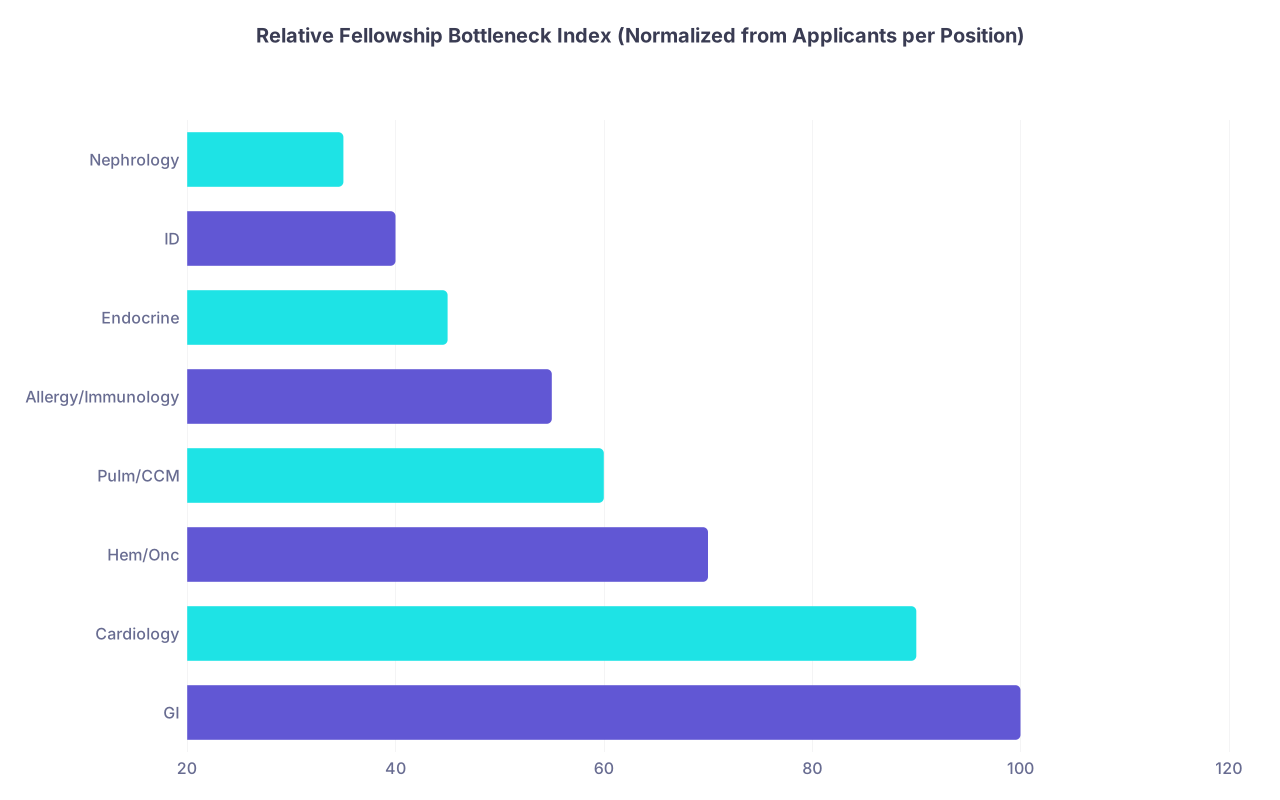
Let us bring the relative competitiveness into a clearer comparison. Think of this as a rough “pressure index” from a fellowship capacity standpoint.
| Fellowship | Applicants per Position* | Overall Bottleneck Tier | Comments |
|---|---|---|---|
| Gastroenterology | ~3.0 | Tier 1 – Very High | Most numerically constrained |
| Cardiology | ~2.5–2.8 | Tier 1 – Very High | Extremely competitive nationally |
| Hem/Onc | ~2.0–2.2 | Tier 2 – High | Brutal at elite cancer centers |
| Pulm/CCM | ~1.7–1.9 | Tier 2 – Moderate-High | Strong regional and program variation |
| Allergy/Immunology | ~1.6–1.8 | Tier 2 – Moderate-High | Small field, many strong applicants |
| Endocrinology | ~1.3–1.4 | Tier 3 – Moderate | Competitive mainly at top programs |
| Infectious Disease | ~1.1–1.3 | Tier 3 – Low-Moderate | Some unfilled positions |
| Nephrology | ~1.0–1.2 | Tier 3 – Low-Moderate | Workforce need > applicant interest |
*APP values are approximate, synthesized from recent NRMP / workforce data trends.
To visualize how that pressure feels as an applicant:
| Category | Value |
|---|---|
| GI | 100 |
| Cardiology | 90 |
| Hem/Onc | 70 |
| Pulm/CCM | 60 |
| Allergy/Immunology | 55 |
| Endocrine | 45 |
| ID | 40 |
| Nephrology | 35 |
GI sits at the top. Nephrology sits at the bottom. The others fall in between.
What Actually Drives Your Odds: It Is More Than the Specialty Name
Residents often ask the wrong question: “Is X fellowship competitive?” That is too coarse. The more accurate questions are:
- How saturated is the specialty nationally (bottleneck)?
- How strong is my application signal relative to that saturation?
- How constrained am I by geography and program tier preferences?
A simple way to think about it is in three layers.

| Step | Description |
|---|---|
| Step 1 | Specialty Bottleneck |
| Step 2 | Your Match Odds |
| Step 3 | Applicant Strength |
| Step 4 | Geography and Program Tier |
If you fix your profile (scores, research, letters) and only change the specialty, match probability moves dramatically.
As a rough, qualitative mapping for a solid academic IM resident (say Step 2 CK 245, some research, top half of class, good but not celebrity letters):
- Apply to GI at only top academic programs in major cities: high unmatched risk.
- Apply to cardiology broadly (mix of academic/community): moderate unmatched risk, but likely to match somewhere.
- Apply to hem/onc or pulm/CCM broadly: reasonably high chance of matching.
- Apply to endocrine broadly: high chance of matching.
- Apply to ID/nephrology broadly: very high chance of matching somewhere, if not in first-choice region.
Your relative competitiveness is what matters. A weaker applicant in a low-APP field can still struggle. A strong applicant in a bottleneck field can still succeed.
Strategy: Matching Your Data Profile to the Right Fellowship Market
If you are early in residency, you have time to improve the numbers that matter. If you are mid-PGY2 or PGY3, you are optimizing around constraints.
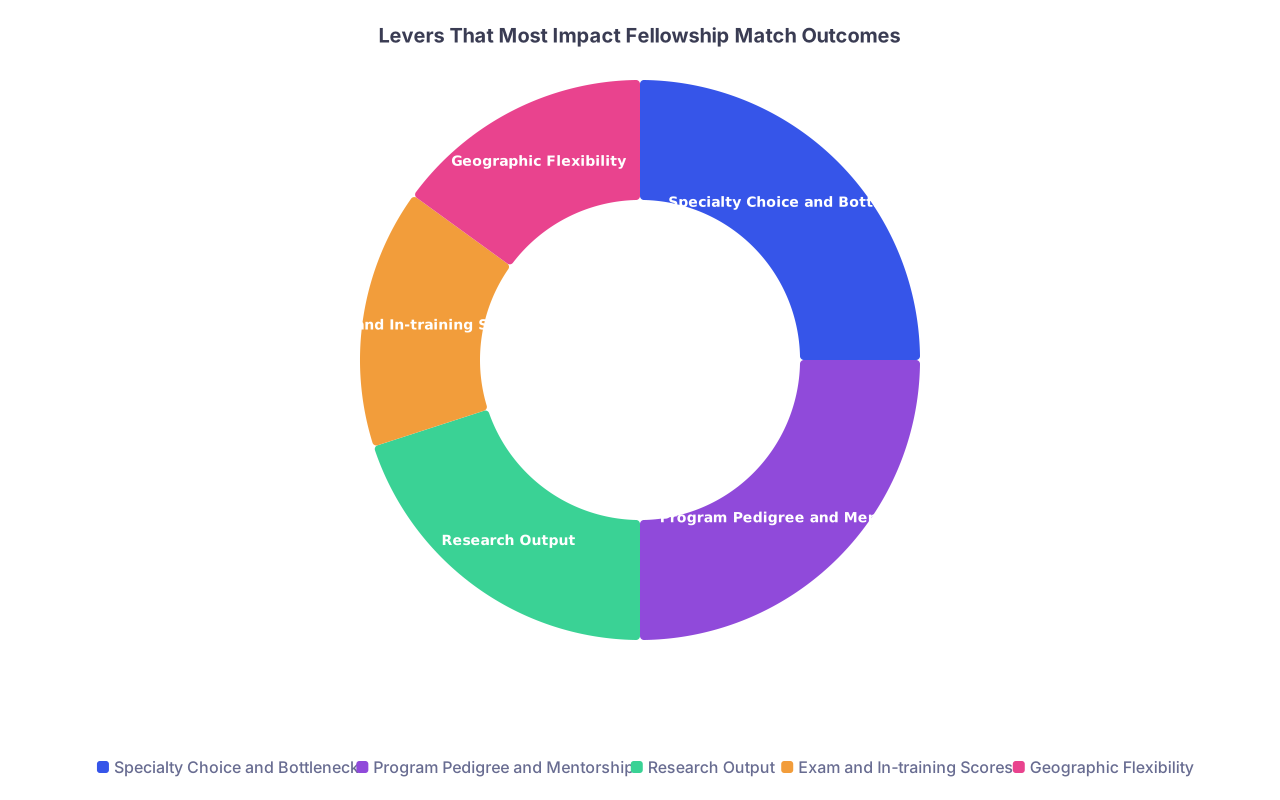
Here is how the data perspective helps you make smarter moves.
| Category | Value |
|---|---|
| Specialty Choice and Bottleneck | 25 |
| Program Pedigree and Mentorship | 25 |
| Research Output | 20 |
| Exam and In-training Scores | 15 |
| Geographic Flexibility | 15 |
A few blunt but data-driven points:
- Choosing a less saturated field (endocrine, ID, nephrology, geriatrics) massively increases your odds of matching, all else equal.
- Being at a strong academic IM program with an in-house fellowship and known faculty helps disproportionately in bottleneck fields like cards and GI.
- Research is “optional but helpful” in lower pressure fields; it is almost mandatory for the top strata of GI, cards, and hem/onc.
- Geographic rigidity (e.g., “I must stay in New York City”) can turn a moderate bottleneck into a personal crisis. For GI/cards, this is brutal.
I have watched residents with very similar raw stats diverge sharply:
- Resident A: mid-240s, at a mid-tier academic center, strong home GI mentors, flexible with locations → matched GI at a solid university program.
- Resident B: same scores, weaker GI mentorship, insisted on staying in a 2-city radius and ranking only big-name programs → did not match, had to reconfigure plans entirely.
The only difference was strategy relative to market saturation.
Final Takeaways
Three concise points.
- Gastroenterology and cardiology are the real fellowship bottlenecks in internal medicine. If you aim there, assume you are entering a 2.5–3.0 applicants-per-position market and plan accordingly.
- Hem/onc, pulm/CCM, and allergy are competitive but not mathematically as choked nationwide; your individual odds depend heavily on research, mentorship, and geographic flexibility.
- Endocrine, ID, nephrology, and geriatrics are not globally cutthroat by the numbers. The challenge there is not matching; it is choosing programs and career paths that justify the training in a system that currently undervalues these fields relative to their importance.