
The belief that “any MD or DO is equal” for competitive specialties is a lie you cannot afford to believe.
You’re asking a real question: Is my school’s reputation quietly capping how far I can go in things like derm, ortho, plastics, neurosurgery, ENT, or rad onc? And more pointedly: How do I actually know, not just guess?
Here’s the answer you’re looking for: yes, school reputation can hurt you in tough specialties—but it does not do it in a mysterious, magical way. It does it through specific, measurable bottlenecks: who interviews you, who vouches for you, and what filters you survive. You can audit this. You can see where you stand. And you can build a workaround if you’re behind.
Let’s go step by step.
Step 1: Stop Asking “Does Reputation Matter?” and Ask “Where?”
Reputation doesn’t matter everywhere. It matters at very specific choke points:
- Getting your application seen (filters, “pedigree bias,” institutional familiarity)
- Getting strong letters and advocacy from people programs actually know
- Getting auditions/aways where you can prove yourself
- Getting the benefit of the doubt when something is borderline (USMLE score, research, small red flags)
Where it doesn’t matter as much: once you’re in the interview room, or once you’ve clearly outperformed on rotations and research. At that point, your performance is more important than the name on your diploma.
The trick is diagnosing whether your school puts you behind at those bottlenecks. That’s what you really care about.
Step 2: Use Your Own Match List as Hard Evidence
Speculation is useless. Your school’s actual match results are not.
Pull the last 3–5 years of match lists from your school (if they’re not public, ask Student Affairs; they usually have them). Then do this:
Highlight all the “tough” specialties:
- Dermatology
- Orthopedic surgery
- Plastic surgery
- Neurosurgery
- ENT (otolaryngology)
- Radiation oncology
- Interventional radiology (independent or integrated)
- Integrated vascular surgery, integrated cardiothoracic surgery
- Sometimes anesthesia and EM in very competitive cycles
For each of those specialties, look at:
- How many students matched each year
- Where they matched (community, mid-tier academic, top programs)
Ask two questions:
- Is your school consistently placing people into these fields?
- Are they landing at solid programs or is it almost all “safety”/low-name institutions?
You’re looking for patterns, not one-offs. If derm shows 0–1 match per year, and that person is always AOA, 260+ Step 2, heavy publications, and often took a research year—that’s a clear signal: your school is not a natural pipeline for derm. Which means reputation and resources are not working in your favor there.
To make the comparison clearer, think side-by-side.
| School Type | Derm Matches/Year | Ortho Matches/Year | ENT Matches/Year |
|---|---|---|---|
| Top 20 Research MD | 5–10 | 8–15 | 3–6 |
| Solid Mid-tier MD | 1–3 | 4–8 | 1–3 |
| New/Low-Rep MD or DO | 0–1 | 1–3 | 0–1 |
Are there exceptions? Absolutely. But this is what the baseline looks like. If your school’s numbers look like the third row, you’re climbing a steeper hill. That doesn’t make it impossible. It makes it conditional on your individual performance being standout.
Step 3: Benchmark Against National Data (So You Don’t Lie to Yourself)
You need to know if your school is underperforming or just normal.
Two key sources (for U.S. residency):
- NRMP’s “Charting Outcomes in the Match” (by specialty, MD vs DO vs IMG)
- NRMP’s “Program Director Survey”
Look at the specialty-specific charts, not just big-picture stuff. Especially:
- Average Step 2 CK for matched vs unmatched
- % AOA for matched vs unmatched (for MD schools)
- Average number of research experiences / publications
- % of applicants with a “home program” in that specialty
Now compare:
- What do your successful applicants in that specialty look like on paper?
- Do they seem to need more than the national average (higher scores, more research, a research year) to match?
If your school’s derm matches are:
- Step 2 255+
- Multiple publications, usually derm-specific
- Often did a dedicated research year
- Strong mentorship with national names
While the national “average matched derm applicant” looks slightly less extreme than that, then yes—your school’s reputation and pipeline are forcing you to overcompensate just to stay in the game.
That’s the quiet tax you’re paying.
Step 4: Look at What PDs Actually Say They Care About
This is where the “school prestige” question gets real.
From the NRMP Program Director Survey, program directors list and rank what they use to decide whom to interview and how to rank. Things like:
- USMLE Step 2 CK score
- Grades in required and specialty-specific clerkships
- Letters of recommendation in the specialty
- Class rank / AOA
- Research in the specialty
- “Reputation of medical school”
Now here’s the nuance that people miss:
- Virtually no PD says “reputation of medical school” is their #1 factor.
- But a non-trivial number list it as important when everything else is equal, or for initial sorting.
In low-competition fields, that matters less. In ultra-competitive fields with 600–800 apps for 3 spots? That “reputation” box is a tiebreaker, a heuristic: Have we had good experiences with this school? Do we know anyone there? Is this student coming from a place we trust to train well?
So yes, it can hurt you. Not dramatically, not everywhere—but at the margins where it’s crowded and programs are lazy with their filters, it absolutely does.
Step 5: Red Flags That Your School Is Holding You Back for Tough Specialties
Here’s where you stop handwaving and actually diagnose.
You’re probably being limited by your school’s name, pipeline, or resources if:
Your school has no home program in your target specialty
- No derm department? No neurosurgery? No ENT? That’s a real disadvantage.
- You lose: built-in letters, home sub-I, mentors who know PDs, easy research access.
Your specialty interest group is weak or nonexistent
- No structured mentorship, no consistent match into the field, no faculty champion.
- Students are “figuring it out on their own” year after year.
Your match list shows very few matches in that specialty, and mostly into lower-tier/community programs, with occasional outlier superstars.
Faculty quietly say things like:
- “Derm is very tough from here, you’d probably need a research year.”
- “Our students in ortho usually need 250+ Step scores to be competitive.”
- Translation: the brand isn’t selling itself. You have to show something extra.
You cold-email external faculty for research or away rotations, and the replies feel hesitant until they see your CV and scores. They don’t recognize your school, so they start from neutral or slightly skeptical.
None of that means you’re doomed. It means the default is “no” unless your individual application forces a “yes.”
Step 6: Factors That Completely Outweigh School Reputation
Here’s the good news: for tough specialties, the gatekeepers actually care more about a handful of specific things than your school’s name. I’ve seen DO students from no-name schools match ortho, ENT, derm, and plastics by crushing the following:
Step 2 CK / COMLEX
You can’t be “okay” here. You need to be clearly on the high side for that specialty.
Ortho, ENT, derm, neurosurg? Think very high 240s+ at minimum, often 250+ for MD applicants, even higher expectations for DOs and IMGs.Audition rotations (aways)
Tough specialties live and die by “known quantity” performance.
If you rotate at a program, show up early, work hard, be teachable, impress the residents—you can absolutely beat out someone from a fancier school who only exists on paper.Letters from recognizable names
Not just “strong” letters. Letters from people PDs know and trust:- Authors of major trials
- Committee members in the specialty’s national organizations
- Faculty who trained or used to work at big-name programs
Specialty-specific research
Multiple projects. Not one poster. Enough that you can talk deeply about the field, show commitment, and list several outputs.Being top-tier within your school
AOA or near-top quartile, honors in key rotations, being clearly “the one” your faculty push forward that year.
When you stack those, your school’s reputation drops dramatically in importance. It doesn’t disappear. But it becomes a background variable instead of a front-door blocker.
Step 7: Practical “Audit” Checklist – Are You Actually Hurt, Or Just Worried?
If you want a blunt answer to “Is my school hurting me for X specialty?”, use this checklist.
Answer honestly:
- Does my school match at least 1–2 people per year into this specialty?
- Do we have a home department in this specialty with actual faculty doing research?
- Can I name at least two faculty in this field at my school who are:
- Known nationally (present at conferences, on committees), and
- Willing to mentor students intensely?
- Do recent grads from my school match at a mix of program tiers (community, solid academic, a few big-name) in this specialty?
- Have I seen grads with non-insane stats (not all 260+, 10+ pubs) still match in this field?
If you’re answering “no” to most of these, your school’s environment is not doing you any favors for that field. That’s not paranoia. That’s a structural reality.
At that point, you stop asking “Is it fair?” and start asking “What do I have to do to overcome it?”
Step 8: If Your School Is a Drag—What You Do About It
Here’s the direct playbook.
Start early (M1/M2)
- Identify at least two tough specialties you could be happy in. Don’t pick just one.
- Get in the door with any related research early, even if it’s just chart reviews.
Lock in serious mentorship outside your own school if necessary
- Use conferences, cold emails, and faculty connections to link with people at bigger-name programs.
- Be specific: “I’m an M2 at [school]. I’m strongly interested in [specialty]. I’d love to help with [type of project] if you have anything available.”
Plan away rotations strategically
- Apply for aways at programs that:
- Know how to train students from less-known schools
- Actually rank and match rotators
- You don’t need all top-10 programs. You need 2–3 places where if you perform well, they’ll fight to rank you highly.
- Apply for aways at programs that:
Overbuild your metrics where you can
- Aim for Step 2 CK clearly above the mean for matched applicants in your specialty.
- Take shelf exams seriously—honors in core and specialty-adjacent rotations matter.
Use data to pick your program list
- Look at which programs have a history of taking:
- DOs
- IMGs
- People from lower-rep schools
- Those programs are already open to “non-traditional” pedigrees when the individual is strong.
- Look at which programs have a history of taking:
To visualize how much extras you might need from a lower-rep school vs a top school:
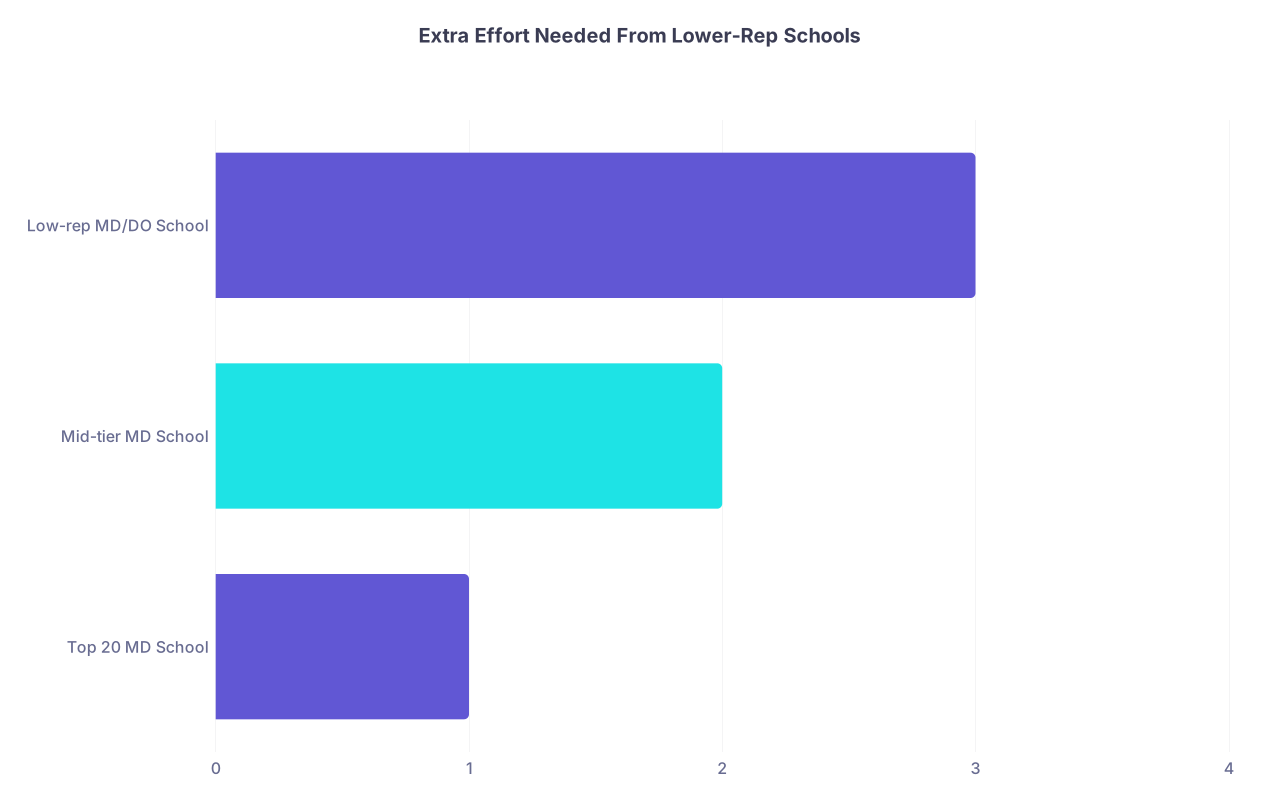
| Category | Value |
|---|---|
| Top 20 MD School | 1 |
| Mid-tier MD School | 2 |
| Low-rep MD/DO School | 3 |
(Think of those numbers as how many “extra” boxes you usually have to check: extra research, extra-high scores, extra aways.)
Step 9: When to Pivot Away From a Tough Specialty Because of School + Stats
There’s a point where you stop asking “Is my school hurting me?” and instead ask “Is this combination of school + my numbers a bad bet?”
Here’s where I’d tell a student to seriously consider pivoting:
- School with weak or no track record in the specialty
- No home program in the specialty
- Step 2 CK significantly below the national matched average for that field
- Minimal realistic path to strong specialty letters or research
- You’re not willing to take a research year or re-apply
You can still chase it. People match with worse. But at that point, yes—your school’s reputation and environment are working against you, and your personal stats are not strong enough to cancel that out. You’ll be relying on luck and an unusually generous program.
One more thing: don’t lie to yourself about back-up plans. For competitive fields from low-rep schools, backup planning isn’t being “pessimistic.” It’s being rational.
Final Thoughts: How To Tell If Your School Hurts You
Boil it down to this:
Look at your school’s match list for your target specialty.
If almost nobody gets in, or only superstars do, your school is not neutral. It’s a drag.Compare your school’s outcomes and applicant profiles to national data.
If students like you need to massively outperform the national “matched” stats, then yes—your school’s reputation and pipeline are costing you.Decide if you’re willing to overcompensate.
High scores. Strong away performance. Real research. External mentorship. If you are, your school’s name stops being destiny and becomes just one more obstacle to outwork.