It is late October. You just opened the NRMP Charting Outcomes PDF, filtered to radiation oncology, and your jaw dropped. A few years ago the match rate was awful; now it looks… almost too good. Your mentors are giving you completely different stories: one says “rad onc is dying,” another says “this is the best time in a decade to match.” Meanwhile, you are trying to decide whether to burn your whole application on this niche field with five spots per program and a reputation for boom–bust cycles.
You are not imagining the whiplash. Radiation oncology has had one of the most volatile competitiveness trajectories of any specialty in the last 10–15 years. I have seen applicants go unmatched with publications, strong Step 2, and home program support. I have also seen average applicants scramble into excellent programs in “down” cycles. Same specialty. Different year. Completely different game.
Let me break this down specifically.
1. How Radiology Oncology Competitiveness Got Weird
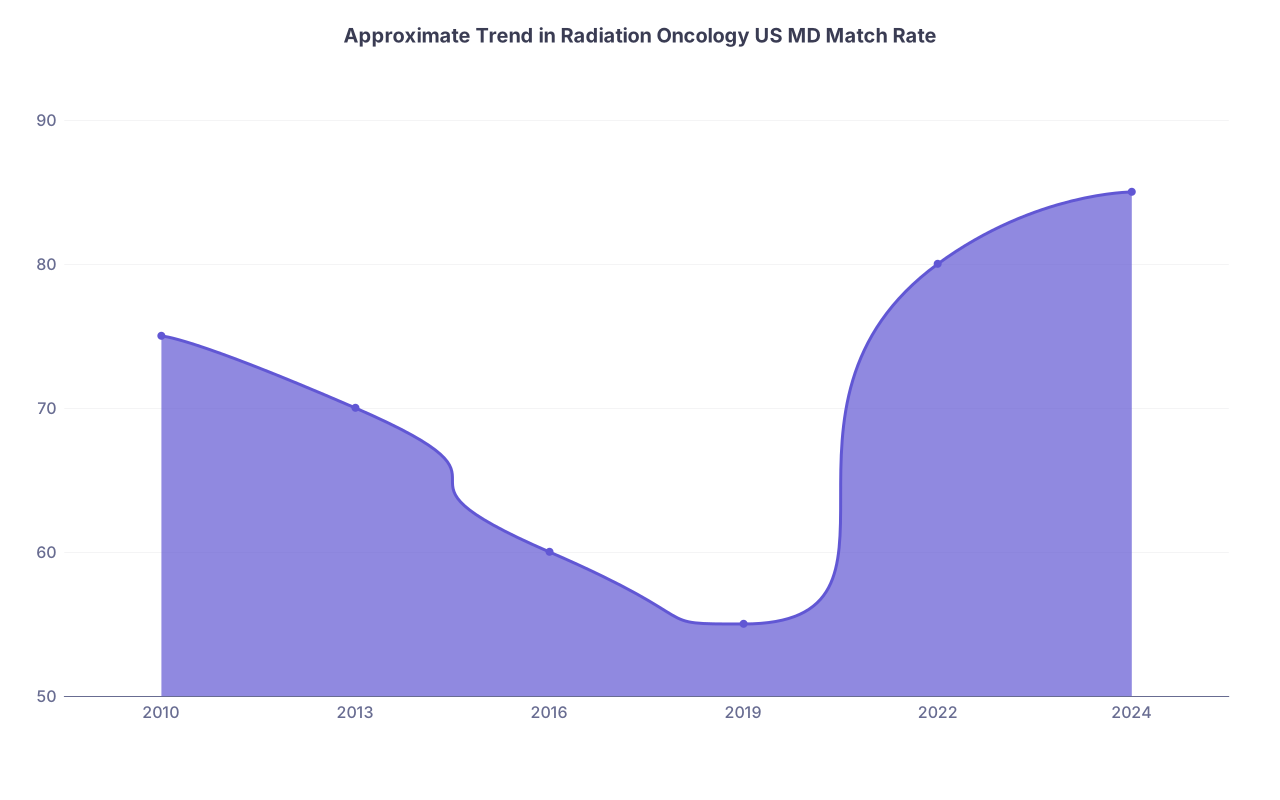
Radiation oncology used to be quietly competitive, then suddenly hyper‑competitive, then suddenly… under‑filled. To understand what you are walking into, you need the rough timeline.
| Category | Value |
|---|---|
| 2010 | 75 |
| 2013 | 70 |
| 2016 | 60 |
| 2019 | 55 |
| 2022 | 80 |
| 2024 | 85 |
This is approximate, not exact NRMP data, but the shape is real.
The boom phase (roughly 2010–2016)
Programs expanded. Cancer incidence is rising. Tech is cool. Money looked good. Medical students saw:
- High technology
- Relatively few emergencies
- Decent lifestyle
- Oncology prestige
So more applicants piled in. Programs kept adding spots, assuming endless demand.
Competitiveness markers in that era:
- Many programs filled entirely with US MDs
- Research was almost a prerequisite
- Away rotations were basically required at a subset of places
- Some very strong applicants went unmatched
The perception: “top‑tier competitive” despite small absolute numbers.
The inflection and bust fears (2016–2019)
Then the anxiety started.
Workforce projections suggested oversupply of radiation oncologists. Several widely circulated analyses predicted underemployment, especially in saturated urban markets. Residents began talking publicly about job issues. A few high‑profile job searches dragged on.
Medical students do not like the words “oversupply” and “job market uncertainty.”
Applications declined. Some programs still behaved like it was 2012. Others quietly worried.
By 2018–2019:
- Total applicants dropped
- Some programs did not fill
- Stories of unfilled rad onc spots spread quickly
This was the first time a lot of students realized: “Wait, this field can be both selective and unstable.”
The underfill shock (2020–2022)
This is when things got truly volatile.
- Several programs had multiple unfilled positions.
- Some cycles had double‑digit unfilled programs.
- A few institutions paused expansion or even cut spots.
For applicants actually willing to apply:
- Match rates improved
- Applicants with profiles that would never have touched rad onc in 2014 were matching solidly
For people watching from the outside:
- The narrative flipped to “rad onc is dead,” which was exaggerated but not innocent.
Where we are now (2023–2025 pattern)
The pendulum has not settled. But a pattern is emerging:
- Fewer total applicants than the hyper‑competitive years
- Continuing concern about long‑term job markets in some regions
- Better chances for well‑prepared applicants who know what they are signing up for
- Still small numbers: a few bad cycles can destabilize things
In other words: the specialty is no longer “orthopedic‑level” competitive. It is selectively competitive. Some programs are still extremely hard to get into. Others struggle to fill. And there is persistent background noise about jobs that you cannot safely ignore.
2. Objective Competitiveness: Where Does Rad Onc Sit Now?
Let us put this against other specialties so this is not just vibes and anecdotes.
| Specialty | US MD Match Rate* | Research Heaviness | Geographic Flexibility | Lifestyle Once Practicing |
|---|---|---|---|---|
| Derm | Very low | Very high | Poor | Excellent |
| Plastics (integrated) | Very low | Very high | Poor | Good |
| Ortho | Low | Moderate–High | Moderate | Fair |
| Rad Onc | Moderate–High | High | Limited (jobs) | Good–Excellent |
| Anesthesia | High | Low–Moderate | Good | Good |
| IM (categorical) | Very high | Low–Moderate | Excellent | Variable |
*“US MD match rate” here is a qualitative descriptor to keep NRMP lawyers calm; look at NRMP/Charting Outcomes for actual numbers.
Here is the key: radiation oncology’s application competitiveness and its job-market competitiveness are not aligned.
- Residency match: currently more forgiving than the horror stories you heard from 2014.
- Job market: more constrained than IM, hospitalist work, or heme/onc.
So as an applicant you are not fighting 50‑deep for each residency seat anymore. But you are signing up for a specialty where geography later may not be yours to choose.
3. Why Competitiveness Is So Volatile in Rad Onc
Other fields are stable. Radiology, anesthesia, even EM (chaotic, but trend is understandable) have more predictable arcs. Rad onc swings harder because of three interacting factors.
3.1 Small denominator effect
There are not 2,000+ spots. There are a few hundred. A 10–20% swing in applicant numbers looks tame in IM. In rad onc, that same swing can flip from “overfilled” to “underfilled” in one year.
Example I have actually seen:
- Year 1: ~1.3 applicants per spot, heavy unmatched.
- Year 3: ~0.8 applicants per spot, multiple unfilled programs.
Same total spots. Slightly fewer applicants. Completely different applicant experience.
3.2 Technology and reimbursement anxiety
The field is married to expensive machines and reimbursement policies. You are not just betting on “cancer is common.” You are betting on:
- How CMS and private payers treat radiation codes
- Whether new systemic therapies displace or complement radiation
- Adoption of hypofractionation (fewer visits, lower total revenue per patient)
- Consolidation of practices and hospital systems
Every ASCO/ASTRO cycle, there are whispers:
- “Will protons eat up academic jobs?”
- “Will AI contouring and automation flatten staffing needs?”
- “Will smaller centers close or be bought?”
Students feel that uncertainty, even if they cannot quote ASTRO white papers.
3.3 Job market stories travel fast
Pathology had a similar problem a decade ago. A perception of poor jobs can depress applications for years. That perception persists long after things partially correct.
In rad onc:
- A few very public job‑hunt horror stories → students back off for several cycles.
- Then programs underfill, residents get jobs more easily, but the rumor lag is 3–5 years.
This information lag is exactly what creates windows of “low apparent competitiveness” for students who have done their homework and still want the field.
4. What Profiles Actually Match in Rad Onc Now
Let me be very explicit about applicant profile categories. This is what applicants always ask behind closed doors: “Do I have a shot or not?”
I will break it into three tiers. Obviously there is nuance, but this maps to what I actually see.

Tier 1: Classic “strong” rad onc applicant
- US MD
- Step 2 comfortably above national mean (e.g., >240)
- Several oncology‑related research experiences; at least 1–2 first‑author abstracts or manuscripts
- Meaningful rad onc exposure (electives, home department involvement, maybe an away)
- Strong letters, ideally including at least one rad onc letter from someone known in the field
This applicant:
- Has a high likelihood of matching, including at many academic programs
- Can be somewhat selective with applications but should not be arrogant
- Still benefits from a thoughtful spread: a few reaches, many solid mid‑tier, and some lower‑visibility programs
In 2014, even this group had legit risk. Today, risk still exists, but if you apply broadly and interview decently, you match.
Tier 2: “Middle” applicant
Examples:
- US MD with Step 2 just around average, minimal research, but clear interest and good letters
- DO with above‑average scores and some research, plus proactive networking
- IMG with strong scores and robust US‑based research, but fewer clinical connections
For this group, the volatility matters most.
Things that push you into realistic territory:
- You show sustained oncology interest, not “I picked this last month.”
- You accumulate at least some scholarly work: QI, case reports, poster, something.
- You target programs that historically interview/do match applicants with profiles like yours.
You must:
- Apply widely. As in, 40–60 programs is not crazy in this field.
- Take every interview seriously; you may not get many.
- Adjust expectations on geography and prestige up front.
I have seen these applicants match to excellent programs in “down” years and go unmatched in “up” years. That is the volatility in action.
Tier 3: “High‑risk” applicant
- Weak exam performance (very low Step 2) without a clear offsetting strength
- No oncology exposure and no serious plan to obtain it
- Late pivot to rad onc in October of M4 without any groundwork
- International grad with no US clinical exposure and no relevant research
Can these applicants match? Occasionally, yes. Usually in borderline emergency fill situations or very specific program contexts. But if you recognize yourself here and you are not already deeply tied to a supportive rad onc department, betting everything on this specialty is reckless.
5. Strategic Application Planning in a Volatile Specialty
Let us talk about what you actually do different because this field is volatile.

| Step | Description |
|---|---|
| Step 1 | Interest in Rad Onc |
| Step 2 | Meet Rad Onc Mentor |
| Step 3 | Find External Mentor |
| Step 4 | Assess Competitiveness Honestly |
| Step 5 | Commit Primary to Rad Onc |
| Step 6 | Dual Apply with Related Field |
| Step 7 | Choose Alternative Specialty |
| Step 8 | Plan Rotations and Research |
| Step 9 | Proceed with New Plan |
| Step 10 | Home Rad Onc Dept? |
| Step 11 | Reasonable Chance? |
5.1 You need brutally honest mentorship
This is non‑negotiable in rad onc. You cannot just look at a Step score and call it.
Steps:
- Identify someone who actually knows the rad onc match. Not just a hematologist or IM advisor.
- Ask for unvarnished feedback: “If I were your own student, what would you advise me to do?”
- Push for specifics: “What tier of programs should I realistically target? Would you advise dual applying in my case?”
Red flag: any mentor who says “You’ll be fine, just apply” without talking about your research, your Step 2, and your geographic constraints. That is lazy, and in this field, dangerous.
5.2 Decide early if you are dual‑applying
Dual applying is not mandatory. But in a small, volatile field, it is often rational.
Common pairings:
- Rad onc + internal medicine (with eye on heme/onc later)
- Rad onc + diagnostic radiology
- Rad onc + prelim/transitional year as explicit back‑up (riskier)
Pros:
- Insurance against an unexpectedly “tight” year
- Psychological relief when interview invites start (or do not start) rolling in
Cons:
- You will dilute your narrative if you do it badly
- Some rad onc PDs view obvious dual‑application with suspicion
The right way:
- Decide by early summer of M4.
- Build two coherent narratives that are truthful. For example:
- Core theme: passion for oncology and imaging, applied slightly differently in each field.
- Make sure your letter writers know exactly what you are doing. No surprises.
5.3 Be explicit about geographic flexibility
With rad onc you almost never get:
- Pick any city
- Pick any type of practice
- Pick any subspecialty niche
You trade some of that autonomy for specialization and lifestyle.
Applicants who handle the volatility best are those who say, early:
- “I am willing to move anywhere for training.”
- “I am willing to consider regional or smaller markets for my first job.”
- “I care more about practicing rad onc than living in Manhattan.”
If you are geographically rigid, your personal competitiveness bar goes up sharply. Factor that in.
6. Program Selection: Reading Between the Lines
Not all rad onc programs are the same, and some differences matter much more here than in big specialties.
| Feature | Highly Competitive Academic | Mid-Tier Academic | Smaller/Regional |
|---|---|---|---|
| Research expectations | Very high | Moderate | Low–Moderate |
| Case mix complexity | Broad, rare tumors | Broad | Common tumors |
| Job placement network | National | Regional | Variable |
| Likelihood to fill | High | Variable | Most volatile |
| Appeal for borderline applicants | Hard reach | Possible reach | Realistic target |
Some things to look at closely:
Fill rates over last 3–5 years.
Programs that repeatedly underfill raise questions:- Are they in an unpopular location?
- Is there something structurally wrong (e.g., chronic leadership turnover)? Not automatically red flags, but you should know.
Resident job placement.
Ask:- “Where have grads gone in the last 5 years?”
- “Academic vs community? Geographic spread?” Strong placement with honest data is reassuring in a volatile market.
Volumes and site mix.
You want:- Breadth of disease sites
- Adequate volume without unsafe overloading of residents A program with barely any pediatrics or rare tumors is not disqualifying, but you want solid training across common malignancies.
Culture around workforce discussions.
On interview day, listen:- Do faculty acknowledge workforce realities?
- Do residents sound blindsided or informed? I have heard both: brutally honest, and magically optimistic bordering on denial. You want the former.
7. What Applicants Must Know Before Committing
This is the part people dance around. I will not.
7.1 Radiation oncology is not “easy oncology with good hours”
If you are drawn by “onc” but allergic to bad news conversations, you will be miserable. You still:
- Own curative and palliative decisions that affect survival and quality of life
- Walk patients through permanent side effects
- Sit in tumor boards where your recommendation carries real weight
Lifestyle is better than many surgical fields. Call is lighter. But emotionally, this is still oncology.
7.2 The job market will probably stay tight in major urban centers
Could this change? Yes. Should you bank on New York, Boston, or SF attending jobs falling into your lap? No.
You must be prepared for one or more of:
- First job in a medium/small city
- Need to be flexible about academic vs community at the start
- Some compromise on ideal practice structure
If that is a non‑starter, reconsider.
7.3 The volatility cuts both ways
The same volatility that scares off the crowd gives you an opening.
Bad year for applications:
- Fewer strong students apply.
- If you are prepared and committed, your odds look very good.
Better year for applications:
- Competition spikes again.
- Borderline applicants get squeezed.
You cannot time this perfectly, but you can:
- Watch application numbers and NRMP data as you plan
- Recognize that “it seems easier now” does not mean unskilled people match. The bar is lower, not gone.
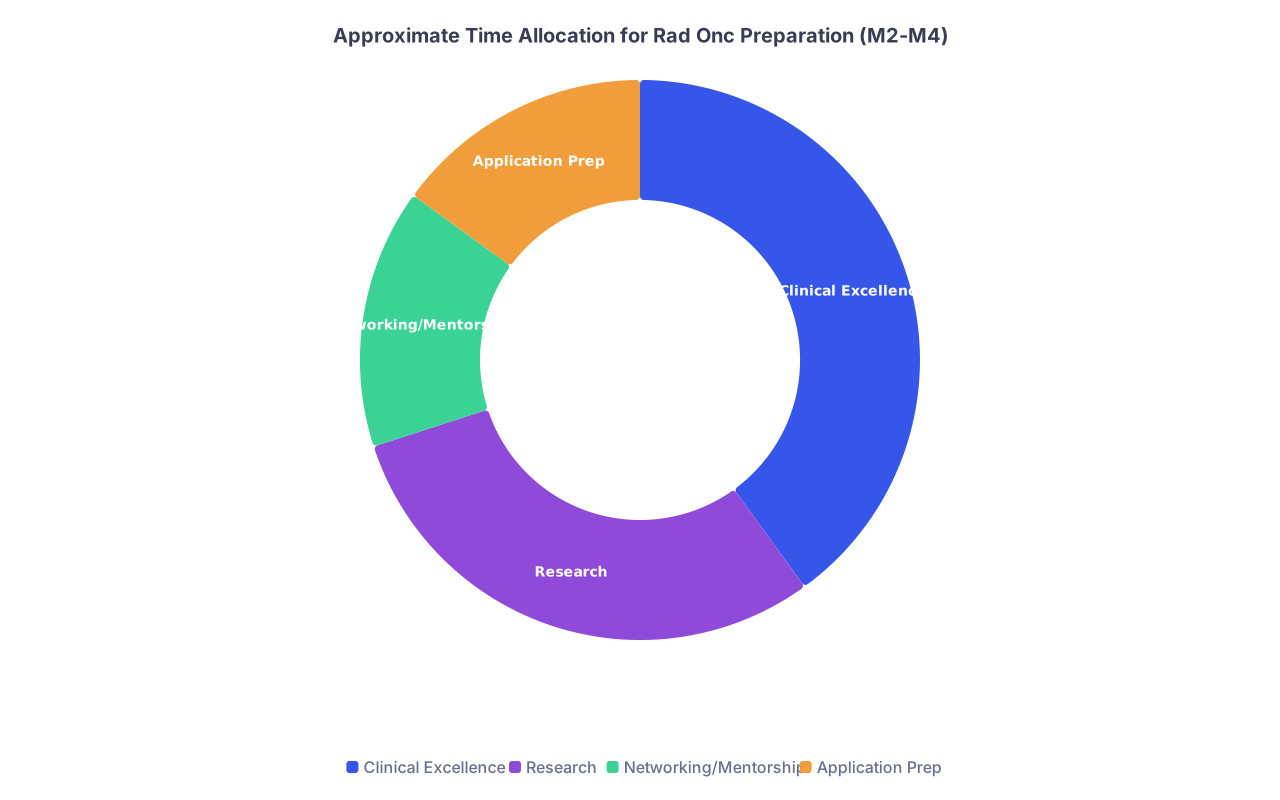
8. Concrete Preparation Plan (M2–M4)
If you are serious about rad onc, here is a realistic preparation skeleton.
| Category | Value |
|---|---|
| Clinical Excellence | 40 |
| Research | 30 |
| Networking/Mentorship | 15 |
| Application Prep | 15 |
M2 – Early M3: Lay the foundation
- Do well in preclinical courses and Step 1/Step 2 prep. Clinical excellence still matters.
- Start talking to your home rad onc department if it exists.
- Get involved in one research project in oncology (rad onc preferred, but med onc/surg onc/radiology acceptable).
Goal: establish a track record that says “I have been orbiting oncology for a while,” not “I googled rad onc last week.”
M3: Clinical credibility and exposure
- Crush core clerkships. You are still a doctor first.
- Do at least one rad onc elective if possible.
- Get to know residents and faculty, not just as a name on an email.
Goal: obtain at least one letter from someone who can say, credibly, that you function well clinically and you fit the specialty’s personality.
Early M4: Signal commitment and sanity
- Schedule a rad onc sub‑I or away rotation if you do not have a strong home program.
- Finalize research outputs: abstracts, posters, small manuscripts. Do not chase 15 low‑yield projects; finish 2–3.
- Decide explicitly:
- Single apply vs dual apply
- Geographic flexibility level
Goal: by ERAS opening, your application reads as coherent, informed, and realistic.
FAQ (Exactly 4 Questions)
1. Is radiation oncology still a “risky” specialty to choose?
Yes, but the risk is nuanced. The main risk is not failing to match residency; that risk is very manageable if you are reasonably strong and apply intelligently. The real risk is long‑term job flexibility, especially if you insist on certain high‑demand cities or purely academic roles. If you can accept some geographic and practice‑type flexibility, the risk becomes much more tolerable.
2. How much research do I actually need for rad onc?
For top academic programs, real research matters: multiple projects, ideally with at least one first‑author abstract or manuscript in oncology or imaging. For many solid programs, you do not need a PhD‑level CV, but you should show evidence of scholarly curiosity and follow‑through. One to three completed projects with clear impact beats ten half‑finished “in progress” bullet points. If you are applying from a DO or IMG background, research is often your main way to compensate for bias and lack of home program connections.
3. Should I avoid rad onc if I know I must end up in a specific big city?
If “must” is literal—e.g., you are absolutely locked to one metro area—then rad onc is a bad bet. There are simply too few jobs to guarantee alignment with a single location. If you have a preferred city but could tolerate a few years in another region and maybe move later, then rad onc can still be reasonable, but you should discuss your constraints frankly with mentors and with residents currently in the field.
4. How many programs should I apply to for rad onc now?
If you are a strong, traditional US MD rad onc applicant, 25–40 carefully chosen programs is often sufficient. If you are in the middle‑tier or coming from a DO/IMG background, stretching that into the 40–60 range is rational, given the small number of total spots and variability in how programs view different schools. Do not send 80 identical applications blindly; instead, build a thoughtful list that includes a spectrum of highly competitive, mid‑tier, and less visible programs, and then commit to preparing well for every interview you receive.
Key points to keep in your head:
- Radiation oncology is no longer universally hyper‑competitive, but it remains selectively competitive with a small, volatile market.
- The main long‑term risk is job flexibility, especially in saturated urban and academic markets, not matching residency itself.
- If you want this field and you prepare intelligently—with research, mentorship, and realistic expectations—the current era is actually one of the better windows to get in.