What if you picked your med school… and then realized it barely has the specialty exposure you need for the field you actually want to match into?
As in: you want dermatology, but there’s no home derm program. You’re falling in love with neurosurgery, but your school’s “neurosurgery exposure” is one clinic day and a single visiting attending. Or you want radiation oncology and literally nobody on campus seems to know what that is beyond “the thing they do in the basement.”
And now you’re thinking:
Did I just quietly torpedo my own chances before I even started Step 1?
Let’s talk about that. Honestly. Including the scary parts.
How Much Does a Weak Home Program Actually Hurt You?
Here’s the part nobody says out loud on interview days: having a strong home department in your desired specialty is a very real advantage.
Not because you’re smarter. But because:
- You get built-in mentors who know the field
- You get “easy” research (as in: handed to you, not actually easy)
- You get home audition-style rotations without begging for them
- You have a program chair who can call their friends and say, “Interview this kid.”
So yeah, not having that? It’s a handicap.
But here’s the thing: it’s not a death sentence unless you treat it like one and freeze.
You’re not the only person in this situation. DO schools, newer MD schools, community-based schools, Caribbean grads, people from schools without neurosurgery, ENT, derm, plastics, rad onc, urology — they match every single year.
Programs know some schools literally don’t have certain specialties. They don’t punish you just for that. They look for how you compensated.
They’re basically asking:
“OK, your school doesn’t have [insert field]. Did you do what a serious applicant would do anyway? Or did you use it as an excuse to be mediocre?”
That’s the harsh line. And you want to be on the first side of it.
Step One: Get Really Clear on How “Weak” Things Actually Are
Sometimes the situation is genuinely bad.
Sometimes it’s just… not as shiny as your classmates’ Instagrams.
You need to be specific:
- Is there no home residency program in your specialty at all?
- Or is there a small program, but they do minimal med student teaching?
- Or you technically have the specialty, but the “exposure” is one half-day clinic in M3 where the attending doesn’t know your name?
Make a brutally honest inventory. Something like:
| Specialty | Home Program? | Electives Available? | Research Access? |
|---|---|---|---|
| Derm | No | None in-house | None obvious |
| ENT | Yes, small | 2-week elective | Maybe, unclear |
| Rad Onc | No | Away only | None in-house |
| Ortho | Yes, active | Core + sub-I | Multiple projects |
This is not about self-torture. It’s about knowing what gap you actually have to close.
Because the gap determines the plan:
- No home program at all → you must build your world externally: away rotations, outside research, virtual mentors.
- Weak but existing department → you’re going to squeeze every drop from what’s there and then go outside for the rest.
Either way, you cannot just “see how it goes.” That’s how people end up as the M4 in January saying, “I guess I’ll just do IM because it’s too late now.”
What Programs Actually Want to See (When You Don’t Have a Strong Home Program)
Programs are not stupid. They know:
- Some schools have zero derm
- Most schools have no rad onc or neurosurg or ENT
- DO / newer MD schools often lack the niche specialties
They don’t expect you to magically conjure a home department.
They expect you to show patterned seriousness.
In competitive specialties especially, they’re basically scanning for:
Early and consistent interest
Not “I liked my month of ortho in October M4 and applied in November.”
They want: you started seeking exposure as early as was reasonably possible.External validation
Away rotations. Letters from people they know and trust. A chair or PD saying: “This student performs like our top residents.”Some research, somewhere in the orbit of the field
No, not 15 first-author JCO papers. But something that says, “I cared enough to put in real work.”Performance when given a chance
This is where away rotations are brutal but crucial. You finally get your shot → you cannot show up unprepared and invisible.
There’s a reason students from schools with weak exposure lean heavily on away rotations and research. It’s not optional fluff. It’s the compensation mechanism.
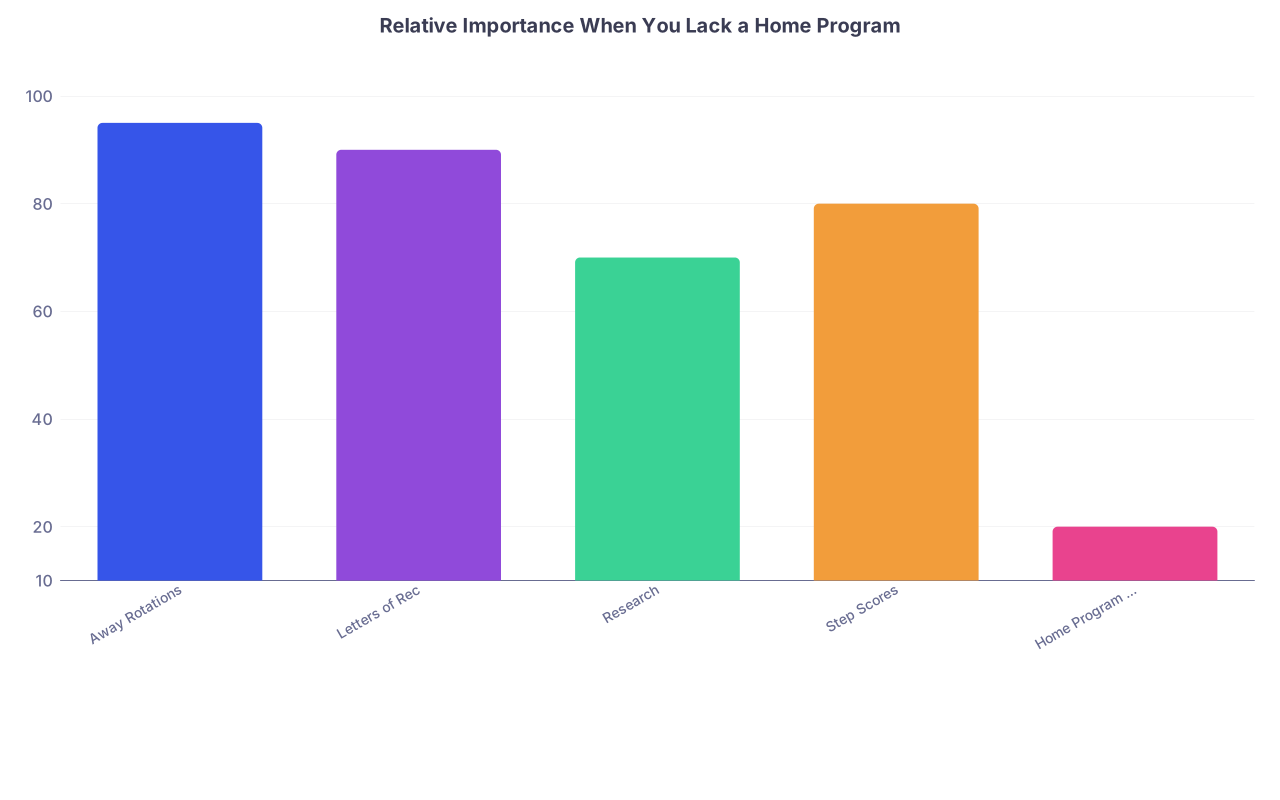
| Category | Value |
|---|---|
| Away Rotations | 95 |
| Letters of Rec | 90 |
| Research | 70 |
| Step Scores | 80 |
| Home Program Prestige | 20 |
Building a Specialty “Home” When Your School Doesn’t Have One
You basically have to manufacture what your classmates at big-name places get by default.
1. Create your own mentor network (yes, from scratch)
This feels terrifying. Messaging random people. Asking for help when you feel like you don’t deserve it yet.
Do it anyway.
Places to look:
- Alumni who matched into your specialty (your dean’s office usually has a list; if they “don’t,” push)
- National organizations:
- Derm: AAD, specialty interest groups
- Ortho: AAOS, Ruth Jackson society, etc.
- ENT: AAO-HNS
- Rad Onc, Plastics, Urology — all have student sections and mentorship programs
- Residents and fellows on your rotations at affiliated hospitals or during away rotations
What you’re asking for is not, “Can you get me a derm spot at UCSF?”
It’s:
- “Can I get your advice on how to make myself competitive from a school without a home program?”
- “Do you know any ongoing student-friendly projects I can help with?”
- “When I’m ready, would you be willing to review my application / give feedback?”
Some won’t answer. Some will ignore you. A few will change your life. You only need the last category.
2. Get any exposure you can, even if it’s ugly
If your school literally has zero in-house exposure, you may need to:
- Use elective time in M3/M4 for that specialty at outside sites
- Find local private practices and ask if you can shadow (yes, it’s awkward)
- Join virtual lecture series and case conferences (lots of smaller fields did this post-COVID and just never stopped)
None of this looks as glamorous as “I did my sub-I at my home neurosurgery program where the PD knows me.”
But it shows genuine effort.
And programs can tell the difference between, “My school didn’t give me opportunities” and “I didn’t look very hard, but I’m blaming my school now.”
Away Rotations: Your Weapon and Your Risk
If you don’t have a strong home department, away rotations become the main stage.
They are both:
- Your best shot at proving you belong in the specialty
- Your fastest way to tank your chances if you’re unprepared
Imagine this sequence (I’ve seen it):
- M3 at a community-heavy school with no ortho realizes they love ortho
- They’re told, “You’ll need strong away rotations since we don’t have a home program”
- They schedule 3 back-to-back ortho aways at big programs
- They show up under-read, slow in the OR, awkward on the team
- They get “polite but not enthusiastic” evaluations
- Suddenly the already-hard field becomes basically closed
This is why you prepare like an absolute maniac before your first away.

| Step | Description |
|---|---|
| Step 1 | Decide on Specialty |
| Step 2 | Identify Target Programs |
| Step 3 | Email for Mentors and Advice |
| Step 4 | Join Interest Groups and Read Resources |
| Step 5 | Study Common Cases and Basics |
| Step 6 | Practice Knot Tying or Skills if Surgical |
| Step 7 | Schedule First Away Rotation |
| Step 8 | Request Expectations from Program |
| Step 9 | Show up Prepared and Early Daily |
What “prepare” actually means:
- Know common diagnoses, standard workups, and basic terminology cold
- For surgical fields: tie knots, know positioning, know basic anatomy
- Read about the attendings you’ll be working with (their interests, research)
- Clarify expectations early: “What does a strong student on this rotation do here?”
Because when you don’t have a home program vouching for you, that away letter is your currency.
Research: Do You Really Need It When Your School Has Nothing?
Short answer: for the most competitive specialties (derm, plastics, ortho, ENT, neurosurg, rad onc, urology) — yes, you basically do.
But it doesn’t all have to come from your home institution.
Options that actually work (if you’re persistent):
- Reach out to nearby academic centers and ask if anyone in your specialty takes remote OR short-term med student help for data collection, chart reviews, case reports
- Ask mentors you’ve cold-emailed if they know “any projects a motivated MS2/MS3 could help with”
- Look into multi-institutional student-led groups (some specialties have them; they publish things like surveys, database studies, etc.)
The key is this: choose doable projects. You don’t need a 3-year R01-level trial. You need:
- 1–2 case reports or case series
- A retrospective chart review
- A small clinical project or a poster at a national conference
That alone signals, “I care enough to go get this, even though my school didn’t hand it to me.”
The Numbers Fear: “Will Programs Just Filter Out My School?”
You’re probably worried they’ll see your school name, note there’s no relevant department, and just quietly screen you out.
Sometimes, sure, your school name won’t help you. But it’s not the only variable they look at.
Programs are mostly filtering on:
- Board scores (for specialties that still care heavily)
- Class rank / AOA / clinical grades
- Letters
- Actual exposure to the field
Your missing home program hurts most indirectly — because it makes those things harder to get:
- Fewer easy research opportunities
- Fewer mentors who know what a good letter in that field even looks like
- No home sub-I to shine on
But it doesn’t create a magical “auto-reject” tag.
Some fields even have a track record of pulling strong students from under-resourced schools because they’re hungry, coachable, and don’t have a sense of entitlement.
If you want a visual of where your energy needs to go:
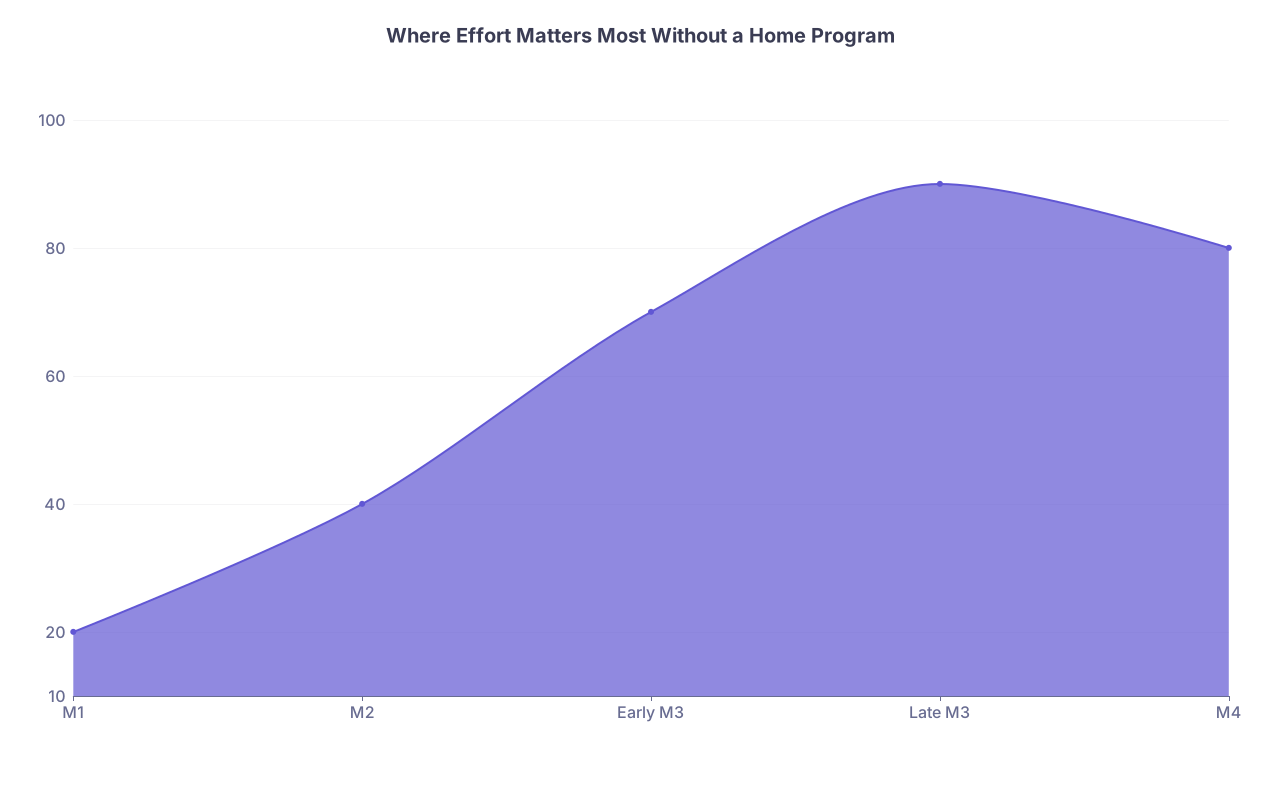
| Category | Value |
|---|---|
| M1 | 20 |
| M2 | 40 |
| Early M3 | 70 |
| Late M3 | 90 |
| M4 | 80 |
The serious building happens M2–M3. By M4, you’re mostly executing what you already laid down.
Worst-Case Scenarios (Because That’s What You’re Thinking About Anyway)
Let’s name the things you’re actually scared of:
- “I fall in love with a hyper-competitive specialty late and it’s literally too late to fix the exposure/research gap.”
- “I do away rotations, but because I never had a home program, I perform badly compared to other students who basically grew up in the specialty.”
- “I don’t match into that field and feel like I ruined my career by going to the ‘wrong’ med school.”
Here’s how I see those:
Late realization
This is tough. If you discover plastics in October of M4 and you have no research, no electives, no letters… yeah, that’s almost impossible.
The only real prevention is: start exploring fields earlier than feels comfortable. Especially if your school doesn’t spoon-feed you variety. Don’t wait for your schedule to bring you exposure. Go chase it.Underperforming on aways
This is why you can’t treat your first away as a “practice run.”
If you’re from a weak-exposure school, your first away is often your only shot at certain programs. You need smaller, safer exposures earlier (shadowing, small local electives) so the away isn’t literally day one in that specialty.Not matching
Brutal, yes. But what actually happens? You either- Reapply more strategically (with a prelim year, more research, more aways), or
- Pivot to a different field that still gives you a solid career and life.
Your med school’s weak exposure did not “ruin” you. It made your chosen path harder. That’s different.
I’m not going to sugarcoat this: if you want derm from a school with no derm and minimal research, you’re climbing a steep hill. It’s doable — people do it — but it takes intentional, uncomfortable work early.
One Thing You Can Do Today (Seriously, Today)
Don’t just absorb this and go back to doom-scrolling.
Do this:
Make a one-page “specialty reality” map for yourself.
Open a doc and write:
- The specialty (or 2–3) you’re most seriously considering
- Exactly what your school has for each:
- Home program?
- Electives?
- Faculty doing research?
- Alumni in that field?
- Then add three concrete actions you can take in the next 7 days for the weakest specialty on that list.
Example actions:
- Email your dean’s office: “Do we have any alumni in [specialty] I could speak with?”
- Email one outside faculty member: “I’m a med student at [school] very interested in [specialty]. We don’t have a home program. Would you have 15 minutes for advice on how to become competitive from my situation?”
- Join the national student section or interest group for that specialty and sign up for the mailing list.
Then actually send one email before you close your laptop. Just one.
That’s how you start clawing back the advantage your school didn’t give you. Not with a perfect 4-year plan. With one uncomfortable, specific step. Today.