
The belief that competitive specialties secretly hate non-traditional applicants is flat-out wrong. Some of them are actively hunting for you.
I’m talking about ortho, plastics, derm, ENT, neurosurg, rad onc, occasionally even IR. The programs that look like they only want 250+ Step scores and spotless 24-year-old CVs. On paper, yes, they’re brutal. Behind closed doors? They’ll bend rules for the right older, “non-trad” applicant in ways they’d never do for a standard M4.
Let me walk you through what really happens in those rank meetings, because you will never hear this on an info session.
What “Non-Traditional” Really Signals to Competitive PDs
Program directors in competitive fields don’t see “non-traditional” and think “red flag.” They see three things:
- Reduced flight risk
- Free maturity and leadership
- A buffer against the nightmare resident
They won’t say this in public, but you aren’t primarily competing with all applicants. You’re competing with the 23-year-old with the perfect Step score but zero life experience, and the 28-year-old gunning for a switch to another specialty the minute they feel tired.
In many selection meetings, it goes like this:
PD: “He’s 34, did engineering for 8 years, then med school. Step scores are solid, not insane, but he’s clearly all-in on ortho.”
Faculty: “Yeah, I’d rather have that than another 245 kid who might try to bail to spine fellowship in a different city.”
Older age and a “previous life” used to be seen as risky. Now, burned-out PDs are desperate for people who know exactly what they’re signing up for.
They’ve done their experiment with recruiting only 26-year-old paper-perfect prodigies. It’s produced some monsters: entitled, fragile, no resilience. The pendulum is swinging back.
The Real Calculus: What PDs Actually Fear
You think their biggest fear is matching a low Step score? Wrong. That’s not even top three.
The worst-case scenarios for a competitive specialty PD are:
- Resident quitting mid-program (hit to ACGME numbers, schedule chaos, faculty resentment)
- Resident being chronically unreliable or toxic (complaints, HR issues, culture damage)
- Resident failing boards or struggling so much they need remediation (time sink, accreditation risk)
A non-traditional applicant — if you present yourself correctly — hits those fears head-on.
You’ve already left a career. Maybe you’ve got a family. Maybe you walked away from a six-figure job. You’re not going to wake up in PGY-2 and say, “You know, I think I actually want to do psychiatry.” PDs know that.
Here’s how they talk about you in real rank meetings:
“Look, she was in the military for 10 years. She’s not quitting surgery because she had a bad call month. She’s seen worse.”
“He ran a business before med school. He isn’t going to melt down when we give him junior attending-level responsibility on night float.”
Does this mean every non-trad gets a sympathy bump? No. But if you’re borderline on some metric, your age and background are often the reason you get pulled out of the “maybe” pile.
Where Non-Trads Quietly Get Preference
Some competitive specialties are more transparent about this internally than others.
| Specialty | Quiet Attitude Toward Strong Non-Trads |
|---|---|
| Orthopedic Surgery | Very positive if athletic, military, or engineering background |
| Dermatology | Selectively positive, especially prior careers in research or business |
| ENT (Otolaryngology) | Positive for prior career, especially military or engineering |
| Plastic Surgery | Mixed, but strong preference for mature, polished applicants |
| Neurosurgery | Strong bias toward focused, older applicants with clear commitment |
Orthopedic Surgery
Ortho loves non-trads who “fit the tribe”: ex-athletes, military, engineers, people who’ve done physically demanding or team-oriented work.
I’ve heard this exact line from an ortho PD:
“I can teach them how to fix a tibia. I can’t teach them how to show up at 4:30 am with a good attitude for six years. The 32-year-old former Marine — I’m not worried about him.”
What they care about is:
- Consistent story: why ortho, why now, and why you’re not going anywhere
- Evidence you can grind without collapsing (work history, military, prior demanding job)
- Coachability and humility — which, frankly, many non-trads do better than the kids who’ve never failed at anything
If you’re a non-trad going into ortho with decent scores and legit dedication, you’re not the liability you think you are. You’re often the safer bet.
Dermatology
Derm superficially looks like the opposite: extremely academic, research heavy, often young hyper-polished applicants.
But derm has another concern: personality time bombs and people who are obviously using derm as a lifestyle ticket.
Non-trads with prior careers in research, industry, or business — especially those who can bring in future value (clinical trials, entrepreneurship, leadership) — get taken very seriously.
I’ve seen a 31-year-old former PhD-turned-MD with a 240-something Step 1 match a strong derm program because:
- Massive sustained research output
- Incredibly believable long-term derm story
- Mature, composed demeanor on interview day
Would a 24-year-old with the same numbers and half the story have matched that same program? Probably not.
ENT, Neurosurg, Plastics
ENT and neurosurgery, in particular, are obsessed with commitment. They’ve been burned by “tourists” — people who are excited about skull base surgery until they actually live a skull base lifestyle.
For them, a 29- or 32-year-old with a coherent story is reassuring:
“He did a master’s in neuroscience, worked in a lab, then went to med school and did three neurosurg electives. He’s not playing games.”
Plastic surgery is more complicated. Some programs are still prestige-drunk and want the 260s and nothing else. But the ones that have lived through a toxic resident will absolutely give mature, balanced, hardworking non-trads a real look, especially on the integrated track.
The Big Trade-Off: Ceiling vs. Floor
There’s a concept I’ve heard PDs use behind closed doors: high-ceiling vs high-floor applicants.
- The perfect young gun with insane scores and research? High ceiling. They might become a superstar. They also might implode.
- The non-traditional with solid but not insane stats, strong work history, and maturity? High floor. You will almost certainly be a solid, dependable, teachable resident.
In subspecialties where one resident imploding can destroy call schedules, research output, and program morale — that floor matters a lot.
Here’s how this plays out in ranking:
- Young, flashy, 265 score, 10 papers, somewhat arrogant on interview
- Non-trad, 244/251, 2 strong pubs, ex-military, clear commitment, universally liked on interview
PDs will talk for 15 minutes about the first candidate. They’ll talk for 3 minutes about you. And then they’ll quietly put you above them on the rank list. Because they have to protect the residency as a system, not just collect trophies.
The Parts of Your Story That Actually Move the Needle
Being non-traditional by itself doesn’t help you. The way you package that non-traditional path does. Most older applicants blow this.
You need three things crystal clear:
- Why you left your old path
- Why you chose this field
- Why your age and background are an asset, not a liability
They are reading your file looking for one thing: commitment signal vs identity crisis.
A bad non-trad narrative sounds like:
“I tried consulting, then law school, then I realized my true passion was dermatology because I shadowed a dermatologist once and loved the lifestyle.”
You’re done. That reads as drifting, chasing comfort, no staying power.
A strong narrative:
“I was an engineer for 7 years working on orthopedic implant design. I spent more time in cadaver labs with surgeons than at my desk. Over time I realized I wanted to be the one in the OR, not the one sending them prototypes. So I went back, did a post-bacc, and now every rotation I’ve done has reinforced that ortho is where I’m supposed to be.”
That’s gold. That shows direction, not randomness.
Where Non-Trads Get Sabotaged (And How PDs Really React)
Non-traditional applicants usually don’t get rejected for being older. They get rejected for one of these:
- Inconsistent academic record with no clear recovery arc
- Vague specialty choice story that looks like FOMO or lifestyle shopping
- Poor letters that subtly hint at “difficult to teach” or “set in their ways”
- Interview vibes that scream “I’m doing them a favor by being here”
PDs care less about your past career than whether you can adapt to hierarchy and structure again.
I’ve sat in on a meeting where an otherwise strong older applicant got nuked because of one line in a letter:
“She often prefers to do things her own way and can be resistant to feedback initially.”
That’s the nightmare non-trad: comes in with prior experience, refuses to be a learner, thinks attending-level immediately.
If your prior career was high-level — leadership, autonomy, advanced degrees — you need to overcorrect on humility. On interview day, you want explicit lines like:
- “I know how to lead, but I also know how to be number three on the team and support the mission.”
- “I’ve managed people before, so I understand how frustrating it is when someone ignores feedback. I don’t want to be that person.”
Those sentences do more work for your application than a lot of people realize.
How You Quietly Beat Younger Applicants
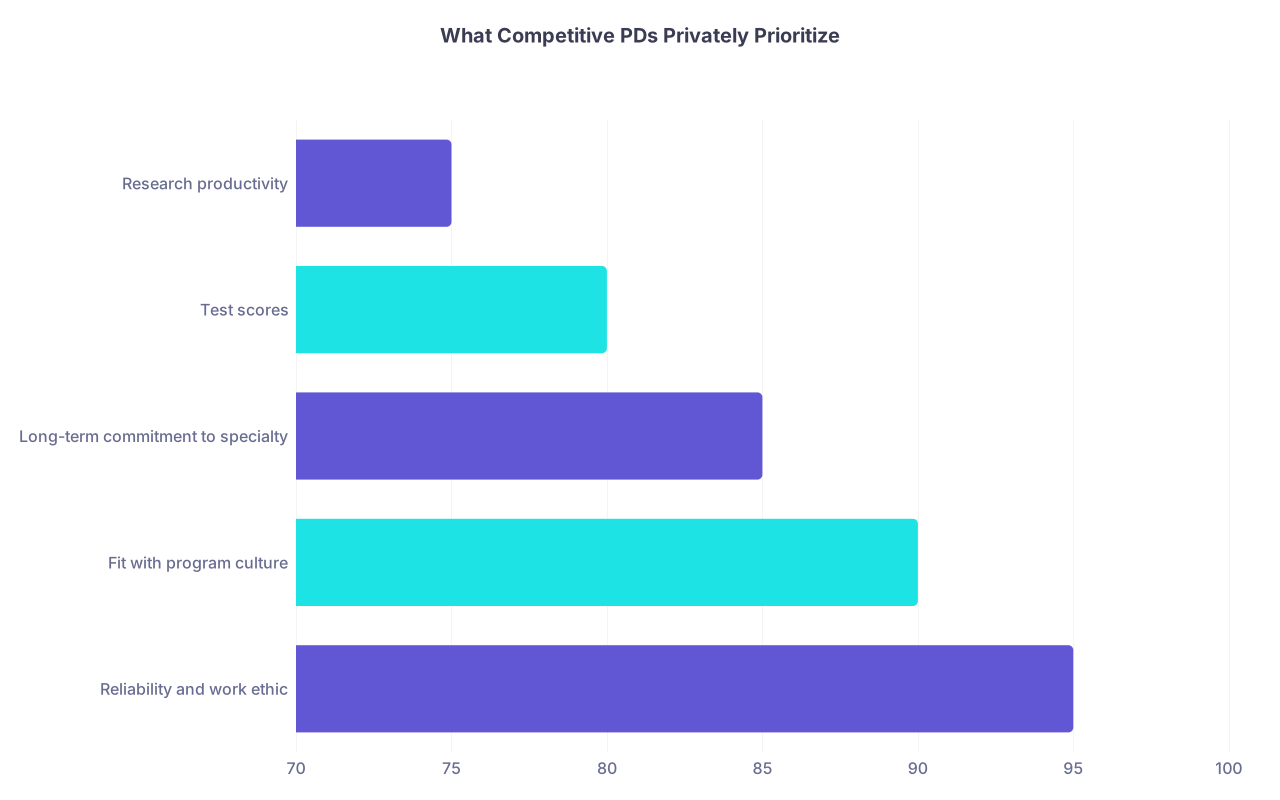
Let me be blunt: you aren’t going to out-flash a 24-year-old with a 265, 12 first-author papers, and a PhD in the exact field they’re applying into. But you don’t have to.
You’re aiming to win on different metrics that PDs care about more than they admit.
| Category | Value |
|---|---|
| Reliability and work ethic | 95 |
| Fit with program culture | 90 |
| Long-term commitment to specialty | 85 |
| Test scores | 80 |
| Research productivity | 75 |
Reliability, fit, and long-term commitment are where you win.
That means you:
- Show up to away rotations like you’re already a sub-I on the team, not auditioning for a trophy
- Ask studied, specific questions that show you understand the real grind, not just the highlight reel
- Talk more about team, systems, and patient ownership than about procedures you’re excited to put on Instagram
I’ve seen rank lists where:
- The non-trad with a 240 Step 1 and average research ended up top 5
- The 250+ with stronger research but questionable attitude ended up buried
The committee usually doesn’t admit, “We ranked him higher because he’s older and seems more stable.” They say things like:
“He’ll be a good colleague.”
“She’ll take care of the interns.”
“I can see him being chief.”
Those phrases are code for: high floor, minimal risk, non-trad advantage.
Timing, Age, and the “Too Old” Myth
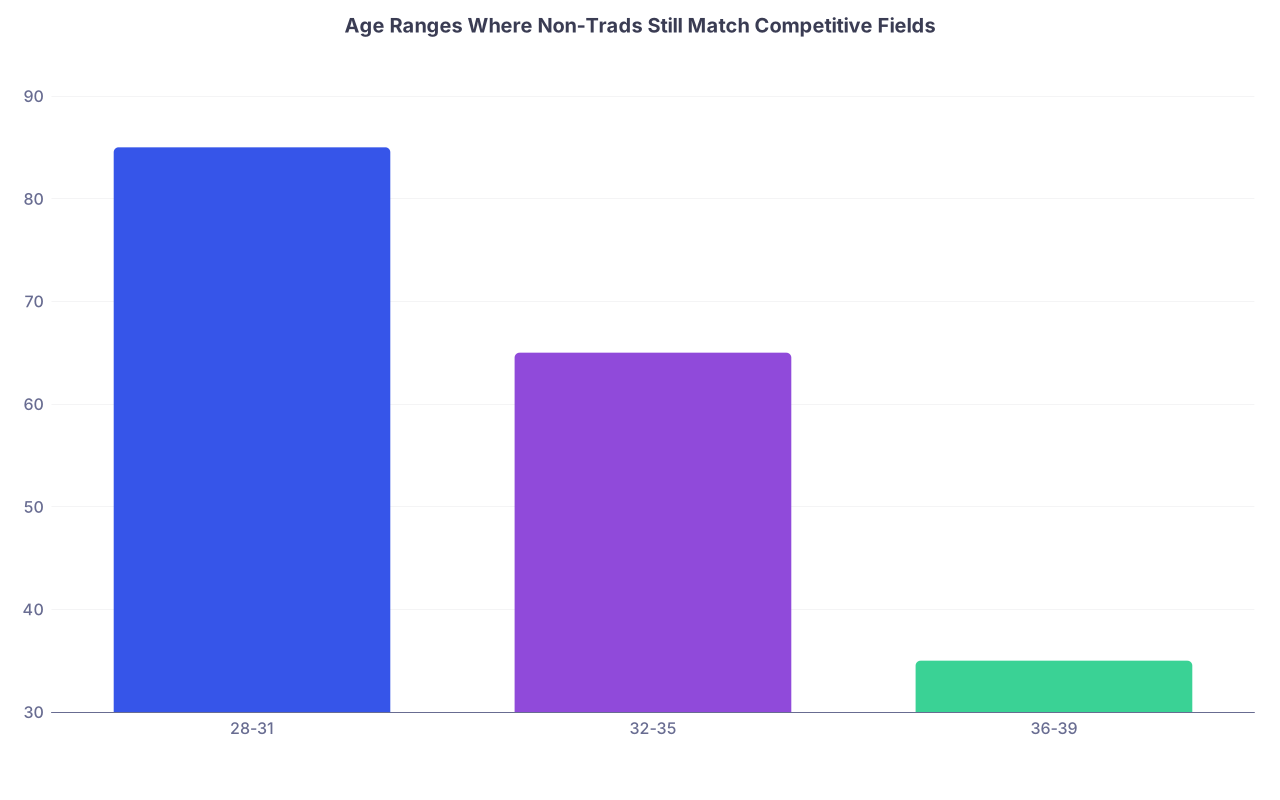
People love to declare hard age cutoffs. “Over 35? Forget ortho/ENT/derm.” That’s lazy.
Here’s how it actually works.
| Category | Value |
|---|---|
| 28-31 | 85 |
| 32-35 | 65 |
| 36-39 | 35 |
Is it easier if you’re 28–31? Absolutely. You’re “older” but not out of sync with the resident age range.
But I’ve seen:
- A 36-year-old ex-engineer match ortho at a strong community academic hybrid
- A 37-year-old prior PhD + hospitalist abroad match neurosurgery after US med school
- A 39-year-old prior RN match ENT at a mid-tier university program
What did they have in common?
- Absolutely clean, upward-trending academic record in med school
- Specialty-specific commitment starting early in school
- No entitlement. At all.
Where age really bites is not PD bias — it’s you underestimating the physical and emotional grind and then projecting doubt. If you show up tired, uncertain, or tentative on away rotations, faculty assume you won’t finish the marathon.
They’re not scared of your birth year. They’re scared of investing a PGY-1 spot in someone whose energy tank is already half-empty.
How to Play Your Hand Like an Insider
If you’re a non-trad aiming for a competitive specialty, you need to stop hiding and start using your profile as a weapon. That means:
- Stop apologizing for being older in your essays. State it as a strength with receipts.
- Tell a clean, linear story: prior life → trigger moment → concrete steps → this specialty.
- Get letters that explicitly call out maturity, teachability, and reliability.
- On rotations, act like the person they’d want covering their sickest ICU patient at 3 am, not the cleverest CV.
And you need to do this early. Non-trads who decide on derm or ortho in late M3 with no runway? Those are the ones who get shredded. It’s not because they’re older. It’s because they look late, unfocused, and behind in the game.
FAQ (Read These Before You Panic)
1. I’m 33 with a previous career and average scores. Do I have a real shot at a competitive specialty?
Yes, if three things are true: your med school performance is strong and clearly upward trending, your commitment to that specialty is obvious (electives, research, mentors, away rotations), and your letters emphasize reliability and maturity. Age 33 is not disqualifying. A scattered story is.
2. Will programs avoid me because I might retire earlier than my peers?
This comes up far less than applicants think. PDs are trying to staff a residency, not predict your retirement at 62 vs 67. They care about whether you’ll finish training, pass boards, and be a good representative for the program. If you seem stable and committed, they are not doing actuarial math on your eventual retirement age.
3. Does being non-traditional make up for weaker Step scores?
It can offset slightly weaker scores, not catastrophic ones. Being 32 with a 232 applying to derm? Brutal. Being 32 with a 240–245 and strong derm story, research, and letters? Very much in play at the right tier of programs. Non-trad status is a tiebreaker and a risk-reducer, not a magic eraser.
4. How do I talk about my previous career without sounding arrogant?
Frame it in terms of skills that transfer to residency and your willingness to be a learner again. For example: “As a project manager, I learned to coordinate complex teams under pressure. In residency, I want to bring that same discipline, but I also know I’ll be at the bottom of a new hierarchy, and I’m ready for that.” If you emphasize service, humility, and growth, your past career becomes an asset, not a flex.
Bottom line: Competitive specialties are not allergic to non-traditional applicants. Many of them quietly prefer you — if you show commitment, humility, and a clean, focused story. Your age is not the problem; confusion and entitlement are. Package your experience as stability and staying power, and you’re exactly the kind of “risk-averse” choice PDs love when the rank list gets real.