

The idea that you must choose between doing global health and paying your loans is exaggerated—and sometimes used as an excuse by people who never wanted to do global health in the first place.
If you’re serious about lower-paid global health work and you’re staring at six figures of debt, you do not need inspiration. You need a plan. With numbers. Timelines. And some non-negotiables.
Let’s build that.
1. Get brutally clear on your numbers first
You cannot “feel” your way through this. You need an exact picture of your debt and your minimum viable life.
Step one: get your loan details in one place. Not “I think it’s around 250k.” Exact.
- Log into studentaid.gov and every private lender
- Export or write down:
- Total balance per loan
- Interest rate
- Type (Direct, Grad PLUS, private)
- Current repayment plan (if any)
Then build a simple table for yourself like this:
| Loan Type | Balance | Interest Rate | Eligible for PSLF? |
|---|---|---|---|
| Direct Unsub | $120,000 | 6.8% | Yes |
| Grad PLUS | $80,000 | 7.2% | Yes |
| Private | $40,000 | 5.5% | No |
Now do the second piece most people skip: figure out the floor of your life.
Not your “ideal lifestyle.” Your survival + sanity baseline.
List actual monthly needs, not guesses:
- Rent (real numbers in the city you’ll live in)
- Utilities + phone + internet
- Food (be honest—most residents underestimate this)
- Transport (car, insurance, gas/public transit, maintenance)
- Health insurance + basic meds
- Minimum spending for mental health (some social life, gym, etc.)
You should end up with something like: “Baseline life = $2,600/month.”
Why this matters: everything in global health and loan repayment revolves around how low you can keep that number without being miserable or unsafe. Nothing else you do will compensate for a wildly inflated lifestyle in a low-paying role.
If those numbers already tell you: “I cannot afford $2,500/mo standard loan payments and still eat,” that’s good. That means you’re awake. Now we can use the tools you actually have.
2. Decide your sequence: when global health fits in
Most people try to solve this backwards: “How do I cram loan repayment around global health?” Better sequence: decide when global health happens relative to your higher-earning years.
You basically have four realistic patterns:
| Pattern | High-Earning First? | Global Health Timing | Financial Safety |
|---|---|---|---|
| Front-load global health | No | Immediately post-training | Low–Medium |
| Hybrid with academic job | Partial | Concurrent | Medium–High |
| Back-load global health | Yes | After partial payoff | High |
| Side-by-side short stints | Yes/Partial | 4–8 weeks per year | High |
Pattern A: Front-load global health
You finish residency/fellowship and jump straight into a low-paid NGO job or field post.
Pros:
- You start global health now, not at 45
- You build credibility and real field experience early
- You find out quickly if you actually like this work, not just the idea of it
Cons:
- Cash flow is tight
- PSLF/IDR/loan strategy has to be sharp from day one
- Private loans can be a nightmare here
This is feasible if:
- You have mostly federal loans
- You commit to an income-driven repayment (IDR) plan
- Your partner or other support can buffer you a bit (not required, but helps)
Pattern B: Hybrid with academic / hospital-based role
You work at an academic center or safety-net hospital with a global health program. You do some international work (1–3 months/year), some domestic clinical, maybe some teaching.
Pros:
- Stable salary (often $180–260k as junior faculty in many specialties)
- Eligible for PSLF if the institution qualifies
- Formal global health tracks, protected time, sometimes internal funding
Cons:
- Less time abroad than a full-time NGO role
- You’re navigating institutional politics and billing pressures
For many, this is the sweet spot. The math works. The global health work is real.
Pattern C: Back-load global health
You do a better-paid job for 5–10 years, crush your loans, build savings, then pivot to mostly global health work when obligations are lighter.
Pros:
- Financially the safest
- You can negotiate or self-fund meaningful work later
- Family planning is often easier
Cons:
- Easy to never actually pivot
- Your energy, flexibility, and risk tolerance drop with age and responsibilities
If you choose this, put a date on it: “I will re-evaluate and potentially switch in 7 years when balance < $100k and savings > $150k.” Otherwise it’s just “someday.”
Pattern D: Short, intense global health blocks
You keep a full-time higher-paying job and carve out 4–8 weeks/year for field work, often unpaid or lightly paid.
Pros:
- You stay on top of loans
- You maintain skills and connections in both worlds
- You reduce the “all or nothing” mindset
Cons:
- Hard on your personal life
- Not always what NGOs want—they need continuity, not random visitors
This is realistic if you negotiate your contract well (we’ll get to that) and your employer sees value in your global work.
3. Use the big levers: PSLF, IDR, and smart refinancing
There are only a few structural tools that actually move the needle. Use them or you’re just tightening your belt forever.
Public Service Loan Forgiveness (PSLF)
If you’re serious about lower-paying work, PSLF is usually your biggest ally.
You need:
- Direct federal loans
- Income-driven repayment plan (SAVE, PAYE, IBR, etc.)
- 120 qualifying payments while working full-time for a qualifying employer
What counts as qualifying employers?
- US government organizations (federal, state, local)
- 501(c)(3) nonprofits (most academic hospitals, FQHCs, many NGOs with US footprint)
- Some other nonprofits providing qualifying public services
Many physicians screw this up by refinancing federal loans to private. Once you convert to private, PSLF is gone. Permanently. No appeal.
If you think global health, academic medicine, or safety-net work is in your future—or even might be—hold off on refinancing your federal loans until you’ve really thought it through.
Income-driven repayment (IDR) + global health
Global health roles are often low-salary or part-time. That’s exactly where IDR shines. Your monthly payment is pegged to income (and family size), not to your loan balance.
If your adjusted gross income is $60k, your monthly payment on SAVE or similar plans may be dramatically lower than the standard 10-year plan—sometimes under $300–400/month early on.
Key move here: keep meticulous records. Every year:
- Re-certify your income on time
- Download and save confirmation of your application
- Use the PSLF Help Tool and keep copies of employment certification forms
Do not trust the servicer to “keep track.” They lose things. People have lost years because HR typed the wrong EIN or checked the wrong employment box. I’ve seen this with big-name institutions that absolutely should know better.
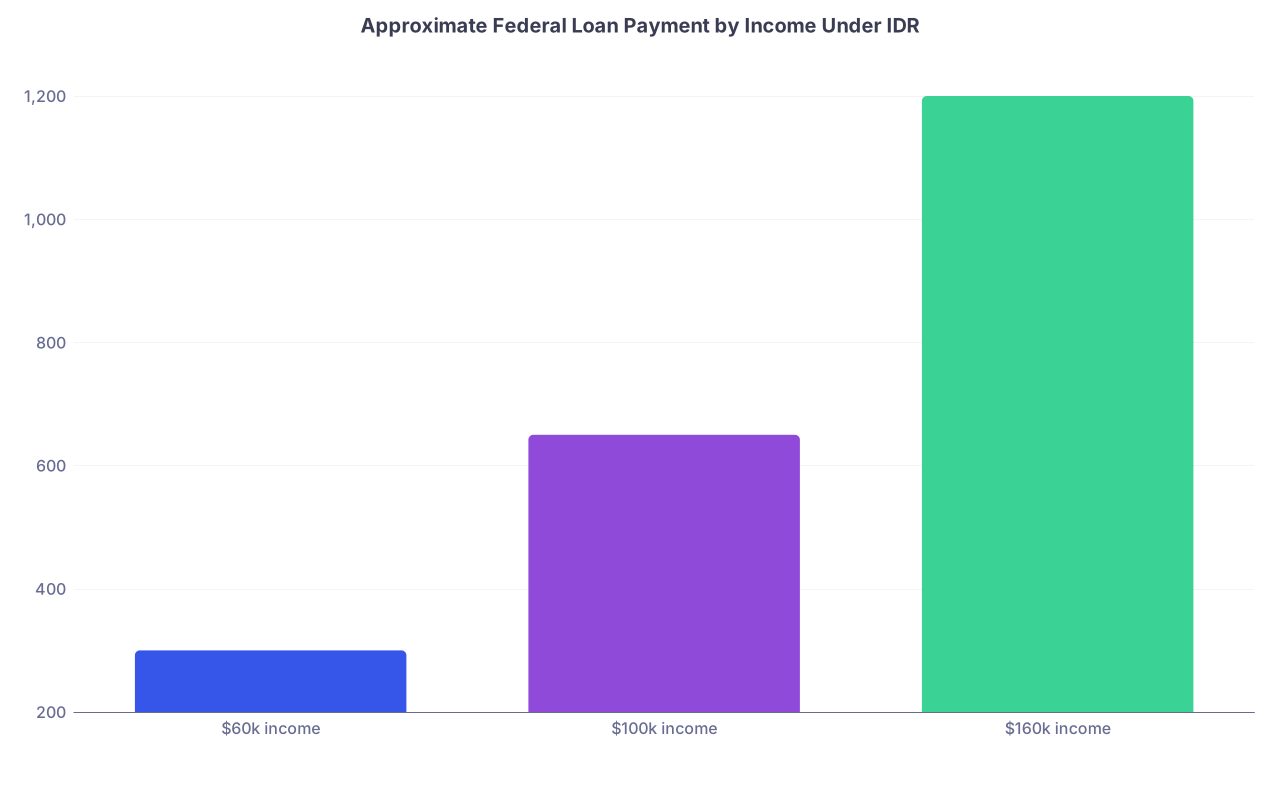
| Category | Value |
|---|---|
| $60k income | 300 |
| $100k income | 650 |
| $160k income | 1200 |
(This is illustrative, not exact—actual payments depend on plan, family size, and tax details.)
What about private loans?
If you already have private loans, those are your problem children. No PSLF. No IDR. Just straight amortized payments.
Your options:
- Refinance for a lower rate and shorter term once you have stable income
- Attack them aggressively for 3–5 years while you still have higher income
- Consider whether a truly very low-paid global role is realistic until those are under control
Here’s the harsh truth: if you’ve got $200k federal + $150k private and you want to make $50k/year in global health immediately post-residency, the math will not be kind. You’ll need at least a partial higher-income period or heavy partner/family support.
4. Design your “bridge job” strategically
If you’re in training or just out, your first attending or post-training job matters more than you think. This is where you either give yourself breathing room or bury yourself.
You want a job that:
- Pays enough to get you ahead of interest, not just treading water
- Keeps PSLF on the table if possible
- Does not burn you out so much you abandon your global health plans
- Lets you build skills that translate to field work (HIV, TB, maternal health, trauma, EM, etc.)
Classic examples:
- Hospitalist in an academic or safety-net hospital with global health connections
- Infectious disease / ID-HIV role at a public hospital or FQHC that’s PSLF-eligible
- Emergency medicine in a county system with academic affiliation
Then you negotiate. Not just salary. Structure.
What to ask for explicitly:
- Option for 0.8–0.9 FTE with proportional pay (and preserved benefits if possible)
- Dedicated weeks per year that can be bunched for global health work
- Ability to classify approved global work as “academic time” or “professional development”
- Written support for external NGO partnerships or MOUs

| Step | Description |
|---|---|
| Step 1 | Finish Residency |
| Step 2 | Higher paying job 3 to 5 years |
| Step 3 | PSLF eligible job |
| Step 4 | Mixed strategy job |
| Step 5 | Reassess after paydown |
| Step 6 | Integrate global health time |
| Step 7 | High Private Loans? |
| Step 8 | Mostly Federal Loans? |
The “bridge job” is not a failure of your global health ideals. It’s a runway, so when you step into low-resource settings, you’re not constantly checking your loan balance between patients.
5. Make global health financially sustainable, not heroic
The global health world is famous for asking people to work like martyrs while paying them peanuts. You don’t have to play that game forever.
Here’s what people actually doing this long-term figure out:
Stop doing long, unpaid “volunteerism” as an attending
A week or two of unpaid work? Fine. A year unpaid with $300k loans? That’s self-sabotage dressed up as altruism.
If an organization wants you to supervise residents, manage a ward, do program design, or lead anything—your skills have value. Ask about:
- Stipends (even small ones)
- In-kind support (housing, food, transport)
- Coverage of travel, visas, licensing, malpractice
If they say, “But we’re a nonprofit, we can’t pay,” the correct internal response is: “Then you can’t sustainably use me as a long-term clinician.” Not “I guess I should donate a year of my life and financial future.”
Attach yourself to funded work
Serious global health work often comes with funding: grants, institutional budgets, partnerships.
Ways to do that:
- Join an academic center’s global health division as junior faculty
- Work under a PI on a funded project
- Build niche expertise (e.g., ultrasound in low-resource settings, MDR TB, obstetric emergencies) that fits into grant proposals
- Help write grants that include your salary and loan repayment support
This is not overnight. But it’s the difference between dabbling and building a career.
Keep one reliable income stream
Most people who make this work long-term have at least one of these:
- A core clinical job at 0.5–0.8 FTE in a PSLF-eligible setting
- A stable academic appointment with salary support
- A contract with an NGO that actually pays market-ish rates for your level (rare but real in some settings, especially leadership roles)
Then they slot global work into that structure. If all your income is fragmented and ad hoc, your loans will own you.
6. Practical monthly tactics once you’re in a lower-paid role
Okay, say you’re already there. You took a $60–80k-equivalent job with heavy global engagement. You’re not going back to full-time private practice. Now what?
Here’s how you keep the wheels on:
- Stay on (or move to) an IDR plan as soon as your income drops. Do not let your servicer auto-switch you to a standard plan.
- Keep your taxable income as honest-but-lean as legally allowed. Max tax-advantaged retirement accounts if you can—yes, even with debt. This can lower your IDR-calculated payment and protect your future.
- Pick one or two “no compromise” expenses that keep you sane (therapy, gym, occasional travel) and cut hard on the rest. You don’t need a fancy car while living this life.
- Build a 3–6 month emergency fund before you start throwing extra at loans. Global health careers involve instability—funding shifts, coups, pandemics. You need runway.
- Automate everything you can: loan payments, savings contributions, retirement. Decision fatigue is real when you’re exhausted from work in hard settings.
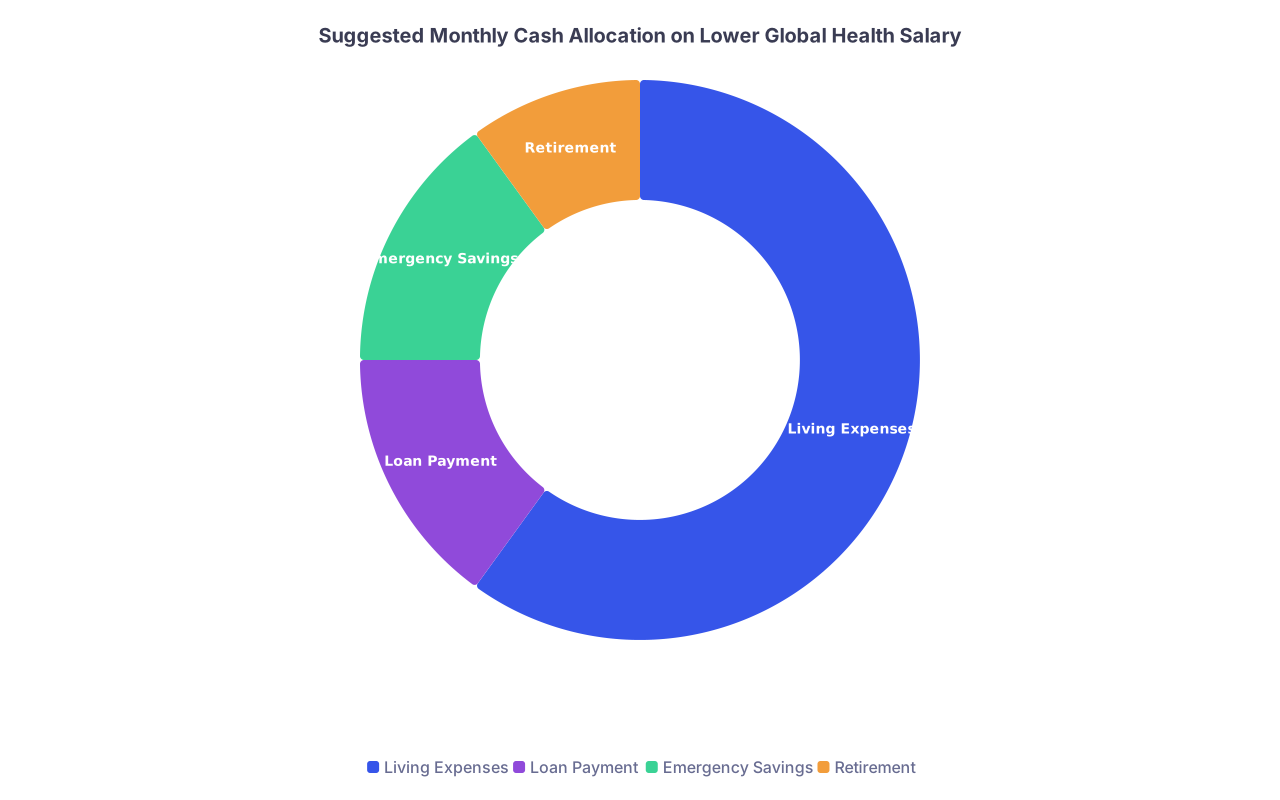
| Category | Value |
|---|---|
| Living Expenses | 60 |
| Loan Payment | 15 |
| Emergency Savings | 15 |
| Retirement | 10 |
Again, this is conceptual, not gospel. But if your “Living Expenses” slice is 85%, you’ve boxed yourself in.
7. Ethical sanity check: money, privilege, and staying useful
Let’s talk ethics for a second—not in the abstract, in your actual life.
You doing unpaid or underpaid heroic work for 2–3 years and then burning out, defaulting on loans, or retreating to high-paid private practice out of desperation—that does not actually serve the communities you say you care about.
What does serve them?
- You staying in this work for 20–30 years
- You having enough financial stability to say “no” to exploitative arrangements
- You being able to pick roles based on impact, not on “who will pay me anything at all”
That requires you to protect yourself financially, not apologize for it.
You’re not “less committed” because you:
- Choose PSLF over refinancing to give yourself breathing room
- Ask an NGO to pay you something approximating a fair wage
- Say no to a glamorous unpaid fellowship that would wreck your finances
The people you serve do not benefit from you being underwater in debt. They benefit from you being competent, consistent, and still there five years from now.
8. Concrete action plan by phase
Let me lay this out by where you might be.
If you’re a med student / early resident
- Avoid private loans if humanly possible. Federal gives you flexibility and PSLF.
- Choose training with strong global health and safety-net exposure, but do not ignore where graduates actually get jobs and what they earn.
- Learn IDR and PSLF rules now, not after graduation.
- Start living like a person who will have a mission, not like someone who’s owed a doctor lifestyle.
If you’re a late resident / fellow
- Decide your 5-year pattern: front-load, hybrid, back-load, or blocks. Write it down.
- Get exact loan numbers and run scenarios: IDR vs standard vs refinance.
- Target PSLF-eligible employers for your first job unless you’re 100% sure you’ll go private long-term.
- Negotiate at least some structure for global work in your first contract (even if small).
If you’re already in a low-paid global health role
- Confirm: Are you maximizing PSLF eligibility if you have federal loans? If not, fix that.
- Renegotiate with your organization at the next natural break: salary, benefits, travel, scope.
- Protect your energy and mental health—global health burnout is real and expensive.
- Map out 3–5 year checkpoints: “At year 3, I want balance down to X and savings at Y.” Revisit annually.
9. One final, uncomfortable piece: your lifestyle inflation problem
You cannot talk honestly about loans and global health without talking about lifestyle.
I’ve watched several people say, “I wish I could do more global work, but the loans…” while:
- Driving a new luxury SUV
- Paying $3,000+ in rent solo in a trendy neighborhood
- Taking 3–4 expensive vacations a year
- Eating out 5–6 times a week
And they’re not lying. With that lifestyle, they cannot do more global health. But that is not a loan problem. That is a choice problem.
The people who pull this off usually:
- House hack early (roommates longer than is comfortable)
- Drive boring, reliable used cars
- Learn to cook and stop bleeding money on food
- Say no to a lot of status purchases their peers accept as “normal” for physicians
You do not have to live monastically forever. But for 3–7 key years, you probably cannot live like your high-earning colleagues if you want a career built around lower-paid global work.
This is the trade. Better to be honest about it.
10. The short version: how to actually balance this
You’re not choosing between “good person who does global health” and “sellout who pays their loans.” That binary is fake.
You’re choosing between:
- Drifting, making emotional decisions, hoping the math works out
vs. - Treating your finances with the same rigor you treat a patient in front of you
So here’s the spine of the whole strategy:
- Know your exact numbers and pick a realistic sequence for global health vs higher-earning years.
- Aggressively use structural tools—PSLF, IDR, reasonable contracts—before you sacrifice your financial stability.
- Deliberately underbuild your lifestyle in the early years so you can overbuild your impact later.
If you hold those three points, you can absolutely do serious global health work without drowning in debt. It will not be easy. But it will be possible—and sustainable.


