
Only 27% of global health workers employed by large international NGOs stay in their first role longer than two years.
So much for “dream job” stability.
Global health trainees, medical students, and early‑career clinicians keep telling me the same thing: “If I can just get into WHO, MSF, or a big UN agency, then I’ll really be doing global health.” It sounds right. It’s also mostly wrong for where you are in your career.
Let’s break the myth cleanly: for starting out, big international NGOs are often one of the least efficient, least educational, and least ethically straightforward ways to get into global health work.
The seduction of the big logo
You know the drill. Polished website. Photos of smiling children. Logos you’ve seen on conference slides: WHO, UNICEF, UNHCR, MSF, Save the Children, Partners In Health, IRC.
The narrative you’ve absorbed:
- Big NGO = more impact
- Big NGO = more mentorship and structure
- Big NGO = more ethical, more regulated, “safer”
- Big NGO on your CV = automatic credibility
Reality: the data and the lived experience do not support that as a blanket rule, especially for early‑career people.
What the numbers actually show
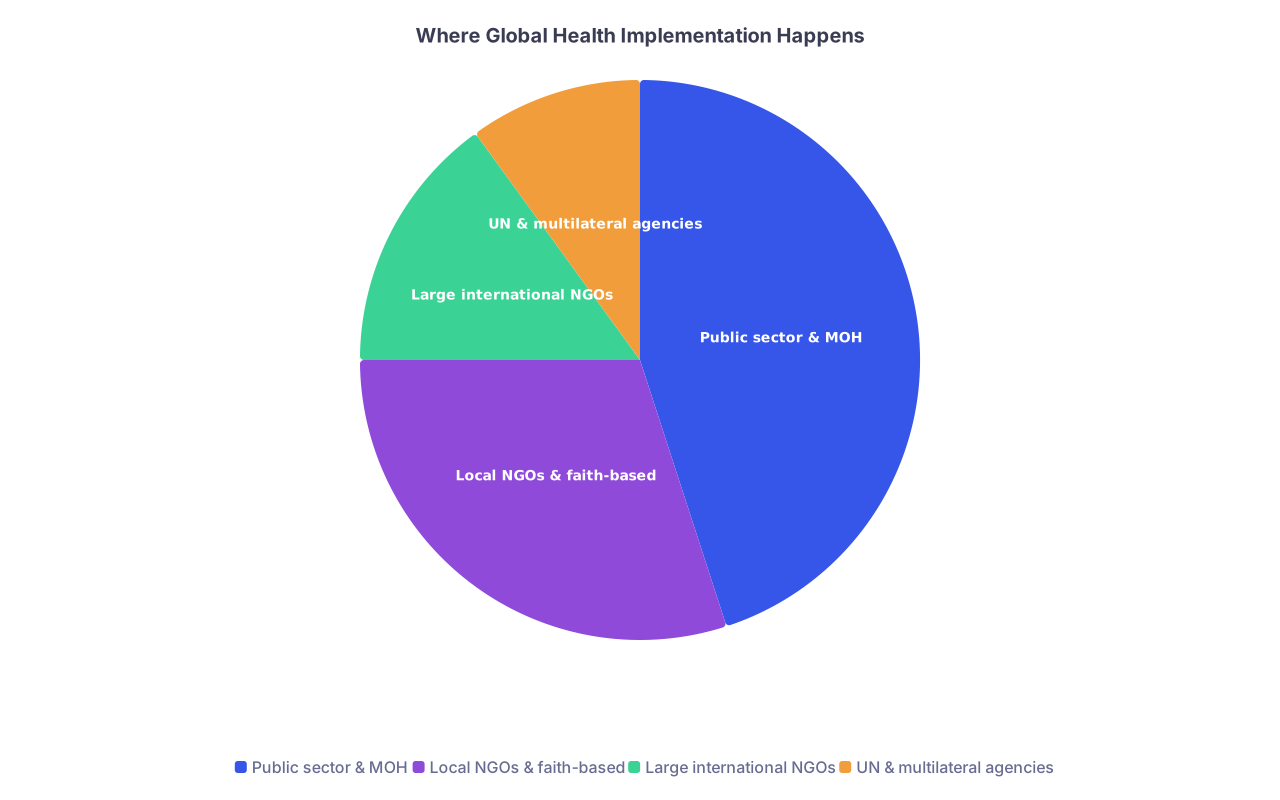
We have decent data on where global health work is actually happening and who employs people:
- The vast majority of health services in low‑ and middle‑income countries are delivered by ministries of health, local NGOs, and faith‑based organizations, not by the big expatriate‑heavy brands.
- A 2016 analysis of development assistance for health showed that while large NGOs and multilaterals move big money, implementation is heavily subcontracted to local entities.
- Studies of “capacity building” projects repeatedly show that outcomes are better when local organizations lead design and decision‑making, not when foreign NGOs dominate.
Translation: the big names are often middlemen. Sometimes necessary middlemen. But not necessarily the best training ground for you.
| Category | Value |
|---|---|
| Public sector & MOH | 45 |
| Local NGOs & faith-based | 30 |
| Large international NGOs | 15 |
| UN & multilateral agencies | 10 |
Why big NGOs are often bad “first jobs”
I am not saying “never work for large NGOs.” I’m saying: as a starting place, they’re overrated and frequently misaligned with what early‑career people actually need to learn.
1. You’ll mostly do PowerPoints, not patients
In big NGOs, entry‑level “global health” usually means:
- Project assistant
- Monitoring & evaluation officer
- Junior technical advisor
- Program coordinator
It sounds impressive. It often translates into:
- Endless logframe updates
- Donor reports no one reads
- Excel sheets of indicators you don’t understand in context
- Sitting in an air‑conditioned office 10 km from the clinic where the data came from
I’ve watched bright, motivated clinicians fly across the world to “do global health,” then spend 90% of their time editing Word docs and attending coordination meetings in English with other foreigners. They could have done the exact same tasks from a coworking space in London.
That’s not worthless. But it’s a very expensive way to learn generic project management.
If your goal is clinical global health experience, community engagement, or learning health systems from the inside, this is the wrong environment to start in.
2. You’re functionally replaceable for years
Big NGOs are risk‑averse. For good reason: they manage huge budgets and reputational risk. That translates into a staffing structure where early‑career people are intentionally low‑responsibility.
I’ve seen junior staff spend:
- One year on internship → no real ownership
- Two years on fixed‑term assistant role → still peripheral
- Promotion to officer level → finally allowed to talk in donor meetings, but not decide anything
You get supervision, sure. But agency? Minimal.
Compare that with a small local NGO or district health office, where you may be the only person with your skill set and suddenly you’re designing an entire training curriculum or leading a quality improvement project by month three. Yes, it’s messier. Also where you actually learn.
3. Big NGOs are not automatically more ethical
Here’s the comfortable myth: “Big, established NGOs must have better ethics and oversight, so I’ll be less likely to be part of something harmful.”
Reality: size and budgets do not immunize anyone from ethical failure. Quick examples you can look up:
- Sexual exploitation scandals in multiple major NGOs in Haiti and elsewhere
- “Parachute” Ebola responses that sidelined local health authorities
- Campaign‑style vertical programs that distorted local health priorities
Ethical global health requires proximity, accountability to local communities, and humility. Big NGOs are often geographically and socially distant from the people affected by their decisions. Staff rotate every 6–12 months. Leadership sits in Geneva, New York, London.
If you’re serious about personal ethics in global health, your first job should be somewhere you can see the consequences of choices. Not five administrative layers away.
Where you actually learn the craft: smaller, closer, less glamorous
Now the contrarian part: many of the best early roles in global health are:
- With local NGOs you’ve never heard of
- Inside public sector programs (district hospitals, MOH units)
- With faith‑based networks or mission hospitals
- In implementation‑focused research groups based in‑country
These do not produce sexy LinkedIn headlines. They do produce competence.
Concrete comparison
Let’s make this less abstract.
| Feature | Big International NGO | Local NGO / Public Sector |
|---|---|---|
| Decision-making responsibility (first 2 years) | Low | Moderate to High |
| Proximity to patients/communities | Low to Moderate | High |
| Exposure to health system reality | Filtered through office | Direct, daily |
| Bureaucratic overhead | Very high | Variable, usually lower |
| Learning curve intensity | Slow, siloed | Steep, broad |
I’ve watched junior clinicians who spent a year as a district hospital medical officer in Malawi run circles around people who did three years in a Geneva‑based NGO when it came to:
- Understanding why stockouts actually happen
- Navigating local politics and power dynamics
- Designing feasible interventions that do not collapse after funding ends
Because they started where the work is real, not where the presentations are glossy.
But what about safety and support?
Yes, there are bad local NGOs and dysfunctional government systems. I am not romanticizing them. You need to vet them, ask hard questions, and protect yourself.
But safety and mentorship are not monopolies of the big players. Some of the worst supervision I’ve seen was in large field missions where junior staff were dumped into complex roles with almost no real support—only a stack of standard operating procedures written three countries away.
You want:
- One or two senior people actually present and accessible
- Clear scope of work
- Real orientation to local context
- Mechanisms for feedback and escalation
Those can exist in a 15‑person local NGO. They can be completely absent in a 3,000‑person multinational operation.
Personal development: what you actually need early on
Early‑career global health work is not primarily about “impact.” That sounds heretical but stay with me. You, as a first‑ or second‑year trainee, are not going to fix maternal mortality in northern Nigeria.
Your real goals should be:
- Build skills that travel: language, negotiation, teaching, clinical competence in resource‑limited settings, data literacy that ties to real decisions.
- Build judgment: when to push, when to shut up and listen, when to walk away from an unethical project.
- Build credibility grounded in actual work, not just brand names on a CV.
Big NGOs can, eventually, offer some of this. But they’re inefficient starting points.
Skill-building: office vs on-the-ground
Look at what your day will actually include.
If you’re:
- Attending coordination meetings
- Copy‑editing reports
- Tracking indicators in a database
- Helping write grant proposals
You’re learning generic bureaucratic survival skills. Useful later. Not the foundation you need as a clinician or serious global health practitioner.
If instead you’re:
- Running morbidity and mortality reviews with a district team
- Helping redesign a clinic flow to reduce wait times
- Training community health workers and then going out with them
- Figuring out how to maintain a cold chain when the power fails
That’s the messy, concrete stuff that makes you dangerous (in a good way) later on.
Ethics: being close enough to be uncomfortable
Ethical development doesn’t happen in abstract “global health ethics” seminars alone. It happens when:
- You see a “free” program collapse after funding ends, and patients lose access to meds
- You’re asked to prioritize one patient group over another because of a donor requirement
- You watch a local clinician get overridden by an expat who arrives for three weeks with a catchy idea
When you’re in a program office 2,000 miles away, those choices are theoretical. When you’re on the ward or in the clinic, they’re concrete. And they force you to develop a spine.

But what about the CV and “getting into” global health?
The most persistent fear I hear: “If I don’t start at a big NGO, I’ll never break into global health.”
This is backwards.
People who hire for serious technical or leadership roles in big NGOs look for one thing above all: evidence you’ve actually done hard things in real systems. That you’re not just another policy tourist.
That can come from:
- A two‑year stint in a rural hospital
- Running a small HIV clinic program
- Being the only clinician in a local NGO trying to integrate NCD care into primary care
- Doing operational research that actually changed how a district does something
I’ve been in recruitment rooms where candidates from WHO fellowships were passed over for someone who had “only” worked in a small Kenyan NGO—because the latter could answer specific questions about dealing with health worker strikes, drug stockouts, and local politics. The WHO guy could talk frameworks. That was it.
The hidden gatekeeping problem
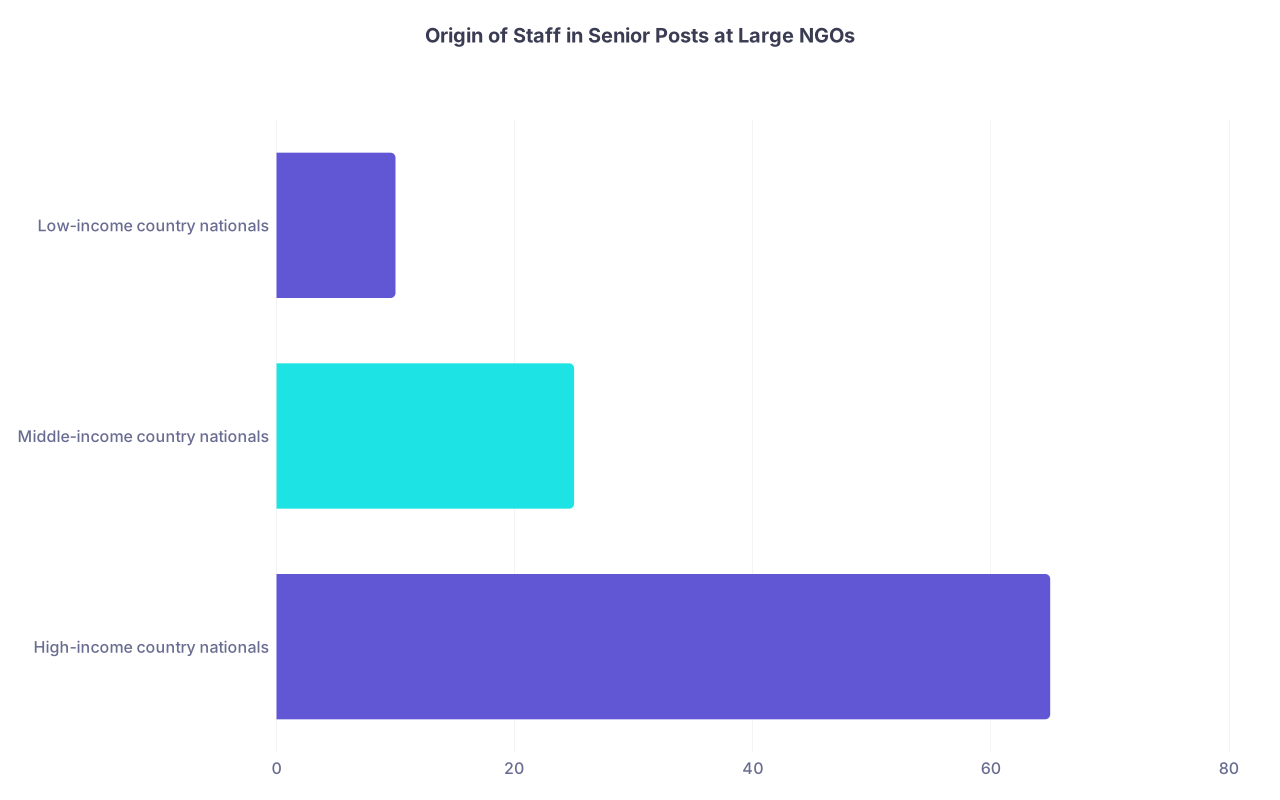
There’s another, less comfortable truth: big international NGOs are structurally biased toward applicants from high‑income countries, elite universities, and people who can afford unpaid or underpaid internships.
Early‑career roles often:
- Pay poorly relative to living costs (especially at HQ)
- Require expensive relocations
- Demand previous international experience—without providing it
So the myth “big NGOs are the way in” accidentally supports a pipeline that’s skewed toward the already‑privileged. If you’re serious about global health equity, you should be skeptical of that.
| Category | Value |
|---|---|
| High-income country nationals | 65 |
| Middle-income country nationals | 25 |
| Low-income country nationals | 10 |
How to choose a first role that actually grows you
I’m not going to give you a platitude list. Instead, here are blunt filters that work.
Ask these questions of any opportunity:
- Will I see patients or frontline services regularly? If the answer is “hardly ever,” this is probably not the place to start if you’re clinically trained.
- What decisions will I be allowed to make in the first year? If your role is essentially administrative support, know that going in.
- Who will I be accountable to—donors or local systems? If all performance metrics are donor‑facing, expect warped priorities.
- How long are staff rotations? If everyone cycles out every 6–12 months, institutional memory and accountability are weak. You’ll learn less than you think.
- What happened after previous projects ended? If no one knows, that’s a bad sign.
If a big NGO role passes those tests, fine. Take it. But don’t assume it will just because of the logo.

| Step | Description |
|---|---|
| Step 1 | Identify opportunity |
| Step 2 | Check actual responsibilities |
| Step 3 | Check supervision and safety |
| Step 4 | Consider strongly |
| Step 5 | Reassess and compare |
| Step 6 | Big NGO or Local/Public? |
| Step 7 | Frontline exposure? |
Where big NGOs do make sense in your trajectory
Let me be fair. Big international NGOs do have real value at later stages:
- When you already understand health systems and want to influence policy across countries
- When you’re moving into technical advisory roles and can bring grounded experience
- When you need scale—multi‑country clinical trials, regional surveillance, global guideline work
They are powerful amplifiers for people who already know what they’re doing. They are poor incubators for people who don’t.
So think of them less as “entry level,” more as “Phase 2 or 3.” Get your hands dirty first. Then, if you still want the big machine, go in with your eyes open and your ethics tested.
Cut through the myth
Let me end cleanly.
- Big NGOs are not automatically better places to start your global health career; they’re often worse for learning, ethics, and responsibility.
- The real training ground is closer to the front line—local NGOs, public systems, district hospitals—where you can see cause and effect.
- Brand names on your CV matter less than demonstrated competence in messy, real‑world health systems. Build that first. The logos can wait.


