

The belief that you must be fluent in the local language to be effective in global health is wrong. It sounds noble. It feels intuitive. It is also one of the most efficient ways students talk themselves out of valuable international experience and delay doing any real work.
Let me be very clear: language fluency is an asset, not a moral prerequisite. And the data – plus decades of field experience from real programs – back that up.
The real ethical line is not between “fluent” and “non‑fluent.” It is between “structured, supervised, team‑based work” and “cowboy medicine with Google Translate and vibes.”
The Myth: Fluency = Ethical, Non‑Fluency = Harm
You’ve heard the script.
“If you do not speak the language, you’re going to harm patients.”
“Going abroad without fluency is just voluntourism.”
“If you can’t take a complex history alone in the local language, you have no business being there.”
Sounds serious. Also sounds conveniently like a way for people to gatekeep global health and sound virtuous on Twitter.
Reality check: global health delivery has always relied on language diversity and layered communication. Most large‑scale, respected organizations operate in multilingual contexts where very few team members are fluent in every patient’s first language.
Look at Partners In Health sites (Haiti, Rwanda, Peru), MSF programs in the Sahel, or government hospitals in India or Nigeria. Within a single team you can have:
- International staff speaking English/French/Spanish/Portuguese
- National staff speaking the “official” language plus 1–3 local languages
- Community health workers speaking hyper‑local dialects only
No one is fully fluent across that stack. And yet, effective, ethical care is delivered daily. Why? Because they build systems to compensate for individual language gaps, not because every outsider sits down and becomes magically fluent in six months.
The claim “you must be fluent to be effective” does not match how serious global health work is actually done.
What the Evidence Actually Shows
Let’s talk data instead of vibes.
There is decent literature on language concordance and health outcomes. Yes, it shows benefits to having a shared language. But read the actual findings, not the social‑media version.
Language Concordance vs Interpretation
Studies from the US, UK, and Canada consistently show:
- Patients with language‑concordant clinicians report better satisfaction and sometimes better adherence.
- But professional interpreter use dramatically improves understanding and outcomes compared with ad‑hoc or no interpretation – often closing most of the gap with concordant care.
For example, a classic JAMA study on Spanish‑speaking patients showed that when professional interpreters were used, error rates plummeted compared with family or ad‑hoc interpreters. Other data show lower ER utilization and improved chronic disease markers when interpretation services are systematically integrated.
Translation: fluency helps, but a non‑fluent clinician working within a robust interpreter system is safer and more effective than a barely‑fluent outsider improvising alone.
The ethical problem is not “you don’t speak the language.” The ethical problem is “you don’t have a safe communication system and you’re pretending you do.”
What Happens in Global Health Programs
Look at structured electives and long‑term partnerships that actually publish their outcomes and curricula:
- Students and residents often arrive with low or zero fluency.
- Programs screen them, limit their clinical role, and require supervised work with interpreters and local staff.
- Projects are chosen that match their capacity: quality improvement, guideline implementation, teaching, data work, systems design, simulation, and yes, clinical care in a supporting role.
Several studies of short‑term medical missions show that harm spikes not when people lack fluency, but when they lack:
- Supervision
- Clear scope of practice
- Integration into local systems
- Continuity of care and handover
Language is one variable. Not the only, or even the main, one.
You want a simple framing? A carefully supervised, non‑fluent student on a defined QI project is far less ethically risky than a “kind of fluent” resident running an unsupervised rural clinic via broken small‑talk.
Where the Real Ethical Lines Are
Let’s stop moralizing about fluency and talk about what actually determines whether you’re effective or dangerous abroad.
| Scenario | Ethical Risk Level |
|---|---|
| Non-fluent, supervised, structured role | Low |
| Fluent, unsupervised, beyond competence | High |
| Non-fluent, no interpreter, doing complex care | Very High |
| Fluent, integrated with local team | Lowest |
| Non-fluent, working mainly on systems/QI | Low |
Fluency changes the ceiling of what you can safely do. It does not automatically fix ethical problems, and its absence does not automatically create them.
Scope, Not Heroics
Here’s the real rule: your language skills should limit your scope, not disqualify your presence.
If you don’t speak the language at all:
You should not be independently making high‑stakes diagnostic decisions, consenting patients for procedures, or managing nuanced prognostic discussions through a cousin who took one semester of English.
But you can absolutely:
- Support ward rounds with a local resident leading the interaction.
- Work on data systems, audit projects, infection control, or guideline implementation.
- Teach skills where language is secondary (e.g., ultrasound technique, BLS, simulation – through a co‑facilitator who translates the teaching points).
- Help write protocols, train staff on checklists, or build tools that local staff then adapt linguistically.
Notice the pattern: you’re not the star. You’re the amplifier.
Interpreters Are Not Optional “Extras”
Professional interpretation is not a luxury. It is infrastructure.
In high‑income hospitals, we actually have data showing that language‑concordant care without interpreters can still lead to miscommunication, because “fluent enough” isn’t always enough for complex medical nuance.
That’s why the gold standard is:
- Local clinician leading the interaction
- Professional or highly trained interpreter when clinician and patient do not share a first language
- Written materials adapted to local language and literacy level
- Team debriefs that include local staff feedback on communication success/failures
Your job as the outsider is to push your host institution and your sending institution to treat interpretation as safety‑critical, not as an afterthought.
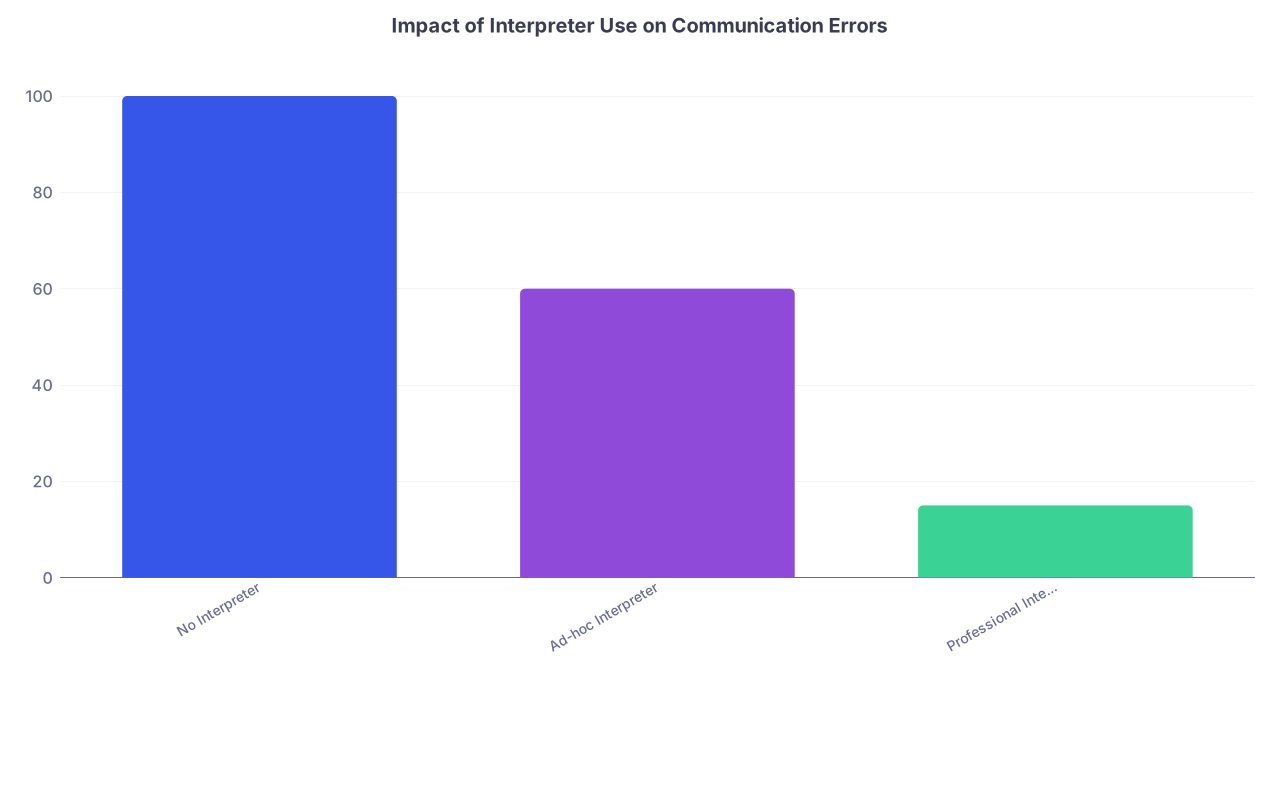
| Category | Value |
|---|---|
| No Interpreter | 100 |
| Ad-hoc Interpreter | 60 |
| Professional Interpreter | 15 |
(Those numbers are stylized, but the pattern mirrors published data: ad‑hoc help is better than nothing; professional systems are far better than both.)
What Non‑Fluent Trainees Can Actually Do Well
This is where the myth really collapses. Because a lot of the highest‑yield work in global health is not about your one‑on‑one conversation with a patient.
Global health is systems, policy, workflow, logistics, education, and ethics. All of that benefits from people who know when to shut up, listen through translators, and work alongside local colleagues rather than trying to be the charming outsider who can joke about soccer in the local tongue.
Systems and Quality Improvement
I’ve watched non‑fluent residents run circles around “fluent” visitors because they focused on:
- Mapping the patient journey with local staff
- Identifying handoff failures, missing supplies, or broken processes
- Designing a post‑operative checklist with the local surgical team
- Building a spreadsheet to track sepsis outcomes, which local colleagues then used to argue for more nurses on night shift
Almost all of that work happens in a mix of English (or French/Portuguese/Spanish) and local language, with bilingual staff acting as bridges. Nobody is pretending this is pure, symmetric communication. It’s practical and collaborative.
Teaching and Capacity Building
You do not need perfect local‑language skills to:
- Help a local educator build a teaching slide deck that they will present in the local language
- Run a simulation session where scenarios are in the local language, but debrief structure and educational design come from you and a local co‑facilitator
- Mentor local trainees on research methods, stats, manuscript writing, or grant applications in a lingua franca
Again, the point is not that language doesn’t matter. It clearly does. The point is that being non‑fluent shifts you to a supporting or backstage role – which is exactly where a visiting trainee ethically belongs anyway.
Longitudinal Partnerships Beat Individual Fluency
A single fluent visitor who leaves after 4 weeks is less valuable than a 10‑year institutional partnership that sends non‑fluent trainees in a structured way, invests in local interpreters, funds local training, and follows the host’s agenda.
Programs that work know this. That’s why they:
- Require pre‑departure training on cultural humility, power dynamics, and communication.
- Define explicit roles and scopes based on trainee level and language skills.
- Emphasize continuity of projects between cohorts.
Fluency might raise the ceiling of what an individual can do. But the real impact comes from continuity, systems, and local leadership.
How To Be Ethical and Effective Without Fluency
This is where people usually start to squirm. Because “I can’t go until I’m fluent” is a great way to avoid confronting the harder truth: you should not go until you’re willing to give up being the hero.
Here’s the uncomfortable list.
1. Be Ruthlessly Honest About Your Limits
Stop pretending that Duolingo streaks equal clinical competence. On your application and in your own head, be precise:
- “Basic conversational ability; cannot conduct independent clinical interviews.”
- “Able to follow structured questions with supervision; not fluent.”
Then match your clinical role to that level. If that leaves you mostly observing early on, good. Earn your way into more responsibility.
2. Demand Real Supervision and Structure
If a program tells you, “Don’t worry, you’ll pick up the language when you get here, and then you can see patients on your own,” that is a red flag. Not a selling point.
You want:
- Clear guidelines on what you can and cannot do clinically.
- Confirmed access to bilingual staff or interpreters for any patient interaction with clinical consequence.
- Defined non‑clinical or low‑risk projects that don’t rely on you being tongue‑tied at the bedside.
If they cannot provide that, reconsider going. Your lack of fluency doesn’t make this unethical; their lack of structure does.
3. Learn Targeted, Not Performative, Language
Yes, you should learn some of the language. But stop confusing “cute phrases” with competence.
Focus on:
- Greetings and basic respect phrases (this matters culturally).
- Body parts, common symptoms, yes/no questions.
- How to say, “My colleague will explain in detail,” and step back.
Your goal is not to impress your Instagram followers. It’s to build trust with patients and then hand off the complex communication to someone actually qualified to handle it.
4. Put Your Energy Where It Scales
If you spend 200 hours trying to reach mediocre fluency before a 4‑week elective, you may feel virtuous. But ask yourself: would those same 200 hours spent on learning QI methods, reading about local epidemiology, or preparing teaching materials have more actual impact?
Often, yes.
Language is one tool. Don’t fetishize it to the point that you ignore everything else you could be bringing to the table.

| Step | Description |
|---|---|
| Step 1 | Assess Language Skill |
| Step 2 | Discuss Clinical Role With Host |
| Step 3 | Limit to Supervised Support Role |
| Step 4 | Focus on Systems, QI, Teaching |
| Step 5 | Still Use Interpreters |
| Step 6 | Agree on Scope and Supervision |
| Step 7 | Fluent? |
The Real Ethical Flex: Centering Local Language, Not Your Own
Here’s the twist nobody wants to admit: the obsession with your fluency is, in itself, a bit self‑centered.
The ethically serious question is not “Am I fluent enough yet?” It is:
- Are patients receiving care in their language, from people who will still be here next year?
- Are local clinicians leading, teaching, and deciding, in the languages that give them power?
- Am I contributing to systems that make language‑appropriate care more accessible after I leave?
Ask those, and suddenly your personal fluency drops a few rungs down the ladder.
The best global health clinicians I know abroad are sometimes not the most fluent foreigners. They are the ones who quietly make sure interpreter positions get funded, patient education materials get translated and field‑tested, and local nurses feel empowered to correct them when they screw up a cultural nuance.
They treat language as shared infrastructure, not personal virtue.
Years from now, you will not be judged by how eloquently you could chit‑chat in the clinic hallway. You’ll be remembered for whether you respected your limits, strengthened local systems, and made it easier for patients to be heard in their own language long after you were gone.


