
The ethical debate about vaccines is incomplete if you ignore the refrigerator.
Warm Data, Cold Chains: Why This Actually Matters
Vaccine ethics gets framed as autonomy, mandates, misinformation. All important. But there is a quieter ethical fault line that kills more children than any social media rumor: whether the vial was kept at 2–8°C on a 40°C day, three transport legs away, on a road that washed out last week.
Let me be precise:
A vaccine that has drifted out of recommended temperature ranges is no longer the same product you think you are injecting. Yet most clinicians talk about “giving vaccines” as if the act at the bedside is the whole story. It is not. The real moral decision often happened three days earlier, at a district store, when the generator died and someone “guessed” the ice packs were still frozen enough.
This is where “warm data” enters. In fragile vaccine logistics, information about temperature, timing, and handling is soft, partial, and delayed. You never see the full thermodynamic biography of that vial. But you still sign your note as if you did.
Let me break this down specifically.
1. What We Actually Mean by “Cold Chain” (Not the Cartoon Version)
People imagine the “cold chain” as a simple line: factory → fridge truck → clinic fridge → patient. That cartoon is wrong and dangerously oversimplified.
In real immunization programs, especially in low- and middle-income countries, the chain is more like a ladder with missing rungs:
- National warehouse (walk-in cold room, usually reliable power)
- Regional store (older cold room, backup generator that sometimes starts)
- District store (domestic-style fridges, kerosene or gas in some places)
- Health facility (tiny refrigerator, maybe solar, maybe not)
- Outreach session (vaccine carriers, ice packs, fluctuating ambient temps)
- Community-level administration point (under a tree, in a school, in a church)
At each step, someone has to:
- Receive, check, and store vaccines
- Maintain a power source
- Monitor and record temperature
- Decide what to do when records or reality look bad
And here is the catch: failure at any one step can inactivate the product without leaving visible traces. A multi-dose vial of DTP can look perfectly fine, reconstitute normally, and yet offer almost zero protection because it sat at 35°C for 36 hours last week.

| Step | Description |
|---|---|
| Step 1 | Manufacturer |
| Step 2 | National store |
| Step 3 | Regional store |
| Step 4 | District store |
| Step 5 | Health facility |
| Step 6 | Outreach session |
| Step 7 | Child vaccinated |
| Step 8 | Cold chain break risk |
| Step 9 | Cold chain break risk |
| Step 10 | Cold chain break risk |
| Step 11 | Data gap |
| Step 12 | Warm exposure |
The cold chain is not just a technical system. It is a moral infrastructure. Because once efficacy drops, you are not just wasting product. You are lying, unintentionally, about what you are offering.
2. Warm Data: The Fog Around Fragile Vaccines
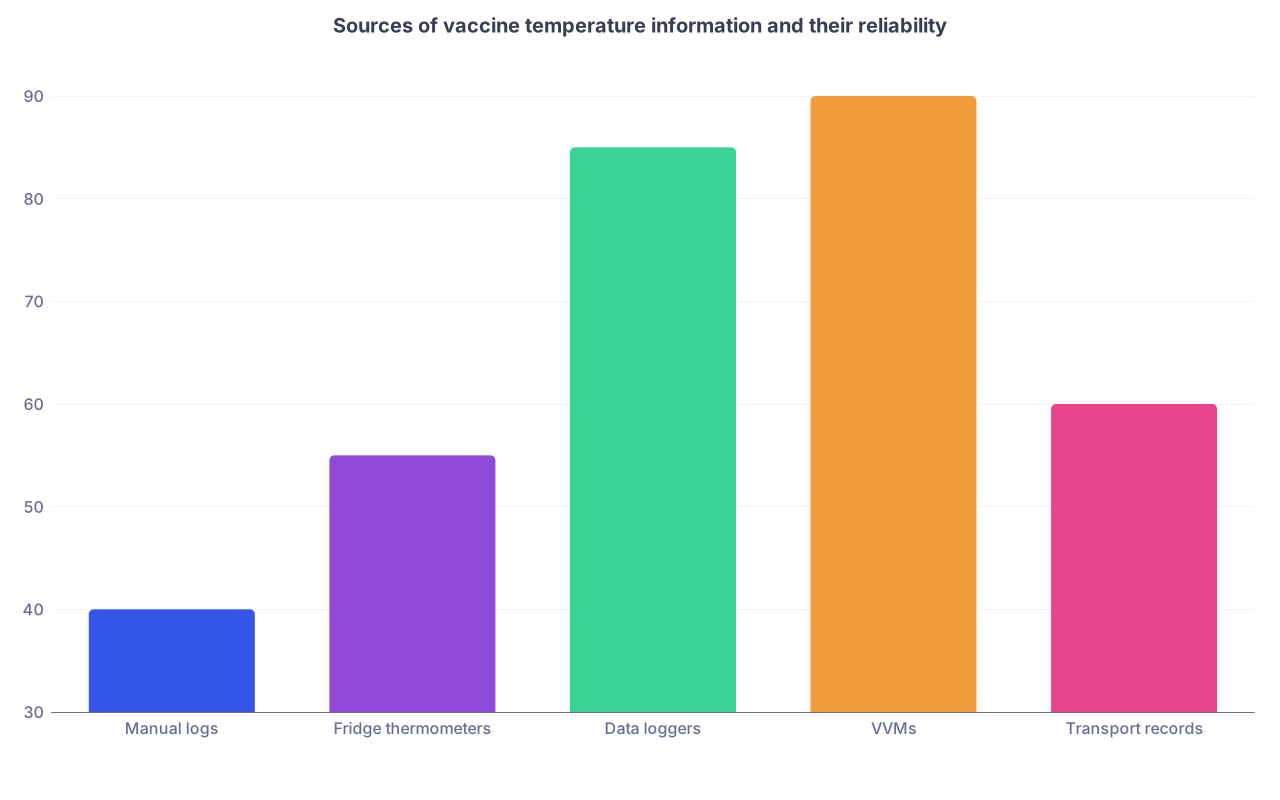
“Warm data” is my shorthand for imperfect, delayed, or missing information on vaccine handling. You never truly know the real thermal history of a single vial. What you have instead are proxies:
- Fridge temperature logs (often filled at the end of the day from memory)
- External thermometers that may never have been calibrated
- Occasional spot checks with data loggers
- VVMs (vaccine vial monitors) on some, not all, vaccines
- Stock records that may “round up” or “round down” inconvenient truths
| Category | Value |
|---|---|
| Manual logs | 40 |
| Fridge thermometers | 55 |
| Data loggers | 85 |
| VVMs | 90 |
| Transport records | 60 |
Those reliability scores are generous. I have seen paper temp charts where all entries are “4°C” for weeks. If you believe that, you have never watched a fridge door that staff open every 10 minutes during a busy outreach preparation day.
The ethical weight of warm data is this:
You, as a clinician, make a claim to your patient—“this vaccine will help protect your child”—based on incomplete evidence that the vaccine is still potent. You import all the published RCT data, the WHO position papers, the national guidelines. Yet those data assume proper storage and handling. Once the cold chain becomes theoretical, the evidence you are invoking is no longer fully applicable.
From a clinical and ethical standpoint, that means:
- Consent may be based on overstated benefit. Parents think they are getting 95% protection; in reality, maybe 40% because half the cold chain was improvisation.
- Surveillance data get distorted. If coverage looks high but cold chain is weak, you interpret “vaccine failures” as biological when they are logistical.
- Trust can be silently eroded. Outbreaks occur “despite vaccination,” fueling anti-vaccine narratives, when the real culprit was persistent unnoticed cold chain breaks.
3. Clinical Implications: What Does a Fragile Cold Chain Do at the Bedside?
Let’s translate logistics into actual clinical consequences, because this is where most trainees completely underestimate the impact.
3.1 Reduced Efficacy and “Phantom Immunity”
If children receive heat-damaged vaccines, three things happen:
- Primary vaccine failure: They never mount adequate immunity despite complete schedules.
- Underestimation of risk: Clinicians reassure families and scale back precautions, assuming population immunity is higher than it actually is.
- Delayed detection of outbreaks: Initial cases are dismissed as “breakthroughs” or bad luck rather than structural system failure.
Clinically, you start seeing patterns like:
- Measles in “fully vaccinated” children from certain villages but not others.
- Tetanus in newborns whose mothers had “two doses” documented—given at outreach sessions in the hottest months.
- Hepatitis B breakthrough infections in adolescents from rural areas with known power issues.
Those cases are not just “rare complications.” They are often cold chain pathology.
3.2 Safety vs Uselessness: Two Different Risk Profiles
Heat exposure usually reduces potency, not safety, for most non-live vaccines. That means you are more likely to be giving “useless” injections than dangerous ones, but that is not ethically benign.
For some live-attenuated vaccines (for example, oral polio vaccine), improper storage can, in extreme circumstances, alter viral viability and rare adverse event patterns, though the main concern is still loss of efficacy.
So clinically you are often balancing:
- Risk of disease from not vaccinating at all, versus
- Risk of disease from giving potentially inactivated vaccine and believing the child is protected.
From a risk-benefit perspective, in high-burden settings, it still makes sense to vaccinate if you believe cold chain is probably intact. But blind faith is not a plan. And once you have evidence of repeated cold chain breaches, continuing business as usual starts to look like negligence.
3.3 Diagnosing Reality: How to Spot a Cold Chain Problem
You will not be given a neat label that says “cold chain failure here.” You have to infer it. Red flags I pay attention to:
- Cluster of vaccine-preventable infections in one geographic area despite documented high coverage.
- Cases linked to specific outreach campaigns or mobile clinics rather than fixed facilities.
- Temperature logs with implausible stability readings (never outside 2–8°C, no variation at all).
- A “too perfect” inventory: no reported wastage, no expired vials, no discards for temp excursions.
- Frequently repaired fridges, off-grid power sources, and no functional backup.
You will never have complete data. But as a clinician in global health, part of your job is pattern recognition at system level. Cold chain failure is a diagnosable condition, even if you never see it on a lab report.
4. Ethical Tension: Beneficence in a System You Do Not Fully Control
Now we get to the ethics that actually bite.
4.1 Are You Obligated to Question the Cold Chain?
Yes. If you are practicing in a setting where cold chain fragility is likely—rural clinics, humanitarian settings, conflict zones, chronically underfunded districts—you do not get to shrug and say, “Supply chain is someone else’s job.”
You are not expected to rebuild the national system. But you are obligated to:
- Ask how vaccines are stored and transported at your facility.
- Look at the actual fridge. Not just the report. Open the door. Check the temperature.
- Request to see temperature logs and ask who is responsible for them.
- Report and act when you see repeated deviations or obviously fabricated data.
Ethically, willful ignorance is not neutral. If you know the system is fragile, you must at least attempt to verify or improve it locally.
4.2 Consent When Evidence is Soft
How do you obtain consent ethically when you suspect the cold chain may be unreliable?
You do not tell parents, “This vaccine might be fake or useless,” because that is not accurate and it will wreck trust. But you also should not overpromise.
A balanced, honest framing in a fragile system sounds more like:
“The vaccine we use here is the same type used around the world and has been shown to greatly reduce the risk of this disease. In our setting, we work hard to store it properly, but things like power cuts can sometimes affect how strong it is. That said, for your child, the benefit of receiving the vaccine is still much greater than the risk of not receiving it.”
You acknowledge system reality without paralyzing action.
4.3 Justice: Who Pays the Price for Cold Chain Failure?
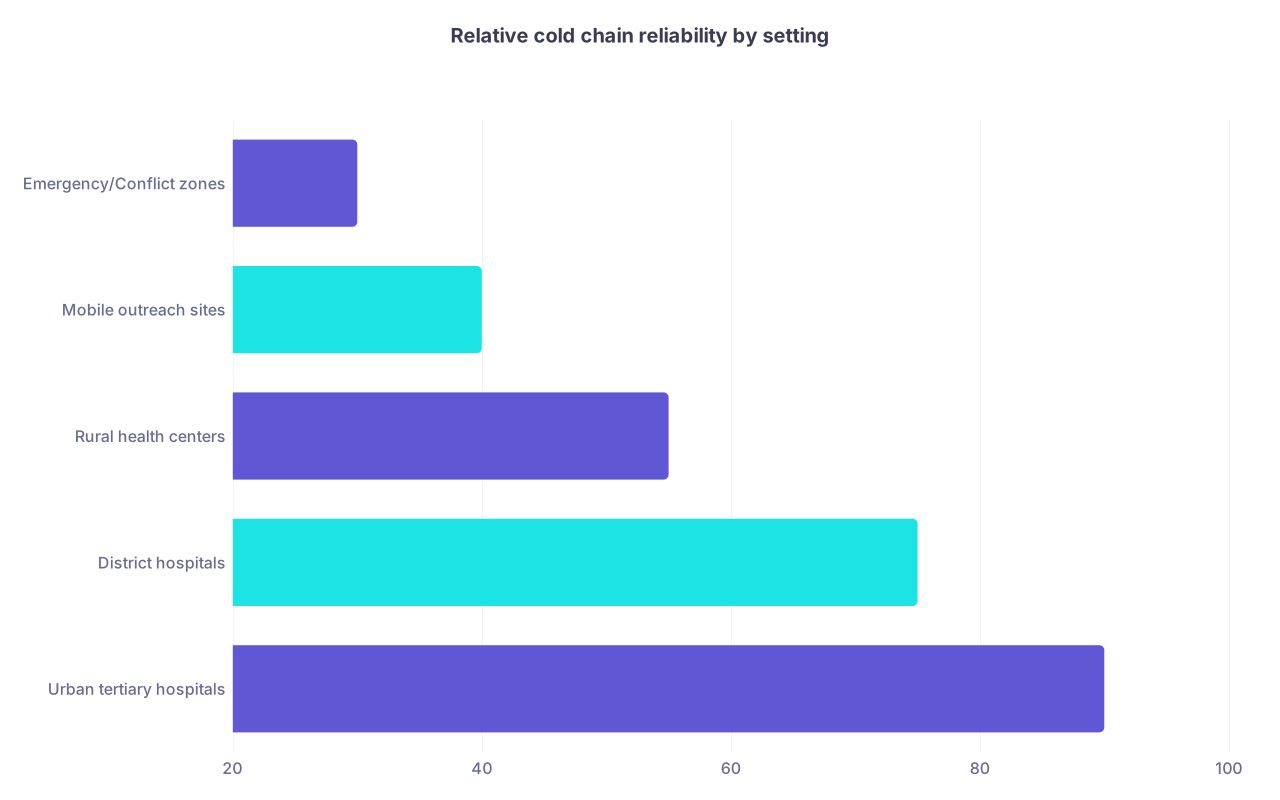
Cold chain fragility is not randomly distributed.
It hits:
- Rural over urban
- Poor over wealthy
- Conflict and climate-vulnerable regions over stable capitals
- Outreach populations over those living next to district hospitals
| Category | Value |
|---|---|
| Urban tertiary hospitals | 90 |
| District hospitals | 75 |
| Rural health centers | 55 |
| Mobile outreach sites | 40 |
| Emergency/Conflict zones | 30 |
Those numbers reflect a pattern I have seen repeatedly. The child in a private urban clinic has an almost perfectly maintained chain. The child in a mountain village gets the same product code, same brand name, same entry in the registry—different reality.
Ethically, this is a justice problem. You are promising equal protection but delivering unequal immunologic reality. It is two-tier immunity, hidden under a single national coverage rate.
5. Your Role as a Clinician: What You Can Actually Do
Let’s get very concrete. You cannot personally fix national cold chain infrastructure. But you are not powerless either.
5.1 At the Clinic Level
Things I expect a serious clinician with global health interest to do:
Physically inspect the vaccine fridge on your first week in a new placement.
Check: current temperature, presence of a working thermometer, how often readings are documented, whether there is a backup power plan.Ask who is the “cold chain focal person.”
If there is no answer, you have found a governance gap that needs filling.Look at the vaccine vial monitors (VVMs) if present.
If you routinely see VVMs close to discard thresholds being used, that tells you about logistics stress.Check stock management.
Are there expired vials? Are opened multi-dose vials properly labeled with date and time? Are discards recorded honestly?
None of this is glamorous. But it is where your ethical practice meets reality.
5.2 During Outreach
Outreach and mobile vaccination sessions are where cold chains go to die if you are not careful.
Some basic non-negotiables:
- Ice packs must be fully frozen before departure. Partial frost is not enough in 40°C ambient temperatures.
- The vaccine carrier lid stays closed except when actively withdrawing vials.
- Multi-hour sessions require a realistic estimate of throughput. Do not carry far more doses than you can use; extra vials will warm up in the carrier all day.
- Monitor time out of the fridge. Some teams use a simple rule: if the carrier has been open and in the sun for more than 6 hours, unused vials return to the fridge only after a temperature check and marked for priority use or discard.
Will you have perfect data? No. But you can prevent the most obvious stupidities—vaccination under direct sun with the box left open “because we are busy.”
5.3 When You Suspect Systemic Failure
This is the hardest part. Suppose you see a measles outbreak in an area with reported 95 percent coverage. VVMs often near cutoff, temp logs garbage, fridges ancient. It is obvious to you that the cold chain is broken.
Ethically, what now?
- Document pattern of clinical cases with vaccination history.
- Raise concerns with district EPI (Expanded Programme on Immunization) officers with specific, not vague, observations.
- Advocate for an external cold chain assessment or use of data loggers to get objective evidence.
- Encourage targeted supplemental immunization activities after cold chain remediation, not as a PR cover-up.
The wrong move is to quietly carry on, telling each parent, “Your child is protected,” when system data and your clinical judgment say otherwise.
6. Warm Data as a Professional Development Challenge
You are not just learning about vaccines here. You are training your ethical reflexes for any situation where the data are incomplete but decisions are high stakes.
This is the real lesson:
- You almost never have perfect information in global health.
- Systems lie, often unintentionally, through bad data.
- Your job is not to be paralyzed by uncertainty, but to act responsibly in it.
Handling warm data around cold chains forces you to grow in several dimensions:
- Epistemic humility – Acknowledging that your “vaccine efficacy” numbers are conditional, not absolute.
- Moral courage – Being willing to question comfortable assumptions and raise inconvenient truths.
- Systems thinking – Seeing illness not just as biology but as the downstream result of infrastructure, logistics, and governance.
- Communication skill – Explaining risk, uncertainty, and benefit without cynicism or sugarcoating.
This is personal development in the only way that matters in medicine: training yourself to be the sort of clinician whose ethics survive contact with reality.
| Problem pattern | Clinician response |
|---|---|
| Implausible temp logs | Ask who logs, retrain, introduce spot audits |
| Frequent power cuts | Advocate for solar backup or ice pack stocks |
| Measles in fully vaccinated kids | Raise suspicion of cold chain failure |
| VVMs often near discard point | Push for better stock rotation, reduce over-supply |
| Outreach in extreme heat | Shorten sessions, more carriers, more ice |
7. The Emerging Tech Temptation (and Why It Does Not Fix Ethics)
You will hear about remote temperature monitoring, smart fridges, solar direct-drive units, RFID tracking. These are useful. I like them. But they do not replace moral responsibility.
High-tech solutions can create a false sense of security:
- Data dashboards that nobody on the ground reads.
- Alerts going to email addresses of staff who left last year.
- “Green” indicators over systems with no fuel for the backup generator.
Technology amplifies capacity, but it also amplifies dysfunction if culture and accountability are weak. Cold chain ethics do not disappear when you add Bluetooth. They just move to a different layer: who responds to the alert when the fridge temperature hits 15°C at 2 a.m. on Saturday?

The core questions remain brutally simple:
- Who owns this fridge?
- Who feels personally responsible if it fails?
- What happens, concretely, when the system records a cold chain break?
If you cannot get straight answers, no amount of sensors will redeem the situation.
8. Ethical Case Scenarios You Should Be Able to Handle
I will give you three compressed cases. If you are serious about this field, you should be able to argue through each one.
Case 1: The Late-Night Power Cut
District hospital, tropical country. Power off for 10 hours overnight, generator failed. Fridge temp this morning is 18°C. Manual logs just say “power cut.” Vaccines include DTP, HepB, measles, and PCV.
Questions you should address:
- Which vaccines might be salvageable? Which clearly not?
- Do you continue immunization sessions today?
- How and to whom do you report the incident?
- How do you document this in case notes for children vaccinated that morning?
The ethically lazy answer is “We cannot afford wastage, just continue as if nothing happened.” The equally lazy opposite is “Discard everything always.” The right answer is more nuanced and relies on national guidelines, vaccine stability data, and transparent documentation.
Case 2: The “Protected” Measles Outbreak
Rural subdistrict reports 20 confirmed measles cases. 17 had documented two doses of measles-containing vaccine. Coverage reports from that area show 95 percent MCV1, 88 percent MCV2. Fridge there is an old aging unit, temp logs always read 4°C.
Questions:
- Do you blame “vaccine failure” or suspect cold chain breakdown?
- How do you investigate without publicly undermining trust?
- What do you tell parents whose children got measles despite being “fully vaccinated”?
- Do you call for an SIAs (supplemental immunization activity), cold chain audit, both, or something else?
If you think this is a purely epidemiologic puzzle, you have missed the ethical heart of it.
Case 3: The Outreach Mission Dilemma
Your team has planned a one-day vaccination outreach to a remote island village by boat. Ambient temp forecast: 38°C. Journey time: 3 hours each way. The facility has one vaccine carrier and limited ice packs that may not stay frozen for the entire day.
Questions:
- Do you proceed with the mission as planned?
- Do you modify the mission (shorter session, fewer doses, splitting trips, additional cold chain equipment)?
- What is worse ethically: delaying outreach or performing it with compromised cold chain?
- How do you frame this to local leaders who have been waiting months for this visit?
This is where the theory of beneficence, nonmaleficence, and justice meets the physics of ice and solar gain.
9. Building Your Ethical Reflexes Around Fragile Logistics
Let me be blunt: if you are serious about global health, you cannot stay at the level of abstract rights talk. You must learn to see ethics in infrastructure. In power lines. In freezer seals. In a pen line on a temperature chart.
A few habits that, over time, separate serious clinicians from dilettantes:
- You physically verify systems rather than trusting reports.
- You treat “coverage rates” as hypotheses, not gospel, when system contexts are weak.
- You default to transparency in documentation—even when nobody is checking.
- You are willing to be the annoying person who asks, “Who is going to respond when this alarm goes off at 3 a.m.?”
And you remember that for the mother sitting in front of you, the ethical question is painfully simple:
“Will this injection actually help protect my child?”
The morally honest answer depends less on your counseling skills and more on a metal box humming in the corner that you rarely look at. You need to start looking.
Because once you learn to see cold chain ethics, you will start seeing the same pattern everywhere—oxygen supply lines, blood bank refrigerators, chemotherapy storage. Warm data over cold metal, with real human consequences.
And that is exactly the kind of vision you will need for the next layer of your career: shaping not just individual clinical encounters, but the systems that make those encounters honest.
But that is a story for another day.


