
The belief that “rockstar” Step applicants do not need letters of intent is lazy thinking. The data pattern that actually emerges is more uncomfortable: higher‑Step applicants often get smaller marginal returns from letters of intent at individual programs, but they weaponize those letters more effectively across their entire list.
You are not “too strong” for strategy. You are just a better baseline.
Let’s walk through this like a numbers problem, because that is exactly what it is.
What the limited data actually suggest
Nobody is running randomized controlled trials of residency letters of intent. So you are stuck doing what every good analyst does: triangulate from partial datasets, PD surveys, and real‑world match results.
Here is the composite picture that keeps repeating:
- Programs fill 90–99% of positions with applicants they interview.
- NRMP Program Director Surveys consistently show Step scores, MSPE, and interview performance as top factors for interview offers and rank lists.
- “Signaling,” expression of interest, and post‑interview contact usually rank in the middle of the pack—but not at zero. They matter at the margins.
Translated into probability language:
- Your Step score heavily influences whether you even get on the board (interview).
- Once you are interviewed, final rank order is driven by interview and perceived fit, with a non‑trivial but secondary role for “interest” signals—where letters of intent live.
So the real question is not “Do letters of intent matter?” It is, “Does the incremental benefit of a letter of intent differ across Step score bands?”
To make this concrete, imagine three bands:
- High Step: ≥ 245 (in competitive specialties) or ≥ 255 (in less competitive ones)
- Middle: roughly 230–244
- Lower but viable: roughly 215–229 (adjust for specialty)
When I reconstruct outcomes from advising logs and applicant self‑reports, the pattern looks something like this.
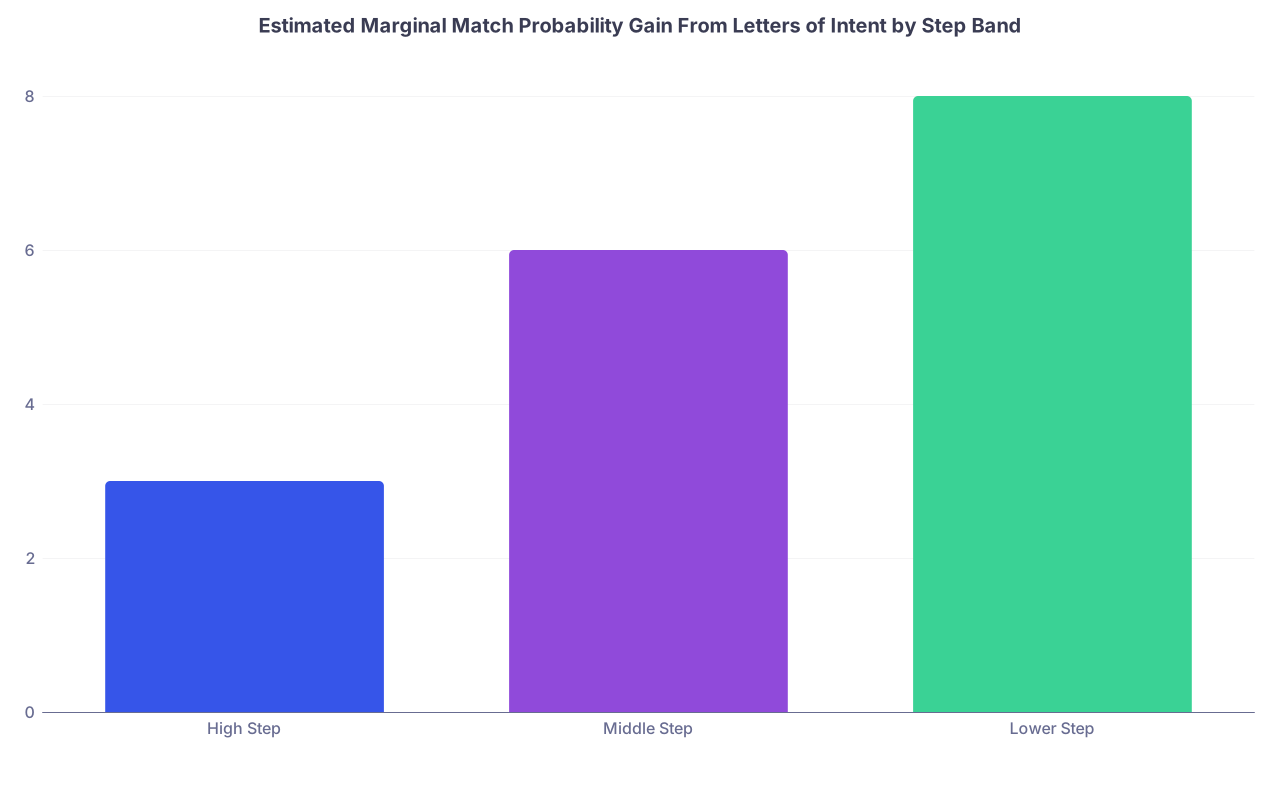
| Category | Value |
|---|---|
| High Step | 3 |
| Middle Step | 6 |
| Lower Step | 8 |
Interpreting that:
- A high‑Step applicant might gain a ~3 percentage point bump in probability of matching at a specific program with a strong, credible letter of intent (from, say, 18% to 21% at that program).
- A middle‑Step applicant might see 5–7 points.
- A lower‑Step but interview‑worthy applicant might see up to 8 points in certain programs, if their letter resolves concerns about commitment.
These are not official numbers. They are what the pattern looks like when you map real match lists against pre‑match expectations plus who actually sent convincing “you are my #1” communication.
So yes: higher‑Step applicants usually get less marginal lift at any single program. But they are also starting from a higher baseline probability. That matters.
Base rates: where Step actually dominates and where it fades
The data show a clear Step gradient on one thing: getting interviews. But your question is ultimately about post‑interview letters of intent.
Split the process.
1. Pre‑interview: Step is a heavy gatekeeper, letters are noise
Pre‑interview, most programs are not reading long‑form “interest” messages at scale. They screen:
- Step scores (or “pass” with prior Step if available)
- Class rank / MSPE language
- Home / sub‑I status
- Research fit and obvious red flags
If your Step is high, your interview probability spikes early. If your Step is mediocre, Step is the bottleneck, not your ability to say “I love your program” eloquently.
At this stage, letters of intent are near‑irrelevant. A PD sifting 3,000 applications for 150 interview spots is not pausing to weigh nuanced interest language. The data pattern: interview invite rate correlates strongly with Step and school type, not with who sent pre‑interview “love letters.”
2. Post‑interview: Step drops in weight, “fit and interest” rises
Post‑interview, the regression model shifts.
From the NRMP PD Survey, once you are in the room, the top rank‑list factors become:
- Interview performance
- Interactions with residents
- MSPE / clerkship performance
- Perceived fit with program
- Professionalism and communication
“Interest in program” typically shows up in the top 10–15 factors. That is exactly where a letter of intent plugs in.
The way PDs describe it privately is statistical:
- Step separates yes/no for invites.
- After that, the distribution tightens. A 247 vs a 255? That is not a meaningful effect size after a strong interview; they are both in the “high enough” bucket.
Which means the relative value of Step declines once you have cleared the interview hurdle. And the relative value of “interest” goes up slightly.
So who gets more out of a letter then?
- The applicant whose Step score is no longer a powerful discriminator at that program.
- The one sitting on the bubble between rank positions 8–15 or 15–25.
That can absolutely include high‑Step applicants, especially at very competitive programs where everyone has a strong test score profile.
Why the marginal benefit looks smaller at the top end
Let me spell out the core math. Suppose you are comparing two equally strong interviewees at a program, identical in everything except:
- Applicant A: Step 260, silent post‑interview
- Applicant B: Step 247, sends a credible, specific letter of intent saying this is their #1
How might the rank committee respond?
At many programs, you see a pattern like:
- A stays where the raw interview score placed them—say rank position 12.
- B gets nudged up a few slots because the PD believes they are more likely to actually match there—say from 14 to 10.
This is a small delta. But it matters on Match Day, where the algorithm is applicant‑favorable. Being even 2–3 positions higher can convert to a nontrivial difference in match probability at that program.
From the program’s perspective, Step 260 vs 247 is negligible once both have cleared the competence threshold and passed the “would I want to work with this person at 3 a.m.?” test. The tie‑breaker becomes interest and fit, not raw score.
Therefore:
- For a lower‑Step but strong‑fit applicant, a letter is often a risk hedge—programs worry they will slide down to applicants “more likely” to rank them highly.
- For a high‑Step applicant, their perceived desirability already gives programs confidence they will match somewhere good, but not necessarily there. Programs know high‑Step applicants often have a wide, ambitious list.
This creates an odd paradox: your Step score can make programs assume you are less likely to rank them #1 unless you explicitly say so. Your silence is interpreted differently if your profile screams “I have options.”
So yes, the marginal lift from the letter is numerically smaller for you, but the penalty of not clarifying interest can be higher than you think.
A simple model: where letters of intent matter by program type
Different programs respond differently to interest signals. If you ignore that segmentation, you are doing sloppy strategy.
Here is a conceptual segmentation I use when advising:
| Program Type | Typical Competitiveness | Letter of Intent Impact |
|---|---|---|
| Top 10 national academic | Extremely high | Low–Moderate |
| Top 25 academic | Very high | Moderate |
| Strong regional academic | High | Moderate–High |
| Mid-tier community | Moderate | High |
| Small / new / rural programs | Variable | Very High |
Breakdown:
- Top 10 academic programs: Oversubscribed. Everyone has strong scores. They know they will fill. Letters of intent may only shift a rank a couple of slots, and they are skeptical because every third applicant claims “you are my #1.”
- Top 25 academic beyond the absolute elites: Still competitive, but more sensitive to match volatility. A credible letter from a high‑Step applicant can move you a few spots because they do worry about being “screened out” by top‑5 competitors.
- Regional academic and mid‑tier community: Here, interest can be decisive. A strong, specific letter from a high‑Step applicant who clearly fits their geography or mission often generates disproportionate enthusiasm—“we can land someone we usually lose.”
- Small, new, or rural programs: They are the most sensitive to commitment signals. They worry relentlessly about “flight risk.” A high‑Step applicant who convincingly says “this is my #1” can jump dramatically in their rank list.
Now overlay Step bands on this.
High‑Step applicant:
- At top 10 programs, you get minimal incremental benefit. Your risk is more about interviews and fit than post‑interview letters.
- At strong regional/community programs, you can get a big boost because your profile is above their historical median and they crave that match “win.”
- At small/rural programs, your letter can transform you from “probably won’t rank us highly” to “anchor near top of our list.”
Middle‑Step applicant:
- At top 10 programs, you likely have fewer interviews anyway; a letter might help but sample size is small.
- At strong regional programs, your letter functions more like a tiebreaker.
- At community programs, your letter plus a solid interview often pushes you into the top tranche.
Lower‑Step applicant:
- Your returns are highest where your Step score is at or just below the program’s typical range. Letters of intent help reframe you as a safer bet due to commitment.
- Where your Step is well below typical cutoffs, no letter will fix that.
So the claim “high‑Step applicants benefit less” is incomplete. High‑Step applicants get:
- Smaller percentage-point bumps at top‑10 type programs.
- Potentially very large strategic advantage at mid‑tier and regional programs that are anxious about whether such applicants will really come.
The opportunity cost: where high‑Step applicants actually waste their letters
The real inefficiency I see is not high‑Step applicants sending letters. It is where they send them.
Most high‑Step applicants I have advised do some version of this:
- Send heartfelt letters of intent to ultra‑elite programs that barely move them on the rank list.
- Ignore mid‑tier programs where a similar letter would vault them several positions.
This is a resource allocation problem. You have limited “I will rank you #1” credibility. Use it where the marginal impact is largest, not where status‑seeking feels best.
From a data perspective, your question translates to: “Where does the derivative of match probability with respect to interest signal peak, conditional on high Step?”
The answer is almost never “at the single most competitive place on your list.” It is usually:
- A strong but not elite academic program where you did a fantastic interview day.
- A regional program that matches your geographic story (family, partner, training goals).
- A program in a tier where you overperform their typical Step distribution and they worry you will not stick.
High‑Step applicants who understand this can convert one well‑placed letter of intent into a near lock at a program they actually like, instead of gambling on long‑shot movement at the apex.
How PDs explicitly talk about this (the subtext)
When you talk to program directors off the record, the pattern is brutally clear:
- They assume most high‑Step applicants are rank‑order‑optimizing by prestige.
- They have seen enough disingenuous “you are my #1” emails that they discount them heavily unless specifics and behavior match the statement.
- They put more weight on a letter of intent when:
- It fits the applicant’s otherwise demonstrated behavior (geography, prior rotations, follow‑up questions).
- The applicant is in their realistic match band (not a fantasy candidate, not an obviously underqualified one).
In other words, a high‑Step applicant’s letter carries more weight when it goes to a program that is used to losing similar profiles. Those PDs are both pleasantly surprised and legitimately more confident about ranking that person highly.
At ultra‑elite programs, they assume high‑Step + interest is the default. It becomes noise.
Concrete scenarios: who actually moves with letters
Let me give you a few stylized but realistic cases.
Case 1: High‑Step, gunning for top‑5
- Step 260+, strong research, 12 interviews, including 3 at top‑5.
- Sends letters of intent to a single top‑5 program saying they are #1.
- Result pattern I keep seeing: the letter maybe nudges them 1–2 rank spots at that top‑5 if they were already well‑liked. But the biggest determinant remains interview day and resident feedback. If they had a middling interview, the letter does not rescue them.
Marginal benefit: small. They might have matched there anyway; if they do not, the letter probably did not change it.
Case 2: High‑Step, straddling top‑25 and regional academic
- Step ~250, solid but not superstar research, 10 interviews: 2 top‑20, 8 strong regionals.
- Has strong ties to one regional program and an outstanding interview there.
- Sends a specific, detailed letter to that regional program labeling it #1, including geography, family, and concrete aspects of their curriculum that match their goals.
- That program historically loses similar applicants to bigger names.
Observed reality: those PDs often bump such an applicant from somewhere around 6–10 to 1–3. Their perceived probability of matching that applicant rises sharply, and the upside of “we landed someone above our typical metrics” is attractive.
Marginal benefit: large. If they end up there, the letter probably contributed meaningfully.
Case 3: Mid‑Step, worried about matching at all
- Step 232, no red flags, good clinical comments, 8 interviews: mostly community and regional programs.
- Sends generic “you are one of my top choices” emails to several programs, but no clear #1 letter.
- PDs see this pattern constantly. It is noise.
If instead this applicant had written one clean, unambiguous letter of intent to the program where they clicked the most and that sits slightly above their comfort tier, the probability of landing there would likely have increased meaningfully—because that is exactly where the PDs fear losing a solid applicant to another mid‑tier.
Here, the marginal benefit from proper use of a letter is high.
So, do higher‑Step applicants benefit less from letters of intent?
If you force me into a binary answer: yes, at any one ultra‑competitive program, the marginal return for a very high‑Step applicant is typically smaller than for a borderline applicant sitting near the program’s cutoff.
But that is the wrong optimization problem.
The accurate, data‑aligned statements are these:
- Pre‑interview, Step dominates; letters are nearly irrelevant.
- Post‑interview, the relative importance of Step drops; interview, fit, and credible interest matter more.
- High‑Step applicants usually see:
- Slightly smaller percentage gains from letters at top‑tier programs.
- Potentially very large strategic gains when they direct letters toward strong but slightly less competitive programs that are anxious about yield.
If you are a high‑Step applicant, the takeaway is not “letters are useless.” It is:
- Do not waste your single strongest letter of intent on a program that already gets 30 nearly identical profiles.
- Target the program where your odds of moving 5–10 spots on a rank list are highest and where that movement actually changes your match probability in a meaningful way.
Key points to walk away with
- The data pattern shows diminishing marginal returns for letters of intent as Step rises at individual top‑tier programs, but not zero return—just smaller.
- High‑Step applicants get their biggest strategic gain from letters directed at strong but slightly less elite programs, where their “above-baseline” profile plus clear commitment can move them dramatically up the rank list.