
You’re sitting at your desk staring at a polished letter of intent to your top residency program. The wording finally feels right. You’ve checked the program director’s name five times. Your cursor is hovering over “Send.”
And then you pause:
“Do I need to run this by my advisor first… or can I just send it?”
Here’s the answer you’re looking for.
Short answer: No, you usually do NOT need advisor approval
You do not need formal “approval” from an advisor before sending a letter of intent. There is no ERAS rule, NRMP rule, or universal program policy that says, “A faculty advisor must sign off before you email a program director.”
Programs do not ask, “Did your advisor approve this?”
They care about three things:
- Are you professional?
- Are you honest?
- Does your message add value or clarity to them?
That said, skipping all feedback is often a mistake. You do not need approval, but you will usually benefit from a quick review by someone experienced.
So the real question is not “Do I need permission?”
The better question is “When is it smart to get feedback, and when can I safely send it myself?”
Let’s break that down.
What programs actually care about in a letter of intent
Before talking advisors, you need to know what’s at stake.
A letter of intent (LOI) is basically you saying:
- “You’re my top choice” (or close to it), and
- “If you rank me highly, I will rank you highly.”
Programs use that information in three main ways:
- To clarify your interest when they’re on the fence about where to place you on the list.
- To distinguish between “generic thanks” and “this person is truly signaling us.”
- To check consistency: does what you’re saying now match what you said on interview day?
They’re not scanning for advisor names in the CC line. They don’t expect an attached endorsement letter. They’re judging you on clarity, professionalism, and integrity.
If your letter:
- Is concise (1 page or less, usually 3–6 short paragraphs),
- States your intent clearly,
- Aligns with what they know about you,
- Does not violate NRMP rules (i.e., does not ask them how they’re ranking you),
then it’s “good enough” on the program side.
That’s the bar you actually need to clear.
When you should absolutely get an advisor to review it
You don’t need sign-off. But there are situations where sending without feedback is just asking for trouble.
Here are the times I strongly recommend getting a quick advisor review:
You’re ranking in a politically sensitive way.
Example: You’re from Program A’s home institution but sending a letter of intent to a direct competitor across town (Program B). That can create awkward department politics. An advisor (especially in your specialty) will know how to phrase your interest without burning bridges.You’re doing something unusual or risky.
- You want to send strong intent to two programs (bad idea, but people try).
- You changed your mind late and want to “switch” your top choice.
- You had a prior professionalism concern or SOAP history and are addressing it directly.
Those situations need careful wording. An advisor has almost certainly seen it before.
You’ve never written an LOI and your first draft sounds like a personal statement.
I’ve seen students send 900-word “manifestos” or vague “I really liked your program” emails with no clear commitment. An advisor can cut this down to appropriate length and tone quickly.You’re applying to a highly political or small specialty.
Think derm, plastics, ENT, ortho in certain regions, competitive fellowships, or hyper-connected subspecialties. People talk. The style and timing of letters matters more, and your advisor likely knows local norms.You’re already stretched thin or burnt out and not thinking clearly.
If you’re post-call, post-ICU month, or in the middle of a family crisis, your ability to judge tone and nuance isn’t at its best. Have someone glance at it.
In those scenarios, a 10-minute advisor review can save you from sending something:
- Overly emotional,
- Over-promising,
- Or politically messy.
When you probably do NOT need advisor approval
There are also plenty of cases where you’re fine to send without looping in anyone.
You likely do not need advisor review when:
You’re sending a single, clear LOI to your true #1 program.
Your draft:- Clearly states they are your top choice,
- Mentions 2–3 specific program features that matter to you,
- Connects those to your goals,
- And closes professionally.
If it reads like a normal, respectful, error-free email, you’re probably good.
You’re sending a brief “update + strong interest” email, not a full LOI.
Example: “I remain extremely interested in your program and wanted to share a recent publication / award / rotation feedback.” That’s low-risk.Your school or department has already given you a template.
Many deans’ offices or specialty advisors give sample LOI formats. If you’ve followed that structure closely and kept your content honest, you don’t need three more layers of approval.Your advisor is unresponsive and time is tight.
I see this a lot:- You email your advisor a draft.
- It’s 3–5 days before rank list certification.
- No response.
If your letter is reasonable, do not hold it hostage waiting. Programs do not need a perfectly optimized LOI on day 1; a good-enough LOI on day 5 is fine.
How to decide in 30 seconds: advisor or just send?
Use this quick mental decision tree.

| Step | Description |
|---|---|
| Step 1 | Have LOI draft ready |
| Step 2 | Get advisor review |
| Step 3 | Send it |
| Step 4 | Is this a single clear LOI to true 1? |
| Step 5 | Any politics or unusual issues? |
| Step 6 | Does email sound professional and honest? |
If you answer:
- “Single clear LOI to #1?” → Yes
- “Any politics, weirdness, or big red flags?” → No
- “Professional, honest, specific?” → Yes
Then send it.
If you hit any “No” or “This is complicated,” involve an advisor.
What “advisor approval” should (and should not) look like
Advisor involvement should be light and surgical, not a full rewrite of your personality.
Reasonable advisor input:
- Fixes clarity and tone: “Cut this sentence, it sounds desperate.”
- Highlights professionalism issues: “Don’t mention how much you hated another program.”
- Corrects factual risk: “Don’t promise you’ll rank them #1 if you’re actually not sure.”
Unreasonable advisor control:
- Forcing you to declare a different #1 than your actual top choice.
- Insisting on sending letters for you, from their email, when you want it to come from you.
- Refusing to “approve” anything that is not their exact preferred wording.
This is your match. Your rank list. Your reputation.
Use advisors as guides, not puppet masters.
If your advisor is trying to override your genuine preference (“You have to rank our home program #1”) that’s politics, not professionalism. You can thank them for their perspective and still send a truthful letter reflecting your real choice.
Common advisor-related mistakes with letters of intent
I’ve watched these play out too many times:
Waiting forever for feedback and missing the useful window.
LOIs are most impactful:- After interviews,
- Before rank list certification,
- With enough time for the PD to actually read and remember it.
If you spend 3 weeks in “draft purgatory” with three different people editing, the timing becomes an issue. Perfectionism here is overrated.
Letting multiple editors dilute your voice.
You show the letter to an advisor, a co-resident, your cousin who’s a lawyer, and someone on Reddit. You incorporate all their suggestions. Now it sounds like a committee wrote it. Programs can smell that.Pick 1–2 trusted reviewers at most. Not five.
Sending different “You’re my top choice” messages without telling your advisor.
This is an ethics problem, not a style problem. Some students quietly send LOIs to two or three programs and don’t tell anyone because they know it’s wrong.
If you’re hiding your strategy from your advisor, that’s a sign the strategy is bad.Over-disclosing internal politics.
Do not say:
“My home program PD doesn’t support my application, so I’m desperate to match somewhere else.”An advisor would stop this in a heartbeat. Programs don’t want to hear your department drama.
A clean template you can use (with or without advisor review)
Keep your LOI brutally simple. Here’s a skeleton that works in almost every specialty:
Subject: Letter of Intent – [Your Name], [Specialty] Applicant
Dear Dr. [Program Director Last Name],
Thank you again for the opportunity to interview with the [Program Name] [Specialty] residency program on [date]. I greatly enjoyed meeting the faculty and residents and learning more about your training environment.
I am writing to let you know that [Program Name] is my first choice for residency, and I intend to rank your program #1.
My experience on interview day reinforced how strongly your program aligns with my goals in [specific interest – e.g., academic cardiology, community-focused primary care, physician-scientist training]. I was particularly impressed by [1–2 specific features: e.g., your [X] clinic, [Y] curriculum, [Z] research mentorship, sense of resident camaraderie]. I believe the combination of [A + B + C] would provide an ideal environment for my development as a [future role].
Thank you again for your time and consideration. I would be honored to train at [Program Name].
Sincerely,
[Your Name, Degree]
AAMC ID: [#######]
[Medical School]
An advisor can tweak this. But if your draft looks close to this and is honest, you are already in safe territory.
How to handle it if your advisor disagrees with sending
Sometimes students do the right thing—seek feedback—and then get stuck because the advisor says, “I wouldn’t send this.”
Here’s how to handle that like an adult:
Ask for specifics.
Not “I don’t like it,” but “Which sentence or claim feels off?” Fix those, not everything.Clarify the disagreement.
Is the disagreement:- About ethics (e.g., you’re promising something you won’t do)? Then listen.
- About strategy (which program you choose as #1)? That’s your call in the end.
Consider a compromise.
Example:
You want to say: “You are my only top choice.”
Advisor suggests: “You are my first choice.”
Same meaning, less dramatic. Easy fix.Own the final decision.
If you’ve heard the feedback and still believe your version is truthful and professional, it is reasonable to send it anyway. You can say, “I appreciate your perspective and made some edits. I’m comfortable with this version.”
Remember: Match consequences fall on you, not your advisor.
Quick comparison: self-send vs advisor-reviewed
| Aspect | Self-Sent LOI | Advisor-Reviewed LOI |
|---|---|---|
| Speed | Fast | Slower |
| Risk of tone issues | Higher | Lower |
| Political awareness | Lower | Higher |
| Authentic voice | Often higher | Can be diluted |
| Best for | Simple, single true #1 | Complex or sensitive cases |
Timeline: when to draft, get feedback, and send
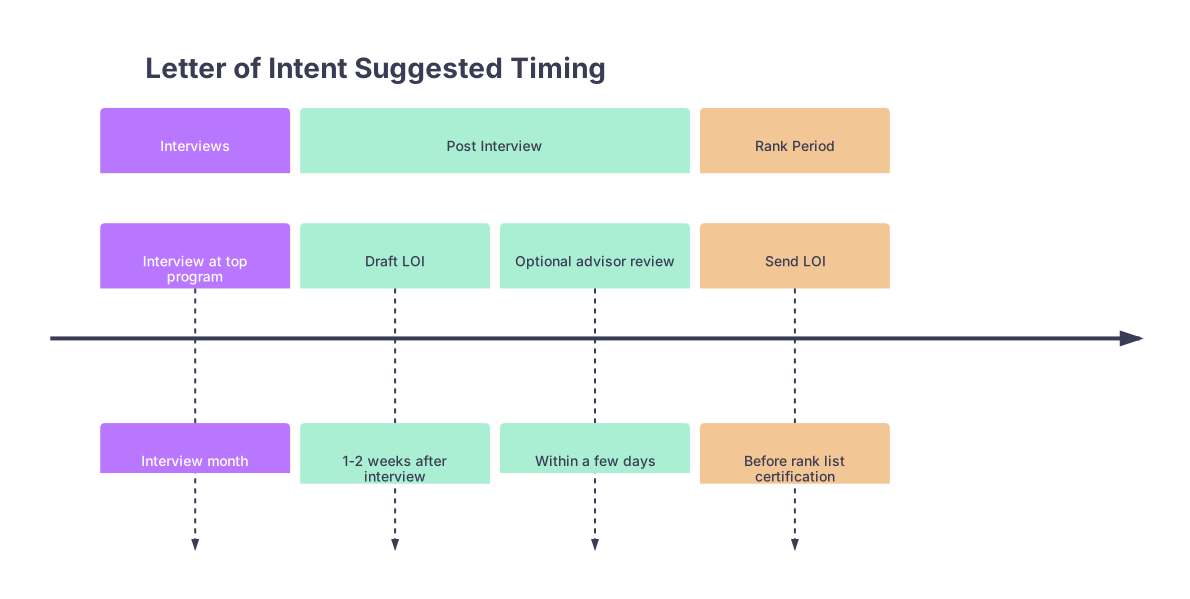
| Period | Event |
|---|---|
| Interviews - Interview at top program | Interview month |
| Post Interview - Draft LOI | 1-2 weeks after interview |
| Post Interview - Optional advisor review | Within a few days |
| Rank Period - Send LOI | Before rank list certification |
If you’re already within a week of rank certification and you have a decent draft, do not overcomplicate it. Minor wording tweaks will not make or break your chances.
FAQ: Advisor Approval and Letters of Intent
1. Will a program expect my advisor to be CC’d or mentioned in my letter of intent?
No. Programs expect an LOI to come directly from you to the program director or coordinator. CC’ing advisors is optional and rarely necessary. Unless your advisor specifically asks to be copied (and you’re comfortable with that), send it directly.
2. Can I send a letter of intent without telling my advisor at all?
Yes. There is no rule that says you have to inform your advisor. Strategically, though, it’s usually smart to tell at least one mentor what you’re doing—especially in small specialties—so they are not blindsided if program directors talk. If your advisor is very controlling or unsupportive, you’re not obligated to run every move by them.
3. My advisor does not believe in letters of intent and says they’re pointless. Should I still send one?
If your advisor personally thinks LOIs don’t matter, that is a preference, not a law. Many program directors say LOIs can influence fine-tuning the rank list when they already like you. I’d still send a concise, honest LOI to your true #1. Just don’t expect it to magically move you from the bottom quarter to #1; it’s a tiebreaker, not a rescue device.
4. What if my advisor wants to send a “behind-the-scenes” email instead of me sending a letter of intent?
An advisor or chair sending an advocacy email can be powerful, but it’s not a replacement for you expressing your own intent. Ideally you have both: your personal LOI plus a brief advocacy note from a faculty member. If they offer to email a PD, great—say yes—and still send your own professional, direct LOI.
5. Is it ever okay to send more than one letter of intent if my advisor says different programs expect one?
No. You should not promise multiple programs they are your “first choice” or that you will rank them #1. That’s a straight-up integrity problem. You can send strong interest or update letters to multiple places, but one true LOI to one true #1. If your advisor encourages breaking that norm, I’d push back.
6. My advisor still has not replied and I’m running out of time. What should I do today?
Stop waiting. Read your letter out loud once. Confirm:
- It states one program is your first choice,
- It includes 2–3 specific reasons,
- It’s under a page,
- There are no grammatical errors or emotional oversharing.
Then send it.
Today’s action step: Open your draft (or start one using the template above), trim it to 3–6 focused paragraphs, and decide—based on the decision flow—whether you truly need advisor input. If the answer is no, put a time on your calendar today to send it.