
Nobody is blacklisting you because you did not send a letter of intent. The myth that “no LOI = automatic drop down the list” is residency folklore, not reality.
You’re being sold anxiety. By older residents who “heard from someone at my program,” by Reddit threads recycling the same anecdotes, and by consultants who make money convincing you every unsubstantiated tradition is life-or-death.
Let me be blunt: program directors are busy trying to rank hundreds of applicants while running clinical services, dealing with accreditation, fighting for funding, and putting out fires daily. They do not have the time—or incentive—to maintain some secret blacklist of people who did not send extra emails.
Let’s walk through what actually happens, what the data show, and where the line is between useful communication and superstition.
How PDs Actually Build Rank Lists (Not the Fantasy Version)
If you want to understand whether “no LOI” hurts you, you have to understand how PDs actually sort applicants.
The basic pipeline is boringly consistent across specialties:
- Applications screened (scores, school, experiences, obvious red flags).
- Applicants selected for interview.
- After interviews, faculty score or comment on candidates.
- PD + selection committee meet, argue, and gradually build a rank list.
- Rank list gets uploaded. People go back to their actual jobs.
Notice what’s not in there: “Cross-reference list of applicants who didn’t send LOIs and drop them 20 spots.”
Most programs use some combination of numeric scoring and qualitative discussion. Typical factors:
- Interview performance and “fit”
- Letters of recommendation
- Board scores / exams
- Clerkship performance
- Research / CV alignment with program strengths
- Home / away rotation performance
- Known mentors or trusted recommenders vouching for you
Post‑interview emails—letters of intent, letters of interest, “you’re my top choice” novels—are at best secondary modifiers. For many PDs, they’re background noise.
How do I know? Because PDs have been telling us this for years in surveys and panel discussions.
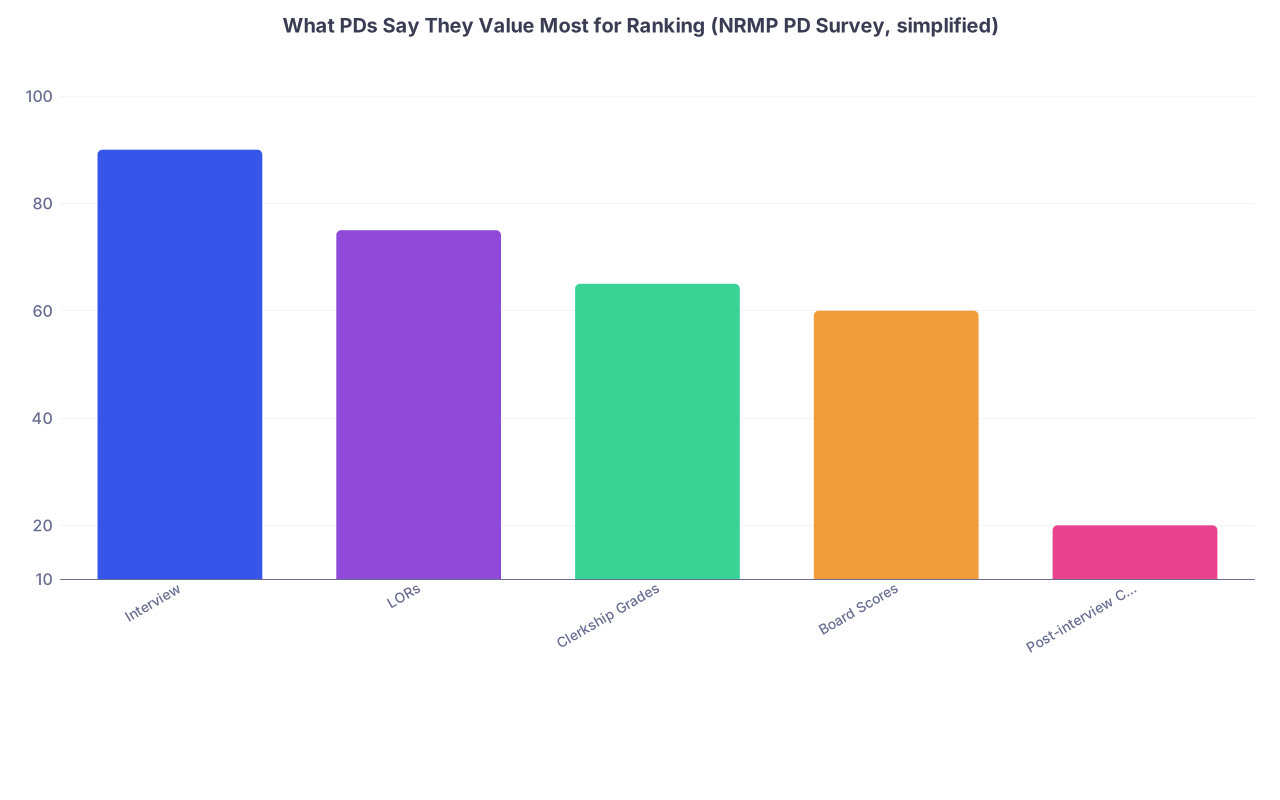
| Category | Value |
|---|---|
| Interview | 90 |
| LORs | 75 |
| Clerkship Grades | 65 |
| Board Scores | 60 |
| Post-interview Communication | 20 |
This is a simplified representation of trends from multiple NRMP Program Director Surveys. The proportions vary by specialty, but the ranking of what matters does not: interview, letters, and performance dominate. Post-interview communication sits at the bottom.
Some PDs explicitly ignore LOIs; some skim them but do not systematically factor them in; a minority actually track them carefully. But “track carefully” is still not “punish you for not sending one.”
The big point: the absence of an LOI usually doesn’t even register as a data point.
The Blacklist Myth: Why It Sounds Plausible but Falls Apart
The myth usually sounds like this:
- “At my program, if you don’t send an LOI, they assume you’re not serious.”
- “My chief told me PDs expect a letter if you’re interested.”
- “I heard from a friend that a PD said, ‘If they really wanted us, they’d tell us.’”
People confuse “can matter a little at the margins” with “catastrophic if you don’t do it.”
Here’s what’s actually going on in those stories:
Selection bias. You only hear intense stories from people who matched or catastrophically didn’t. The thousands in the middle who matched without ever sending a letter? They’re not posting 2,000‑word threads about how they…did nothing extra and it was fine.
Post-hoc storytelling. Someone doesn’t match. They go hunting for a reason. What’s easier to swallow—“my interviews weren’t as strong as I thought” or “I didn’t play the LOI game right”?
Residents overestimating PD attention. Senior residents love to sound plugged‑in to PD thinking. They see a couple of emails move a candidate a few spots and generalize that into some universal doctrine. But they rarely see all the factors in the room when the list is built.
One-off PD quotes treated like policy. A PD saying in a casual hallway conversation, “If someone tells me we’re their #1, I might bump them a few spots,” turns into: “If you don’t send a #1 email, you’re toast.”
Different thing.
What the Data and PDs Actually Say About LOIs
Let’s stick to evidence instead of legends.
From the NRMP Program Director Survey and multiple specialty-specific surveys, we know:
- Many programs don’t track post-interview communication in any structured way.
- Of those that “consider” it, it’s usually framed as a tie‑breaker, not a core criterion.
- PD panels repeatedly emphasize: do not spam, do not play games, do not send disingenuous “you’re my #1” emails to multiple programs.
I’ve heard PDs say variations of:
- “If someone writes a thoughtful note, I remember them more clearly. But if they don’t write, I don’t hold it against them.”
- “I’ve never once said, ‘Drop them because they didn’t send a letter.’ That’s absurd.”
- “Honestly, most LOIs say the same thing. We glance, maybe nod, and move on.”
Some even actively dislike the whole LOI culture. They see it as pressure, noise, and ethically messy. Especially since NRMP Match rules prohibit programs and applicants from soliciting or requiring rank commitments.
So are there any programs where it might hurt not to send something?
Sure. Occasionally:
- Small, hyper‑relationship‑driven programs where they interpret silence as lack of interest.
- Niche specialties (think very small fields) where everyone knows everyone and explicit interest signals can matter more.
- Programs whose PDs are outspoken about wanting to hear if you will really come.
But even in those places, not sending a letter is not a “blacklist” event. It is, at most, a modest negative if they’re trying to decide between you and someone else who looks nearly identical on paper and told them “You’re #1.”
That’s not a blacklist. That’s human psychology.
Where LOIs Actually Matter (A Little) vs Where They Don’t
Let’s separate signal from static.
Where a Letter of Intent Can Help
A well‑targeted, honest LOI can help at the margins when:
- You have a clear, specific connection to a program (geography, family, research niche) and you articulate it well.
- The program is mid‑range on your list but you would absolutely come if you matched there, and you want to be sure they don’t assume they’re your “safety.”
- You had a genuinely standout interaction—with a resident, faculty, PD—that you reference specifically. It affirms fit, not just flattery.
- You’re on the cusp: your application is decent but not amazing for that program’s usual stats, and any extra sign of commitment may tip them from “rank low” to “rank reasonably.”
Notice the pattern: LOIs are mostly tie‑breakers, memory joggers, or soft nudges. They do not convert a weak interview into an elite ranking. They don’t rescue glaring red flags. They don’t override faculty saying, “I’d rather not work with this person for three years.”
They’re seasoning. Not the dish.
Where a Letter of Intent Does Almost Nothing
You can send the best‑crafted LOI on Earth and it will not:
- Save you from a bad interview where you came off arrogant, unprepared, or weirdly disengaged.
- Beat out a candidate who rotated with them, crushed the service, and has three internal champions.
- Override a serious professionalism concern or sketchy past event.
- Turn a program that doesn’t have enough CS/Neuro/whatever into your “research dream home” just because you say you’ll rank them #1.
Also: mass emails don’t move anyone. Generic content? PDs spot it. They’ve seen “Your program is my top choice because of your commitment to clinical excellence and diverse patient population” about 2,000 times.
They shrug and move on.
So Does NOT Sending an LOI Hurt You?
Here’s the straight answer:
For the vast majority of programs, not sending an LOI does not hurt you at all. You will not be blacklisted. You will not be auto‑dropped. You will blend into the default pool of interviewed applicants who get ranked on the usual criteria.
Where your silence might matter a tiny bit:
- Programs trying to guess who will actually show up if they match you.
- Very small or highly competitive programs where they’re splitting hairs between candidates and are sensitive to perceived interest.
- Situations where you explicitly promised to send more info or follow up—and then ghost. That’s not LOI‑specific; that’s reliability.
Let me be even more concrete.
| Program Type / Situation | Effect of No LOI |
|---|---|
| Large academic IM program | Essentially none |
| Mid-size community program | Usually none, maybe tiny effect at margins |
| Small, very competitive niche (e.g., Derm) | Slight potential negative vs. similar peers |
| Your home program where they expect engagement | Small effect if they perceive disinterest |
| Program stating “we don’t consider LOIs” | No effect |
Even in the places where it might matter, we’re usually talking about moving a few slots up or down a list. Not flipping from “match” to “no chance.”
The bigger truth: your interview day and application content overwhelmingly dwarf the impact of whether you did or didn’t send a follow‑up email.
The Real Thing PDs Do “Blacklist” You For
If you want to worry about something, worry about the things that actually get you quietly tanked:
- Lying or playing games with multiple “you’re my #1” LOIs that somehow all get back to the PD circle.
- Weird, inappropriate, or hostile communication—yes, people still send unhinged emails.
- Breaching Match rules by implying guarantees, pressuring programs, or trying to negotiate in shady ways.
- Major unprofessionalism on interview day or during rotations.
PDs may not care whether you sent an LOI. But they absolutely care if you’re dishonest or high‑maintenance before you’re even a resident.
Sending no LOI is safer than sending a manipulative or obviously templated one to twenty programs claiming each is “my top choice.”
The “blacklist” story is backwards. You are more likely to hurt yourself by how you write and how many programs you mislead than by not writing at all.
A Sane Strategy for Letters of Intent
So how do you play this without being naive—and without feeding the paranoia machine?
Here’s a rational, evidence‑aligned approach:
Decide if you truly have a #1. If there is one program where, honestly, you would rather match than anywhere else, that is the only place that deserves an actual “you are my #1” LOI.
Write a short, specific, honest note. 3–5 tight paragraphs. Why their program, specific features, how you see yourself there, and a clear, non‑manipulative line: “Your program is my first choice, and I will be ranking you #1.”
Optionally, send a few interest notes. Not “you’re my #1.” Just: “I really enjoyed my interview, I can see myself training here, your X/Y/Z aligns with my goals.” Again, specific, not copy‑paste mush.
Stop there. Do not write everyone. Do not panic if your friend sends more emails. That’s their anxiety, not your problem.
Then trust your interviews and application. Because that’s what actually carries you.
And if you do not send any LOIs at all? You’re not sabotaging yourself. You’re just opting out of a low-yield, high‑stress game that PDs themselves often roll their eyes at.
The Future of LOIs: More Noise, Less Power
There’s a reason a lot of PDs quietly hate LOIs: as more applicants send more messages, the signal‑to‑noise ratio collapses.
We’re already at the point where:
- Programs get flooded with nearly identical “You’re my top choice” claims.
- Some PDs now ignore all post‑interview communication entirely to stay sane.
- Others draw a hard line: “We do not accept or consider letters of intent.”
If anything, the culture is shifting toward less weight on LOIs, not more. The explosion of social media and online “advice” has made them too common to be reliably meaningful.
You can either keep inflating the bubble … or quietly step off the treadmill and focus on the parts of the process that still actually distinguish you.

| Step | Description |
|---|---|
| Step 1 | Post interview |
| Step 2 | Send many generic emails |
| Step 3 | Strong interviews and honest few notes |
| Step 4 | Minimal impact and more stress |
| Step 5 | Higher impact with less noise |
| Step 6 | What to focus on most |
Years from now, you will not remember whether you sent one extra letter of intent to Program #7 on your list. You will remember whether you carried yourself like an honest, competent future colleague—or like someone who let fear drive every move.