
What if the only thing standing between you and your dream program is a letter… that your advisor told you never to send?
The uncomfortable truth about LOIs no one agrees on
Let me just say the quiet part out loud: everyone talks about letters of intent (LOIs) like there are clear rules.
There aren’t.
You’ve probably heard some combo of these:
- “LOIs are desperate. Don’t send them.”
- “Programs don’t care what you say; they care what you ranked.”
- “Everyone lies in LOIs anyway.”
- “If a program wants you, they’ll rank you high. End of story.”
And at the same time:
- Residents say, “I sent an LOI to my #1 and I matched there.”
- A PD on Reddit says, “I do read them, and sometimes it bumps someone up.”
- Your friend swears their post‑interview email “definitely helped.”
So you’re stuck in this awful middle ground:
If you send one, you’re scared you’ll look needy, manipulative, or clueless.
If you don’t send one, you’re terrified you’ll miss your one shot to show commitment.
Let’s dissect this before your brain keeps running the “what if I ruined my match by one email?” loop at 2 a.m.
What people mean when they say “LOIs are desperate”
When advisors or attendings roll their eyes about LOIs, they’re usually reacting to how people send them, not the entire concept.
They’re thinking of stuff like:
- Mass‑produced “you’re my top choice” letters sent to 15 programs
- Gushy, almost embarrassing language: “I’ve dreamed of your program since I was a child”
- Emails that come off as bargaining: “If I match here, I’ll work harder than anyone”
- Applicants who send multiple follow‑ups, then CC more faculty, then DM on LinkedIn (yes, I’ve seen it)
Desperate isn’t “I wrote a thoughtful, honest LOI to my #1 program.”
Desperate is “I’m flailing and spraying emotional emails everywhere hoping something sticks.”
And let me be blunt: there are ways to look desperate.
But they’re very avoidable.
What LOIs realistically do (and don’t do)
Here’s where we need to drag this out of the fantasy zone and into the reality zone.
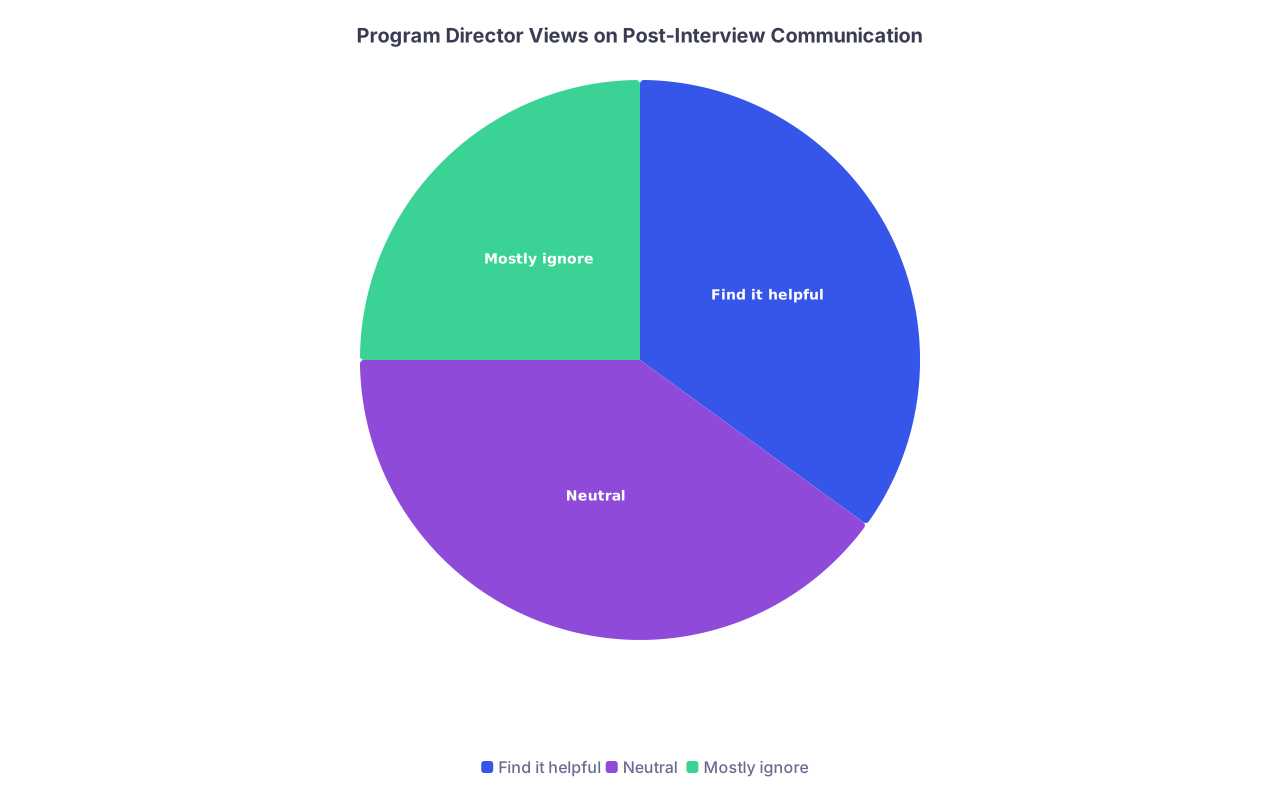
| Category | Value |
|---|---|
| Find it helpful | 35 |
| Neutral | 40 |
| Mostly ignore | 25 |
No, those numbers aren’t exact for every specialty, but that rough split is what you hear when you talk to PDs and faculty across places:
- Some do care
- Some are indifferent
- Some barely look
What LOIs won’t do:
- They won’t take you from “we’re not ranking this person” to “rank #1.”
- They won’t magically erase bad interviews, professionalism issues, or poor fit.
- They won’t override institutional policies (e.g., “we rank our home students first,” “we don’t change the list after the committee meets”).
What LOIs can do:
- Break a tie between you and a similar applicant.
- Remind a program you exist and are genuinely interested.
- Nudge you up a few spots if someone in the room advocates for you.
- Clarify your intentions if your application has mixed signals (e.g., region, partner location, niche interest).
So the real question isn’t “Are LOIs desperate?”
The real question is: Is a small possible upside worth a very small, controllable risk—if you send it correctly?
Usually: yes.
When sending an LOI actually makes sense
Here’s when I’d seriously consider sending one, even if your advisor hates them.
1. You have a clear, honest #1
Key word: one.
If you’re tempted to send “you’re my top choice” to multiple programs, don’t send any. That’s how people end up lying. And yes, people in academic medicine talk. PDs compare notes. It’s not an urban legend.
If you’re sitting there thinking:
- “If I get into Program X, I’m 100% going there, no question”
Then an LOI can make sense.
2. You already interviewed there
Pre‑interview “LOIs” are basically “please, please notice me” messages. Those are much more likely to feel desperate.
Post‑interview LOIs are about:
“We’ve already seen each other. I’ve thought about it. You’re my top choice.”
Very different vibe.
3. You have specific reasons that connect you to that program
If your whole argument is:
- “Great reputation”
- “Supportive faculty”
- “Diverse patient population”
Yeah… that’s every program’s website.
What actually sounds grounded:
- “My partner is starting a job in your city this summer; we’re long‑term committed to staying here.”
- “Your 6+6 ICU schedule and the exposure to complex transplant cases is exactly the training I want for critical care fellowship.”
- “When I talked to Dr. Smith about your addiction medicine track, I realized it lined up almost perfectly with what I want to build my career around.”
If you can’t name two or three specific, program‑unique things you care about… you’re not ready to send an LOI.
4. You can say it once, clearly, and then stop
If you’re the type to panic after sending and want to follow up again and again, that’s where the desperation look creeps in.
One LOI.
To one program.
Sent once.
No chasing.
That’s the rule.
When an LOI is more likely to hurt than help
Here’s where your advisor’s “desperate” warning is actually right.
1. You’re sending multiple “you’re my #1” messages
This is not “playing the game.”
This is lying.
If a PD ever calls another PD and both pull up emails where you swear they’re your #1? You’re not just done at those places. Word absolutely can spread. Faculty move. People talk. You don’t want to be That Applicant.
2. The content sounds needy, not professional
Red flags:
- “I’m begging you to give me a chance.”
- “I’m really scared I won’t match, so I hope you can help me.”
- Overly emotional oversharing about your anxiety, family expectations, etc.
You can be human, but you can’t make them feel emotionally responsible for your outcome. That’s how you get quietly side‑lined as “high‑maintenance” before day one.
3. The email is long, repetitive, or unclear
If your LOI is basically a second personal statement or reads like a diary entry, they won’t finish it. And you’ll look… not concise. Which is not a great look in a field that lives on notes, orders, and efficiently worded documentation.
4. You send it way too early or way too late
Too early: 24 hours after the interview. That feels impulsive.
Too late: after rank list certification (for either side). That’s just wasted emotional energy.
Programs differ on timing, but a safe-ish window is usually:
- 1–3 weeks after interview
- And definitely before you certify your own rank list
If you’re reading this in February stressed out of your mind, you’re probably still okay.
“But my advisor insists LOIs never matter”
I’ve heard versions of this:
“We’re a top‑tier program. We don’t care about LOIs. Rankings are based on committee scores only.”
Okay. Sometimes that’s true.
But also:
- Some PDs do walk into the room and say, “FYI, this person told us we’re their #1.”
- Some committee members do advocate a little harder when they know you’re invested.
- Some mid‑tier and smaller programs especially care about people who actually want to be there, because they’re tired of being everyone’s “safety.”
Different program cultures, different realities.
| Program Type | LOI Impact Likely | Why It Might Matter |
|---|---|---|
| Big-name academic | Low–Moderate | Rigid scoring, large committees |
| Mid-tier university | Moderate | More wiggle room, value fit |
| Community programs | Moderate–High | Care a lot about commitment/retention |
| Highly competitive specialties | Low–Moderate | Tiebreaker for similar applicants |
None of this guarantees anything. But if the downside risk is basically “one polite email they might ignore,” I’m not convinced sending an LOI is inherently desperate.
Sending a bad LOI is.
How to send an LOI without sounding desperate
Let’s be ultra practical, because spinning in your head isn’t helping.
Here’s roughly what a normal, non‑cringey LOI looks like.
Subject line options:
- “Letter of Intent – [Your Name], [Specialty] Applicant”
- “Post‑Interview Update – [Your Name]”
Then something like:
Dear Dr. [PD Last Name] and the [Program Name] Residency Selection Committee,
Thank you again for the opportunity to interview with your program on [date]. After reflecting on all of my interviews, I wanted to let you know that [Program Name] is my first choice, and I will rank your program #1.
I was especially impressed by [specific feature #1] and [specific feature #2]. Speaking with [resident/faculty name] about [topic] confirmed that your program offers the type of training and environment I’m looking for. I can see myself thriving there and contributing meaningfully to your team.
[Optional 1–2 lines of relevant update if you have one: a new publication, position, or project—not fluff.]
Thank you again for your time and consideration. I would be honored to train at [Program Name].
Sincerely,
[Your Name], [Med School]
AAMC ID: [if applicable]
That’s it.
No begging. No drama. No three paragraphs about how you’ve “always dreamed of living in the Midwest.”
You’re stating a fact: they’re your #1. You’re giving 2–3 grounded reasons. You’re done.

The ethics spiral: “What if I change my mind?”
Here’s the anxiety‑inducing part: you send an LOI saying “you’re my #1”… and then:
- Another program later blows you away.
- Your partner’s job situation changes.
- A life event shifts your priorities.
Now what? Did you “lie”? Are you morally bankrupt? Is the NRMP going to kick down your door? (No.)
Here’s the line I go by:
- When you send the LOI, it should be true at that moment.
- You should intend to rank them #1.
- If major circumstances change later, you’re not morally required to stick with a decision that no longer makes sense.
But: if you know you’re indecisive, and every week your “true #1” changes, hold off. Don’t send a letter just to calm your anxiety. That’s not about strategy; that’s about wanting reassurance.
If you’re 60–70% sure and terrified? Fine, sit on it a few days. Re‑rank your list. Ask yourself:
“If rank list certification were tomorrow, who would I put first?”
If it’s consistently the same program, that’s enough.
The fear underneath: “If I don’t send one, I’ll regret it forever”
This is the sick feeling that really drives this question.
Not the advisor’s opinion. Not PD culture. Not the literature.
It’s the image in your head of:
- Opening your email on Match Day (or SOAP week)
- Seeing you didn’t match your #1
- Instantly thinking, “If I had just sent that letter…”
Here’s the uncomfortable but freeing answer:
You will never actually know if an LOI would have changed anything.
And that cuts both ways:
- If you do send one and don’t match there, you’ll think, “Was my letter trash? Did I annoy them?”
- If you don’t send one and don’t match there, you’ll think, “I should’ve tried more.”
Your brain is going to create regret scenarios no matter what. That’s what anxious brains do.
So instead of trying to pick the path that guarantees “no regret” (impossible), pick the one where:
- You acted ethically
- You acted thoughtfully
- You didn’t lie
- You didn’t harass anyone
- You gave yourself a nonzero chance at a small edge
By that metric, one honest, targeted LOI to a true #1 is very reasonable.
Spraying half‑truths? Not reasonable.

| Step | Description |
|---|---|
| Step 1 | Have you already interviewed? |
| Step 2 | Do not send LOI yet |
| Step 3 | Do you have a clear #1? |
| Step 4 | Wait and think more |
| Step 5 | Will you rank them #1 if list due tomorrow? |
| Step 6 | Do not send LOI |
| Step 7 | Can you explain 2 to 3 specific reasons? |
| Step 8 | Research program more |
| Step 9 | Send one concise, honest LOI |
| Step 10 | Yes? |
What about “LOIs are dead, it’s all signaling now”?
Future of medicine, right? Signaling tokens. Preference signaling. Geographic signals. Supplemental apps. All the flashy new stuff.
People will say, “LOIs don’t matter anymore—signals replaced them.”
Not really.
Signals are just:
- A structured, official way to say “I like you”
- With equally limited influence and lots of variability across programs
Programs might:
- Use signals heavily for screening
- Barely care post‑interview
- Or treat them as one tiny data point
Here’s my take:
If you signaled a program, interviewed there, and it’s your true #1, an LOI isn’t redundant. It’s reinforcing the same message at a later, more decisive stage.
Signal = “Before interviews, I was very interested in you.”
LOI = “After seeing everything, I still want you the most, and I’m acting on that.”
Those are different statements.
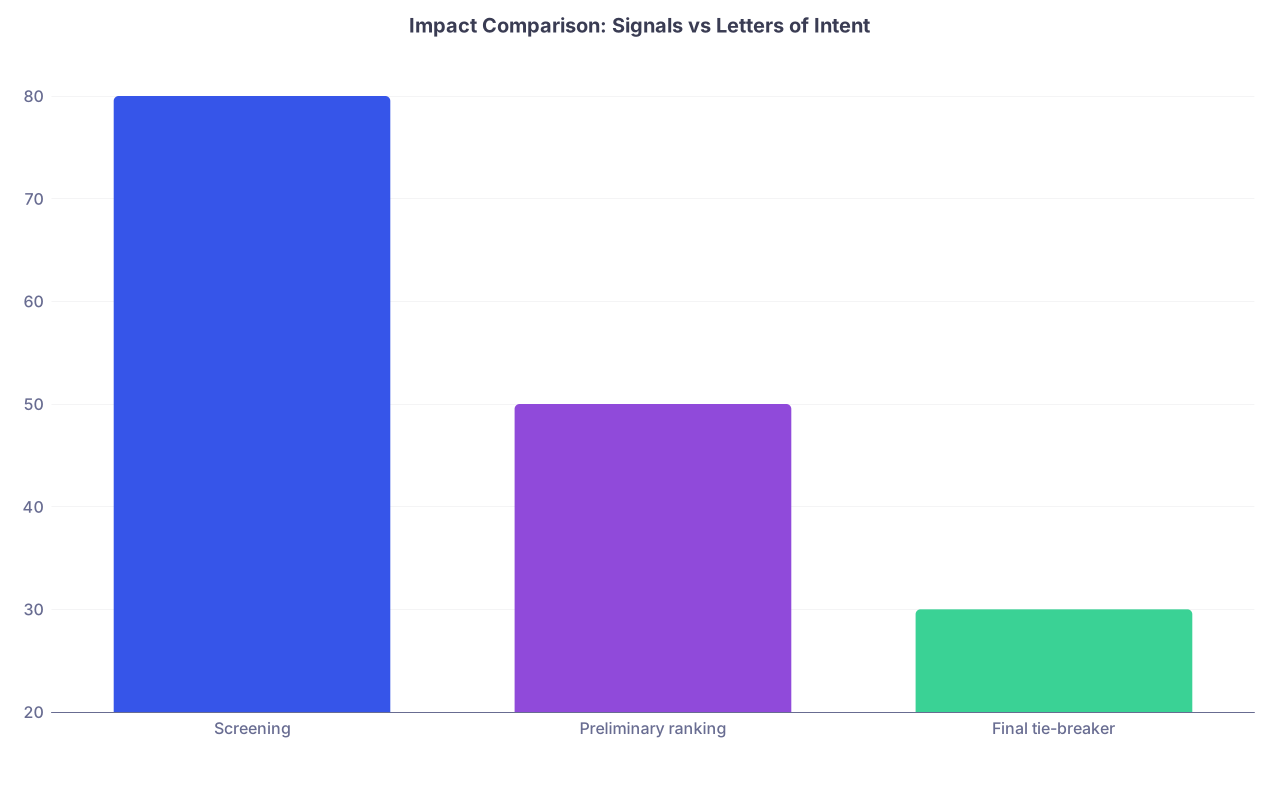
| Category | Value |
|---|---|
| Screening | 80 |
| Preliminary ranking | 50 |
| Final tie-breaker | 30 |
Think of it this way:
- Signals: more impact early (getting the interview)
- LOIs: tiny but possible impact late (final discussions, tiebreakers)
Neither is magic. Both are tools.
How to stop obsessing and actually decide
If you’re still spinning, do this:
- Open your current rank list.
- Ask yourself, “If I could only send one LOI, who gets it?”
- If there’s no clear answer, you’re not ready. Don’t send anything.
- If there is a clear answer, write a draft LOI—no sending yet.
- Let it sit 24 hours.
- Re‑read your rank list. Is that program still #1?
- If yes, polish the email and send. If no, delete the draft.
You’ll still be anxious. That’s fine. But at least you’ll know you made a deliberate choice instead of freezing.

So… should you still send one?
If your advisor thinks LOIs are desperate, they might be reacting to bad behavior they’ve seen. Mass emails. Manipulative wording. Emotional dumping on PDs.
But a single, honest, concise LOI to the program you truly plan to rank #1?
That’s not desperate. That’s you quietly putting your card on the table.
Will it change everything? Probably not.
Can it help a little in a close call? Sometimes, yes.
Is that tiny chance worth one professional email? For a lot of people, yeah.
Just don’t let the LOI become an emotional crutch or another way to punish yourself.
Do this today:
Open a blank document. At the top, type the name of the program you think is your true #1. Under it, force yourself to list three specific reasons—tied to training, geography, or people—why you’d choose them over anywhere else. If you can’t hit three real reasons, don’t send an LOI yet. If you can, you’ve got the backbone of a strong, non‑desperate letter of intent.