
It’s late. Your email draft is open. Subject line: “Letter of Intent.”
Your cursor is blinking right after: “You are my top choice program…”
And your brain is screaming:
“Am I about to break Match rules? Are they going to report me? Could this literally get me blacklisted? Am I about to tank my entire career because I picked the wrong verb tense?!”
If that’s you right now, yeah, same. This is exactly the kind of thing I spiral about. So let’s walk through it like two people who are both low‑key terrified of the NRMP police kicking down our door over a poorly worded LOI.
First: Are You Actually Going to Get in Trouble for LOI Wording?
Short answer: almost certainly not.
But I know that’s not enough, so let me be more specific.
The big fear is: “If I say ‘I will rank you #1’ or ‘I intend to rank you highly,’ am I violating NRMP rules?”
Here’s what’s actually going on:
NRMP rules (the Match Participation Agreement) primarily restrict programs and coercive behavior. Things like:
- Programs asking you how you’re ranking them
- Programs requiring verbal commitments
- Programs hinting that they’ll rank you higher if you make certain promises
You, as an applicant, are allowed to send post‑interview communications, including letters of intent. You’re allowed to say a program is your top choice. You’re allowed to say you plan to rank them #1.
Where you can get yourself into trouble is less “legal violation” and more “you look untrustworthy or unprofessional.”
I’ve seen applicants:
- Tell two different programs “you are my #1” and get caught because people talk
- Use weird manipulative language that makes PDs roll their eyes
- Sound like they’re trying to bargain (“If you rank me highly, I will definitely rank you #1”) which does brush up against Match spirit
No one’s dragging you to NRMP court over “I loved your program,” but you absolutely can hurt your reputation if you sound dishonest or transactional.
What the Rules Actually Care About vs What You’re Scared Of
This is the part I wish someone had spelled out for me instead of just saying “don’t worry, it’s fine.” Because I do worry. Constantly.
Let’s separate the real rules from the imagined landmines.
What the NRMP really cares about
At a high level:
- You submit a rank list that reflects your true preferences
- There’s no coercion, intimidation, or requirement to reveal your rank list
- No one promises guaranteed positions outside the Match
- No one is forced to disclose how they’re ranking someone
You writing: “I intend to rank your program #1” is not a violation of that. You’re revealing your own preference voluntarily. That’s allowed.
Where it edges into gross territory is if either side tries to use that to create a “deal”:
- “If you rank me to match, I’ll rank you #1”
- “If you tell us we’re your first choice, we will rank you highly”
That’s the kind of thing that gets into NRMP complaint territory because it undermines the algorithm’s independence.
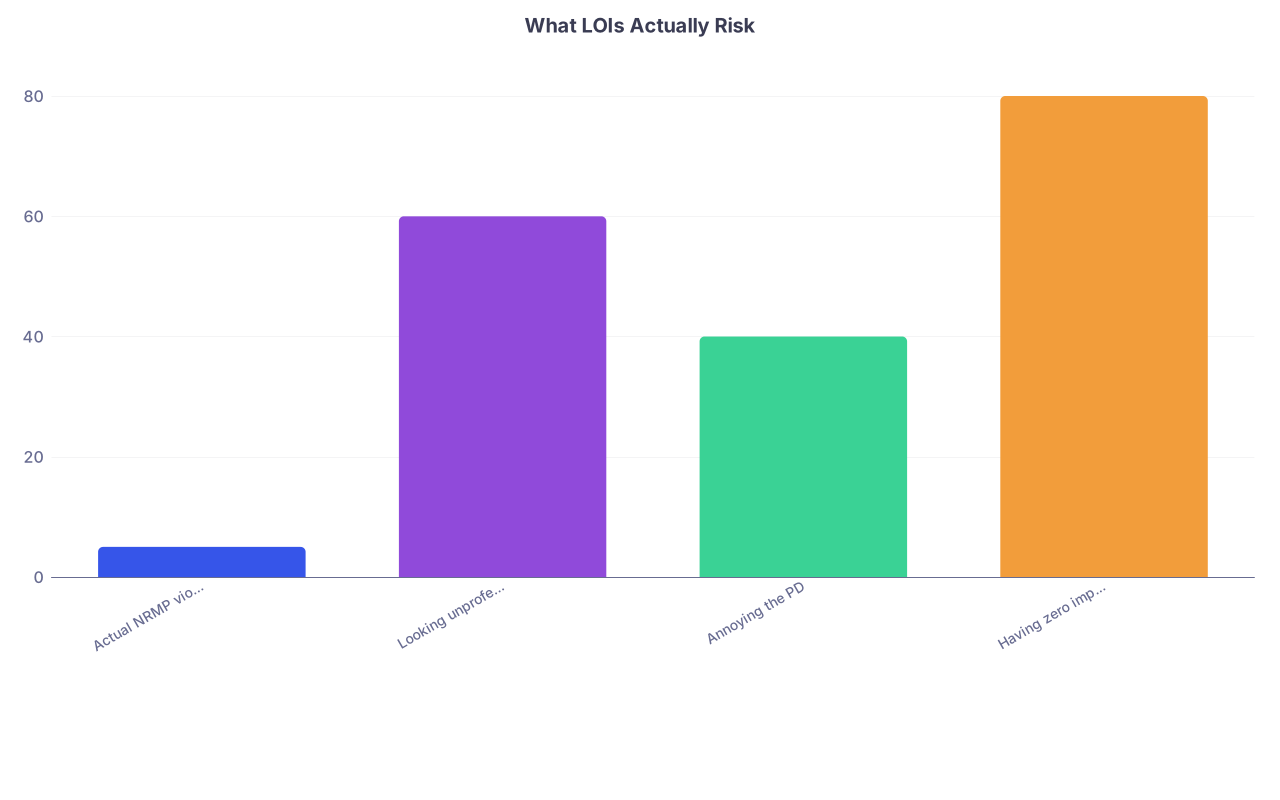
| Category | Value |
|---|---|
| Actual NRMP violation risk | 5 |
| Looking unprofessional | 60 |
| Annoying the PD | 40 |
| Having zero impact | 80 |
What you’re scared of
You’re probably imagining:
- They screenshot your email
- They send it to NRMP
- NRMP opens a file on you labeled “ETHICS VIOLATION – LETTER OF INTENT”
- You get some official notice, your medical school dean calls you in, and you walk out unmatched
That’s not how this goes. At all.
The most realistic “worst case” if you use clumsy LOI wording?
- They roll their eyes and ignore it
- They think you’re a little overeager
- If you lied blatantly (e.g., told multiple places they’re #1) and they find out, they might drop you on their list for integrity reasons
Which sucks. But it’s not NRMP jail. It’s just people not wanting to work with someone they don’t trust.
Exactly What You Can Say (and What’s Risky But Not Illegal)
Let’s go way more concrete. Because the devil is in the phrasing and that’s exactly what’s making you nervous.
Phrases that are safe to use
These don’t even come close to Match violations:
- “Your program is my top choice.”
- “I will be ranking your program #1.”
- “After my interview day, I have decided to rank [Program] as my first choice.”
- “I would be thrilled to train at [Program] and believe it is the best fit for my goals.”
That’s you expressing a preference. That’s allowed.
Phrases that are cringey but not illegal
These are more about tone and professionalism than rules:
- “I promise I will definitely rank you #1 no matter what.”
- “I will not consider any other program above you.”
- “You are my dream program and I will do anything to match here.”
No one is submitting an NRMP complaint because you’re dramatic. But you may come across as emotionally unstable or not self‑aware. Not ideal.
Phrases that start to smell like bargaining
These are the ones to avoid, not because they’re guaranteed violations, but because they sound like you don’t understand the Match:
- “If you rank me to match, I guarantee I will rank you #1.”
- “If I know you’ll rank me highly, I will withdraw applications from other programs.”
- “I hope my commitment to ranking you #1 will influence how you rank me.”
This is where programs get uncomfortable. It sounds like you’re trying to create a side deal. The algorithm doesn’t work that way, and experienced PDs hate it when applicants talk like it does.
The “Only One True #1” Rule (Ethical, Not Legal)
Here’s the part everyone dances around:
You can technically email five programs saying “you are my #1,” and there is no automatic NRMP drone that descends from the sky.
But if programs find out you did that? You’re done in their eyes. And rightfully so.
I’ve watched this happen:
Applicant tells Program A “you’re #1,” Program B “you’re #1,” and then they match at Program C. PD at A texts PD at B:
“Hey, did X tell you that you were their #1 too?”
“Yep.”
“Cool, never ranking them again if they reapply.”
They remember. They absolutely remember.
So the real rule, the one that actually matters if you care about your professional reputation:
- If you’re going to send a true Letter of Intent (“I will rank you #1”), send it to exactly one program.
- For everyone else you like, you can send “letter of strong interest” style notes without promising rank order.
| Letter Type | How Many You Send | Can Say #1? | Risk Level |
|---|---|---|---|
| True Letter of Intent | 0–1 | Yes | Medium |
| Strong Interest Letter | Several | No | Low |
| Generic Thank You Email | All programs | No | Very Low |
Concrete LOI Templates That Won’t Get You in Trouble
Let’s just write the thing you’re scared to write.
1. True Letter of Intent (one program only)
Use this only if you are actually going to rank them #1.
Dear Dr. [Last Name] and the [Program Name] Residency Leadership,
Thank you again for the opportunity to interview at [Program]. After reflecting on my interview day and speaking with residents and faculty, I’ve decided that [Program] is my top choice, and I will be ranking your program #1.
The combination of [specific strengths – e.g., strong clinical training at a county hospital, supportive culture described by the residents, and opportunities in medical education] aligns closely with my goals. I was especially impressed by [1–2 concrete things you actually noticed].
I would be honored to train at [Program] and contribute to your resident community.
Sincerely,
[Your Name], [Your Med School]
This does not violate Match rules. It’s direct, honest, and doesn’t try to bargain.
2. Strong Interest Letter (when you’re scared of over‑committing)
Use for places you like a lot but aren’t necessarily #1.
Dear Dr. [Last Name] and the [Program Name] Residency Team,
Thank you again for an excellent interview day at [Program]. I remain very interested in your program and believe it would be an outstanding place to train.
I was especially drawn to [specific things]. The way the residents described [X] really resonated with what I’m looking for in residency.
I will be ranking [Program] very highly on my list and would be excited to join your team.
Sincerely,
[Your Name]
Notice the difference? No #1 language. No bargaining. Zero NRMP drama.
What If I Already Sent Something and Now I’m Panicking?
This is the 3 a.m. “oh God what have I done” scenario.
Your brain: “I wrote ‘I intend to rank you #1,’ but now I think another program is my top choice. Am I doomed? Do I need to call NRMP? Am I morally bankrupt?”
Deep breath.
Here’s the hierarchy of disaster:
You told one program they’re #1, then later changed your mind before submitting your rank list.
- Is this ideal? No.
- Is it a federal crime? Also no. People change their minds.
- If the wording was “intend,” you technically haven’t lied yet because intentions can change.
You told Program A and Program B “you are my #1” and you know it’s not true for at least one of them.
- This is where it becomes a character issue.
- No one may ever find out. But you will always know you lied to multiple PDs.
- If they do find out somehow, don’t expect sympathy.
You made actual explicit quid‑pro‑quo deals (“If you rank me to match, I will rank you #1 and withdraw from others”) and wrote this in writing.
- This is the sketchiest scenario.
- A program could theoretically report that because it undermines the Match process.
If you’re currently in group 1 or 2, here’s my honest take:
You do not need to send some awkward “retraction email.” That just calls more attention to it and makes it worse.
Submit the rank list that reflects your true preference. Learn from the over‑promising. Move on.
If you’re in group 3 and you literally put conditional deals in writing, stop doing that immediately, and on your rank list, just follow your real preferences. The algorithm protects that.
How Much Do LOIs Even Matter?
This is the part that makes all of this feel both high‑stakes and pointless at the same time.
Programs vary wildly:
- Some PDs barely read any LOIs and sort them into a “nice but irrelevant” folder
- Some skim them but only remember extreme outliers (super weird or super impressive)
- A few genuinely factor in a sincere, specific LOI when debating between similar applicants
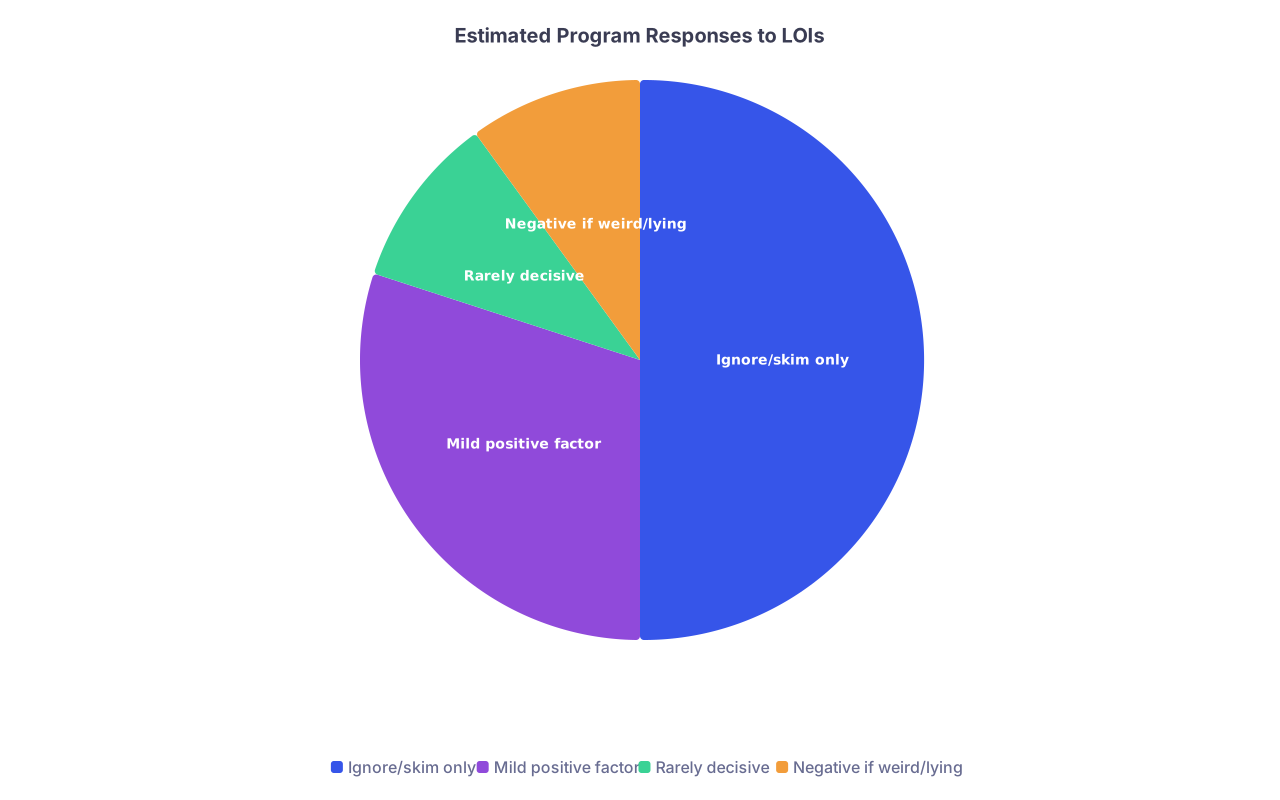
| Category | Value |
|---|---|
| Ignore/skim only | 50 |
| Mild positive factor | 30 |
| Rarely decisive | 10 |
| Negative if weird/lying | 10 |
So here’s the messed‑up truth:
- LOIs are unlikely to save a weak application
- They can sometimes nudge you upward if you were already in the “maybe” pile
- They can absolutely backfire if you look dishonest, unprofessional, or unhinged
That’s the real risk. Not Match police. Human beings reading what you write and forming opinions about your judgment.
The Real Safety Rules for LOI Wording
If you want something super simple to hold onto so you can stop obsessing over every word:
- Don’t lie. If you say they’re #1, actually rank them #1.
- Don’t bargain. Don’t talk about how they should rank you based on what you’ll do.
- Don’t be dramatic. No begging, no theatrics, no “I will die if I don’t match here.”
- Do be specific. Mention real details from the program so it doesn’t feel like a mail merge.
- Do keep it short. 3–5 short paragraphs max. No one wants a novel.
If your draft follows those, you’re not breaking rules. You’re just participating in the weird theater of the Match like everybody else.
FAQ: LOI Wording and Match Rules (Because Your Brain Won’t Let This Go)
1. Can I literally write “I will be ranking your program #1” without breaking NRMP rules?
Yes. That’s allowed. You’re allowed to share your own intentions. It becomes a problem only if you’re lying or if you’re using that statement as part of some conditional deal (“if you rank me high, I’ll rank you #1”). Morally, only send that sentence to one program.
2. What if a program asks me to tell them if they’re my #1? Is that a violation?
Technically, programs aren’t supposed to pressure you to reveal rank order. People stretch this all the time with “you’re free to let us know if we’re your top choice.” If they ask directly, you don’t have to answer. You can respond with: “I’m very interested in your program and it will be ranked highly.” That’s safe and non‑committal.
3. I already told one program they’re my #1, but now I changed my mind. Do I have to honor that in my rank list?
No. The NRMP explicitly says your rank list should reflect your true preferences at the time you certify it. You’re not contractually bound by LOIs. The issue is ethical, not legal. Just don’t make a habit of over‑promising like that.
4. Could a badly worded LOI actually get me reported to NRMP?
It’s extremely unlikely unless you write something that clearly shows you’re trying to make or enforce a side deal (conditional ranking, withdrawing from others based on program rank promises, etc.). Normal “you’re my first choice” or “I’ll rank you #1” wording doesn’t rise to that level. Programs are not itching to file complaints over LOI fluff.
5. Do I even need to send a letter of intent at all?
No. Plenty of people match without ever sending one. It’s optional. If doing it sends you into a spiral and you can’t bring yourself to send a clean, honest, simple letter, you’re better off sending a straightforward thank‑you email and stopping there. No one is matching only because of an LOI.
Here’s your next step so this doesn’t just stay as more anxious reading:
Open your LOI draft right now and do three things:
- Delete any sentence that mentions how the program should rank you.
- Make sure you only say “#1” or “top choice” in a letter to one single program.
- Add two specific details from your interview day that prove you actually paid attention.
Then send it. And close the tab.