
67% of program directors say post‑interview communication rarely changes their rank list—yet a measurable minority admit it sometimes does. That gap between “official line” and real behavior is exactly where letters of intent live.
Let me be blunt: “Never send LOIs, they’re useless or unethical” is legacy advice from a pre‑Zoom, pre‑overapplication, pre‑4,000‑applications‑per‑program era. The landscape changed. A lot of the advising did not.
You’re here because someone—usually an old‑guard faculty advisor who trained when people actually wrote letters on paper—told you LOIs are a waste of time or will somehow get you blacklisted. And you’re smart enough to sense that might not be the whole story.
You’re right to question it.
Where “Never Send LOIs” Came From (And Why It’s Cracking)
The anti‑LOI mantra didn’t appear out of nowhere. It’s based on three half‑true premises that used to be more reasonable than they are now.
1. The NRMP “Do Not Ask / Do Not Tell” Misread
NRMP rules say programs cannot require you to commit and cannot ask you where you’ll rank them. They also heavily discourage coercive or misleading communication. Many advisors grossly over‑extend that into: “Any letter of intent is unethical or against the Match.”
That’s wrong.
The NRMP’s own communications analyses have repeatedly distinguished voluntary, non‑coercive post‑interview communication from pressuring or deceptive behavior. You’re allowed to tell a program, “You’re my top choice, and I intend to rank you first.” You’re not allowed to lie about that across 10 programs.
There’s a moral line: honest vs performative spam. The rule isn’t “never communicate.” It’s “don’t misrepresent and don’t pressure.”
2. They Remember a Smaller, Slower Market
A lot of current advisors built their careers when:
- Programs got a few hundred applications, not thousands.
- Interview lists were shorter and more targeted.
- Faculty actually knew most applicants by the end of interview season.
In that world, sure, a post‑interview note didn’t change much. Everyone already had a mental model of each candidate.
That’s not the world you’re in.
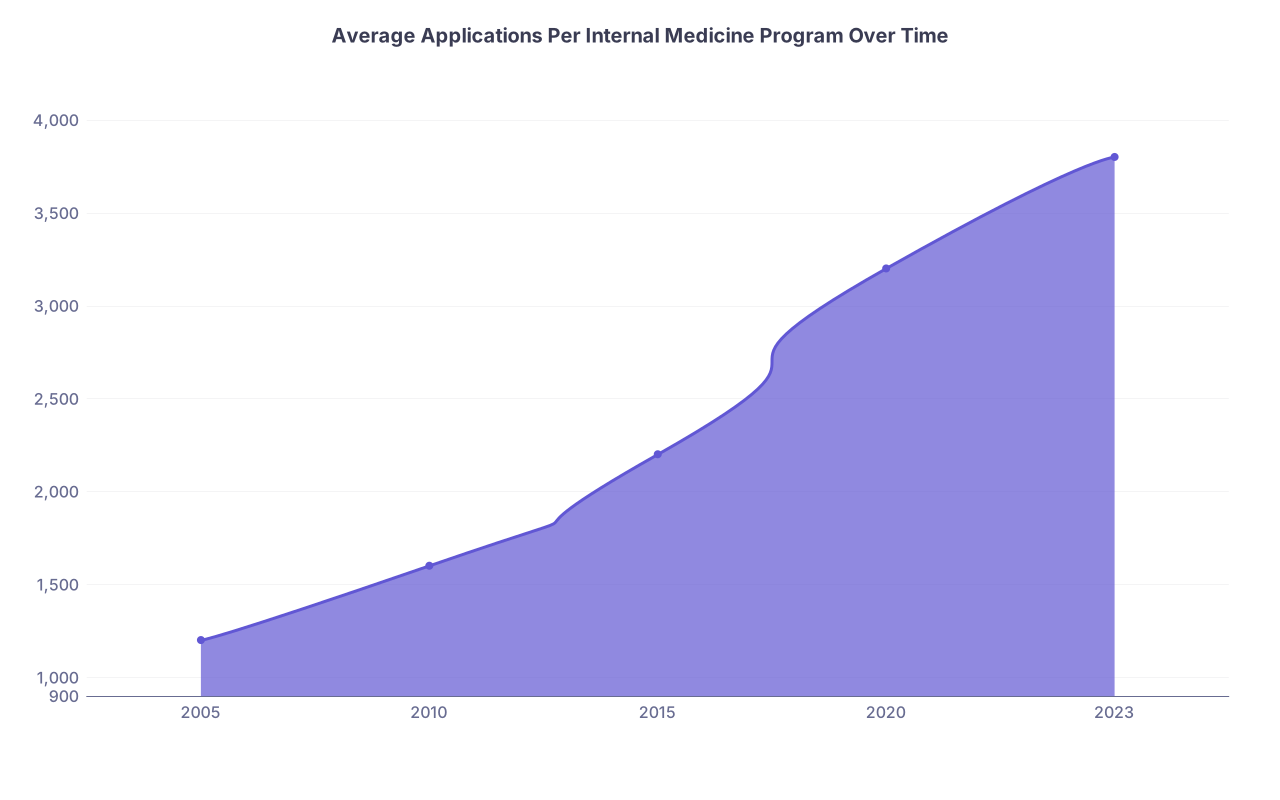
| Category | Value |
|---|---|
| 2005 | 1200 |
| 2010 | 1600 |
| 2015 | 2200 |
| 2020 | 3200 |
| 2023 | 3800 |
When a program director is staring at 3,000+ ERAS files and a Zoom grid of 40 identical smiling faces, there is more randomness and more noise. Intentional, targeted communication can—sometimes—break that symmetry.
3. They Confuse “Not Guaranteed” With “Not Useful”
The data we do have is messy but consistent:
- Most PDs say post‑interview contact usually doesn’t move the needle.
- A smaller, but non‑trivial, group openly admit that it occasionally bumps someone up or down when choosing between similar applicants.
- Almost all agree that dishonest LOIs, or mass‑mailed “you’re my top choice” nonsense, hurt applicants.
This is a classic advising failure: turning “this is not a magic bullet” into “never do this under any circumstances.”
You do not apply that logic to away rotations, research, or Step 2. You know they matter, just not deterministically. LOIs are in the same category: low‑cost, situational upside, easy to misuse.
What Program Directors Actually Say (Not What People Quote)
I’ve sat in rooms where PDs talk candidly about this, off the record, after the residents leave. The public statement is always: “Post‑interview communication doesn’t affect our rank list.”
And then, over lunch, someone says something like:
“We had two borderline applicants for our last spot. One of them sent a thoughtful note that made it clear she really got our mission and wanted to be here. It didn’t decide it, but it nudged us.”
That’s not rare. That’s normal.
Let’s separate the mythology from the actual behavior.
The “Official” Line vs the Real Behavior
Official surveys (NRMP, specialty societies) consistently show high percentages of PDs claiming they don’t let post‑interview communication influence rankings.
But when you look at nuance, it turns into something like this:
| PD Attitude Category | Rough Proportion | Practical Meaning for You |
|---|---|---|
| “Never influences ranking” | ~50–60% | LOI is neutral unless you annoy them |
| “Rarely, but occasionally” | ~25–35% | Tiebreaker between similar candidates |
| “Sometimes influences meaningfully” | ~10–15% | LOI can shift position within a tier |
Are these exact numbers? No. But that’s the pattern across multiple specialties: most of the time, no effect; some of the time, minor tiebreaker; occasionally, meaningful.
Your advisor takes the “most of the time” and extrapolates “never.” That’s intellectually lazy.
Where LOIs Have the Highest Yield
A letter of intent will not rescue a catastrophically weak application. It will not take you from the bottom of a program’s list into their top 5.
But in specific scenarios, PDs and coordinators admit they matter:
- Borderline cases where the committee is split.
- Highly mission‑driven programs (rural, safety‑net, VA‑heavy, research‑intense) where “fit” is king.
- Smaller or mid‑tier programs worried about applicants using them as backups and not actually showing up in July.
- When trying to decide between two near‑identical candidates—same Step, same grades, similar LORs.
You know what’s often missing in the file? Any evidence that you specifically want them.
A well‑targeted LOI solves that information gap.
The Real Problems With LOIs (Hint: It’s Not That They Exist)
The blanket “never send LOIs” advice is lazy. The more honest sentence is: “Most LOIs are written badly, sent indiscriminately, and erode trust.”
That, I agree with.
Problem 1: Applicant Dishonesty
This is the big one. Every year, some genius sends “You’re my number one and I will rank you first” to five programs. Then people talk. PDs compare notes at national meetings. Residents swap stories with friends at other institutions.
Once PDs realize this is happening, a predictable reaction follows: degrade the signal. Many of them start ignoring all LOIs because enough applicants lied for marginal gain.
That is why advisors say “never send LOIs.” They’re reacting to the worst behavior, not the tool itself.
The fix is not “never communicate.” It’s “if you say you’re ranking a place first, mean it—and say it once.”
Problem 2: Spammy, Generic Content
Most LOIs read like they were generated by a “residency letter of intent template” search, copy‑pasted, and sprinkled with a single program name.
- “I was impressed by your diverse patient population.”
- “I would be honored to train at your esteemed institution.”
- “Your commitment to education and research aligns with my goals.”
None of that distinguishes you from the other 300 people who wrote the same thing.
Faculty who see these en masse tune them out. So your advisor sees that tuning out and decides “doesn’t work.” No—bad LOIs don’t work.
A good LOI is short, specific, and obviously not sendable to any other program without being ridiculous.
Problem 3: Timing and Desperation
I’ve watched programs receive panicked “I LOVE YOU PLEASE RANK ME HIGHER” emails the week after interview season ends, when their list is already locked—or within 48 hours of the rank list deadline when nothing structurally will change unless there’s some extraordinary reason.
That kind of timing just makes you look anxious and unsophisticated about the process. It doesn’t help you; it occasionally hurts you.
A letter of intent is not a Hail Mary after months of silence. It’s a deliberate, well‑timed signal that you’re serious about them, sent when programs are still actively discussing and sorting candidates.
When LOIs Actually Make Sense (And When They Don’t)
Let me strip away the noise and give you a framework that actually matches how PDs work now.
Use a True LOI for One Program Only
If you’re going to use the phrase “you are my first choice” or “I will rank you number one,” you get to do that exactly once. Not three times. Not “1a, 1b, 1c.”
One.
If you cannot honestly pick a single program where you’d be happiest, then you are not ready to send a true LOI. You can still send updates or strong interest letters, but drop the “I will rank you first” language.
That one honest LOI has a chance of being taken seriously. The scattershot “I love all of you equally” approach trains programs to distrust everyone.
Differentiate LOIs from “Letters of Interest” and Updates
This is where most students are confused.
- A Letter of Intent says: “You are my top choice and I will rank you first.” You send one.
- A Letter of Strong Interest says: “You are very high on my list; I would be excited to train here.” You can send a few of these, without claiming rank order.
- An Update Letter says: “Here are concrete new achievements or changes since my application/interview.” You can send these to multiple programs.
Bundling all of these as “LOIs” and then saying “never send LOIs” is silly. It deprives you of legitimate, honest communication channels just to keep everyone “pure.”
LOIs Make Sense If Three Conditions Are Met
You should consider a real LOI when:
- You’ve already interviewed there (virtual or in person).
- You have done enough homework and self‑reflection to say with a straight face: “If I matched here, I’d be happy. This is my top choice.”
- The program has not explicitly said “we do not want post‑interview communication.”
That third one matters. Some programs now clearly state in their interview day slides: do not send additional communications; it won’t be read. You do not win points by ignoring explicit directions.
How to Write an LOI That Doesn’t Get Ignored
Here’s the part your “never send LOIs” advisor usually never gets to: how to do it without being cringe or unethical.
Keep It Short and Concrete
You’re aiming for something like 3–5 short paragraphs, total length under one page.
Hit three things clearly:
- Your commitment – a single, unambiguous sentence that this is your top choice and you will rank them first (if true).
- Your alignment – 2–3 specific, non‑generic features of the program that actually matter to you and are unique enough that another PD reading it would think, “Yeah, that’s definitely our place.”
- Your added value – 1–2 specific strengths you bring that match their stated priorities (not a generic CV recitation).
Make It Obviously Program‑Specific
If your letter could be read aloud at a different program with just the name swapped, you failed.
Examples of what does feel specific:
- Citing a particular clinic, rotation site, or longitudinal curriculum they heavily feature.
- Referencing an actual conversation with a resident or faculty member and what you took away.
- Connecting their program’s specific mission—rural training, LGBTQ+ health, VA‑heavy care, community engagement, heavy research, etc.—to concrete past work you’ve done.
This is where pre‑interview homework and attention during interview day pay off. LOIs written solely from website buzzwords are easy to spot.
The Future: Why Rigid “No LOI” Advice Will Age Poorly
The Match system is straining under application inflation, interview hoarding, and generic CV sprawl. Programs are experimenting with signals—preference signaling tokens, supplemental ERAS essays, geographic preference statements—for exactly one reason: they’re desperate for real information about who actually wants to be there.
LOIs are a crude, applicant‑side version of the same thing.
As signaling systems formalize, I expect two trends:
- Dishonest, mass‑mailed “you’re my top choice” LOIs will become even more counterproductive and transparent.
- Honest, specific, rare LOIs—backed up by coherent rank lists and authentic interest—will retain value as one of several signals PDs consider when splitting hairs.
The advisors clinging to “never send LOIs” are pretending we still live in a world where your dean’s letter and a Step score told the whole story. They don’t. They never did. But the gap between the file and the person is wider now than it has ever been.
Used sparingly and honestly, LOIs are one of the few tools you control to narrow that gap.
Two Numbers You Should Actually Remember
To close this out, here’s the rough calibration that matches what I’ve seen and what the data suggests:
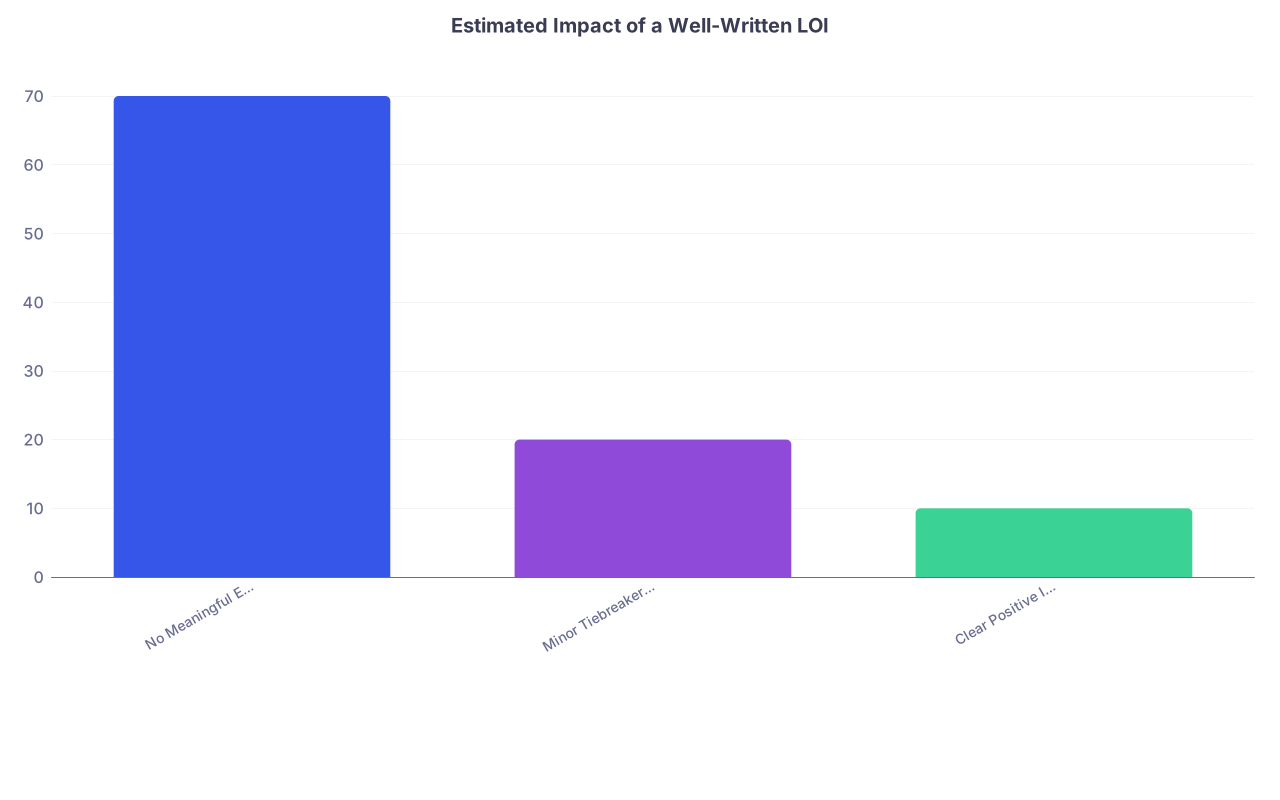
| Category | Value |
|---|---|
| No Meaningful Effect | 70 |
| Minor Tiebreaker Effect | 20 |
| Clear Positive Impact | 10 |
Roughly:
- Most of the time (maybe 70%), a good LOI doesn’t move your position. It just confirms what they already thought.
- Sometimes (maybe 20%), it acts as a tiebreaker between similar candidates or reinforces that you’re serious enough not to drop them if they match you.
- Occasionally (maybe 10%), it nudges you upward within a tier and that actually changes whether you match there.
Low guaranteed return. But not zero. And the cost is a carefully written page and a bit of honesty.
That’s why “never send LOIs” is outdated.
Use a true LOI rarely, honestly, and surgically. Respect programs that explicitly forbid them. And ignore anyone who insists that the only ethical, modern strategy is total radio silence after your interview.
Key points:
- “Never send LOIs” overshoots the real problem—dishonest, generic, spammy letters—not the concept of signaling genuine interest.
- A single, truthful, program‑specific LOI can matter at the margins, especially as application volumes explode and PDs look for any credible signal of fit and commitment.