
The hierarchy of “who actually lives in the hospital at night” is not random. The data show clear patterns by specialty and by PGY level, and some fields are simply call-heavy by design.
If you care about sleep, family, or not losing your mind on a 3 a.m. cross-cover page about “mild SOB x 2 years,” you need to look at numbers, not vibes.
Below I will walk through:
- Which specialties have the heaviest night call loads
- How those loads change from PGY‑1 to PGY‑3+
- Typical call schedules with concrete ranges (nights/month, 24‑hr calls, night float)
- Where the pain is front‑loaded vs back‑loaded in training
I am synthesizing ACGME duty-hour rules, program websites, survey data (NRMP, Medscape, specialty societies), and what I have seen across large academic centers and community programs.
1. The Core Reality: Night Call Is Not Distributed Evenly
Look at the hospitals where residents actually run the place at 2 a.m. You see the same core services over and over:
- Internal Medicine (and subspecialties)
- General Surgery (and many surgical subspecialties)
- OB/GYN
- Emergency Medicine (EM)
- Anesthesiology (OB, trauma, transplants)
- Pediatrics and NICU
- Neurology and Neurosurgery
- Orthopedics
Then there are the “mostly daytime, rare nights” fields:
- Dermatology
- Pathology
- PM&R
- Psychiatry (with some important exceptions)
- Radiology (residents often from home call, esp. IR)
For a clean comparison, think in terms of:
- Nights per month (in-house, 12–14 hour or 24h+ shifts)
- Whether those nights are concentrated into night float blocks
- Whether call remains heavy beyond PGY‑2
Here is a high-level comparison by typical peak night burden (not the cushiest or the absolute worst program, but the modal experience at a busy teaching hospital).
| Specialty | Peak PGY Level | Nights/Month (Peak) | Common Call Type |
|---|---|---|---|
| General Surgery | PGY-2 | 6–8 (24h in-house) | Q4–Q6, 24h + postcall |
| OB/GYN | PGY-1/2 | 6–8 (24h in-house) | Q4–Q6, L&D heavy |
| Internal Medicine | PGY-1 | 6–7 (12–16h) | Night float |
| Emergency Medicine | PGY-2 | 8–10 (8–12h) | Core schedule nights |
| Pediatrics | PGY-1/2 | 5–7 (12–24h) | NF + 24h weekends |
| Neurology | PGY-2 | 5–7 (12–24h) | Stroke, cross-cover |
Those are central tendencies. Some surgery and OB/GYN programs push the upper bounds until they are forced to stop by duty-hour policing.
2. Internal Medicine: Heavy Early, Then It Tapers
Internal Medicine is the baseline for comparison. The data from multiple large IM programs show a consistent pattern:
- PGY‑1: Heaviest night exposure
- PGY‑2: Still significant, but more supervisory
- PGY‑3: Noticeably lighter overall
Typical Internal Medicine Night Structure
Most IM programs have shifted away from q4 24‑hour calls toward night float. That changes how pain is distributed but not the total number of nights worked.
Common setups for PGY‑1:
- Night float block: 4 weeks / year, 5–6 nights/week → 20–24 nights
- Additional scattered weekend nights on wards/ICU → ~6–10 nights
- Total nights PGY‑1: usually 26–34 nights / year
Split over 12 months, that is roughly 2–3 nights/month, but in reality those nights are clumped into brutal multi-week stretches.
PGY‑2 and PGY‑3:
- More ICU night blocks, fewer ward nights
- PGY‑2 might see 20–28 nights/year, PGY‑3 closer to 15–20 at many programs
So IM is front-loaded in PGY‑1, then gradually improves.
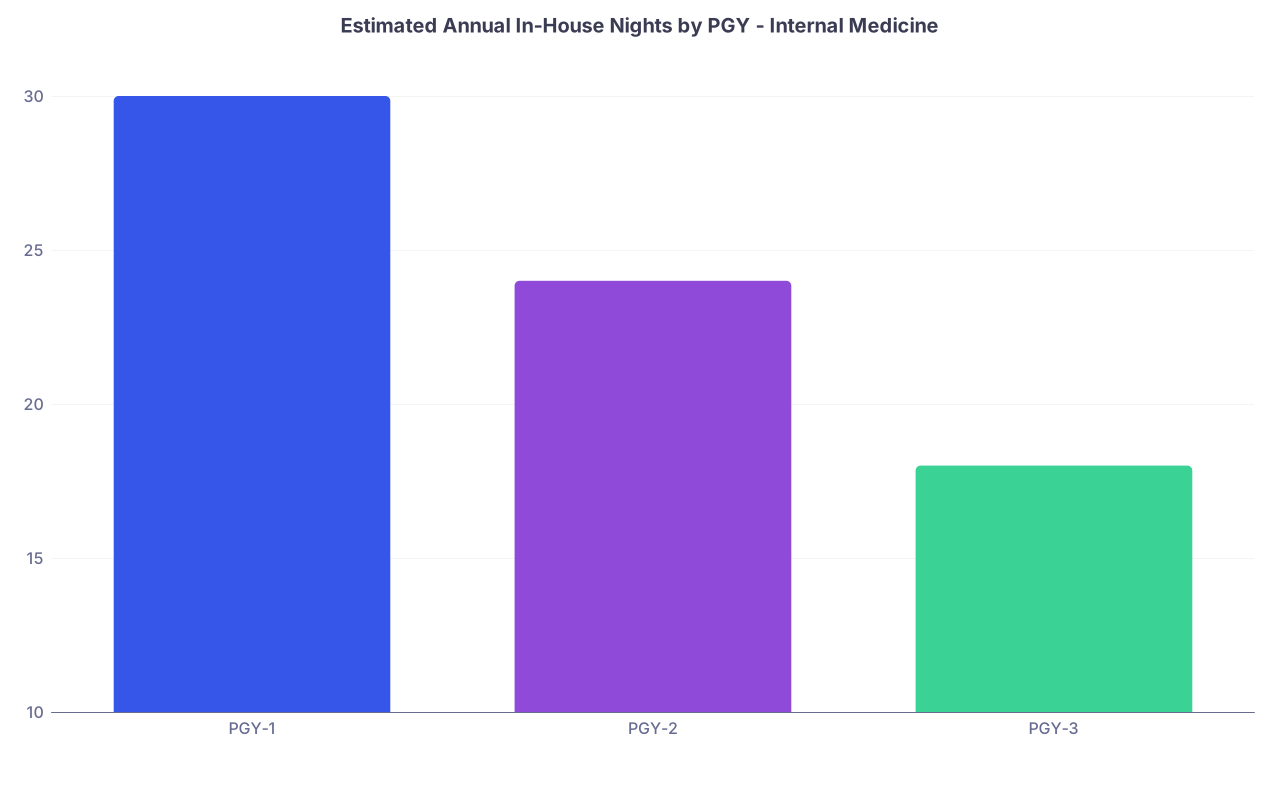
| Category | Value |
|---|---|
| PGY-1 | 30 |
| PGY-2 | 24 |
| PGY-3 | 18 |
Who actually has the heaviest call within IM?
- ICU rotations (MICU, CCU): More frequent nights (often q3–q4 short calls or night float)
- Busy academic safety-net hospitals: More admissions, more cross-cover, more 3 a.m. chaos
But compared to surgery and OB, IM usually has:
- Fewer true 24‑hour in-house calls
- More post-call days fully off
- Cleaner transitions as ACGME and hospitalists have forced more predictable relief
From a survival perspective, IM is heavy but not in the “live here” category beyond PGY‑1.
3. General Surgery: The Classic “I Live Here” Specialty
If you want to talk heaviest night call loads by PGY, General Surgery and OB/GYN tend to be at the top. The difference is that surgery often maintains significant overnight load deep into residency.
General Surgery Call by PGY
A common pattern at busy academic programs:
- PGY‑1: 4–6 calls/month, mix of:
- 24‑hour in-house q4–q6 on ward/trauma
- Night float blocks in some programs
- PGY‑2: Often the peak. 6–8 in-house 24‑hour calls/month is not rare. Trauma, SICU, consults.
- PGY‑3: Still heavy but more focused on specific services; 4–6 calls/month typical in big centers.
- PGY‑4/5: Decrease somewhat, but chief residents still take q4–q6 in many places, especially in trauma and transplant.
On paper, duty hours cap weekly hours at 80 averaged over 4 weeks. In reality, you routinely see weeks scraping that 80-hour ceiling because of 24‑hr calls that run long.
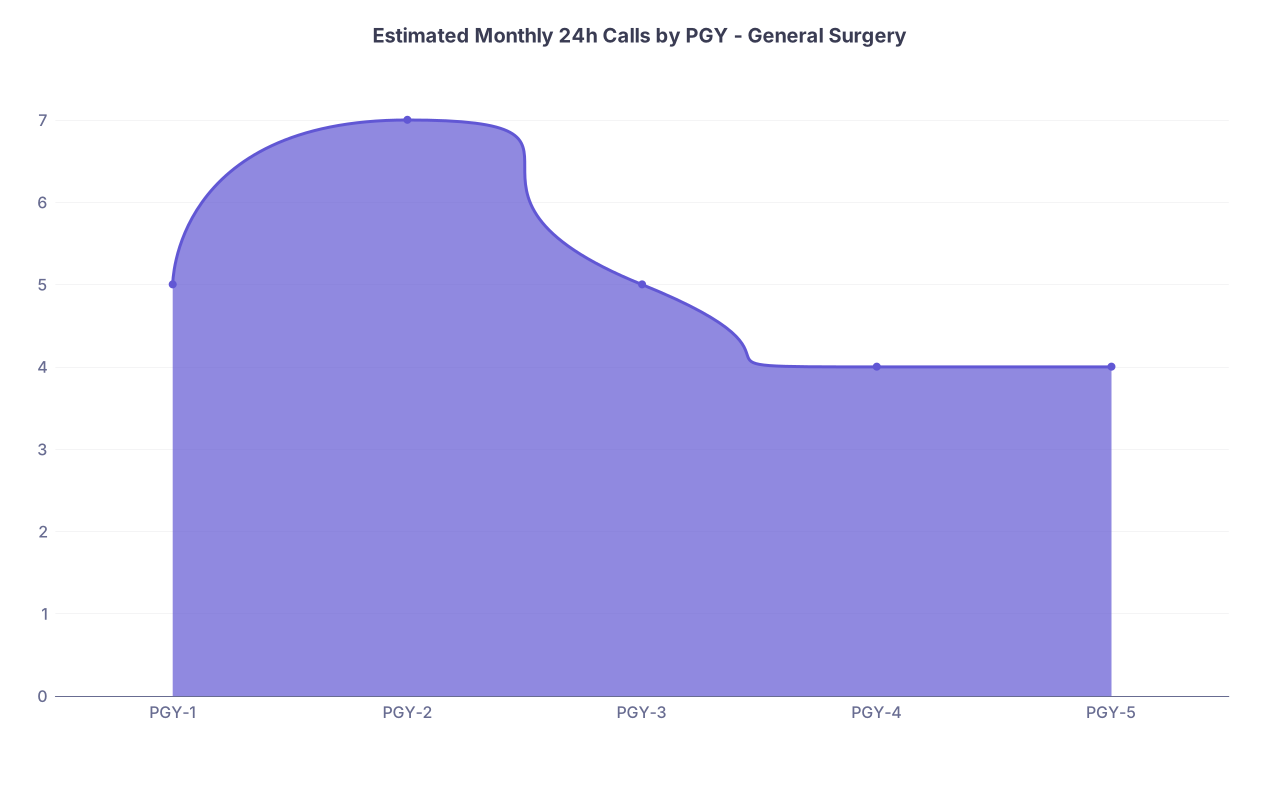
| Category | Value |
|---|---|
| PGY-1 | 5 |
| PGY-2 | 7 |
| PGY-3 | 5 |
| PGY-4 | 4 |
| PGY-5 | 4 |
The painful part: 24‑hour call is not truly 24 hours. Add morning rounds beforehand, sign-out after, and you get 26–30 hours awake if the pager will not stop. That distorts your life in a way a 12‑hour night shift does not.
General Surgery has:
- The highest density of 24‑hour calls early on
- Major trauma and emergency operative volume at night
- Less relief from hospitalist or nocturnist models
If your question is “Which specialties have the heaviest night call loads by PGY level?” General Surgery PGY‑2 is consistently in the top 3 at any hospital with a real trauma service.
4. OB/GYN: Nights on Steroids in PGY‑1 and PGY‑2
OB/GYN mixes the worst of both: medicine-level cross-cover plus constant potential for emergent operations (stat C-sections, hemorrhage, ectopics).
Most OB/GYN residents describe PGY‑1 and PGY‑2 as dominated by L&D and night call. Numbers from several program schedules show:
- PGY‑1:
- 2–3 months of L&D with q4–q5 24‑hour calls
- Additional GYN service call (often 24‑hour)
- Peak months: 6–8 in-house 24‑hour calls
- PGY‑2:
- Often the heaviest. More responsibility on L&D, still high call frequency.
- 6–8 24‑hour calls/month on busy rotations common.
- PGY‑3 and PGY‑4:
- More subspecialty (MFM, REI, Gyn Onc) but still frequent call, 3–5 nights/month at many programs.
OB/GYN call is uniquely unpredictable because of:
- Continuous labor floor
- Emergency cases that cannot wait until morning
- High medicolegal pressure at all hours
In terms of night call intensity, a PGY‑2 OB resident on a busy L&D service basically lives on the unit. They might technically be off some days, but their circadian rhythm never really resets.
If you are comparing pure nocturnal suffering:
- General Surgery PGY‑2
- OB/GYN PGY‑1/2
are the two majors that usually own the top slots.
5. Emergency Medicine: Nights as a Core Job Function
Emergency Medicine is weird compared with other specialties: there is no “call” in the classical sense, there are just shifts. Day, evening, and night shifts. Forever.
But the proportion of nights is not random.
Common pattern in 3‑year EM programs:
- PGY‑1:
- 14–18 shifts/month total
- Nights: 4–6/month (roughly 25–35%)
- PGY‑2:
- 16–20 shifts/month
- Nights: 6–8/month (30–40%) – often the peak for nights
- PGY‑3:
- Slightly fewer total shifts (12–18) and sometimes a modest reduction in nights (4–6/month), but not universally
The primary difference vs surgery/OB:
- Length: 8–12 hours, not 24+
- You are paid in circadian damage rather than consecutive hour count
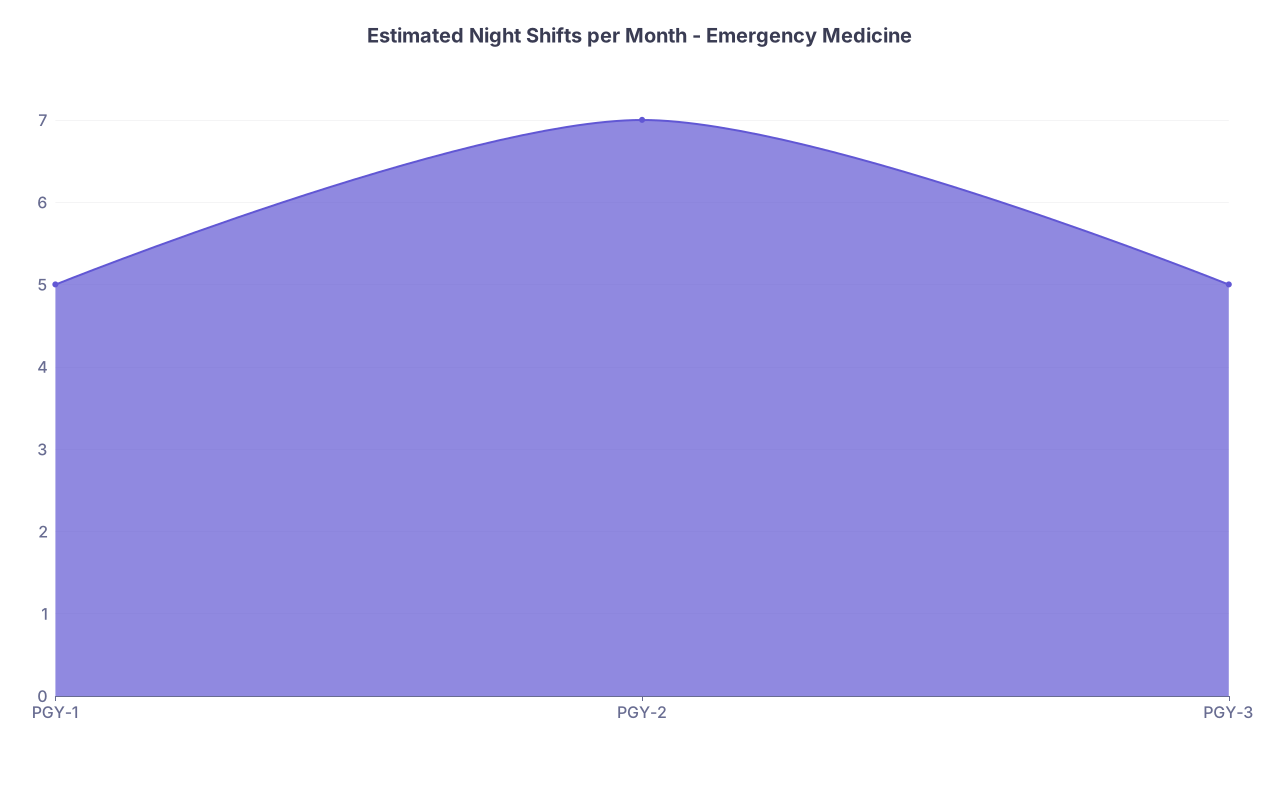
| Category | Value |
|---|---|
| PGY-1 | 5 |
| PGY-2 | 7 |
| PGY-3 | 5 |
Many EM folks will tell you nights feel worse than the numbers suggest, because:
- You never fully adapt (constant rotation through days, evenings, nights)
- Nights are often higher acuity and lower staffing
- Sleep after a 3 a.m. to 7 a.m. adrenaline peak is garbage
If the question is “Who has nights forever, even as an attending?” EM is top of the list. But if the question is “Who has the heaviest call loads by PGY?” EM is intense but more evenly distributed, not front-loaded in the first two years like surgery and OB/GYN.
6. Pediatrics and NICU: Heavy but Slightly Softer Edges
Pediatrics does not get the same reputation as surgery or OB, but the data from schedule templates show that peds residents still carry a substantial night burden, especially in:
- NICU
- PICU
- General wards at children’s hospitals
Typical 3‑year categorical Peds pattern:
- PGY‑1:
- 2–3 night float blocks (4 weeks each, 5–6 nights/week) → ~20–30 nights
- Some 24‑hour weekend calls → +4–6
- PGY‑2:
- ICU-heavy, often 2 months of PICU/NICU nights + gen peds night float → 22–30 nights
- PGY‑3:
- A bit lighter, 15–22 nights/year
Peak PGY? Usually PGY‑1 or PGY‑2 depending on how ICU is structured.
Night work in pediatrics feels different for many residents:
- Fewer overnight elective cases
- A lot of “sick but stable” cross-cover calls
- Periodic terror when a kid decompensates suddenly
Still, on a pure numeric basis, Peds sits just behind IM for night load, with subspecialty variations. NICU-heavy combined programs can skew higher.
7. Neurology and Neurosurgery: The Stroke Pager Never Sleeps
Neurology residents tend to have:
- Night float systems for general neurology and stroke
- A similar profile to IM in terms of nights/year, but with higher-intensity admissions when things hit
Common neurology pattern:
- PGY‑1 (often preliminary medicine): Night call matches IM prelim schedule
- PGY‑2:
- 1–2 blocks of night float → ~15–25 nights
- PGY‑3/4:
- 1 block of night float/year + scattered weekend nights → 10–20 nights/year
Neurosurgery is a different beast. Seven-year programs, heavy call almost the entire way:
- PGY‑1: Surgery-style intern year → 4–6 24‑hour calls/month
- PGY‑2–4: Often q3–q5 24h calls for large chunks of the year on busy services
- PGY‑5–7: Still frequent 24‑hour call but with more control and some from-home elements at smaller centers
Even if the raw number of calls/month is similar to general surgery, the longevity (5–6 years of substantial call) pushes neurosurgery into the “lifetime of nights” category.
8. Orthopedics, ENT, Urology: Surgical but Slightly Less Brutal
Orthopedics, ENT, and Urology are still surgical, still in-house at night for big cases, but the call frequency is often slightly lower than General Surgery and OB/GYN, especially after PGY‑2.
Rough generalization for orthopedics:
- PGY‑1: Similar to surgery interns at that institution; 4–6 calls/month
- PGY‑2: Ortho consult and trauma nights, often 4–6 24‑hour calls/month
- PGY‑3+:
- 2–4 calls/month, often with home-call elements depending on hospital size
ENT and Urology show a similar pattern: extremely painful at a few high-volume academic centers, more moderate at community-heavy programs.
These are not “light night call” fields. They are just somewhat lower on the suffering index than general surgery and OB/GYN when you look at average nights/month across all PGY levels.
9. The Relatively Lighter Night-Call Specialties
Let me be blunt: if you want minimal nights, select out of most hospital-based procedural specialties. The data point strongly at a few fields for reduced night work.
Dermatology
- Most programs: no routine in-house night call
- Occasional home call or rare weekend consult coverage
- PGY‑2–4 derm residents may have effectively zero night shifts in many places
Pathology
- Rare in-house nights
- Some frozen section coverage or transplant-related call from home
- Most residents’ sleep is limited more by exams than by pagers
Radiology
- Diagnostic radiology:
- Night float blocks rather than scattered calls, 1–2 per year
- Often 1 week of nights at a time, 5–6 nights/week, then long break
- Interventional radiology: more true call (emergent bleeding, trauma), many programs still home call with in-house returns as needed
Psychiatry
The variability in psychiatry is under-appreciated.
- Academic psych programs with large ED psych services:
- 4–6 nights/month early on, mix of in-house and home call
- Many community psych programs:
- 1–3 nights/month, sometimes entirely home call
The trend line over the last decade has been toward less overnight in-house psych coverage as hospitals lean heavily on ED physicians and tele-psych.
10. How PGY Level Really Changes Night Call
The question you asked is specifically about how night call varies by PGY level. If we step back and aggregate across specialties, the pattern looks like this:
PGY‑1:
- Heavy nights in IM, Peds, Surgery, OB/GYN, Transitional Year, and EM.
- You are the workhorse; night float and q4 call hit hardest here.
PGY‑2:
- Peak for Surgery, OB/GYN, EM, Neurology, many subspecialty services.
- You are both worker and decision-maker, which programs exploit.
PGY‑3+:
- Convergence: IM, Peds, Neurology, Psychiatry typically get somewhat lighter.
- Surgical fields stay heavy, but gradually trade frequency for responsibility.
If I had to rank “heaviest night call by PGY” across the hospital, looking at typical busy academic centers, it would look something like this:
| PGY Level | Top 3 Heaviest Fields (Typical) |
|---|---|
| PGY-1 | OB/GYN, General Surgery, Internal Medicine |
| PGY-2 | General Surgery, OB/GYN, Emergency Medicine |
| PGY-3 | General Surgery, Neurosurgery, EM |
| PGY-4+ | Neurosurgery, General Surgery, OB/GYN Chiefs |
Is that exact everywhere? Of course not. But the pattern repeats enough that I am comfortable calling it the norm.
11. What This Means for Your Night Shift Survival Strategy
You are not just asking a trivia question. You are trying to predict what your day-to-day will feel like.
Different night-call structures hurt in different ways:
- 24‑hour q4 calls (surgery, OB/GYN, early neurosurg)
- Fewer nights/month but they destroy two calendar days each time: the call day and the postcall “zombie” day.
- Night float blocks (IM, Peds, Neuro, Radiology)
- High density of nights across 2–4 weeks, then long stretches without.
- Distributed 8–12h night shifts (EM, some ICU models)
- Constant circadian disruption, but individual nights are less annihilating.
Your coping strategy has to match your specialty’s pattern:
- For surgery/OB-style 24‑hour calls:
- You protect the 24–48 hours around call as fiercely as the call itself. You do not stack life tasks there.
- For night float:
- You treat it as deployment: adjust your sleep fully to nights, cut extraneous obligations, lean on batch meal prep and automation.
- For shift-based EM:
- You learn your own circadian math. I have seen residents track reaction time, sleep latency, bowel patterns—yes, really—to find their optimal pre-night routine.
None of that changes the structural reality. It just changes how much damage you sustain.
12. Zooming Out: What the Data Say about Sanity and Specialty Choice
One last uncomfortable but necessary point. Surveys of burnout and depression across residents and attendings show a correlation with:
- High night call volume
- Lack of control over schedule
- Long duration of such schedules (years, not months)
Surgery, OB/GYN, EM, and some ICU-heavy internal medicine subspecialties cluster high on all three dimensions.
If your tolerance for sleep deprivation is low, you owe it to yourself to take these numbers seriously. You can love the OR and still choose a specialty with less night work (ophthalmology, for instance). You can love acute care without signing up for five years of trauma nights (hospitalist medicine with a nocturnist track is one option later).
The point is not that heavy call is bad and light call is good. The point is fit. Some residents actually thrive on busy ICU nights and shrivel during quiet clinic days. Others are the opposite.
The data are there so you are not surprised.
With this call landscape in your head—who takes the brunt at each PGY level, how many nights we are talking about, and what shapes those nights take—you are better equipped to choose a specialty and to plan your survival tactics. The next step is translating that into concrete, week-by-week systems for staying functional on nights. That is where night shift survival moves from theory to practice—but that is a story for another day.


