

The biggest lie international professionals hear about US medicine is this: “If you just work hard enough, it’ll work out.” No. Hard work is the minimum. Strategy is what makes or breaks you.
You’re not a 20-year-old biology major with parents in New Jersey and a premed advisor on speed dial. You’re 28, 34, maybe 42. You have a degree from India, Nigeria, Brazil, the Philippines, the UK, wherever. You’ve got a career, maybe a family, maybe a visa that expires in two years. And now you want a US MD or DO.
This is absolutely doable. But only if you stop treating it like a “dream” and start treating it like a logistics and risk management project.
Let’s go step by step.
1. First: Get brutally clear on your starting point
Before you touch an MCAT book or email a single school, you need to know exactly what you’re working with. I mean numbers, not vibes.
Here’s what you write down on a single page:
- Your age
- Your citizenship and current visa status
- Your country of undergrad and degree type
- Your GPA (or the closest you can approximate)
- Your science background (courses actually taken)
- Your financial reality (actual numbers, not “I’ll figure it out”)
- Your timeline constraints (visa expiry, family obligations, job contracts)
I’ve watched too many people spend two years on MCAT prep only to find out later that most schools will not accept their foreign credits as prerequisites. That’s how you lose years.
The degree problem: foreign vs US/Canadian
If your bachelor’s degree is from outside the US or Canada, you are in a different game than domestic students.
Most US MD and DO schools want:
- Either a US/Canadian bachelor’s degree
- Or at least 60–90 credits from a US/Canadian institution
- Plus specific prerequisite science courses taken in the US/Canada
There are exceptions, but not many. And “exceptions” often mean “you need to be extraordinary or fit a specific institutional mission.”
So you sort yourself into one of three buckets:
| Profile | Undergrad Location | US/Canada Coursework | Typical Path |
|---|---|---|---|
| A | Entirely foreign degree | 0 credits | Post-bacc or 2nd bachelor's in US/Canada |
| B | Foreign degree + some US credits | 15–60 credits | Target post-bacc or complete prereqs in US |
| C | Full US/Canadian degree (on visa or abroad) | 120+ credits | Standard non-trad premed route |
If you’re in A or B, you’re most likely looking at at least 1–2 years of US coursework before you’re even a credible applicant. Not optional. Required.
2. Choose your realistic strategic “lane” early
You essentially have four main target paths. Don’t chase all four at once.
- US MD
- US DO
- Caribbean MD with goal of US residency
- Stay in your country, become a physician there, then US via ECFMG (IMG route)
Each has tradeoffs. Rough version:
- US MD: Most competitive, best long-term flexibility, most conservative schools about foreign credits.
- US DO: Slightly more open to nontraditional paths, more holistic at some schools, still competitive.
- Caribbean MD: Easier entry, much harder on the back end (residency bottleneck). High risk.
- IMG route: You train as a physician abroad first, then USMLE + match. Possible, but you’re committing to two systems.
If you’re already 30+ with zero US coursework and limited money? Pure US MD-only fixation can be a trap. You can still aim there, but you need contingency lanes built in early.
3. Fix the foundation: courses, GPA, and US credibility
If your prior degree is from outside the US/Canada, you have two problems:
- Your GPA doesn’t convert neatly into a US GPA
- Adcoms don’t know how rigorous your school actually was
So what do you do? You build a US academic track record they can understand.
Paths that actually work
Here are realistic options, in order of control and credibility:
Formal post-bacc in the US
- Examples: Columbia, UPenn, Goucher, state school post-baccs
- Pros: Structured, advising, linkage possibilities, strong signals
- Cons: Expensive, selective, may require you to already be in the US
DIY post-bacc at a US state university or community college
- You enroll as a non-degree or second-degree student
- Take core prereqs: Gen Chem, Bio, Physics, Org Chem, Biochem, maybe Calc/Stats
- Pros: Cheaper, more flexible, widely available
- Cons: Requires more self-organization; some top MD schools prefer 4-year institutions over community college, but many DO schools are fine
Second bachelor’s in the US
- Pros: Maximum credits, clear GPA, full immersion in US system
- Cons: Time-consuming and expensive, but can work well for visa purposes (F-1)
You’re aiming for as close to a 3.7+ in your US work as you can reasonably get. Especially in the core sciences.
If your foreign background is in non-science (law, business, engineering, arts), that’s not a problem. You just have to prove you can crush science coursework now.
4. Visa and immigration: the silent constraint that can ruin good plans
If you’re not a US citizen or permanent resident, you do not get to ignore immigration realities. Schools and residency programs certainly don’t.
Common situations I see:
- H-1B worker in tech/finance trying to switch
- F-1 student finishing a US degree, wants to pivot to medicine
- Spouse on H-4 or dependent visa
- Outside the US entirely, no visa yet
Each one changes your strategy.
Key truths:
- Only a small subset of US MD/DO schools accept or fund international students
- Many schools technically accept internationals but rarely actually take more than 1–2 per year
- Those that do often require proof of 4 years of tuition in escrow or certified funding
- Federal loans are not available to non–green card holders
So if you’re international + non-PR, your practical target list shrinks fast. And your financial planning has to be ruthless.
For some people, the better first move is:
Get to the US on a realistic path (master’s, second bachelor’s, employment), build US presence and academics, then apply.
This is not as glamorous as “I’m applying straight from abroad to Harvard Med,” but it has a much higher success rate.
5. MCAT strategy when you’ve been out of school for years
If you’re a mid-career engineer from India or an accountant from South Africa, the MCAT will punch you in the face if you treat it like a generic standardized test.
The MCAT tests:
- US-style undergraduate science assumptions
- Speed reading and synthesis of long passages
- Stamina over 7+ hours
- English nuance that even native speakers find annoying
You’re managing two problems at once: content gap and test-culture gap.
Basic sequence that works
Do a brutally honest diagnostic
- Not a 20-question quiz. A full-length or at least a legit half-length early on.
- Just take it, bomb it, and see where you actually are.
Front-load content review smartly
- You cannot spend 12 months “just reviewing content” and then start practice exams. That’s how people stall.
- You want maybe 3–4 months of structured study, mixing content review with practice questions from week 1.
Treat CARS like its own language
- If you’re not trained in dense English humanities-style reading, CARS is a separate project.
- Daily CARS practice. No exceptions. 30–60 minutes, like brushing your teeth.
-
- You’re probably working full-time. That means you need a calendar, not vibes.
- Block 10–20 hours per week, consistently, for 4–8 months depending on your starting point.
You want to aim realistically:
- For MD: 510+ is where you stop being dismissed out of hand at most places. Higher is better.
- For DO: Many strong applicants are in the 500–508 range, though higher always helps.
Don’t sign up for an MCAT date until you have 2–3 practice scores in your target range. Not “hoping you’ll jump 10 points on test day.”
6. Clinical experience: your “international healthcare” history is not enough
Common situation: you were a pharmacist, nurse, physio, or even a physician outside the US. You think, “I have tons of clinical experience.”
US adcoms don’t automatically see it that way.
Reality:
- They want to know you understand US medicine: culture, system, patient expectations
- They want to see you in explicitly subordinate, learner roles: shadowing, volunteering, scribing, etc.
- They want to see recent experience, not just “I was a doctor 10 years ago in Cuba”
So whether you have prior healthcare experience or none at all, you need US-based exposure.
Concrete options that work
- Shadowing US physicians (in-person, ideally multiple specialties)
- Hospital volunteering (patient transport, ED volunteer, etc.)
- Clinical jobs: medical assistant, scribe, CNA, phlebotomist, etc.
- Community clinic volunteering, free clinics, mobile clinics
If you’re abroad, this is harder but not impossible. You find:
- US-trained physicians practicing in your country
- Telehealth shadowing opportunities
- NGOs and global health orgs with US affiliations
But if you ultimately want US MD/DO, at some point you need real US-based exposure. Your file looks much weaker without it.
7. Research, volunteering, and the “too mature” concern
Some older applicants worry: “Am I too old to be doing student-level research or volunteer work?” No. You do what the process demands.
You don’t need to fake being 20. You do need to show:
- You can function in academic or clinical teams
- You understand service and patient populations
- You can commit to something consistently
For research:
- Not mandatory for DO and many MD schools, but strongly helpful
- Can be clinical, translational, or even educational—doesn’t all have to be bench science
- One solid multi-year project beats five short fluff projects
For volunteer/service:
- Longitudinal is better than random
- Deep engagement in 1–3 things looks more mature than 10 scattered one-offs
- If you’re already in a caring profession (teacher, social worker, etc.), that can count—but supplement it with something closer to healthcare
You’re building a narrative: “I understand service, I understand patients, and I can commit.”
8. Targeting MD vs DO vs Caribbean as a mid-career international
You need to be honest about risk tolerance and time.
If you’re:
- Age 25–32
- Can commit to 2–3 years of US coursework
- Have or can get stable visa/PR status
- Willing to relocate as needed
Then aiming at both MD and DO is reasonable, MD somewhat aspirational, DO as a very strong main lane.
If you’re:
- Age 35+
- On a precarious visa
- Cannot afford multiple years of pre-reqs + unpaid time
- Pressured by family/finances to “start training soon”
Then Caribbean or IMG routes get tempting. But they carry serious match risk. I’ve seen too many people go there thinking, “I’ll just work harder,” and run into objective barriers: low match rates, limited residency options, visa sponsorship issues.
Here’s a cold summary:
| Path | Entry Difficulty | Residency Risk | Visa/Financial Burden |
|---|---|---|---|
| US MD | Highest | Lowest | High but most stable |
| US DO | High | Low–Moderate | Similar to MD, slightly fewer programs in some specialties |
| Caribbean MD | Moderate/Low | High | Very high total cost, major match risk |
If you’re older and must move faster, I’d still lean toward:
- Aggressive DO targeting
- Some MD applications
- Caribbean only after you’ve talked to honest graduates and have eyes open on match data
9. Dealing with your prior career: asset, not baggage
Your old life is your competitive edge, if you know how to use it.
The mistake I see: people either ignore their old career, or they spend 80% of their personal statement writing about it with one vague paragraph about medicine at the end.
You want to do this instead:
- Extract 3–4 concrete skills or insights from your career (leadership, working under uncertainty, cross-cultural communication, data analysis, etc.)
- Show how those have already translated into your premed life (in your classes, research, clinical work)
- Then connect them forward to medicine with specifics, not clichés
So if you were:
- A software engineer: Talk about systems thinking, debugging complex problems, working in sprints → then show how that helped you analyze clinical workflows or research data.
- A teacher: Classroom management, empathy, communication → then show how that shows up in patient interactions or peer teaching.
- A lawyer: Advocacy, negotiating conflicting interests, reading dense text → then show how that aligns with ethics, policy, or complex patient cases.
Adcoms like nontraditional applicants when they see maturity + purpose. They reject nontraditionals when all they see is “midlife crisis + no plan.”
10. Money: if you skip this section, you’ll regret it later
I’ve sat with applicants who had 520+ MCATs and 3.9 GPAs, admitted to US schools, who still couldn’t attend because they didn’t understand the financial side as internationals.
You need hard numbers:
- 4 years tuition and fees: often $45k–$70k per year
- Living expenses: $20k–$30k per year depending on location
- Total 4-year cost: $260k–$400k+ easily
If you’re an international without PR:
- You most likely don’t get federal loans
- Some schools require proof of full 4-year funding up front
- You’ll rely on private loans, family support, savings, or sponsorship
Sometimes the smarter move is:
- Get US permanent residency first (through work, family, etc.)
- Then apply as a domestic student with federal loan access
It might “delay” things 2–5 years but dramatically improves your financial and admissions outlook. Harsh truth but reality.
11. What the actual multi-year path looks like
Let me lay out a realistic 5–7 year arc for a 30-year-old international professional with foreign undergrad, working full-time, currently abroad.
You could adjust, but this is the scale you should be thinking in.
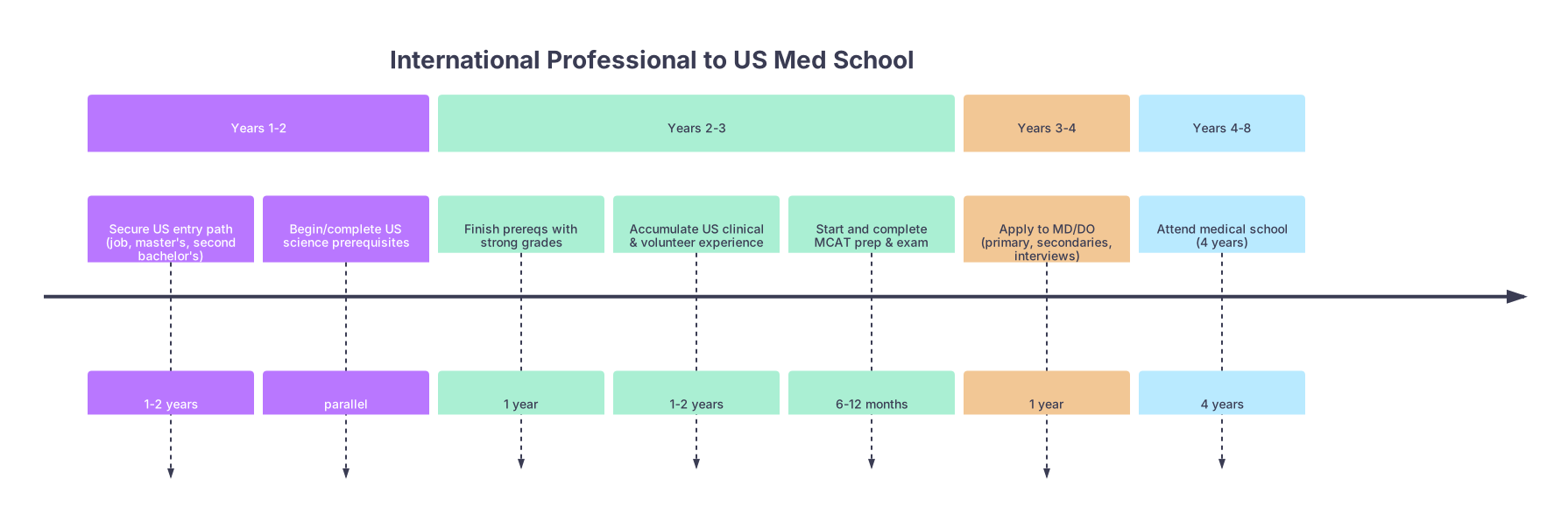
| Period | Event |
|---|---|
| Years 1-2 - Secure US entry path (job, master's, second bachelor's) | 1-2 years |
| Years 1-2 - Begin/complete US science prerequisites | parallel |
| Years 2-3 - Finish prereqs with strong grades | 1 year |
| Years 2-3 - Accumulate US clinical & volunteer experience | 1-2 years |
| Years 2-3 - Start and complete MCAT prep & exam | 6-12 months |
| Years 3-4 - Apply to MD/DO (primary, secondaries, interviews) | 1 year |
| Years 4-8 - Attend medical school (4 years) | 4 years |
Yes, it’s long. No, that doesn’t mean it’s not worth it. But you need to stop thinking in 12-month chunks and start thinking in phases.
12. How to decide if this path is still right for you
If you’ve read this far, you’re serious. So here’s a straight test I use with people:
You probably should pursue this if:
- You’ve looked at a 7–10 year timeline and your main reaction is, “Okay, what’s step one?”
- You’re willing to redo undergrad-level work and be a beginner again in your 30s or 40s
- You can tolerate uncertainty for several years and still keep moving
- You’ve talked to actual physicians (not just YouTube) about their daily reality and still want in
You probably should not if:
- The main attraction is prestige or a vague “doctor = success” idea
- You deeply hate studying or taking tests and always have
- You’re hoping this will be easier than fixing your current career
- You cannot afford for this to go wrong financially and have no safety net
Harsh, but better now than after $40,000 of post-bacc and MCAT prep.
13. How to start in the next 30 days
You don’t need a five-year plan right now. You need a 30-day plan that isn’t delusional.
If you’re abroad:
- Research which US schools accept international students and foreign degrees vs which require US coursework
- Map visa options that could plausibly get you to the US (study, work, dependent)
- Start a basic MCAT diagnostic just to feel the test, not to master it yet
- Begin contacting US-trained physicians in your country for shadowing or advice
If you’re already in the US:
- Talk to an actual premed advisor at a 4-year college or state university, even if you’re not enrolled yet
- Register for 1–2 science courses in the next term (Gen Chem + Bio for most people)
- Start low-intensity MCAT exposure (CARS passages, basic content review)
- Apply to one hospital/clinic volunteer or scribe/MA opening
Momentum beats perfection.
Key Takeaways
- Being an international professional is not a disqualifier—but it absolutely changes the rules. You need US coursework, US clinical exposure, and a visa/financial plan that isn’t fantasy.
- Pick your lane early: MD, DO, IMG, or Caribbean, and build a multi-year plan that matches your age, money, and immigration reality—don’t just “see what happens.”
- Treat this as a long, structured project: fix your academic foundation, build a credible US profile, respect the immigration/financial constraints, and move in deliberate 6–12 month phases, not in impulsive leaps.


