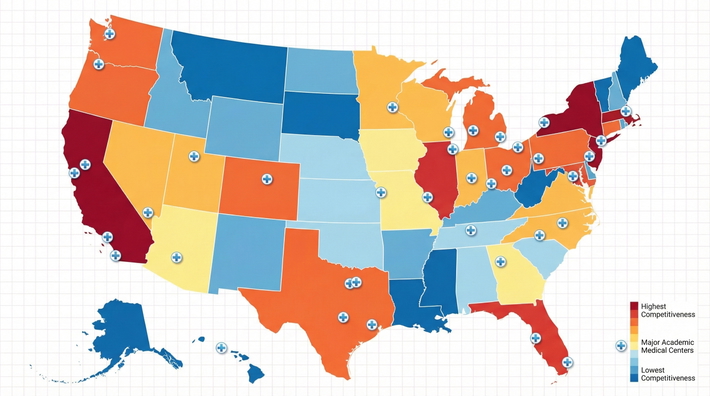
The worst way to choose between two regions you like is to “go with your gut” without forcing your gut to explain itself.
If you’re torn between two very different regions for residency or your future career—say, Pacific Northwest vs. Southeast, big coastal city vs. midwestern college town—what you’re feeling is normal. I see this every year with MS4s and residents: “I could be happy in both places… but which one is right?”
Here’s the answer: stop looking for the perfect place. Start asking the right questions, in the right order, with the right level of honesty.
This is how you do it.
Step 1: Decide What Actually Matters (Not What Sounds Good)
People say all the same things on interview day: “I care about training quality, work-life balance, and being near family.” Fine. But that’s vague enough to be useless.
You need to translate those into specific, rankable priorities. Not 20 of them. 5–7 at most.
Start with these buckets and force yourself to be concrete:
Career and training
- Do you need a strong pipeline into a specific fellowship?
- Are you planning on academic medicine, private practice, or you truly do not know?
- Do you care about big-name reputation or just solid clinical volume and teaching?
- Are there niche opportunities (global health, health policy, biotech, sports medicine, rural practice) that cluster in one region?
Relationships and support system
- Where will your partner realistically be happiest and employable?
- How often do you actually see your family now? Monthly? Twice a year? Be honest.
- Who will physically show up if you get sick, burned out, or depressed?
Money and long-term positioning
- Cost of living differences. Not theoretical—actual numbers.
- State income tax, property prices, loan repayment programs, retirement savings potential.
- How each region positions you for where you might want to settle later.
Lifestyle you’ll sustain during residency
- Climate you tolerate versus climate you fantasize about.
- Commute length and transportation (do you hate driving? hate subways?).
- Do you need nature on your days off, or do you want restaurants and nightlife you’ll barely use?
Identity and values fit
- Political climate and cultural norms.
- Diversity of patients, colleagues, and the community.
- Safety and how comfortable you feel walking home at 9–10 pm.
Now, here’s the part people skip: you have to rank these. Not “they’re all important.” That’s how you stay stuck.
Write them down, then force this kind of specificity:
- “If I had to choose, I’d sacrifice proximity to family for better fellowship chances.”
- “I care more about my partner’s job prospects than about living near mountains.”
- “I’m willing to earn less now for a place I’d be happy to settle long term.”
This gets uncomfortable. That’s how you know you’re finally doing it right.
Step 2: Turn Vibes into Data
You probably “like” both regions. The food was good. People seemed friendly. The scenery slapped. None of that helps you decide when rank list certification is staring you down.
You need structured comparisons.
Start with a simple table. Keep it brutal and short.
| Factor | Region A (e.g., East Coast City) | Region B (e.g., Mountain West) |
|---|---|---|
| Training/fellowship match | Strong in subspecialty X | Weaker in X, stronger in Y |
| Partner job market | Good but saturated | Smaller, higher demand |
| Cost of living | High | Moderate/low |
| Family proximity | 1-hour flight | 4–5-hour flight |
| Weather you tolerate | Humid, mild winters | Dry, snowy winters |
| Long-term settle potential | 7/10 | 9/10 |
This is not about fake precision. It’s psychological. Once you see trade-offs on one page, your brain stops pretending it can “have it all.”
Then assign weights. If career is 40%, relationships 30%, money 15%, and lifestyle 15%, then each row isn’t equal. A 1-point difference on “career” matters more than a 3-point difference on “restaurants.”
If you want to go full spreadsheet nerd, you can literally score each region 1–10 on each factor and weight it. I’ve watched more than one resident realize, “Oh. I keep saying both are equal, but when I weight things honestly, the result isn’t even close.”
Step 3: Separate Training Needs from Forever-Home Fantasies
This is where people quietly screw themselves.
Residency is 3–7 years. That’s a long time, but not your whole life. Yet I see applicants pick a region based on forever-home fantasies when residency is actually a stepping stone.
Ask two hard questions:
Do I want to stay in this region long term, or is this a training chapter?
- If you know you want to end up on the West Coast long term, training in the Southeast doesn’t kill that, but it does slightly reduce network density and “home field” advantage later.
- Regions tend to retain people. Train in Texas, you will intersect a ton of Texas attendings, recruiters, and alumni. Same for New York, Midwest, etc.
Is this specialty and this stage of life about training above all else, or do I need emotional stability more than elite pedigree?
- For a super competitive fellowship (peds heme/onc, cardiology at top programs, certain surgical subspecialties), region can matter through name brand and research infrastructure.
- For IM aiming for hospitalist, EM without academics obsession, FM, psych, or peds in community practice, you have more freedom to prioritize life and relationships.
So decide: is this a launchpad choice or a roots choice?
If it’s a launchpad, you bias toward:
- Stronger program reputation and outcomes.
- Region with denser academic centers and opportunities.
- Places where fellowship directors say, “We know residents from there. Solid.”
If it’s a roots choice, you bias toward:
- Region where you can plausibly see yourself buying a house, building community.
- Reasonable cost of living.
- Somewhere your partner and/or kids can actually thrive, not tolerate.
You can absolutely combine both. But if they conflict, you need to know which one wins.
Step 4: Think in Failure Modes, Not Best-Case Scenarios
Everyone imagines the best-case: you crush residency, discover a perfect niche, make friends, and your partner lands a dream job.
You should be asking instead: If this goes poorly, where would I rather be failing?
Because at some point you’re going to:
- Have a terrible block.
- Get into a conflict with leadership.
- Feel like quitting.
- Miss a major family event.
- Deal with illness, breakups, financial stress, or all of the above.
Now you compare regions on their failure cushioning:
- Where do I have at least one person nearby who can show up in person?
- Which region’s culture fits my worst self better—burned out, sleep-deprived, not instagramming hikes?
- If I needed therapy, meds, a new job for my partner, or a quick move within the region, which place is more forgiving?
That’s often where decision clarity suddenly appears.
I’ve heard residents say:
- “I loved the city, but the idea of being that far from anyone who actually knows me scared me.”
- “I realized if things went bad, I’d rather be stuck in a smaller midwestern city with family driving distance away than in a sexy coastal city alone.”
If your two regions are tied on best-case life, choose based on worst-case life.
Step 5: Adjust for Bias and Glamour
Some regions just have better PR.
The coasts. Major “destination” cities. Mountain towns you’ve seen on aspirational blogs. You know the ones.
You need to ask:
- Am I in love with the idea of this place, or the reality for a resident working 60–80 hours a week?
- Will I actually ski/surf/hike weekly, or will I be post-call and asleep?
- Am I letting prestige or Instagram aesthetics drive this, when my actual daily radius will be hospital → apartment → grocery store?
Here’s a rough sanity check:
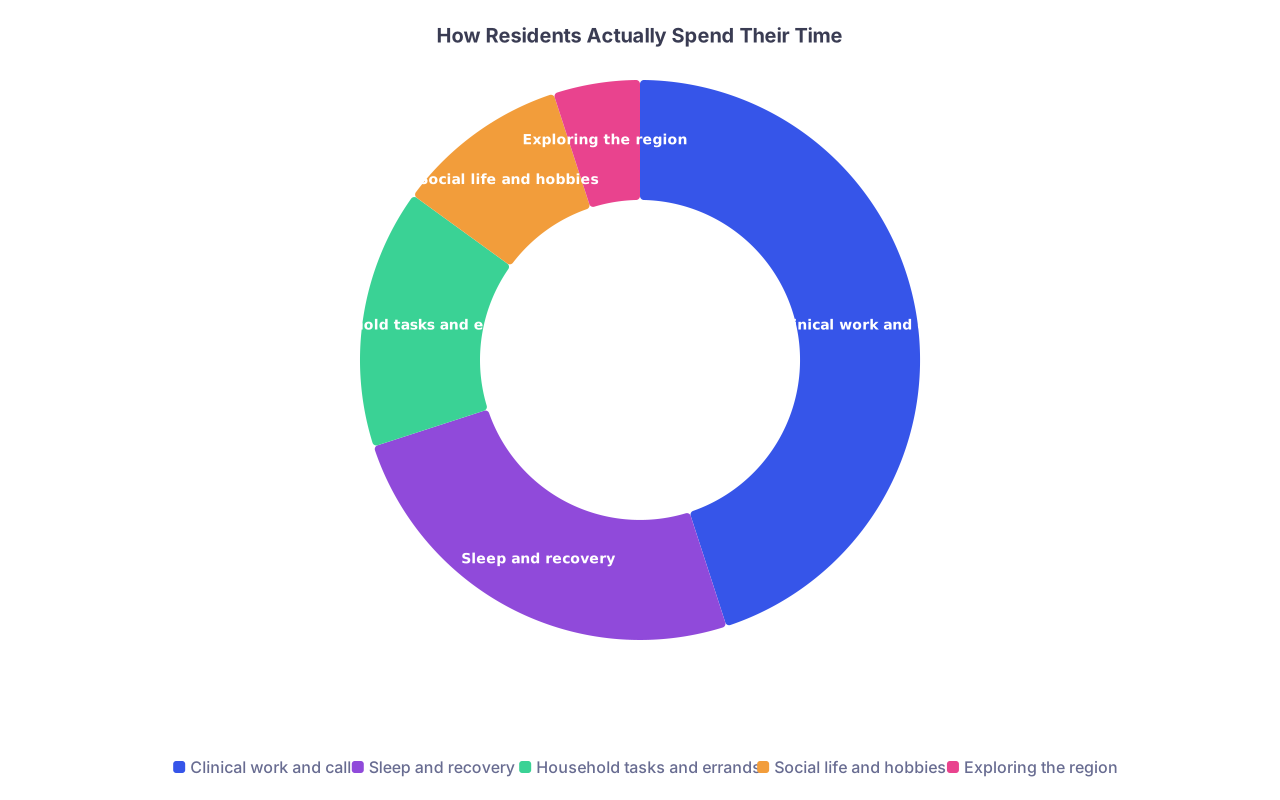
| Category | Value |
|---|---|
| Clinical work and call | 45 |
| Sleep and recovery | 25 |
| Household tasks and errands | 15 |
| Social life and hobbies | 10 |
| Exploring the region | 5 |
If you’re choosing a region 90% because “the city is amazing,” but your actual lifestyle will not allow you to use what’s amazing more than a few hours a week, be honest about that.
On the flip side, don’t romanticize the “cheap, quiet life” if:
- You draw energy from crowds, events, and diversity that simply won’t exist at the level you crave.
- You know you feel out of place in culturally homogeneous or politically misaligned areas.
Here’s the rule: Do not choose a region hoping it will turn you into a different person. It won’t.
Step 6: Pressure-Test With Real Scenarios
Stop thinking in generalities. Run simulations.
Take each region and ask:
- “It’s January. I’m on wards. It’s been raining/snowing/blazing hot for 10 days. What does my day off look like in Region A vs Region B?”
- “My partner didn’t match nearby or lost their job. How hard is it for them to rebuild in each region?”
- “I decide I want fellowship X. Which region gives me more shots—mentors, research, faculty connections?”
- “I have a sick parent. From which region is it more realistic to fly/drive in a crunch?”
- “I hate my program. If I try to transfer or later switch jobs, is this region a trap or a platform?”
Walk through these mentally like you mean it. It’s amazing how quickly one place starts feeling more workable.
If you want to take it further, sketch a simple flow of how your decision plays out.

| Step | Description |
|---|---|
| Step 1 | Choose Region |
| Step 2 | Pick Region with stronger training network |
| Step 3 | Pick Region with better support and fit |
| Step 4 | Use worst case scenario test |
| Step 5 | Commit and stop second guessing |
| Step 6 | Priority - Career or Life |
| Step 7 | Still torn? |
That last box is important: at some point, you have to pick and stop spinning.
Step 7: Use a Simple Tie-Breaker When It’s Truly Equal
Sometimes, after all this, the regions are still basically tied. Different strengths, similar net value.
At that point, you do not need a “right” answer. You need a decision.
Use one of these tie-breakers:
- 10-year self test: Imagine your 10-years-from-now self looking back:
- Which regret stings more: “I never tried living in X” or “I was far from Y during residency”?
- Identity alignment: Which region feels closer to the person you’re becoming, not the person you were at 18?
- Micro-preference honesty: When you stopped thinking about this for a week, which place did you quietly assume you’d chosen?
- Physical reaction check: Say out loud, “I’m moving to Region A for residency.” Then, “I’m moving to Region B for residency.” Which one gives you a tiny sense of relief, even if it also scares you?
If both still feel equal, then flip a coin—and pay attention to which face you silently hope for while it’s in the air. That tells you everything.
And if even that fails? Then yes, actually flip the coin and be done. You’ve done the thinking. There is no hidden cosmic right answer waiting to punish you.
The One Thing You Should Not Outsource
People love to ask attendings, residents, and Reddit: “Which region is better?” Wrong question.
Ask mentors:
- “Given that I care about X and Y, how would you think about Region A vs B for my long-term goals?”
- “Do you know grads from these regions and where they ended up?”
But do not let anyone else’s fantasy life become your plan. Your co-resident who loves New York might have zero desire for kids, no partner, and family 8 time zones away. That’s not your context.
You are the one who has to live your Tuesday nights there. Not the PD. Not your classmates. You.
What You Should Do Today
Right now, write down your top 7 decision factors and rank them in order of importance. Then score your two regions honestly against that list—even if it makes you uncomfortable.
Do not move on to anyone else’s opinion or another round of “pros and cons” until you’ve done that on paper.