The first 90 days of PGY‑1 can make or break how you adapt to a new region’s culture. Most interns drift and “figure it out eventually.” That is a mistake.
You do not have time to wander. You have three months to learn a new hospital, new city, new patient population, and often a completely different cultural rulebook. Treat it like a second hidden curriculum. With a hard deadline.
Here is how your first 90 days should run, week by week, with concrete moves at each point.
Big Picture: The 90‑Day Culture Curve
Think of your adaptation in three phases:
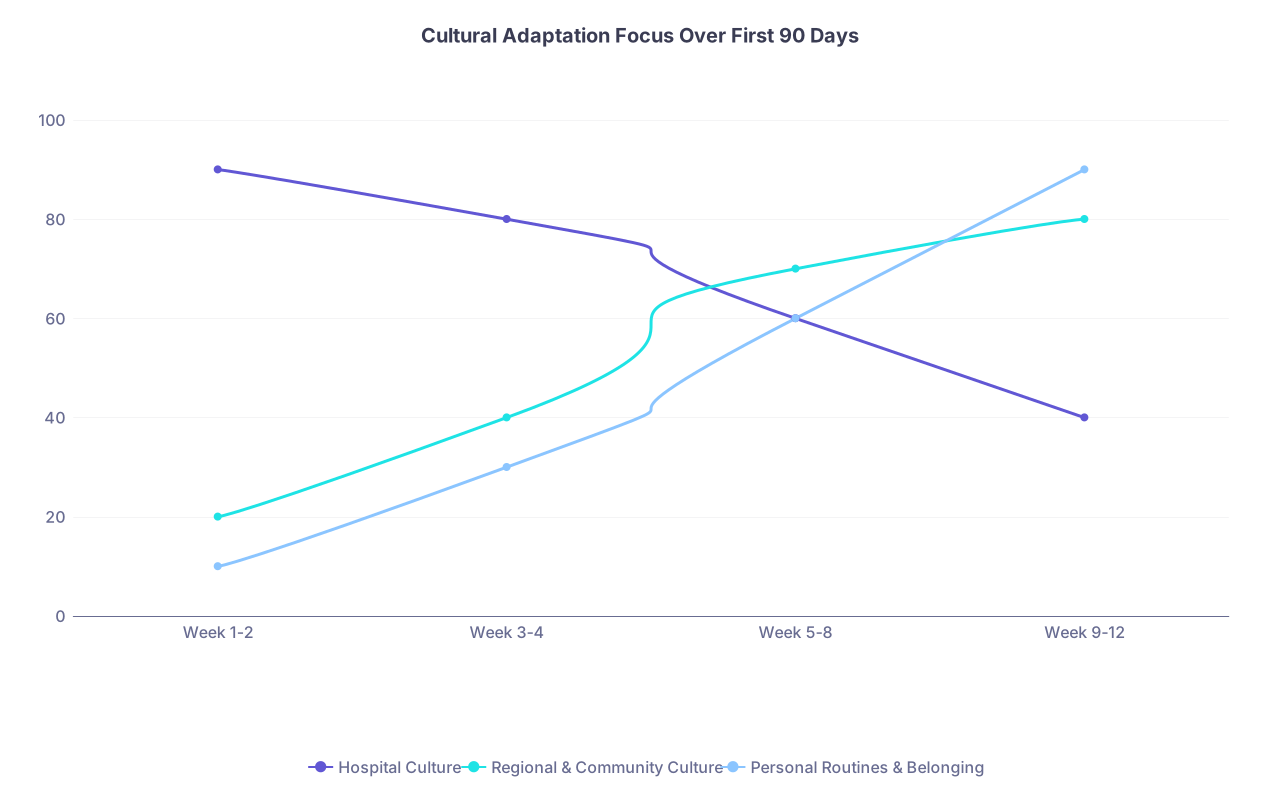
| Category | Hospital Culture | Regional & Community Culture | Personal Routines & Belonging |
|---|---|---|---|
| Week 1-2 | 90 | 20 | 10 |
| Week 3-4 | 80 | 40 | 30 |
| Week 5-8 | 60 | 70 | 60 |
| Week 9-12 | 40 | 80 | 90 |
- Weeks 1–2: Decode the hospital. Survive the firehose.
- Weeks 3–6: Decode the region and community. Stop being a tourist.
- Weeks 7–12: Integrate. Build lasting routines and relationships.
You will work in the hospital. You will live in the region. Both matter. You are learning how to take care of a specific community with specific history, politics, language patterns, and health norms. That does not happen “automatically.”
Days 1–7: Shock Control and Rapid Orientation
At this point, you should not be trying to “fit in” socially. Your job in Week 1 is to:
- Not get lost.
- Not offend people by accident.
- Start a mental map of local cultural landmines.
Hospital + Service Culture (Days 1–3)
You arrive. You are overwhelmed. Good. That means you are paying attention.
In your first 3 days:
Map the people hierarchy by region, not just title.
Watch who everyone defers to on:- Discharge planning (often a senior social worker who knows community resources cold).
- Language issues (the nurse who grew up locally and speaks the dialect).
- Difficult families (the attending who “gets” the neighborhood).
Listen for regional patterns on rounds.
Examples I have heard:- “She’s from East Baltimore; get social work early.”
- “He’s Hmong; ask if we can bring in the community liaison.”
- “He is a fisherman, so he will not leave during lobstering season.”
Write those down. You are hearing cultural shortcuts.
Ask one pointed question per day about the community.
To a nurse, resident, or social worker:- “For patients from [X neighborhood], what do we usually miss?”
- “If a patient refuses [X] here, what’s the usual reason in this area?” This gets you 10x better intel than generic “What is this area like?”
City + Region Basics (Days 1–7)
You are exhausted. You still need to leave the hospital.
In your first week evenings:
Do one 30–45 minute walk in three different directions from where you live.
You are not sightseeing. You are collecting:- What languages you see on storefronts.
- Who is on the street at different hours.
- What food options exist at 10–11 pm when you get off call.
Identify your “support triangle”:
- Closest 24‑hour pharmacy.
- Closest urgent care or ED not at your own hospital (for you).
- Closest grocery store open late.
Note local transit patterns.
In some cities, the subway is safe until midnight. In others, residents and nurses will tell you plainly, “Do not take the train after 9 pm from that station.” Believe them.
Immediate Cultural Red‑Flag List (End of Week 1)
By Day 7, you should have started a list on your phone titled: “Don’t Do This Here.”
Examples:
- “Do not joke about college football with elderly patients in Alabama unless you know their team.”
- “Do not assume Spanish = Mexican; lots of Puerto Rican and Dominican patients here.”
- “Do not call the reservation just ‘the reservation’—use the tribe name.”
You will add to this list constantly. It will save you.
Weeks 2–4: From Tourist to Competent Local Beginner
Now that you are not constantly lost, you shift from pure survival to targeted adaptation.
Week 2: Language and Communication Patterns
At this point, you should build a translation plan and basic regional vocabulary.
Clarify the interpreter reality.
In some regions, every other patient needs an interpreter. In others, there is one Somali interpreter for the entire hospital.Ask:
- “For which languages do we have in‑person interpreters?”
- “When do we use the phone vs. video?”
- “Which communities really dislike phone interpreters?”
Learn 10–15 high‑yield phrases or terms per dominant language / dialect.
Not full sentences. Just the things that matter:- The local word for diabetes, blood pressure, stroke (often different from textbook translations).
- How people refer to certain roles (“Do you say ‘doctor’, ‘provider’, ‘nurse practitioner’, something else?”)
Watch how attendings open conversations with local patients.
In New England, the style may be more reserved. In the South, more small talk. In some immigrant communities, asking about family first is non‑negotiable.Write down 2–3 opening lines that clearly worked and mimic them.
Week 3: Health Beliefs and “Normal” in This Region
By the third week, you should be systematically mapping local health beliefs.
Create a simple table for yourself:
| Category | What You Are Seeing / Hearing |
|---|---|
| Common chronic diseases | e.g., coal-related lung disease, diabetes |
| Typical diet | e.g., heavy fried foods, rice-based, etc |
| Alternative medicine | e.g., cupping, curanderos, herbal teas |
| Mistrust sources | e.g., prior hospital scandal, racism |
| Religious patterns | e.g., prayer times, Sabbath observance |
How to fill it:
- Ask social work: “If I am counseling on diet for patients from [X community], what will actually be realistic?”
- Pay attention when patients say “My pastor said…” or “Back home we…”
- Notice which topics explode quickly:
- Vaccines.
- Pain meds.
- End‑of‑life discussions.
The goal is not to stereotype. The goal is to not walk in ignorant.
Week 4: Work Culture + Off‑Service Rotations
By Week 4, you will often rotate to a new service or at least feel the daily grind.
At this point you should:
Decode each service’s micro‑culture.
Surgery in the Midwest is not the same as psychiatry in the Bay Area. Months can feel like different countries.On Day 1 of any rotation, ask your senior:
- “Anything I should know about how we handle families / visitors here?”
- “Are there particular community issues that come up on this service a lot?”
Track how attendings modify plans based on region.
Examples I have seen:- “We are not sending him home on insulin; he lives 90 minutes from the pharmacy and has no car.”
- “She lives alone in rural Maine; if she falls, no one finds her. She stays until PT clears a safe plan.”
- “This neighborhood has spotty power; that home oxygen plan is a problem.”
Learn the constraints that are invisible on paper.
Do a 1‑month check‑in with yourself.
On a post‑call day, write for 10 minutes:- Three moments when regional culture clearly affected care.
- One interaction you handled poorly because you misread local norms.
- One small behavior change you will try this week.
That reflection keeps you from repeating the same mistakes on loop.
Month 2 (Weeks 5–8): Deepening Ties and Avoiding Cultural Burnout
The second month is danger territory. The initial adrenaline is gone. The hours are still brutal. Culture shock morphs into cynicism if you are not careful.
Weeks 5–6: Build a Local Support Web
By now you should not be socially isolated. If you are, fix it immediately.
Identify three categories of “anchors”:
- Inside hospital, same role: one co‑intern you trust.
- Inside hospital, different role: one nurse or RT who seems grounded.
- Outside medicine: one person or group unrelated to health care.
Do one deliberate “culture lunch” per week.
Could be:- Lunch with a nurse who grew up locally. Ask: “If a new doc keeps making cultural missteps here, what are they usually doing wrong?”
- Coffee with a senior resident who moved here 3 years ago. Ask: “What did you wish you understood about this city in your first three months?”
Record their answers. They are giving you the cheat codes.
- Set one small, recurring non‑work routine in the community.
Examples:- Same coffee shop every Sunday post‑call.
- Weekly farmers market.
- Free community yoga at the park.
This is not “self‑care fluff.” It is how your brain learns: “I live here,” rather than “I am trapped in this hospital box.”
Weeks 7–8: Master Regional Workflows That Affect Care
Now you start thinking like someone who will practice here long‑term, even if you will not.
Learn the local referral ecosystem.
Where do people actually go?- Which FQHCs / clinics reliably see uninsured patients from your population?
- Which mental health resources have 2‑week waits vs 6‑month waits?
- Which home health agencies will drive into that rural county?
Understand regional safety nets and gaps.
Ask case management:- “If a patient here loses their job, what realistic options do they have for meds?”
- “Which neighborhoods are ‘food deserts’ where diet advice is a joke unless we connect them to resources?”
Watch for your own cultural fatigue.
Red flags:- You start rolling your eyes at “these patients” or “this city.”
- You stop trying to pronounce names correctly.
- You default to “noncompliant” instead of “this plan does not fit this person’s world.”
When that happens, you need a reset day. Sleep, eat actual food, talk to someone who is not from your hospital, and then deliberately look for one patient interaction that goes well the next day.
Month 3 (Weeks 9–12): From Surviving to Contributing
By the third month, you are not just adapting. You should start adding value because you understand the region better.
Weeks 9–10: Become the “Local Rookie Expert” for Something
Pick one narrow area where regional culture and medicine intersect, and get good at it.
Examples:
- In a program in Arizona: “I am the PGY‑1 who understands basics of caring for undocumented patients and where they can realistically get follow‑up.”
- In a New Orleans program: “I am the intern who actually read about local environmental exposures and knows which neighborhoods are hot spots.”
- In a rural Midwest program: “I am the intern who knows the reality of farm work injuries and what it means for return‑to‑work planning.”
Concrete steps:
- Spend 1–2 hours one evening reading local public health reports or hospital community needs assessments (they exist; they are usually dry but gold).
- Ask a social worker or community health worker: “What should every intern know about [topic] here?”
Then use that on rounds. Offer practical, region‑savvy suggestions. You will suddenly sound like you belong.
Weeks 11–12: Codify What You Have Learned
At this point, you should stop “winging it” and start capturing your system for the interns who come after you (and for yourself when you circle back to services).
Do two things:
Write a 1–2 page “Regional Culture for Interns” doc for your service.
Keep it concrete:- Common local languages and how to get interpreters fast.
- Three cultural pitfalls to avoid with this patient population.
- Key community resources by type (food, housing, mental health, addiction).
Share it with your chief or program director. Some programs will literally adopt it into orientation.
Make your own “Regional Playbook” for future rotations.
Sections:- Communication: How do patients here prefer to be addressed? Any titles, honorifics, or forms of respect that matter?
- Sensitive Topics: How to approach vaccines, reproductive health, addiction in this region.
- Logistics: Transportation limitations, pharmacy deserts, insurance quirks unique to your state.
This turns your first 90 days into a reusable asset. Not just a blur.
Micro‑Timeline: A Typical Week in the First 90 Days
Here is what a realistic adaptation rhythm can look like once you are not in week‑1 chaos.
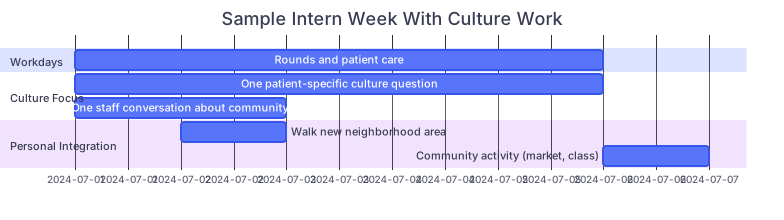
| Task | Details |
|---|---|
| Workdays: Rounds and patient care | a1, 2024-07-01, 5d |
| Culture Focus: One patient-specific culture question | a2, 2024-07-01, 5d |
| Culture Focus: One staff conversation about community | a3, 2024-07-01, 2d |
| Personal Integration: Walk new neighborhood area | a4, 2024-07-02, 1d |
| Personal Integration: Community activity (market, class) | a5, 2024-07-06, 1d |
Notice:
- You are not adding hours of extra work.
- You are embedding cultural adaptation into things you already do:
- One targeted question per day.
- One new neighborhood or community space per week.
- One small reflection or note‑taking session on a lighter evening.
This is how you adapt without burning out.
Common Regional Scenarios and How to Time Your Response
Just to be blunt, here are three classic “new region” traps and when to handle them.
| Scenario | When To Address It | What You Do |
|---|---|---|
| Deep historical mistrust (e.g., Black patients in the South) | Weeks 1–4 | Learn history, listen more than you talk, avoid defensive explanations |
| Strong religious framing of illness | Weeks 2–6 | Learn basic terms, negotiate plans around services and observances |
| Rural resource deserts | Weeks 3–8 | Map realistic follow-up, understand transport, adjust discharge criteria |
Do not wait until Month 6 to realize “Oh, a big chunk of our population is [X] and that changes how we should talk about [Y].” That is a first‑90‑days job.
Final Checkpoint: Are You Actually Adapting?
By Day 90, you should be able to answer “yes” to at least most of these:
- Can you describe your hospital’s main patient populations in 2–3 sentences each, including cultural or regional context?
- Can you name at least three community resources you have actually used in discharge planning?
- Do you have at least one local non‑medical place (café, park, faith community, gym) where you feel like a semi‑regular?
- Can you give one recent example where understanding the region clearly changed your medical decision?
If the answer is “no” across the board, you are not failing as a doctor. But you are behind on learning this place. Catch up deliberately in Months 4–6.
Your Move Today
Do not wait for orientation to “cover” this. It will not.
Today, before you forget:
- Open your notes app and create two headers:
“Regional Culture – What I Notice” and “Don’t Do This Here.”
Under each, add at least one bullet from your current or upcoming region (even if it is just based on what you have heard so far).
That becomes the spine of your 90‑day adaptation plan the moment you step into PGY‑1.