
The belief that “away rotations always beat research for matching highly competitive specialties” is wrong. So is the opposite claim that “research is the real currency now; aways barely matter.” Both are lazy takes that ignore what the actual match data and program director surveys show.
Away rotations and research are tools. Powerful ones. But they do very different jobs in your application, and which one is “better” depends almost entirely on your baseline stats, your target specialty, and how realistic your program list is.
Let me walk through what the numbers actually say, not what the loudest person on Reddit insists.
What Away Rotations Actually Do (And Don’t Do)
First myth to kill: an away rotation is not some magic golden ticket where “if you rotate there, they have to rank you.” No they don’t.
NRMP and specialty-specific data paint a more nuanced picture:
- In procedural and very competitive fields (orthopedics, neurosurgery, plastic surgery, ENT, derm), aways function as month-long auditions.
- In less competitive fields (peds, psych, FM, even many IM programs), aways are often optional, lightly useful, or occasionally net negative if you underperform.
Here is where aways actually move the needle:
They convert you from unknown to known.
You become a real person, not a PDF. Faculty see how you pre-round, how you react when the intern is drowning, how you respond when you miss something on the presentation. Those are things no letter alone can fully capture.They generate very specific, high-yield letters.
“I worked with this student daily on our trauma service; they functioned at or above the level of a sub-intern and would be in the top 5% of our residents” is far more powerful than generic home-institution praise. Program directors repeatedly say high-quality specialty-specific letters from people they know are huge.They give the program cover to rank you aggressively.
Many programs, especially in ortho, neurosurgery, plastics, EM, say some version of this in NRMP Program Director Surveys: “We feel most comfortable ranking applicants highly if we have observed them clinically, often via a sub-I/away rotation.”
Here’s the part people do not like to hear: aways are high variance. If you crush it, great. If you show up underprepared, tired, or socially awkward in the wrong way, you just spent thousands of dollars to convince a program not to rank you. I’ve watched this happen. Multiple times.
So no, aways are not “always good.” They’re an amplifier. They make you more of what you already are.
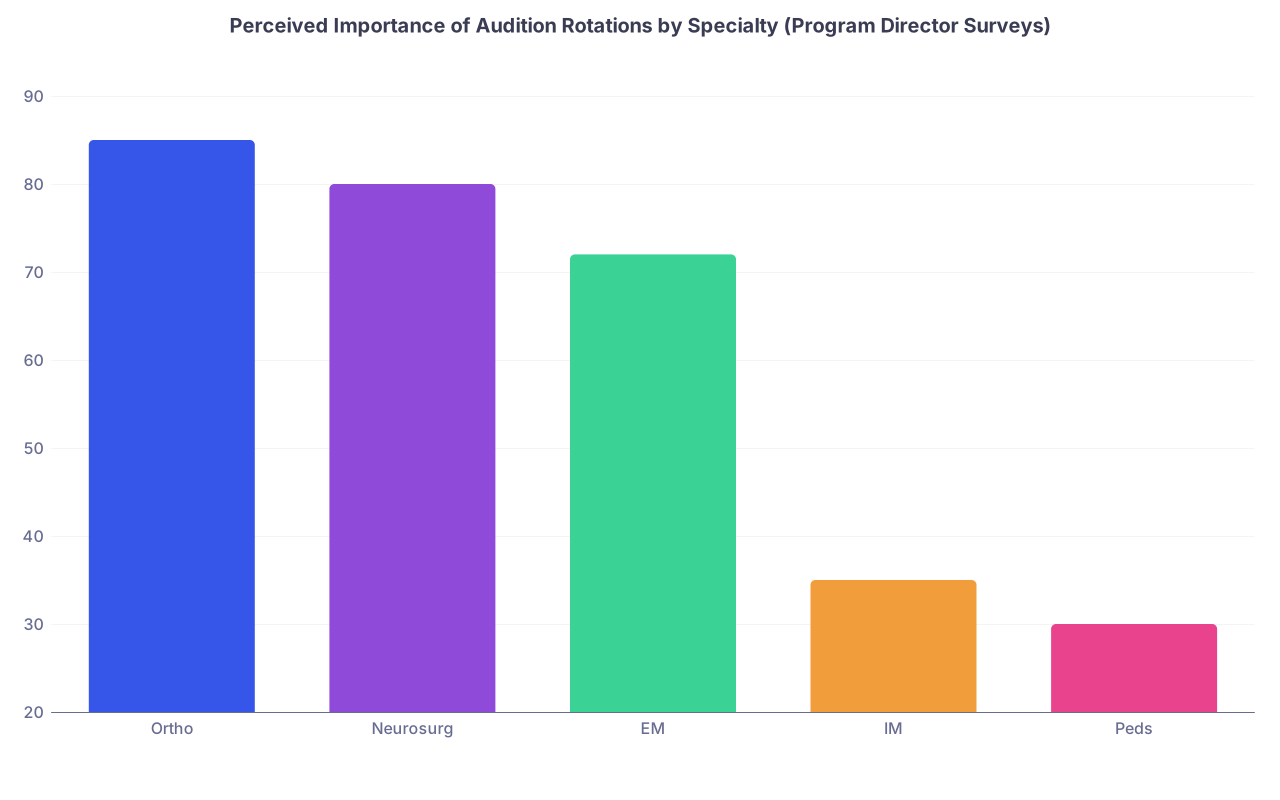
| Category | Value |
|---|---|
| Ortho | 85 |
| Neurosurg | 80 |
| EM | 72 |
| IM | 35 |
| Peds | 30 |
(Values approximate the % of program directors rating away/audition rotations as “very important” in rank decisions. The exact numbers shift by survey year, but the pattern is consistent: much higher in competitive/procedural specialties than in core non-procedural fields.)
What Research Actually Buys You
Now let’s flip to research.
Another myth: “Programs don’t really care about research unless you’re going into academic medicine.” That’s outdated.
Look at NRMP Charting Outcomes data across recent cycles. Applicants who successfully match into the top competitive specialties overwhelmingly have far more research output than those who don’t. We’re not talking one poster in M1. We’re talking multiple abstracts, presentations, and often publications.
But here’s the subtlety people miss: research has diminishing returns and context matters.
- One to three serious, specialty-relevant experiences with at least one tangible output (poster, oral presentation, or publication) is high-yield.
- Twelve “experiences” that are really just your name somewhere in a giant author list from a one-off database study nobody remembers? That’s fluff.
Research helps you in three key ways:
It signals you’re serious about the field.
Derm with no derm research? Red flag at many places. Radiation oncology, neurosurgery, plastics, ortho, academic IM—same story. If you’ve never engaged with the academic side of the field, some programs assume you either don’t understand it or aren’t that invested.It opens doors to mentors who can advocate.
I’ve watched applicants matched at elite programs primarily because a PI picked up the phone and called their former trainee now on faculty at Program X and said, “You should look closely at this one.” That call only happens if you’ve been in the trenches with that mentor.It smooths over slight weaknesses in other areas.
Does research fully compensate for mediocre Step 2 or weak clinical evals? No. But a strong research record can get you on the interview list at places that otherwise might have filtered you out on numbers alone.
But research will not fix chronic unprofessionalism. It will not undo an MSPE full of red flags. It does not magically transform you into a good teammate on wards.
The real problem is students treating “more research” as the answer to everything, piling on projects they barely touch just to inflate ERAS entries. Program directors are not stupid; they can spot the CV-padding strategy a mile away.
Aways vs Research: What the Data Really Suggest
Let’s put some structure to this instead of vague advice. For competitive specialties, here’s roughly how the trade-off looks:
| Specialty | Aways Impact | Research Impact | Notes |
|---|---|---|---|
| Ortho | Very High | High | Both often expected |
| Neurosurgery | Very High | Very High | Nationally small applicant pool |
| Dermatology | Moderate | Very High | Research-heavy, aways variable |
| EM | High | Low-Moderate | SLOEs > research |
| Internal Med | Low-Mod | Moderate | Research matter at top tiers |
| Pediatrics | Low | Low-Mod | Both can help but not crucial |
These are general patterns, not absolute rules, but they line up with NRMP Program Director Surveys and specialty org guidance.
Now the uncomfortable truth: for most students, there is no globally “better” answer. There is only “better for your current situation and target list.”
So let’s be explicit.
When Away Rotations Beat Research
If any of the following describe you, aways are probably higher yield than another generic research poster:
- You’re targeting a specialty where audition rotations are explicitly valued: ortho, neurosurgery, EM, ENT, urology, some surgical subs.
- Your home program is not strong or well known in that specialty, or you don’t have a home program at all (common in derm, ENT, some surgical fields). You need external credibility.
- Your Step 2 and core clerkship performance are solid, but you don’t stand out on paper. You need people to see you in person.
- You already have baseline reasonable research (1–3 solid experiences) but nothing in your application shows that attendings trust you clinically.
I’ve seen mid-tier students land top-25 ortho and EM spots because they just crushed two away rotations. Showed up early, read every night, supported the intern, asked for feedback, fixed weaknesses fast. The letter that came out of that month was worth more than another retrospective chart review any day.
But this only works if you’re realistically strong enough that, when closely scrutinized for four weeks, you look like a plus, not a liability. If your medicine clerkship comments repeatedly say “struggles with reliability,” why would you choose to be evaluated intensely at an away?
When Research Beats Away Rotations
On the other hand, research is clearly higher yield than aways in several situations:
- Extremely research-heavy specialties and programs: dermatology, radiation oncology, neurosurgery, plastics at big-name academic centers. They expect academic curiosity.
- You’re early in med school (M1–M3) and still building your profile; you can’t even do aways yet, but you can build meaningful research and relationships.
- Your clinical performance is fine but not spectacular, and you’re not confident that an away will showcase some hidden superpower you have on the wards.
- You’re trying to break into very academic IM or pediatrics programs (think top 10–20 university hospitals) where publications and conference presentations are currency.
I’ve also seen the reverse story: a student with a 250+ Step 2 and multiple first- or second-author derm papers, who never did an away and still matched at a top-five derm program because their mentors were nationally known and pushed hard for them.
Another nuance: applications with zero research in historically academic specialties are absolutely at a disadvantage at certain programs. No, it may not kill your chances everywhere. But it will quietly filter you out of some of the highest-tier places. They may never say it out loud, but it happens.
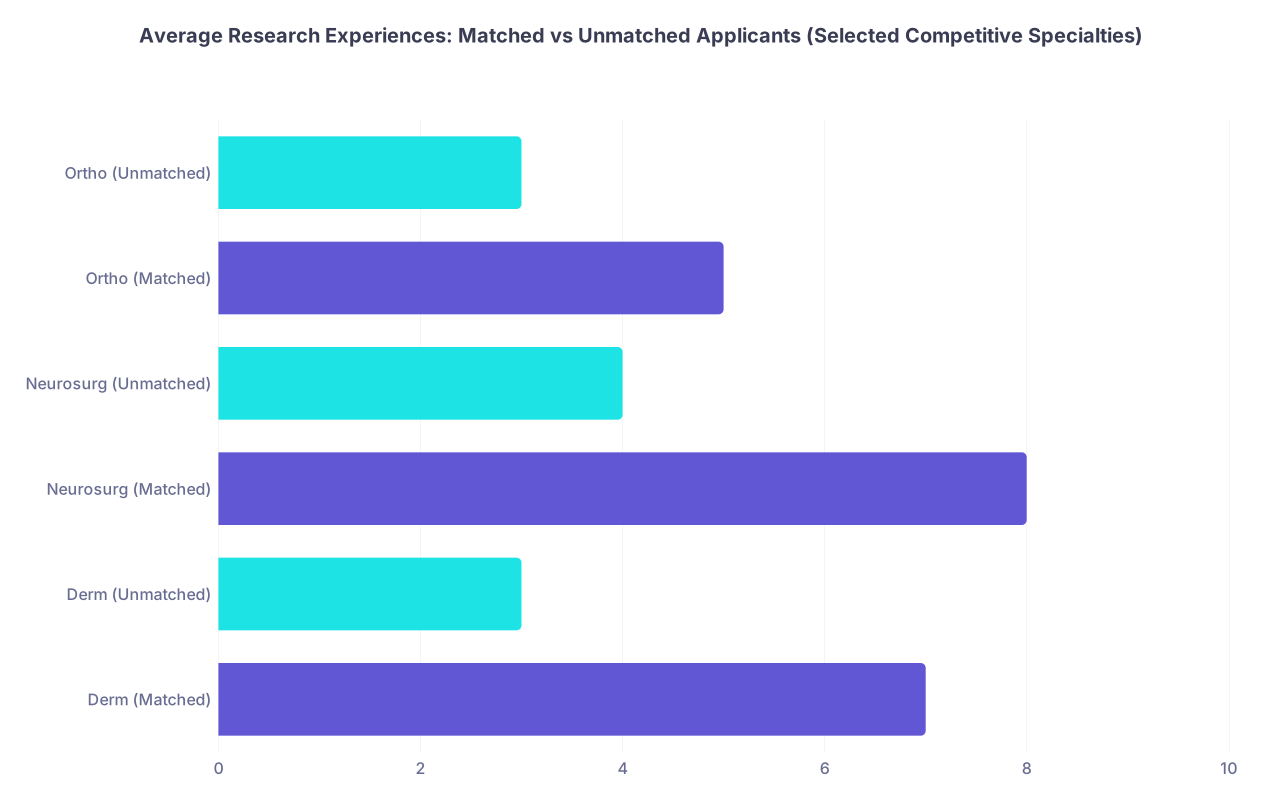
| Category | Value |
|---|---|
| Derm (Matched) | 7 |
| Derm (Unmatched) | 3 |
| Neurosurg (Matched) | 8 |
| Neurosurg (Unmatched) | 4 |
| Ortho (Matched) | 5 |
| Ortho (Unmatched) | 3 |
These are representative of NRMP patterns: matched applicants systematically show more substantial research involvement. Not infinite. But more.
How to Decide Between Away Rotations and Research (For You, Not in Theory)
Here’s the part that actually helps: a decision framework, not another vague “both are important” answer.
Step 1: Be brutally honest about your baseline
You need to know:
- Your Step 2 score relative to your specialty’s typical matched range
- The tone of your MSPE and clerkship comments (are you “outstanding” or “solid”?)
- Whether you already have at least 1–2 meaningful research experiences and any real outputs
If you’re significantly below average on scores and have no research, neither aways nor research is magic. Your primary job becomes realism in specialty choice and program list. Harsh, but true.
Step 2: Map your target specialties and programs
Look up:
- NRMP Program Director Survey for your specialty: how highly do they rate away rotations vs research in rank decisions?
- Your specialty’s resident/applicant profiles at top, mid, and lower-tier programs (most academic programs list resident bios, with research history).
Get specific. Not “ortho in general.” “Midwest community ortho vs top-20 academic ortho.” Different worlds.
Step 3: Apply a simple rule of thumb
If you’re reasonably competitive on paper for your target field and programs (scores, grades, no major professionalism issues), then:
Competitive, audition-heavy specialty (ortho, neurosurg, EM, some surgical subs):
Prioritize 1–2 high-yield aways, make sure you have at least moderate research (even if not stellar). Do not vanish into a 20-project research rabbit hole if you haven’t yet proven you’re an excellent sub-I.Research-heavy, smaller specialties (derm, rad onc, some neurosurg, plastics):
Prioritize serious, sustained research with real outputs and strong mentorship. Do an away if the field strongly values them, but don’t sacrifice a publication for a random away that won’t generate a powerful letter.Core fields (IM, peds, FM, psych):
For top academic IM/peds, research with meaningful output probably beats an away at a random mid-tier place. For everything else, neither is strictly required; do what aligns with your career goals and genuine interest.
Step 4: Stop chasing checkboxes, chase signal
Programs are not counting bullet points. They’re looking for signal that you’ll be a good resident for them.
Aways, when done well, scream: “I can function on a team in your environment. You’ve seen it.”
Research, when done well, says: “I think like an academic, I can push the field forward, I’ve finished hard things.”
If your whole identity is “checkbox collector,” both aways and research will come across hollow. That hurts more than doing fewer things with depth.

| Step | Description |
|---|---|
| Step 1 | Choose Target Specialty |
| Step 2 | Prioritize Strong Research + 1 High-Yield Away |
| Step 3 | Prioritize 1-2 Aways + Baseline Research |
| Step 4 | Prioritize Research with Output |
| Step 5 | Optional: Either Aways or Research Based on Interest |
| Step 6 | Refine Program List |
| Step 7 | Competitive & Procedural? |
| Step 8 | Research-Heavy Culture? |
| Step 9 | Aiming for Top Academic Programs? |
Common Misconceptions You Should Ignore
A few popular myths that keep circulating:
“If you don’t do an away, you can’t match X specialty.”
False. Plenty of applicants match without aways, especially at their home programs or in research-heavy fields where their CV speaks loudly.“If you don’t have publications, you can’t match competitive specialties.”
Also false. Are you disadvantaged? In some fields and programs, yes. But lack of PubMed entries does not automatically mean game over if you have superb clinical performance and strong mentorship.“You need three aways to be competitive.”
Usually a waste. Two well-chosen, well-executed aways beat three exhausted, mediocre ones. By the third, a lot of students are just burned out and sloppy.“Any research is good research.”
No. Low-quality, superficial involvement that you can’t speak about intelligently in detail is obvious and unimpressive. Depth beats sheer count.“Programs only care about Step scores.”
Less true every year, especially with Step 1 pass/fail. Step 2 is still a screen, but once you’re above a cut-off, letters, fit, research, and performance on interview/aways matter more.

The Real Answer: Neither Is “Clearly Better” in Isolation
If you wanted a blunt slogan: aways are for proving you’re a good resident; research is for proving you’re a good academic bet. Different currencies, different buyers.
Strong candidates for highly competitive specialties usually have both. Not a ton of each. Enough of each, done well.
If you are forced to choose because of time, money, or opportunity, your decision should not be based on vague forum wisdom. It should be based on:
- Your actual competitiveness today
- The norms of your specialty and target programs
- Where your genuine strengths lie: clinical performance vs academic curiosity
And then commit. If you pick aways, show up like your career depends on it. Because in some specialties, it does. If you pick research, treat it like real work, not a checkbox. Get something finished and on a poster or paper, not just “ongoing database project” on ERAS.
FAQ (Exactly 5 Questions)
1. If I can only afford one away rotation, is it still worth doing?
Yes—if you choose the program strategically and you’re reasonably confident in your clinical performance. One strong away that yields an outstanding letter is absolutely worth it in audition-heavy fields. But if your choice is between a single random away at a place unlikely to rank you vs a major research opportunity with a strong mentor, many applicants are better off choosing the research.
2. Does my research have to be in the same specialty I’m applying to?
It helps but is not mandatory. Specialty-aligned research is particularly important in derm, neurosurgery, rad onc, and certain academic IM programs. For EM, ortho, peds, and FM, general clinical research or even basic science with serious involvement still looks good, especially if you can explain your role and what you learned. What matters is depth, ownership, and outcomes.
3. How many away rotations are “ideal” for competitive specialties?
For most students: one to two aways. Three is sometimes done in ortho, neurosurg, EM, but the returns diminish and burnout risk skyrockets. Program directors care more about how you performed where you did rotate than whether you collected a third audition just to “show commitment.”
4. Can strong research compensate for not doing any away rotations in EM or ortho?
Generally no. In EM, standardized letters (SLOEs) from home and away rotations are heavily weighted; without them, you’re in trouble. In ortho, seeing you in the OR and on the floor matters a lot. Research can help you get interviews and signal commitment, but it doesn’t replace the audition function of aways in those specific fields.
5. I’m late (M4 already) with minimal research and no aways scheduled. What should I do?
You need to get brutally realistic. For very competitive specialties, your odds may be low this cycle; consider broadening your application, planning a research year, or adjusting specialty choice. For less competitive fields, focus on maximizing your home sub-internship performance, securing strong letters, and, if possible, adding even a small, tangible research product (a case report, small QI project) rather than aimless last-minute aways that won’t generate meaningful advocacy.
Key takeaways:
Away rotations and research aren’t enemies. They’re different tools. For audition-heavy specialties, a strong away beats marginal extra research; for research-heavy fields and top academic programs, serious research often outweighs another random month on wards. The right choice is the one that amplifies your genuine strengths and matches the expectations of your target specialty—not whatever trend happens to be dominating this year’s Reddit threads.


