

You are on day 3 of a five‑day stretch where you somehow scheduled 9 virtual interviews across 7 programs. Your laptop has three different Zoom links open in separate tabs, your phone calendar is screaming overlapping alerts, and you just called the program coordinator “Dr. Nguyen” because that was the PD’s name from the interview you finished 40 minutes ago.
This is what I am talking about: multi‑program virtual interview weekends. Or weeks, really. Brutal if you wing them. Manageable—actually strategic—if you set them up right.
Let me walk through how to handle these with precision, not survival-mode chaos.
1. The Real Problem: Overlap, Cognitive Load, and Fragmented Identity
The challenge with clustered virtual interviews is not just “a lot of interviews close together.” It is three specific problems:
Time collisions and logistics:
- Programs running over time
- Central vs local time confusion
- Socials tacked on unpredictably
- Platform chaos (Zoom, Webex, Teams, proprietary)
Cognitive switching:
- Program A: community heavy, 3+1, no fellows.
- Program B: research powerhouse, QI expectations, three tracks.
- Program C: “family feel,” but you cannot remember anyone’s name from last night’s social.
Identity fatigue:
Telling your “why this specialty / why our program” story 9 times in 4 days. You start sounding like a bad recording of yourself and they can feel it.
Multi‑program weekends magnify all of this. Your margin for error shrinks. So you stop trying to “remember everything” and start building a system that does the remembering for you.
2. Design the Calendar Like You’re Controlling Air Traffic
If you get this wrong, nothing else matters. The number of people who miss interview rooms or show up flustered because “I thought it was Eastern time” is higher than you think. I have seen it every season.
Build a single source of truth
You do not rely on half‑updated emails and a default Google Calendar. You build a master.
- Use one digital calendar only (Google, Outlook, Apple—pick one and commit).
- Set its default time zone to where you will physically be on interview days. Not “where the program is,” not “my home time zone where my family lives,” where you will actually sit.
- For each interview, manually convert the program’s listed time to your local time and type it clearly into the event title.
Example event standards:
- Title: “UCSF IM – Interview Day – 7:45–12:30 local (5:45–10:30 PT)”
- Description:
- Original email blurb pasted in.
- Link(s).
- Contact for tech issues.
- Brief bullets: “Break 9:30–9:45; social 18:00–19:30 PT (separate link).”
Do not rely on automated time zone parsing from links alone. They fail often enough to burn you.
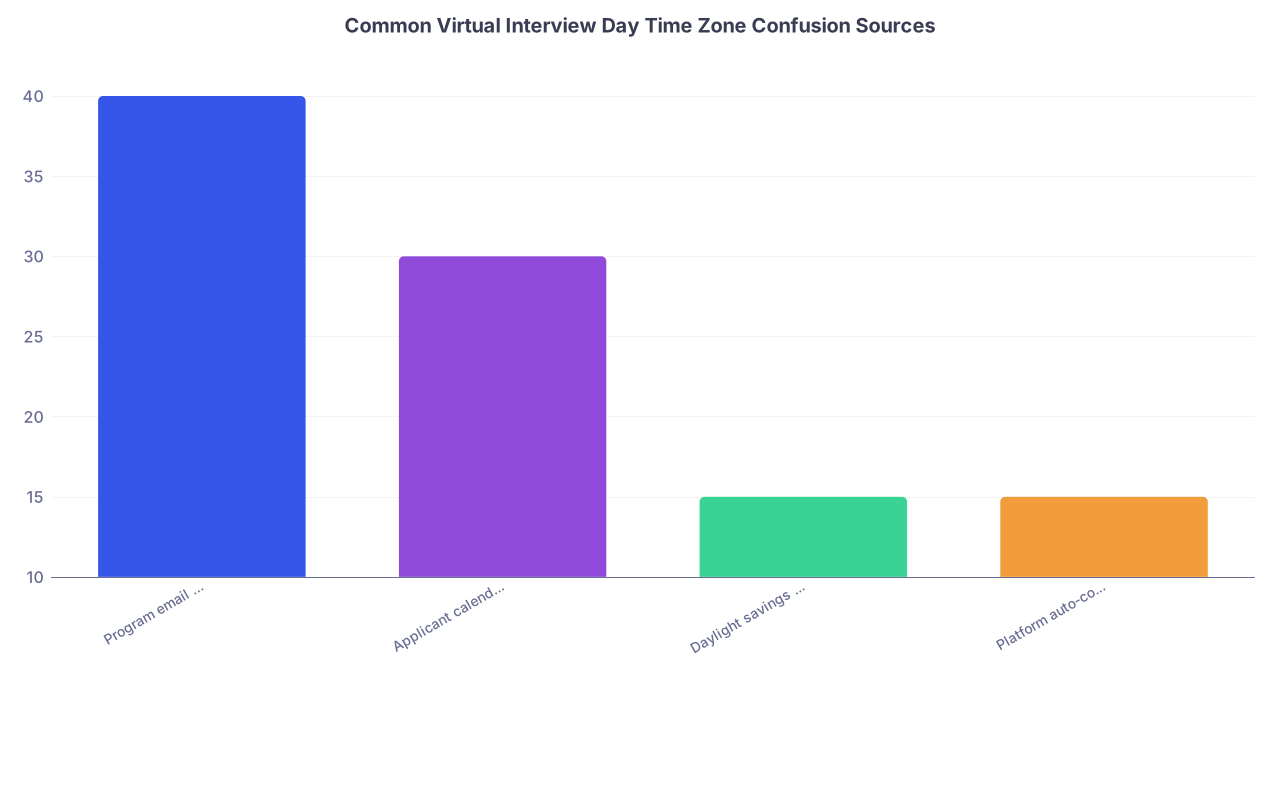
| Category | Value |
|---|---|
| Program email ambiguity | 40 |
| Applicant calendar mis-set | 30 |
| Daylight savings issues | 15 |
| Platform auto-convert errors | 15 |
Hard boundaries on the calendar
When you start stacking interviews, you must protect your transition windows. That means:
No back‑to‑back main interview blocks on the same day.
Two half‑days is fine. Two full days smashed together is how you end up scrambling to log in late.60 minutes protected between interview blocks.
Not “prep time.” Protected. Bathroom, snack, decompress, re‑review notes, tech check. Yes, 30 minutes can work. But if you are stacking programs, you want an hour.Label non‑interview time clearly.
“Admin / notes / break” from 13:00–14:00 is not optional if you have another social at 18:30.
If a program wants to schedule you in a way that will directly collide with another interview? You say so. Early and professionally.
Example email:
Subject: Interview date – scheduling conflict
Dear [Coordinator Name],
Thank you again for the interview invitation. I am very interested in [Program Name].
I have a previously scheduled interview that overlaps with the standard time block on [Date]. Would there be any flexibility for an alternate date or time shift on [Date] (for example a later interview group or a different day)?
I understand if this is not possible and appreciate any accommodation you can provide.
Best regards,
[Your Name], [AAMC ID]
You are not the first person to ask. Good coordinators will work with you if they can.
3. Physical Setup: Treat Your Space Like a Fixed OR, Not a Shared Clinic Room
Multiple interview programs in one stretch means you cannot be troubleshooting equipment on day 3. The setup must be stable, predictable, and boring.
Minimum viable hardware that actually works
- Wired internet if possible. If not, sit next to the router.
- One main screen + one auxiliary screen if you have it.
- A real webcam or at least a stable laptop at eye level. - A dedicated microphone or decent headset. AirPods and Bluetooth introduce latency and battery anxiety—you do not need extra failure points.
Here is what I recommend you lock in at least a week before the big stretch:
- Run full mock interviews using Zoom, Teams, and Webex. Yes, all three.
- Check camera angle: you want head and upper torso, not just floating head.
- Check lighting at the exact times of your interviews (morning glare and afternoon dark are very different).

The “Command Center” layout
You are going to be mid‑conversation while also trying to remember which program uses Night Float vs 24‑hr call. Do not keep that in your head.
On your desk, every day, in the exact same layout:
- Left: printed or handwritten one‑pager for the program you are currently interviewing with.
- Center: laptop / main screen with video platform.
- Right: small notebook for jotting names, specific phrases, and post‑interview notes.
- On the wall or screen edge: small clock that shows your local time, not the computer’s tiny taskbar version.
Consistency reduces cognitive friction. If you are on day 4 of a run, familiar layout is not cosmetic—it is stabilizing.
4. Program Prep When You Have 6+ in 3–4 Days
You cannot do deep‑dive prep for each program the night before when you have three interviews in 36 hours. So you standardize your prep.
Build standardized one‑pagers
One page. Not three. Not “I read their whole website each time.” You will not remember it. Make a template and fill it for each program as you schedule them.
Core sections:
Program basics:
- Location, size of class, community vs academic vs hybrid
- Call structure (night float vs 24‑hour, ICU vs floor)
- Any major tracks (primary care, research, hospitalist, etc.)
“Why this program” anchors:
3 bullets max that you can plug into your answer:- “Strong QI curriculum with resident‑led projects.”
- “Exposure to underserved urban population + county hospital.”
- “Longitudinal mentorship model I actually like.”
Names & roles:
- Program director
- Associate PDs (if highlighted)
- Chief residents
- Any faculty whose work overlaps with your stated interests
Your tailored questions (at least 3–5):
Split by who they are aimed at:- PD/APD questions (curriculum, culture, graduate outcomes).
- Resident questions (schedule reality, support, vibe).
- Fellow/subspecialist questions (if applicable).
| Section | Contents (Max) |
|---|---|
| Program Basics | 5–7 bullet points |
| Why This Program | 3 specific anchors |
| Key People | 3–6 names + roles |
| Questions – PD | 3 focused questions |
| Questions – Residents | 3–5 behaviorally focused questions |
| Red Flags / Concerns | 2–3 items to clarify |
Fill all these out before your heavy week starts. Not the night before. The night before is for quick refresh, not research.
Use focused questions that do real work for you
If you are interviewing at 7 programs in 5 days, you need your questions to gather discriminating data, not fluff.
Compare:
- Weak: “How would you describe the culture here?”
- Strong: “Can you give me an example of how leadership handled a resident struggling with burnout or family issues in the last year?”
The second gives you something to actually compare across programs. Ask the same high‑yield questions everywhere so you see patterns.
5. Managing Identity Fatigue and Keeping Your Story Sharp
By your seventh virtual interview, your “tell me about yourself” answer may sound like it is coming from a tired audiobook. Programs pick up on that.
You need two things: a stable core narrative and flexible edges.
The stable core (you do not rewrite this daily)
You should have:
One 60–90 second “about me” story that covers:
- Where you came from (not your whole life, just anchor).
- Why this specialty.
- The 2–3 themes that define you professionally (education, QI, global health, clinical reasoning, whatever is actually true).
One 60–90 second “why this specialty” that:
- Uses 1–2 concrete patient or rotation experiences.
- Connects to how you like to work (teams, acuity, procedures, continuity, etc.).
- Ends with where you see yourself roughly heading (hospitalist, subspecialty, rural, academic).
You memorize these—not word for word robotic, but structure and order. On day 4 when you are mentally cooked, structure does the heavy lifting.
The flexible edges (where you customize)
You then make small adjustments for each program, not overhaul the whole story.
For a county-heavy safety net program:
- Emphasize your work with underserved; bring that closer to the start.
For a research‑intense university program:
- Pull your QI or research experiences earlier; add one sentence on how their environment fits.
You are not fabricating a new persona. You are prioritizing different true parts of your story.
6. Real-Time Day-of Execution When You Have Multiple Programs Packed
Now we are in the practical hour‑to‑hour handling of multi‑program stretches.
The “power up” 20 minutes before each interview
Standard routine, same every time:
20 minutes out:
- Close irrelevant tabs.
- Open program one‑pager on left screen or printed copy on desk.
- Re‑read PD’s name, any unusual structures (3+1, X+Y, call system).
- Confirm link works; test audio/video quickly.
10 minutes out:
- Bathroom, water, quick snack if needed.
- Put phone on Do Not Disturb but visible for true emergencies.
2–3 minutes out:
- Open your notebook to a clean page with program name and date written at top.
- Take two slow breaths. You are not trying to calm your entire nervous system. Just create a tiny buffer before you perform again.

| Step | Description |
|---|---|
| Step 1 | 20 min before |
| Step 2 | Open one-pager & confirm link |
| Step 3 | Quick AV check |
| Step 4 | 10 min: bathroom & water |
| Step 5 | Phone on Do Not Disturb |
| Step 6 | 2-3 min: open notebook, write program name |
| Step 7 | Join interview room |
When you are doing three interviews in 36 hours, this repetition keeps you from drifting.
During the interview: capture real, not generic, notes
You simply will not remember what the PGY‑3 at Program #4 said about ICU autonomy by the time you are ranking. Take notes like someone who knows future‑you will be tired and skeptical.
In your notebook during or immediately after each block:
Write names + 1–2 words:
“Dr. Patel – PD – very direct; residents laughed a lot with her.”
“Sarah (PGY2) – loved ICU, warned about documentation burden.”Write unexpected positives:
“Strong palliative presence, weekly case conference. Not on website.”Write concerns as questions, not just “bad vibe”:
“Only one categorical night float resident per night? Ask about support / admissions volume.”
“Residents mentioned ‘we are stretched thin’ twice.”
If you are mid‑weekend and have another interview in 45 minutes, do a 5‑minute brain dump immediately after logging off. Future‑you will thank you.
7. Handling Socials and Optional Events Without Burning Out
On multi‑program weekends, socials are where many people overextend themselves. They try to attend all of them, on camera, high energy, then show up flat the next morning.
You need a simple decision rule.
Decide in advance, not in the moment
Before the week starts, for each program:
High priority (top 3–4 on your current list):
- Attend social if at all possible.
- Stay the full time or close to it.
Medium priority:
- Attend at least 45–60 minutes, enough to ask key questions and listen.
- Camera on, but you do not need to be the most talkative person in the room.
Low priority or “safety net” programs:
- You can skip the social and not ruin your chances, particularly in large IM/FM/psych programs.
- If you are exhausted and have 3 interviews next day, sleep is a far better investment.
This is not about disrespecting programs. It is triage. You cannot show up engaged everywhere if you never rest.
Socials as intel gathering
During socials, you are not there to perform. You are there to observe. Things I pay attention to:
- Do residents interrupt each other constantly, or do they give each other space?
- How do they talk about leadership when unprompted?
- When someone asks about work‑life balance, do they give canned “we support wellness” or concrete examples?
Keep your notes minimal but focused. Social minutes are long; your brain will not store all of it without help.
8. Comparing Programs After a Heavy Cluster
You finish a multi‑program weekend and now have a messy impression of 7 different places. This is where people either hand‑wave or get systematic.
Be the systematic one.
Do structured, same‑day scoring while impressions are fresh
The same day as the interview (not two weeks later), do a fast structured rating for each program. Not because numbers capture everything, but because they force you to be concrete.
Categories I like for residency:
- Training quality / clinical exposure
- Resident happiness / culture
- Support / mentorship / leadership responsiveness
- Fit with your career goals (academic, fellowship, community, etc.)
- Lifestyle / schedule / location tolerance
Rate 1–5 in each. Then add a very short free‑text note: “Pros: X; Cons: Y.”
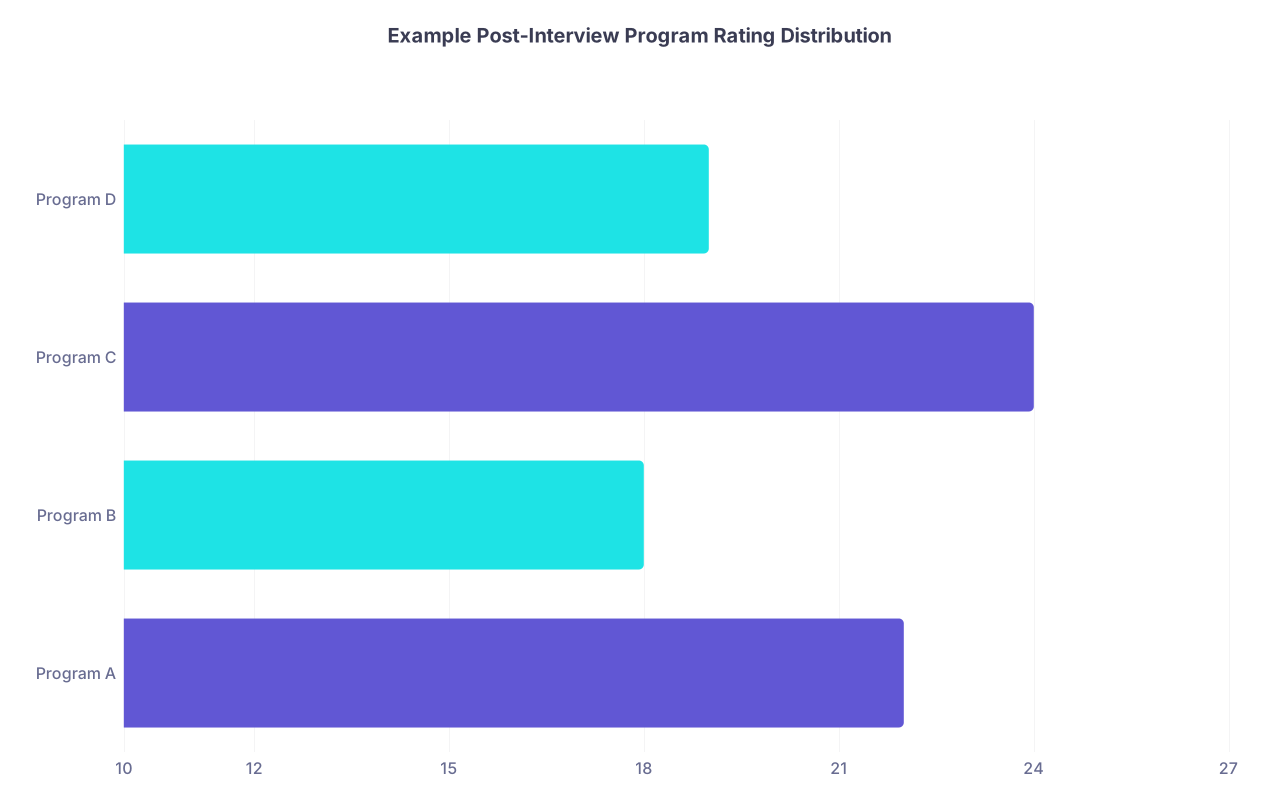
| Category | Value |
|---|---|
| Program A | 22 |
| Program B | 18 |
| Program C | 24 |
| Program D | 19 |
(Assume totals out of 25 across 5 categories.)
The numerical piece is not binding. It just anchors your memory. Later, when you actually build your rank list, you can override numbers with gut. But the gut is better when informed by something you wrote closer to the event.
Write one brutally honest paragraph per program
No bullet lists, no marketing phrases. After completing scores, force yourself to write a 3–5 sentence paragraph answering:
- “What would my day‑to‑day life actually feel like here?”
- “What am I most excited about?”
- “What, if it went wrong, would I say: I saw that coming?”
You will surprise yourself with what comes out when you stop trying to be neutral.
9. Damage Control: When Things Go Wrong Mid‑Stretch
If you are doing many programs in one weekend or week, something eventually will go sideways. Tech failure. Late arrival. Time‑zone mistake. It happens.
You do not spiral. You execute a small, clean recovery.
Tech crashes
Your Zoom dies mid‑PD interview.
- Immediately try to rejoin once.
- If it fails within 1–2 minutes: switch to alternate device if you have it ready (you should).
- After the interview day, send a short note to the coordinator acknowledging the issue and thanking them for their flexibility.
Do not send a 6‑paragraph apology. They have seen worse.
You log in late
If you are 5–10 minutes late to a group start because of prior program overrun or time confusion:
- Join quietly.
- When it is appropriate: “Apologies for joining a few minutes late, I had a prior interview that ran over. Thank you for letting me still participate.”
Then drop it. Do not keep self‑flagellating.
You realize mid‑interview you confused details between programs
Example: you mention you like their county hospital and they are actually a pure VA + university system.
Fix it directly, do not pretend.
“Actually, I misspoke—your setting is [correct details]. I was thinking of another program’s county affiliation from earlier this week. What I appreciate here is [true statement about them].”
They know you are interviewing at multiple places. What they do not want is someone who doubles down on incorrect assumptions.
10. The Week Before and the Week After: Protect the Edges
Multi‑program interview weekends are not isolated events. What you do before and after determines how much damage they do to your brain and your performance.
The week before
You front‑load:
- Finish as much non‑interview academic work as possible.
- Build and finalize all one‑pagers.
- Test all tech on all platforms.
- Decide in advance which socials you will fully attend, partially attend, or skip.
You do not re‑write your personal statement or re‑design your entire answer set. At that point, that is just procrastination disguised as preparation.
The week after
Give yourself explicit time to decompress and consolidate.
- Block at least one mostly free day if you can.
- Within that week, review your notes and adjust your early “if I had to rank them now” sense. Do not wait a month.
If you have more heavy clusters coming, iterate on your system. What failed? Where did you feel rushed? Fix layout, calendar, routines before the next round.
Key Takeaways
Treat multi‑program virtual interview stretches like a complex procedure: standardized prep, precise timing, and a stable physical setup. You cannot improvise your way through 7 interviews in 4 days without something cracking.
Offload memory aggressively. One‑page program sheets, structured notes, same‑day ratings, and short honest summaries will protect you from the blur effect when every program starts to sound “nice” and “supportive.”
Protect your energy and time with intention. You do not owe every social 100% presence. You do owe yourself strong performance in the interviews that actually shape your rank list. Prioritize accordingly.


