
The worst LOI advice circulating in residency circles right now is this: “Letters of intent don’t matter.” That is lazy, and for applicants with a low interview count, it is dangerous.
If you have fewer interviews than you expected, you cannot afford to treat LOIs like a formality. You need to treat them like a targeted intervention. Done correctly, strategic letters of intent will not magically create interviews from thin air, but they can:
- Convert “borderline” post-interview impressions into ranks
- Trigger a second look from programs that have not decided
- Prevent you from quietly sliding down lists at places where you are actually competitive
The key word is strategic. Most applicants send vague, copy‑pasted, feelings‑heavy LOIs that program directors barely skim. You are going to do the opposite.
Here is how.
1. Get Honest About Your Situation in One Hour
Before you write a single letter, you need a cold, clinical assessment of your position. No wishful thinking. No magical outcomes. Just data.
Sit down and write out:
- Number of interviews so far
- Total programs applied to
- Specialty competitiveness (and whether you are applying categorical, prelim, advanced)
- Current date vs Match timeline
- Objective metrics:
- USMLE/COMLEX scores (or pass/fail with Step 2 numeric)
- Class rank/AOA if applicable
- Red flags (failures, LOA, significant course repeats)
- Geographic constraints (partner, kids, visa, care for parents, etc.)
Now categorize your interview count. For categorical programs in a moderately competitive specialty (IM, Peds, FM, Psych, Neurology, Anesthesia):
| Category | Categorical Applicants | Emergency Level |
|---|---|---|
| Comfortable | 15+ | Low |
| Cautious | 10–14 | Moderate |
| Concerning | 6–9 | High |
| Critical | 0–5 | Very High |
If you are in the “concerning” or “critical” zone, LOIs are not optional. They are one of the few levers you still control this season.
Now, two separate realities:
- Pre‑interview LOIs: trying to get interviews at places that have not invited you
- Post‑interview LOIs: trying to improve your rank position where you have already interviewed
Both matter, but they are used differently. And programs read them differently.
2. Understand What LOIs Actually Do (And Do Not Do)
Let me be blunt about LOIs and the Match.
What Letters of Intent Do Well
Clarify genuine interest in a realistic target
PDs are drowning in applicants. If they are on the fence about a candidate, seeing “This is my clear top choice in your region, and here are three reasons why” can move you from “meh” to “we should probably rank them in the middle instead of the bottom.”Correct misperceptions or fill gaps
Example: you rotated at a similar institution, have a spouse job in that city, or have specific experience that fits their niche (e.g., VA-heavy, rural training, underserved). LOIs let you spell that out.Signal maturity and professionalism
A well‑structured, precise, error‑free letter tells a PD you are not chaotic. That matters more than most applicants think.Support a faculty advocate
If someone at the program likes you (interviewer, home faculty, chair), a strong LOI gives them something concrete to forward to the committee.
What Letters of Intent Will Not Do
- They will not make a noncompetitive application competitive at a hyper‑elite program.
- They will not override major red flags at places that are risk‑averse.
- They will not be a substitute for poor interviews.
- They will not guarantee a #1 rank at your “top choice” because you wrote “I will rank you #1” in bold.
So the job is not “write a beautiful emotional letter.” The job is: deliver program‑specific, believable information that makes you easier to rank above someone else.
3. Build a Strategic LOI Plan: Who, What, When
Scattershot LOIs are a waste of time. You need a plan that matches your risk level.
Step 1: Sort Programs into Buckets
Make a spreadsheet. Three buckets:
High‑priority interviewed programs
- You have already interviewed
- You would be happy training there
- You are realistically competitive
Target pre‑interview programs
- You applied
- You have some connection or realistic hook (home state, prior communication, faculty link, rotation, strong geographic tie)
- They have not rejected you (yet)
Stretch programs
- Reach‑tier places where you have some tie but not a strong one
- You already applied, not yet rejected, but you are not their usual “numbers range”
Now match LOI strategy to your bucket.
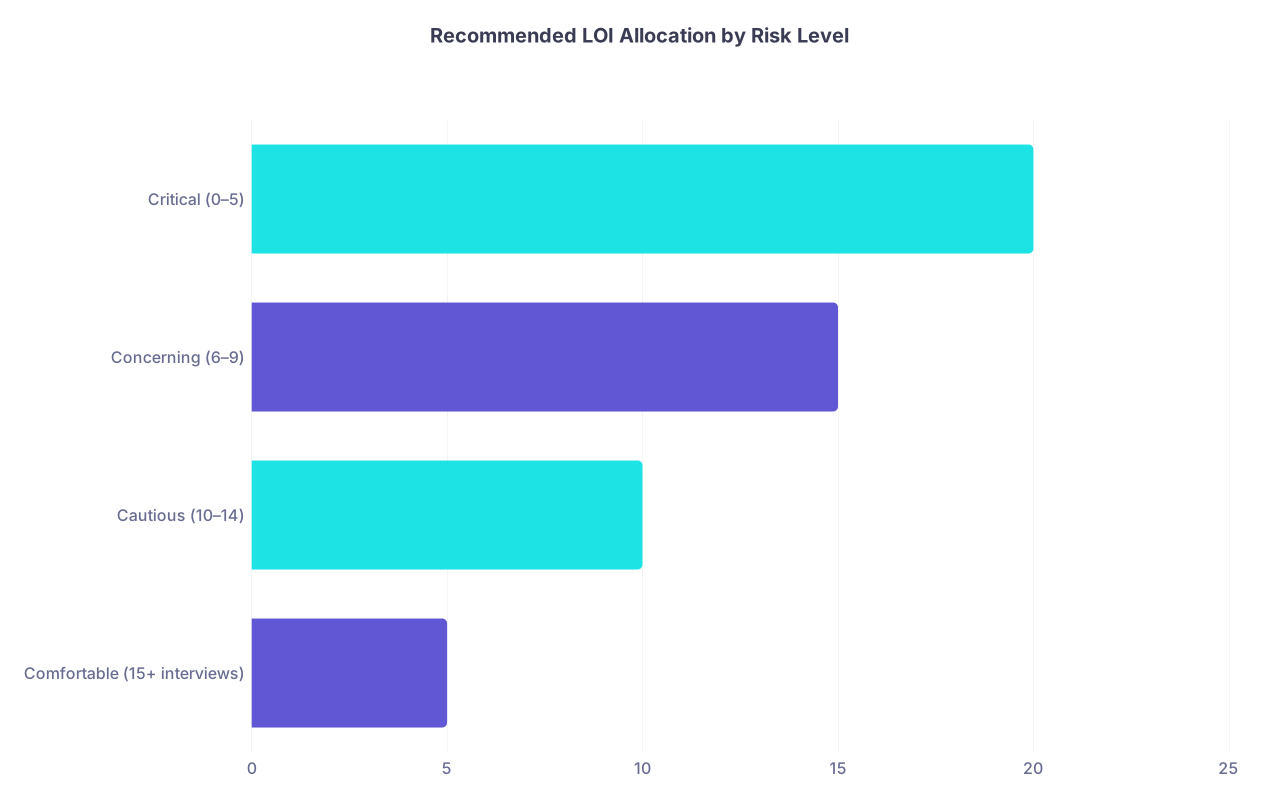
| Category | Value |
|---|---|
| Comfortable (15+ interviews) | 5 |
| Cautious (10–14) | 10 |
| Concerning (6–9) | 15 |
| Critical (0–5) | 20 |
Think of those numbers as a cap on total targeted LOIs you write (pre + post), not a quota you must hit.
Step 2: Timing Windows That Actually Matter
LOIs matter more at certain times of the cycle.
Pre‑interview window (September–December)
Goal: bump yourself up for an interview offer
Who: target programs + a few stretches with believable tiesPost‑interview early window (within 1–2 weeks after each interview)
Goal: solidify a strong impression while they still remember youPost‑interview late window (January–early February, before rank meeting)
Goal: one clear “I will rank you #1” letter to your true top choice (if you want to play that game; more on ethics later)
If you are reading this in January with 5 interviews, you are not “late.” But your LOIs must be surgical.
4. How to Write a Pre‑Interview LOI That Is Not Ignored
Most pre‑interview LOIs fail because they are vague and clearly mass‑produced. You will write something different.
Structure: 4 Tight Paragraphs
Aim for one page, 3–5 short paragraphs. That is it.
Paragraph 1 – Direct, program‑specific opening
- State who you are and your clear purpose in one sentence.
- Name the program and location.
- Explicitly connect your background or goals to something they are known for.
Example:
I am a fourth‑year medical student at SUNY Upstate applying to categorical Internal Medicine, and I am writing to express strong interest in the [Program Name] Internal Medicine residency in [City]. My clinical training and long‑term plan to work with underserved, predominantly refugee populations align closely with your program’s VA and county hospital missions.
No fluff. No “ever since I was a child.” They do not care.
Paragraph 2 – Concrete program‑specific reasons
Show that you actually know their program outside of a Google search.
Pick 2–3 specifics:
- Training sites (VA, county, community)
- Unique tracks (urban health, global health, hospitalist, research pathway)
- Culture values you saw on the website and can connect to your behavior
- Geography tied to your life (partner job, family, prior residence, state ties)
Example:
I am particularly interested in your program because of the continuity clinic at [Clinic Name], the dedicated refugee health track, and the strong emphasis on resident autonomy at [County Hospital]. During my time volunteering at [Local Refugee Clinic], I saw how language and systems barriers caused avoidable morbidity, and I want training that prepares me to lead in similar settings.
Paragraph 3 – Why you are a good investment
Now you pivot to yourself — not with adjectives, but with receipts.
- One sentence on strengths (with evidence)
- One sentence on what you would bring to the program cohort
- Avoid generic “I am hardworking, passionate, etc.”
Example:
My core strengths are clinical work ethic and reliability in high‑acuity settings. During my sub‑internship on MICU, I consistently received feedback for staying late to complete sign‑outs and following up on cross‑cover issues, and I was selected by the ICU team to present a case at our departmental M&M.
Paragraph 4 – Clear, non‑desperate ask
You close by stating your continued interest and a simple request for consideration for interview, nothing manipulative.
I appreciate your consideration of my application in such a competitive cycle. If granted an interview, I would be grateful for the opportunity to learn more about how I can contribute to your residency community.
Sign with full name, AAMC ID, contact info.
Critical Constraints
- No lying about “ranking” or “top choice” pre‑interview. You have not seen the program. Program directors see through this.
- No mass‑mail tone. If you can drop in any other program name and your letter still works, you did it wrong.
- No begging. You are not asking for mercy. You are giving them information to justify pulling your app from the middle of a list.
5. Post‑Interview LOIs: Turning a Decent Day into a Solid Rank
Once you have interviewed, the rules change. Now they know your face, your voice, and some version of your story. Your LOI must reinforce that memory.
There are two main post‑interview letter types:
- Thank‑you + strong interest (standard)
- True LOI: “I will rank you #1” (single‑use only)
Type 1: Thank‑You + Strong Interest
This should go out within 1–7 days after the interview, program by program.
Structure:
- 2–3 short paragraphs
- No more than half a page
Content:
Specific callback to the day
- Reference 1–2 specific conversations or experiences from your interview day.
- Name the faculty or resident if appropriate.
I particularly enjoyed speaking with Dr Smith about the night float system and hearing how residents are supported to manage high‑acuity admissions early in training.
Reinforce fit with their strengths
- Tie something you learned on interview day to your goals.
- Keep it concrete.
Learning more about your structured ICU rotations every year confirmed that your program would prepare me well for a career as an academic hospitalist.
State your continued strong interest
- Use “very interested,” “strongly interested,” “remains one of my top choices” if true.
- Avoid “I will rank you #1” unless this is the program.
After meeting the residents and faculty, [Program Name] remains one of the programs where I can most clearly see myself training.
Do not send this exact letter to every program. The content has to match what actually happened there.
Type 2: The Single True LOI (“I will rank you #1”)
Ethically, you get one of these. You send it late in the cycle (January to early February) after you have seen all or most of your interviews and sketched a rank list.
This is where many applicants panic and spam multiple programs with “you are my top choice” lies. PDs talk. It backfires.
Use this only for:
- A program where you would genuinely be thrilled to match
- A place where your application is plausible (you are not Step 200 aiming for the single most competitive program in the country)
- A program you have already interviewed at
Structure:
Direct, first line clarity
I am writing to let you know that I will be ranking the [Program Name] Internal Medicine residency as my first choice.
That is the line PDs look for. Do not bury it.
2–3 clear reasons they are #1
- Geography (family, partner, children, visa stability)
- Program structure (tracks, mentorship, specific faculty, unique rotations)
- Culture fit (resident support, diversity, advocacy)
Reassurance of commitment
If I am fortunate enough to match at [Program Name], I am committed to contributing fully to the resident community and taking advantage of the exceptional training opportunities you provide.
You are not violating the Match by stating your intent. You are violating it if you try to manipulate or mislead multiple programs.
6. Use Data and Judgment: Which Programs Deserve a LOI?
You should not send LOIs to all 40 programs you applied to. That is spam. You are trying to move the needle where you are most “rankable.”
Favor programs where:
- Your metrics are at or slightly below their average, not dramatically below
- You have a real tie (geography, school, rotation, recommendation from a faculty who knows someone there)
- They explicitly say they value ties to the region or underserved work
De‑prioritize:
- Programs that have already rejected you
- Programs that have said publicly “We do not consider LOIs or post‑interview communication” (respect that; trying to “be the exception” just marks you as someone who does not follow instructions)
- Absolute reach programs with nothing connecting you to them
Ask your faculty advisor or PD:
- “Given my profile and current interviews, which 5–10 programs would be most realistic for a meaningful LOI?”
- Sometimes they know program‑to‑program differences you do not see.
7. Common LOI Mistakes That Quietly Sink You
Let me list the patterns I see every year.
Mass‑mailing generic letters
- “I am very interested in your excellent program and believe it will help me become a compassionate physician.”
- Translation for PD: “This applicant sent this to 50 places. Trash.”
Over‑sharing personal hardship in the LOI
- LOIs are not the place to introduce major new personal disclosures. That belongs in your ERAS application or a formal update / addendum if something changed.
- Keep LOIs focused: fit, interest, relevant updates, professionalism.
Aggressive or entitled tone
- “Given my extensive research and leadership, I believe I would be a top candidate for your program.”
- No. Confident is fine. Arrogant is forgettable at best, disqualifying at worst.
Spamming “I will rank you highly” to multiple programs in late January
- They know everyone says this. It carries almost no weight.
- Either pick one true #1 letter or do not play the #1 game.
Ignoring instructions
- Some programs explicitly say “We do not accept or consider post‑interview communication.”
- Sending anyway tells them you do not read or follow directions. A bad look.
Typos, formatting errors, wrong program names
- I have seen “I will rank the XYZ Anesthesiology Program #1” in a letter sent to an IM program. That applicant is done at that institution.
- Triple check everything before sending.
8. Coordinating LOIs with Your Whole Application Strategy
LOIs are not standalone. They must fit into your broader rescue plan if your interview count is low.
Here is what that rescue plan might look like:

| Step | Description |
|---|---|
| Step 1 | Notice low interview count |
| Step 2 | Audit application weaknesses |
| Step 3 | Meet with advisor or PD |
| Step 4 | Identify realistic target programs |
| Step 5 | Send targeted pre interview LOIs |
| Step 6 | Plan away rotations or observerships if time |
| Step 7 | Prepare aggressively for each interview |
| Step 8 | Send post interview thank you letters |
| Step 9 | Select one true LOI for top choice |
| Step 10 | Build realistic rank list |
A few coordinating moves:
Advisor/PD outreach
If your home PD or department chair is willing, ask them to send a short email or make a call to 1–3 programs where you have a realistic shot. Your LOI then backs that up.Update letters vs LOIs
If you have significant new achievements (Step 2 score, publications, new leadership role), those go in a brief update letter that can double as a LOI if you shape it well.Parallel planning
If you are in the “critical” interview range, you should also be:- Exploring SOAP strategies
- Considering a parallel specialty in future cycles
- Tightening up your personal statement and future letters in case you reapply
LOIs are not a magic cure. They are a force multiplier on top of a realistic, sober plan.
9. A Simple Writing Protocol You Can Reuse For Every LOI
To keep yourself from overthinking (or under‑thinking), use this repeatable template.
10‑Step LOI Writing Protocol
- Pick the program and letter type (pre‑interview, post‑interview interest, or #1 LOI).
- Write three bullet points about the program that are specific and true for you.
- Write three bullet points about you that match those program features.
- Draft a 1–2 sentence opening naming the program, your status, and your purpose.
- Draft a 3–4 sentence middle connecting your bullet points to the program specifics.
- Draft a 1–2 sentence closing stating interest and, if applicable, your ranking intent.
- Check program website to ensure you are not violating any stated policy.
- Proofread for names, spelling, and tone (read out loud; clunky phrases will jump out).
- Save a version in your LOI folder with clear naming: “ProgramName_PreInterview_LOI_v1.docx”.
- Wait 1 hour, then re‑read once and send. Do not rewrite it 10 times. Move on.
You are not trying to write literature. You are trying to transmit clear, useful signals.
10. The Realistic Upside: What Success Looks Like
Set the right expectations. A good LOI will not flip your whole cycle upside down. But here is the sort of impact I do see:
- A program that was going to rank you in the bottom third bumps you to middle third because your LOI confirmed a strong geographic tie and commitment.
- A PD who was lukewarm sends your LOI to two faculty who liked you, and the group decides, “Let us keep them in the solid rankable range; they really want to be here.”
- A pre‑interview LOI to a realistic program with a strong geographic tie leads to one or two extra interview invites that end up on your final rank list.
Those marginal gains matter when your interview count is low. The Match is often decided at the edges.
Do something concrete right now: open a blank document and list the 5 programs where matching would most change your life for the better and where your application is realistically competitive. For each one, write three specific reasons you fit that program. Those six lines per program are the backbone of your first wave of strategic LOIs.