
The most confusing advice you’ll get about second looks after SOAP is from people who haven’t actually been through SOAP.
Already Matched in SOAP: Should You Do a Second Look?
You’ve matched in the Supplemental Offer and Acceptance Program (SOAP). You have a signed position. You’re exhausted. Now someone says: “You should still do a second look.”
Here’s the blunt truth:
If you already matched in SOAP, a classic “second look” in the old pre‑Match sense is mostly theater. It will not change your contract, your rank, or your specialty. But it can still matter for three concrete reasons:
- Confirming you can actually live and work there for 3+ years
- Strategically positioning yourself with leadership (future letters, electives, fellowships)
- Making sure there are no ugly surprises you would have caught with one more visit
So the question isn’t “Should I second look to impress them?”
The real question is: “Do I need another in‑person look to protect myself and set myself up well?”
Let’s walk through this like I’m sitting across from you after SOAP week.
What “Second Look” Even Means After SOAP
Before SOAP, “second look” = you were still being evaluated before rank lists were finalized. Programs cared, a little, because it could influence their rank decisions.
After SOAP, the game is different.
You’re in one of these buckets:
You matched into a SOAP spot at a program you never visited in person
Maybe all you saw was a Zoom interview and a website.You SOAP’ed into a program you ranked but didn’t love
You’re worried you settled and now you’re second‑guessing everything.You SOAP’ed into a totally different specialty or type of program
Example: You wanted categorical IM, ended up in a prelim medicine year or a transitional year.
Each situation has a different “second look” strategy. But the rules are the same:
- You are not trying to change their mind about you.
- You’re trying to get enough information to make the best of the situation, and to build the right early relationships.
First Big Question: Do You Even Need to Go Back?
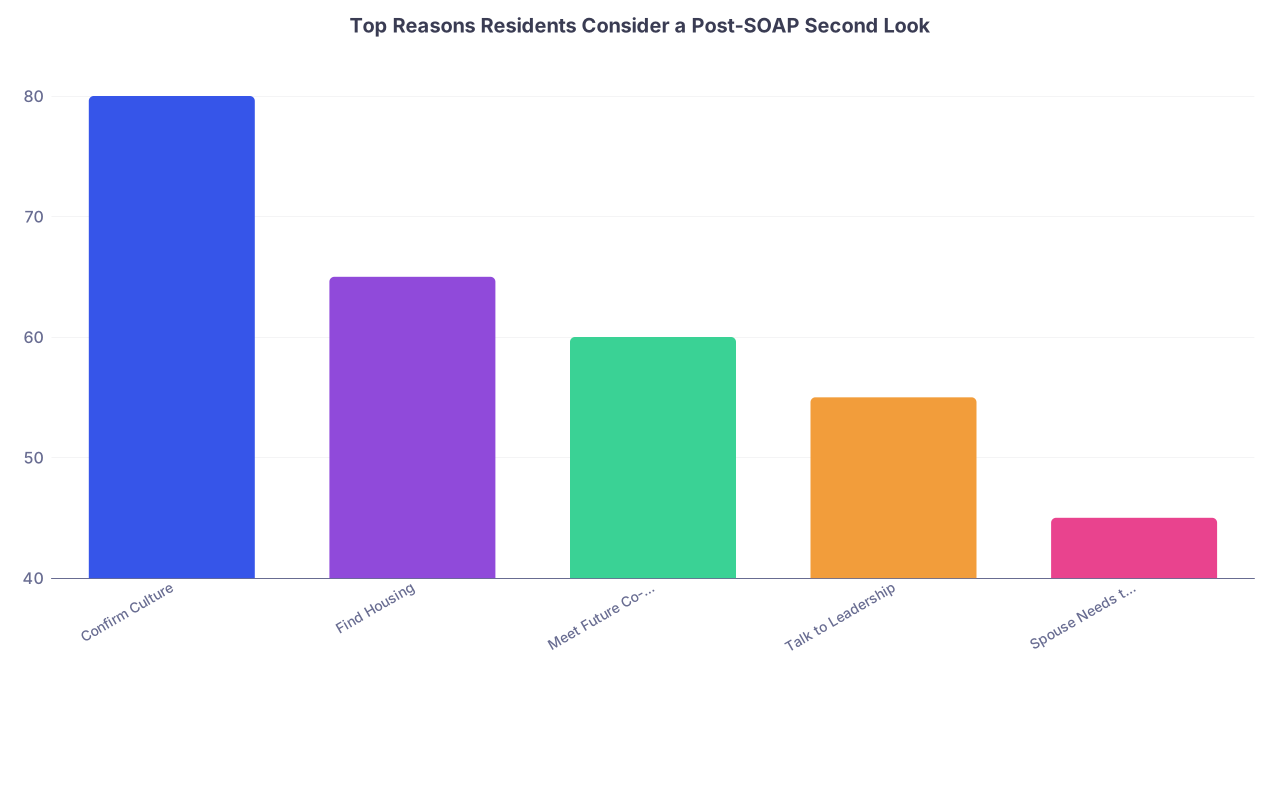
Let me be practical. Before you burn money and time on flights and hotels, answer these five questions honestly:
| Category | Value |
|---|---|
| Confirm Culture | 80 |
| Find Housing | 65 |
| Meet Future Co-Residents | 60 |
| Talk to Leadership | 55 |
| Spouse Needs to See City | 45 |
If you answer “yes” to at least two of these, a second look is probably worth considering:
- Did you accept the offer without ever physically seeing the hospital or city?
- Would moving there blindly put you or your family at financial or personal risk? (Childcare, partner job, safety)
- Are you already uneasy about something the program seemed to gloss over?
- Is this a transitional/prelim year and you know you’ll need strong letters for your reapplication?
- Do you have multiple housing/job/school decisions that hinge on actually seeing the area?
If the only reason you’re considering a second look is “I heard it makes a good impression” — skip it. You already signed. They are not re‑ranking you.
How to Ask for a Second Look (Without Sounding Awkward)
Here’s the script. Use email, not MyERAS messages. Be direct and low‑maintenance.
Subject: Post‑SOAP Visit / Second Look
Body:
Dear Dr. [PD Last Name],
Thank you again for the opportunity to join [Program Name] this July. After matching through SOAP, I would really appreciate the chance to visit the hospital and city in person, primarily to sort out housing and logistics and to meet a few residents if possible.
I want to emphasize that I understand the position is already finalized; this would purely be for orientation and planning on my end. If it’s feasible, I’ll work entirely around your schedule and am happy with a brief visit.
Would there be a convenient day in the next few weeks when I might come by for a quick tour and meet one or two current residents?
Best regards,
[Your Name]
[Matched PGY‑1, Specialty]
Key details:
- You explicitly say you know you’re not being evaluated for a spot.
- You keep the ask light: “brief visit,” “quick tour,” “one or two current residents.”
- You frame it as logistics and planning, not “I want to re‑judge you.”
If they say no? That’s data. Programs that can’t be bothered to greet a signed incoming intern in person are telling you something about culture and bandwidth.
What to Do If They Say “Yes, Come On Over”
Do not treat this like a second interview. Treat it like recon.
Here’s what to actually do that day.
1. Meet With the Program Director or APD (If Offered)
Your goals are not to impress. Your goals:
- Clarify expectations
- Understand red flags
- Start the “this is a reasonable, thoughtful resident” impression
Questions that actually matter:
- “How do you see interns who matched through SOAP usually doing here? Any pitfalls I should avoid early on?”
- “What do your strongest residents do in their first 3–6 months that sets them up well?”
- “If I’m interested in [fellowship X / switching to categorical / research], who should I connect with after I start?”
- “How do you handle struggling residents? What kind of support is truly available?”
You are listening for tone as much as words. Defensive, vague, or dismissive answers are red flags.
2. Talk to Current Interns Without Faculty in the Room
This is where you learn the truth.
Ask:
- “If you had to do it again, would you still come here?”
- “What surprised you most after you started?”
- “What are the 2–3 hardest parts of intern year here specifically?”
- “How often do people cry in the stairwell? For real.”
- “What would you tell a friend starting here in July to do in their first month?”
You’re watching for patterns. One unhappy intern is just residency. Five unhappy interns is a culture problem.
What If the Visit Makes You More Anxious?
This happens more than anyone admits.
You go back. You see chaotic wards, tired seniors, a PD who seems rushed. Now you’re spiraling: “Did I make a mistake?”
Here’s the cold reality: after SOAP, barring serious, documentable issues (fraud, major misrepresentation), you’re not getting out of that contract before July.
So the goal is not “Do I stay or leave?”
The goal becomes “How do I survive and set myself up for my next move?”
If your second look feels bad, here’s what to do:
Identify what’s actually bad vs. what’s normal “residency is brutal.”
- Chronic understaffing, toxic leadership, no one has your back = structural problem
- Long hours, being tired, overwhelmed EMR = residency
Decide your time horizon:
- “I’m here for one year then aiming to reapply elsewhere”
- Or “I’ll likely stay for the duration, so I need to find a tolerable niche”
Early strategy (before July if possible):
- Pinpoint one or two faculty with reputations for being decent, not necessarily “famous”
- Reach out early in PGY‑1 to get on their radar (rounds, projects, simple QI work)
- Guard your mental health aggressively: therapy, peer support, boundaries where possible
You’re not stuck emotionally just because you’re stuck contractually. Big difference.
If You SOAP’ed Into a Different Specialty or a Prelim/Transitional Year
Here, second look is almost tactical.
If you:
- SOAP’ed into a prelim medicine spot after failing to match categorical
- Or landed a transitional year with the plan to reapply in your desired specialty
…you’re playing a different game.
Your priorities are:
- Does this program reliably help prelims or TYs match into something else?
- Will I get usable letters and enough exposure to my target specialty?
- Is there a path out if this year is clearly intolerable?
During a second look, ask specifically:
- “Where did your last few prelim classes end up?” (Ask residents. Then ask leadership. Compare the answers.)
- “Do prelims have protected time or realistic opportunities for research/away rotations?”
- “How do you handle schedule changes for interviews if prelims are reapplying?”
If residents say “prelims get crushed and nobody cares where they end up,” believe them.
| Goal | Question to Ask |
|---|---|
| Culture | Would you choose this program again? |
| Prelim Outcomes | Where did recent prelims match? |
| Support for Struggling Residents | How does the program respond when someone struggles? |
| Fellowship/Next Step Opportunities | Who should I meet if I’m interested in X? |
| Logistics | How do most interns handle housing/parking? |
Using the Visit for Logistics (Which Is Underrated)
Do not underestimate how much smoother your July will be if you use this visit to solve basic life problems.
While you’re there:
- Drive or walk from likely apartments to the hospital during rush hour
- Find parking lots/garages, ask about waitlists and monthly costs
- Locate the nearest grocery store, pharmacy, and 24‑hour options
- Check neighborhoods after dark if safety is a concern
- If you have a partner or kids, bring them if possible and let them react honestly
This isn’t “soft” stuff. Residents who solve these logistics early are less burned out August 1st.

How Second Look After SOAP Fits in the Bigger Picture
Let’s zoom out.
You’ve just survived the most chaotic part of the match system. SOAP is messy, rushed, and frankly, often unfair. But once the dust settles and you’re matched, what you do next matters more than how you got there.
Second look, post‑SOAP, is about:
- Fighting back against “I’ll just show up in July and see what happens.”
- Getting eyes on the place where you’ll spend the most intense years of your life.
- Starting relationships on purpose, not by accident.
Think of this visit as:
- 40% intel gathering
- 30% logistics
- 30% subtle reputation‑building as a thoughtful, low‑drama incoming intern
Not 100% “I need them to like me.” They already hired you.
Practical Timeline: When to Go and What to Expect
Here’s roughly how it plays out for most people who do this well:
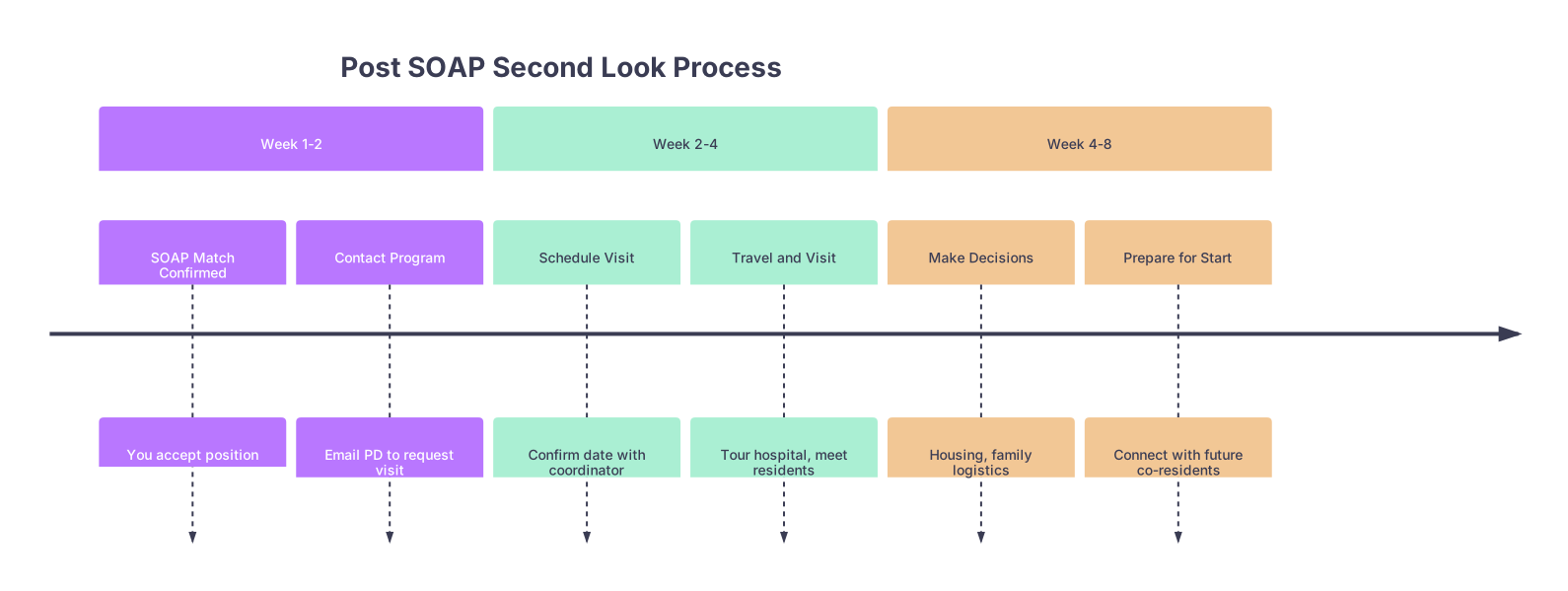
| Period | Event |
|---|---|
| Week 1-2 - SOAP Match Confirmed | You accept position |
| Week 1-2 - Contact Program | Email PD to request visit |
| Week 2-4 - Schedule Visit | Confirm date with coordinator |
| Week 2-4 - Travel and Visit | Tour hospital, meet residents |
| Week 4-8 - Make Decisions | Housing, family logistics |
| Week 4-8 - Prepare for Start | Connect with future co-residents |
Realistic expectations:
- Some programs will roll out the red carpet: tour, PD chat, lunch with residents
- Some will offer a quick resident meet‑up and that’s it
- A few will basically say, “Orientation in June will cover it, no need to come now”
You’re not grading them like an applicant anymore, but their response is still data you’ll pack with you into July.
What If You Can’t Afford a Second Look?
Then do a “virtual second look” instead. Do not just shrug and go in blind.
You can still:
- Ask the coordinator to connect you with 1–2 residents for candid Zoom/phone conversations
- Request a quick separate call with the chief resident
- Ask for any resident‑run orientation guides, neighborhood lists, or shared docs
- Join unofficial group chats (many programs have WhatsApp/GroupMe for incoming classes)
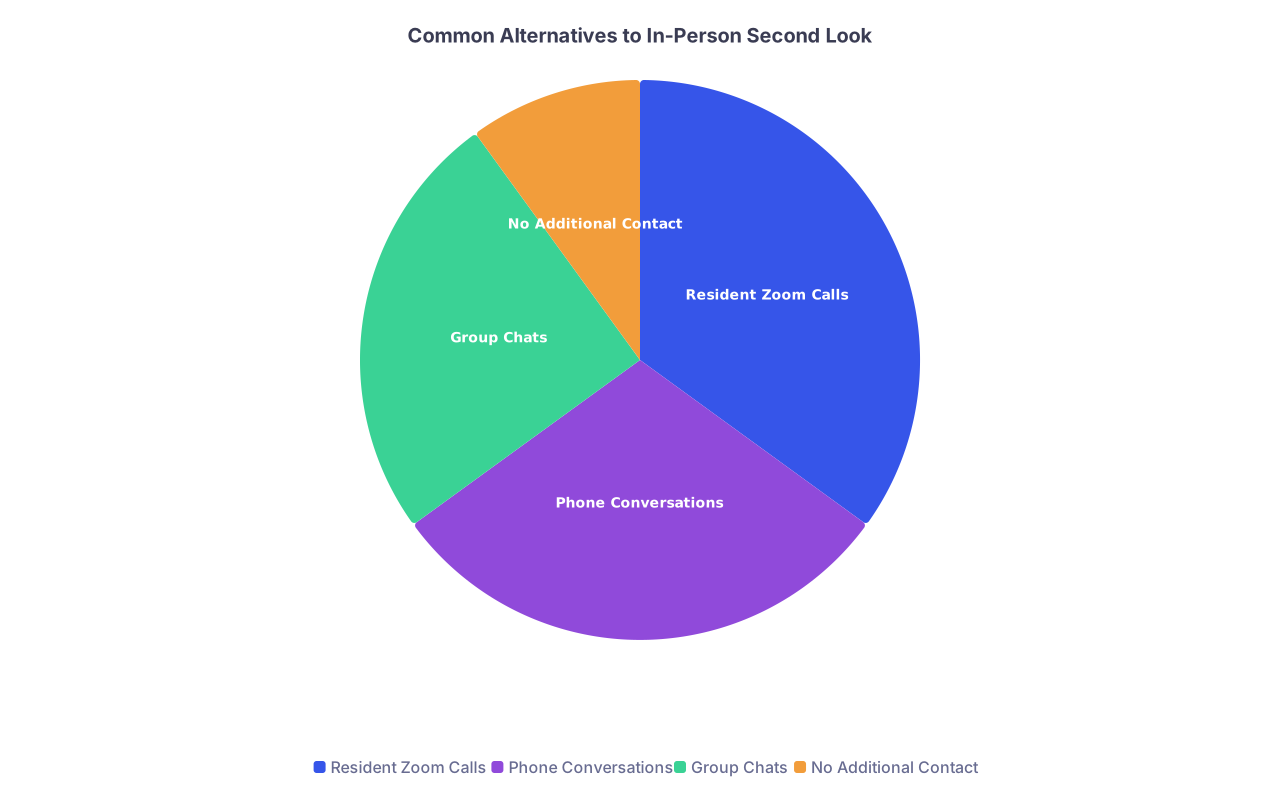
| Category | Value |
|---|---|
| Resident Zoom Calls | 35 |
| Phone Conversations | 30 |
| Group Chats | 25 |
| No Additional Contact | 10 |
If they refuse even that? Again, strong signal about communication culture.
What Not To Do On a Post‑SOAP Second Look
Let me save you from some classic mistakes I’ve watched people make.
Do NOT:
- Act like you’re still choosing between programs. You’re not.
- Ask, “Can I switch into categorical X now that I’m here?” on day one. That’s a long‑term conversation. Not second‑look material.
- Criticize the SOAP process or say, “You weren’t my first choice.” Just unnecessary.
- Overshare future plans to leave after prelim year in front of people who control your schedule and letters. Be honest, but calibrated.
Use this frame:
You are an incoming colleague, not a supplicant. Respectful, curious, professional. But not groveling.

How This Ties to the “Future of Medicine” Buzzwords People Love
There’s a lot of talk about “fit,” “culture,” and “wellness” in residency recruitment now. But during SOAP, all of that gets shoved aside by panic and numbers.
Doing a focused second look after SOAP is a way of re‑inserting actual human judgment into a process that just treated you like a line in a spreadsheet.
You’re saying:
- I’m not just a warm body filling a slot.
- I care about where I’ll be at 3 a.m. in January.
- I’m willing to be proactive about my own training environment.
Medicine is slowly becoming more transparent about program culture and resident outcomes. You doing this—asking specific questions, validating what you were told on Zoom—is part of that shift. Quietly, but still.

FAQ: Post‑SOAP Second Look
1. Can a bad second look make the program change their mind and drop me?
Extremely unlikely unless you behave wildly unprofessionally. After SOAP acceptance, it’s essentially an employment contract. You’d have to do something egregious (think: harassment, clear dishonesty, serious conduct issues) to jeopardize it. Asking questions or looking tired won’t do that.
2. Should I bring my partner or family to the second look?
If logistics and lifestyle are big concerns, yes, if you can afford it. Have them walk the neighborhoods, see the housing stock, test commute times. Just keep them out of official meetings with PDs unless the program explicitly invites spouses.
3. Can I ask about switching specialties or tracks during this visit?
You can gently signal long‑term interests, but don’t come in guns blazing about switching immediately. Better version: “I’m very interested in [X]. Down the road, if there are opportunities to get exposure or explore that path, who would you recommend I connect with?” Then follow up months later as you prove yourself.
4. What if the program ignores my email about visiting?
Follow up once a week later, politely. If nothing after that, assume (1) their admin structure is overtaxed, and (2) you’re not going to get extra support easily. Build redundancy into your plans: more resident outreach, more online research, more private backup support (family, therapy, mentors outside the program).
5. Is it a red flag if residents seem guarded when I ask questions?
It can be. But context matters. If one resident is quiet and another is open, that’s personality. If everyone gives polished, vague, “everything is great” answers while their faces say otherwise, that’s concerning. Try asking, “What would you change if you were PD for a day?” If they still can’t say anything real, make a mental note.
Key points, so you walk away with something actionable:
- Post‑SOAP second looks are for your benefit, not for “impressing” the program.
- If you go, treat it as recon: culture check, logistics, and early relationship‑building.
- Whether you visit or not, be intentional about how you enter this program—because how you start will matter far more than how you SOAP’ed in.